
SaaS companies rarely grow at a predictable pace. A new funding round can accelerate the roadmap, a large customer may request enterprise features and a sudden increase in users can expose performance problems that were not visible during the early product stage.
These changes often create an immediate need for engineering capacity. However, creating a permanent position for every temporary workload or specialized requirement can increase operating costs before the company has proven that the demand will continue.
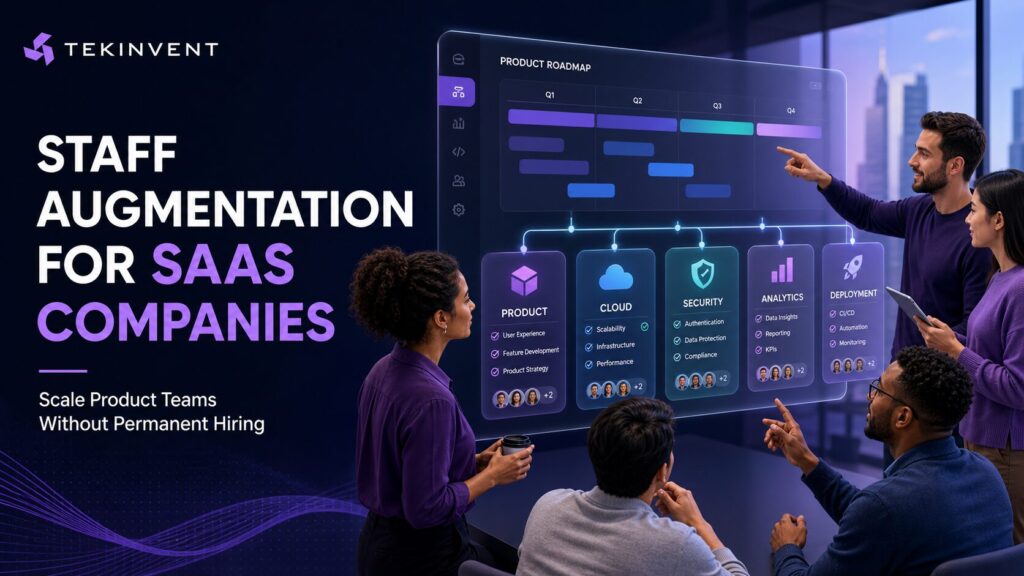
Staff augmentation for SaaS companies offers another approach. It allows a SaaS business to add external developers and specialists to its existing product team while retaining control of product strategy, architecture and delivery.
Augmented professionals work within the company’s established development process. They can support a product launch, cloud migration, security initiative, technical-debt program or new AI capability without requiring the company to build every role permanently from the beginning.
The model creates the most value when the company defines the outcome first, selects professionals with relevant SaaS experience and makes knowledge transfer part of daily delivery.
Why SaaS Companies Experience Uneven Engineering Demand
A SaaS product does not require the same combination of technical skills at every growth stage.
An early product may depend mainly on full-stack development and rapid experimentation. As customer demand grows, the company may need specialists in cloud infrastructure, automated testing, data engineering, cybersecurity and performance.
The move from smaller customers to enterprise accounts can introduce another layer of requirements. Single sign-on, role-based permissions, audit logging, data retention, security documentation and availability commitments may suddenly become sales priorities.
The US Bureau of Labor Statistics projects software-publishing employment to grow 19.3% between 2024 and 2034, adding approximately 124,600 jobs. It also expects strong growth in computing infrastructure and data-processing services as demand increases for cloud computing, cybersecurity and AI. US Bureau of Labor Statistics
The World Economic Forum also identifies software and application developers among the fastest-growing technology roles through 2030. World Economic Forum
For SaaS businesses, this means that experienced engineering talent will remain important and competitive. Staff augmentation can provide access to specialized professionals without forcing the company to create a permanent cost structure before the workload becomes stable.
What Is Staff Augmentation for SaaS Companies?
SaaS staff augmentation is a hiring and delivery model in which external technology professionals join a company’s existing product or engineering team.
The SaaS company continues to manage the roadmap, priorities, architecture and acceptance criteria. The augmentation provider assists with sourcing, screening and engagement administration, while the selected professionals collaborate with internal developers, designers and product managers.
An engagement can involve one professional or several complementary roles. A company may add a QA automation engineer before a major release, a DevOps specialist during a cloud migration or an AI engineer to help deliver a new product capability.
This is different from outsourcing the entire product. In an outsourced project, the vendor normally assumes greater responsibility for project management and delivery. In staff augmentation, the professionals contribute inside the client’s delivery structure.
The distinction matters when a product is evolving quickly and internal leaders want to retain close control of customer priorities and technical decisions.
When SaaS Staff Augmentation Creates the Most Value
Staff augmentation is not the right answer to every staffing problem. It works best when a company can identify a valuable product outcome that is blocked by missing capacity or expertise.
A Release Date Cannot Wait for Permanent Recruitment
Permanent technical recruitment can take months, particularly for specialized roles. A product opportunity may not remain available for that long.
If the company has validated the feature, approved its scope and assigned internal ownership, augmented developers can provide the additional capacity required to protect the release schedule.
The engagement should be tied to the release outcome rather than an open-ended request for more developers. This gives the team a clear objective and makes performance easier to evaluate.
The Internal Team Lacks a Specialized Skill
A SaaS company may have strong frontend and backend developers but no one experienced in data engineering, cloud security, AI or performance optimization.
Hiring a specialist permanently may not be justified if the requirement is connected to one initiative. An augmented professional can complete the work while transferring practical knowledge to internal employees.
Companies should identify their actual technical skill gaps before choosing a role. A general request for a senior developer may attract strong candidates whose experience does not address the real delivery constraint.
Technical Debt Is Affecting Product Delivery
Technical debt becomes commercially important when it slows releases, increases defects, raises cloud costs or damages customer experience.
Internal engineers often struggle to modernize foundational systems while continuing to deliver customer-facing features. Augmented professionals can support a focused migration, automated-testing program or infrastructure improvement while the permanent team maintains the core roadmap.
The objective should be measurable. “Improve the platform” is vague. “Reduce deployment failures and cut the time required to release a production change” gives the engagement a clearer purpose.
Enterprise Customers Require New Capabilities
A SaaS product built for small businesses may not initially include the controls expected by enterprise buyers.
Larger customers may require single sign-on, detailed permissions, audit trails, data encryption, security reviews, integration support and formal availability commitments.
Professionals with enterprise SaaS experience can help the company design these capabilities without weakening the existing product. Their experience can also reduce the risk of building a one-off solution for a single customer that later becomes difficult to maintain.
An Approved Permanent Role Remains Unfilled
Staff augmentation can protect delivery while permanent recruitment continues.
The augmented professional should not be treated as a temporary placeholder without context. The company should involve that person in documentation, code review and knowledge transfer so the permanent employee can assume ownership smoothly after joining.
Early-stage businesses should also consider the financial and operational tradeoffs discussed in TekInvent’s guide to staff augmentation for startups.
SaaS Roles That Can Be Augmented
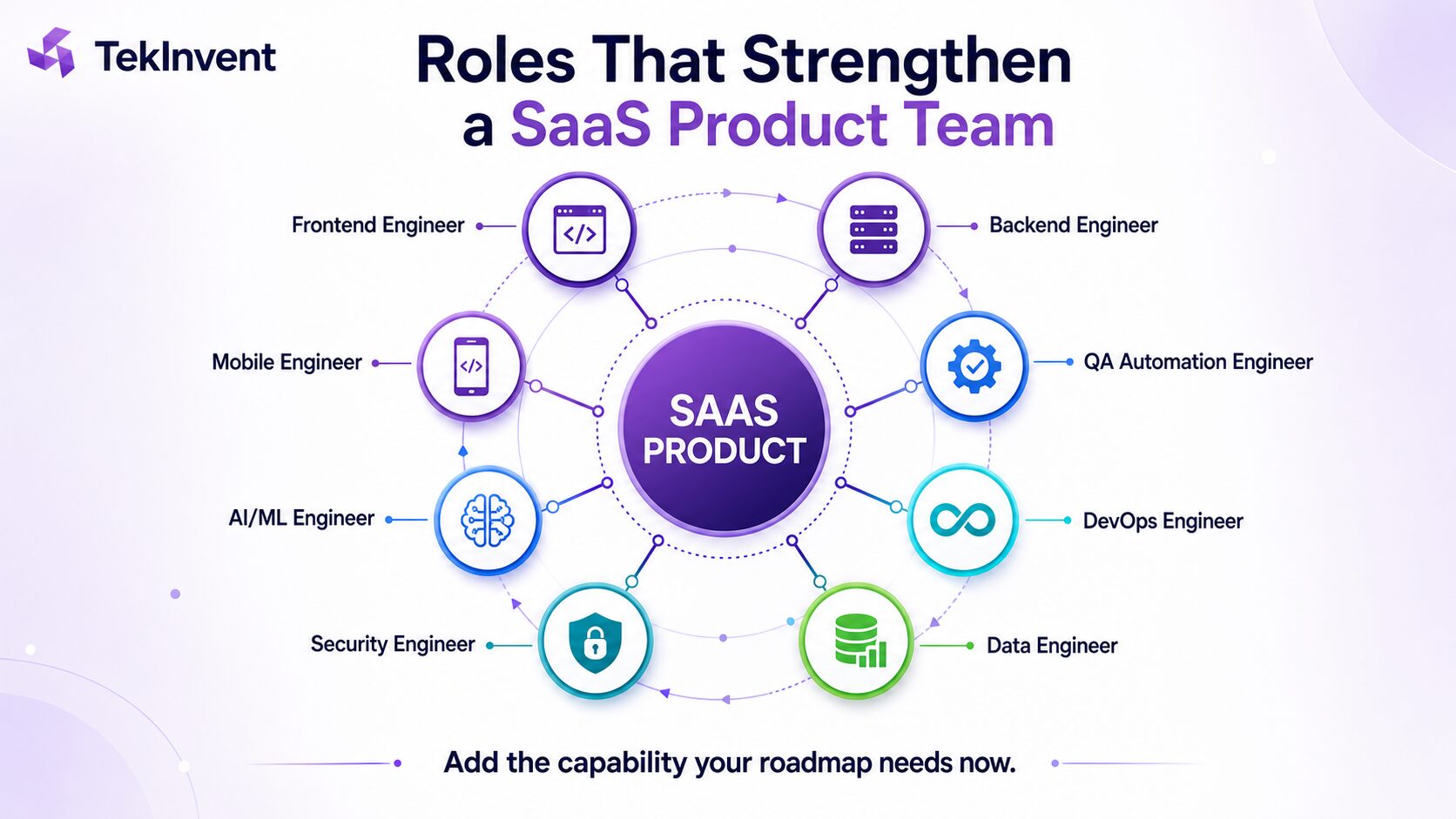
The right role depends on the product constraint, not the job title that appears most often in the backlog.
| Role | Typical SaaS contribution | When the role is valuable |
|---|---|---|
| Frontend engineer | Builds accessible and responsive product experiences | Interface work exceeds internal capacity |
| Backend engineer | Develops APIs, services and business logic | The product needs new integrations or scalable services |
| QA automation engineer | Creates repeatable product and regression tests | Manual testing is delaying releases |
| DevOps or platform engineer | Improves cloud infrastructure and delivery workflows | Deployments, reliability or environments block progress |
| Data engineer | Creates dependable analytics and product-data pipelines | Reporting, personalization or AI requires trusted data |
| Application security engineer | Integrates security into product design and delivery | Enterprise customers or sensitive data increase risk |
| AI or ML engineer | Builds AI features and production model workflows | The roadmap includes assistants, predictions or automation |
| Mobile engineer | Creates native or cross-platform applications | Mobile demand exists but does not justify a permanent team |
Some initiatives require a small group instead of one specialist. An enterprise-readiness program, for example, may need backend, QA, security and DevOps capabilities working under one internal product owner.
Adding too many people at once can create unnecessary coordination. Start with the role connected to the largest product constraint, evaluate the results and expand only when the work justifies it.
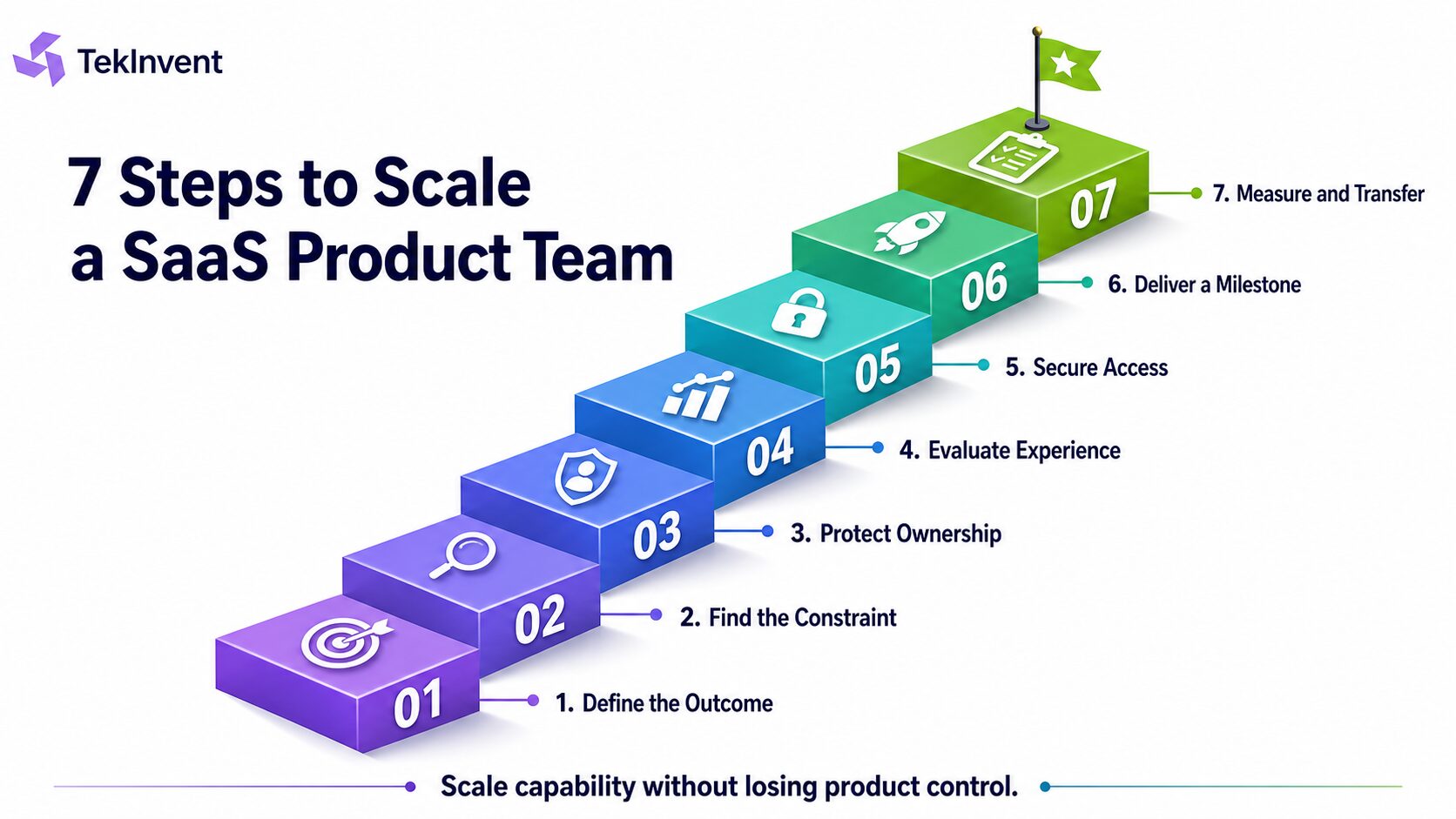
A Seven-Step SaaS Staff Augmentation Process
1. Define the Product Outcome
Begin with the result the company wants to create for customers or the business.
“Hire two developers” describes an input. “Deliver role-based access and audit history before the next enterprise sales cycle” describes an outcome.
Document the intended user, business value, deadline, current baseline and acceptance criteria. Include performance, security and compliance requirements where relevant.
This information determines which skills are required and provides a basis for measuring the engagement.
2. Find the Real Delivery Constraint
A large backlog does not automatically mean the company needs more developers.
Work may be delayed because product requirements remain unclear, technical decisions have no owner or releases depend on a slow manual process. Adding engineers to an unresolved workflow may increase work in progress without increasing delivery speed.
Review recent releases, incidents, backlog movement and team responsibilities. Identify where valuable work waits and why.
If testing is the bottleneck, a QA automation engineer may create more value than another application developer. If environments take days to prepare, platform expertise may be the priority.
3. Decide What Must Remain Internal
The SaaS company should retain ownership of product strategy, customer knowledge and important architectural decisions.
Assign an internal product owner who can clarify priorities and accept work. Assign a technical owner who can approve architecture, security and production changes.
External professionals can recommend solutions and complete delivery work, but the client should not become dependent on them for undocumented product knowledge.
Company-controlled repositories, cloud accounts, domains and production credentials should also remain under internal administration.
4. Evaluate Relevant SaaS Experience
A candidate may be technically strong without having the production experience required by a SaaS product.
Use scenarios based on the actual environment. A backend engineer might be asked how they would introduce a database change without interrupting customers. A security engineer could explain how they would design permissions for different account roles.
Candidates should discuss monitoring, failure handling, backward compatibility, performance and customer impact. Framework familiarity alone does not prove production judgment.
Communication should be evaluated alongside technical ability. SaaS developers regularly work with product managers, designers, support teams and customer-facing employees.
Ask candidates to explain a previous production problem, the options they considered and the result. This provides evidence of decision-making and accountability.
5. Establish Security and Access Controls
Augmented developers may need access to valuable intellectual property and customer information. Access should be controlled before development begins.
Use individual accounts, multifactor authentication and role-based permissions. Separate development, testing and production environments. Store secrets in approved credential-management systems rather than code repositories or personal tools.
CISA’s Secure by Design guidance encourages software manufacturers to take responsibility for customer security outcomes and make secure defaults part of product design. These principles should apply to every contributor, whether permanent or augmented. CISA Secure by Design
The contract should address confidentiality, intellectual-property ownership, data handling, subcontracting, approved tools and offboarding.
Companies can use the IT staff augmentation contract checklist to review important commercial, ownership and security provisions before signing.
6. Start With a Meaningful Milestone
The first milestone should use the real codebase and delivery process.
It might involve implementing one integration, automating a regression suite, improving one deployment workflow or delivering a bounded customer-facing feature.
The milestone should be substantial enough to demonstrate technical judgment but limited enough to control risk. Evaluate code quality, communication, documentation and delivery reliability before expanding the engagement.
Avoid beginning with a complete platform rewrite. A smaller production milestone provides evidence and helps the company refine its estimates.
7. Measure Impact and Transfer Knowledge
Measure outcomes rather than hours or ticket volume.
Useful SaaS measures include cycle time, deployment frequency, escaped defects, availability, incident frequency, feature adoption, support volume and cloud cost.
The selected measures should reflect the original objective. A reliability engagement should be judged by changes in incidents and recovery time, while a product initiative may be judged through adoption and customer value.
Documentation, code review and pairing should occur throughout delivery. Knowledge transfer should not be postponed until the final week.
Internal engineers need to understand what was built, why important decisions were made and how the system will be operated after the engagement ends.
How to Integrate Augmented Developers Into a SaaS Team
Augmented developers should work inside the company’s existing product-delivery system rather than through a separate external workflow.
Give them access to the same backlog, technical documentation and coding standards used by permanent employees. Explain the product’s customers, commercial priorities and known limitations.
An engineer who understands the customer problem can make better implementation decisions than someone receiving isolated tasks without context.
Assign one internal owner who can remove blockers and provide timely feedback. Slow decisions can make an otherwise capable augmented team appear unproductive.
TekInvent’s practical guide to manage augmented teams explains how to organize the first 30 days, including access, communication, ownership and knowledge transfer.
Meetings should support delivery rather than create unnecessary overhead. A focused daily coordination session, regular product review and clear written decisions are often sufficient.
Protect Product Ownership and Continuity
A SaaS company’s value is concentrated in its source code, infrastructure, customer data and product knowledge.
The contract should clearly assign ownership of code, documentation, configurations and other deliverables to the client. It should also explain the treatment of pre-existing tools and open-source components.
All work should be committed to company-controlled repositories. Architectural decisions and operating procedures should be recorded in shared systems.
The company should retain administrative ownership of cloud platforms, source-control organizations, domains, analytics tools and deployment systems.
Access removal is only one part of offboarding. The company should also review incomplete work, open incidents, documentation and component ownership before the professional leaves.
These controls reduce the risks of IT staff augmentation, particularly knowledge dependency, security exposure and disruption during replacement or offboarding.
How Much Does SaaS Staff Augmentation Cost?
Pricing depends on role, seniority, location, engagement duration and product complexity.
A senior cloud architect working on a multi-region platform will normally have a different rate from a developer implementing a clearly defined interface. Security, AI and data specialists may also command higher rates because of limited supply and specialized experience.
The hourly rate is only one part of the financial decision. Companies should also consider sourcing time, onboarding, internal management, rework, infrastructure expenses and the business cost of delaying a launch.
A lower-priced developer can become costly if the work introduces recurring defects or architecture the internal team cannot maintain.
Companies comparing engagement locations should consider communication coverage and management requirements alongside cost. TekInvent’s comparison of onshore, nearshore and offshore staff augmentation explains how time zones, talent availability and rates affect each model.
US companies seeking greater working-hour overlap may also evaluate nearshore staff augmentation for product initiatives requiring frequent collaboration.
The final decision should be based on delivery value rather than the lowest rate. Establish the current baseline and calculate staff augmentation ROI using product, delivery or operating improvements.
Need to accelerate your SaaS roadmap without committing to premature permanent hiring? TekInvent can help identify the roles required for your next product milestone.
Choosing a Staff Augmentation Provider for a SaaS Product
A suitable provider should understand the difference between adding general development capacity and solving a specific SaaS delivery constraint.
The provider should ask about the product stage, users, architecture, deployment process, security requirements and expected outcomes before presenting candidates.
Ask who performs technical screening and how SaaS experience is verified. Review whether proposed candidates have worked with evolving products, recurring releases, cloud environments and production incidents.
Replacement support, pricing and working-hour expectations should be documented. The company should understand what happens if a professional becomes unavailable or does not meet expectations.
A strong provider should present a small number of relevant candidates rather than a large collection of generic profiles.
The client should interview every proposed professional directly. The provider’s screening process should make that evaluation more efficient, not remove the client from the decision.
Mistakes That Reduce the Value of SaaS Staff Augmentation
The first mistake is adding people before stabilizing priorities. More engineers cannot compensate for an unclear roadmap or missing product ownership.
The second is hiring only for technology keywords. SaaS engineers must also understand reliability, customer impact, permissions, migrations and production operations.
The third is separating augmented developers from product context. A developer can complete the requested ticket while still missing the customer outcome behind it.
Another mistake is granting unnecessary production access to accelerate onboarding. Permissions should remain limited and reviewed.
Companies also create risk when they postpone documentation. If only the augmented developer understands a delivered feature or system, the engagement has created dependency instead of capability.
Finally, avoid measuring success through activity. Hours, commits and ticket counts do not show whether the product became more valuable, reliable or easier to deliver.
Staff Augmentation or Permanent SaaS Hiring?
Permanent hiring is appropriate when the responsibility will remain essential to the company over the long term.
A platform leader, product architect or core application engineer may hold knowledge and responsibilities that should remain permanently inside the organization.
Staff augmentation is more suitable for urgent gaps, specialized initiatives, fluctuating workloads and requirements whose long-term demand has not yet been proven.
| Decision factor | SaaS staff augmentation | Permanent hiring |
|---|---|---|
| Starting speed | Often faster | Requires a complete recruitment cycle |
| Commitment | Can match a roadmap phase | Creates a continuing employment commitment |
| Specialization | Adds precise skills when required | Develops lasting internal capability |
| Scaling | Capacity can change with product demand | Additional recruitment is required |
| Knowledge | Requires planned transfer | More likely to remain internally |
| Best use | Urgent, specialized or variable work | Continuous responsibilities central to the product |
Many SaaS companies use both models. Permanent employees retain product strategy, architecture and customer knowledge while augmented specialists accelerate particular initiatives.
The company can later convert recurring responsibilities into permanent roles after proving the workload and understanding the required experience.
Scale Your SaaS Roadmap Without Losing Control
Staff augmentation for SaaS companies can provide specialized engineering capability without forcing the business to hire permanently before demand is stable.
The model works when leaders define a measurable product outcome, identify the real constraint and select professionals with relevant production experience.
Security, product ownership and knowledge transfer must remain part of the engagement from the beginning. The goal is not merely to increase development activity. It is to help the company deliver valuable product improvements while strengthening the internal team.
TekInvent’s IT staff augmentation services can help SaaS companies add screened developers and specialists while maintaining control of their product roadmap, architecture and delivery.
Share your SaaS roadmap constraint with TekInvent and receive a role-based team recommendation.

Build Smart with The Right Team.
We bring expertise, technology, and trust you look for in your digital journey.