


Growing a startup requires careful decisions about people, technology, and money. Your company needs enough technical talent to build products, resolve development bottlenecks, and meet customer expectations. However, every permanent employee also brings recruitment expenses, benefits, equipment costs, onboarding requirements, and a long-term financial commitment.
Staff augmentation for startups provides a flexible alternative. Instead of recruiting every specialist as a permanent employee, a startup can temporarily add external professionals to its existing team. These specialists can support a particular project, fill a skill gap, or provide additional capacity during a period of rapid growth.
The startup continues to control its product roadmap, priorities, and technical decisions. Meanwhile, the augmented professionals provide the expertise needed to keep development moving. When used strategically, this arrangement helps a startup scale without creating more permanent overhead than its budget can support.
What Is Staff Augmentation for Startups?
Staff augmentation is an engagement model in which external professionals join an existing team for a defined business or technical requirement. A startup might use this model to add software developers, quality assurance engineers, UI/UX designers, DevOps specialists, data engineers, or technical project managers.
These professionals typically work within the startup’s existing processes. They may use the same communication channels, attend relevant sprint meetings, receive tasks from the internal product owner, and follow the company’s development standards.
The main distinction between augmentation and complete project outsourcing is control. With outsourcing, a vendor may take responsibility for delivering an entire project. With augmentation, the startup generally retains direct control over the backlog, priorities, technical standards, and daily work.
For example, imagine that a startup has an internal product manager and senior engineer but needs two mobile developers for an upcoming release. Creating permanent positions could require a lengthy recruitment process and a significant long-term commitment. Using IT staff augmentation services allows the business to add the required professionals for the relevant development period while continuing to manage the product internally.
Why Permanent Hiring Can Be Expensive for Startups
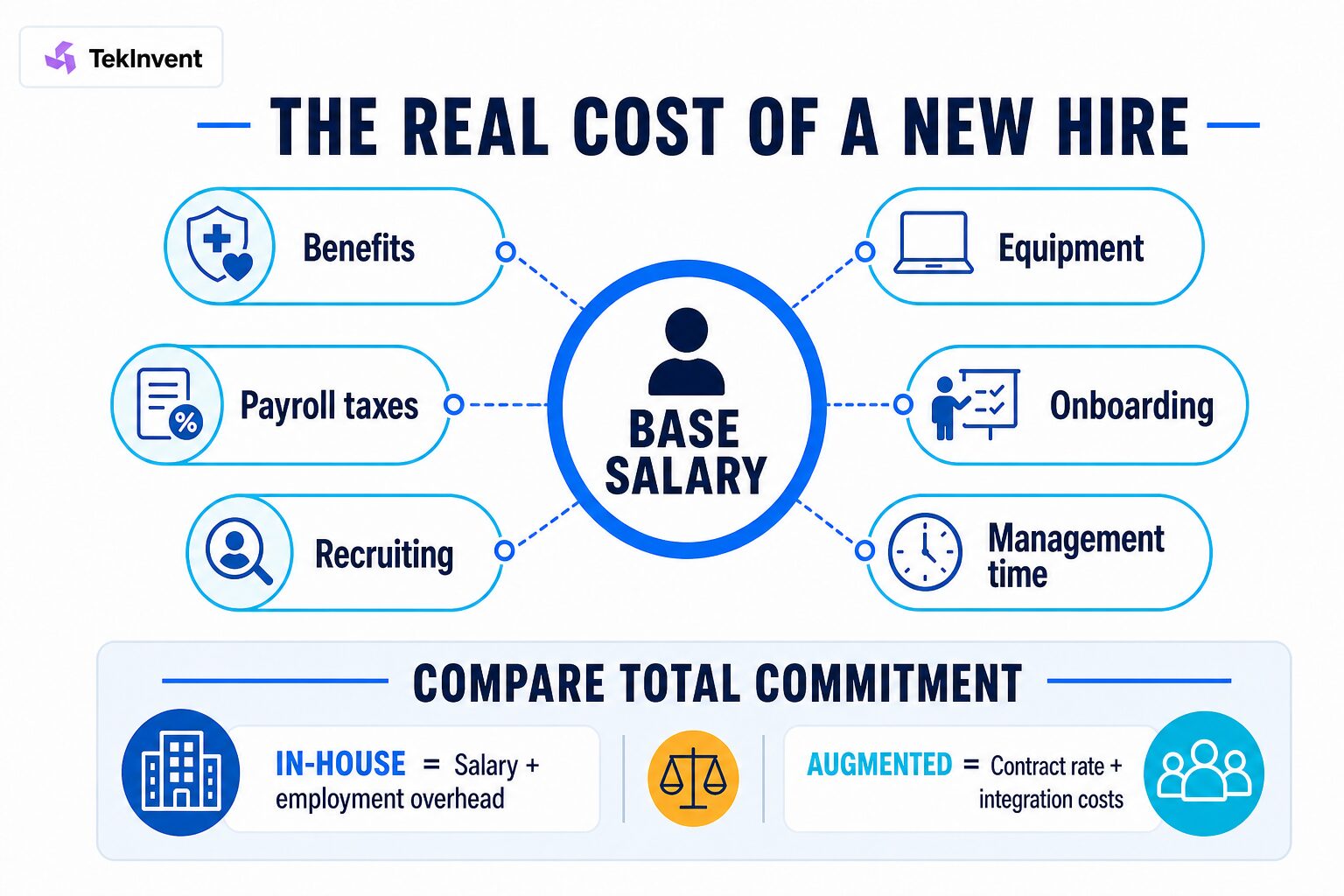
The cost of hiring a permanent employee extends beyond the advertised salary. A startup may also need to account for recruiting, interview time, payroll taxes, health insurance, paid leave, equipment, software licenses, onboarding, training, and ongoing HR support.
According to the US Bureau of Labor Statistics, employee benefits represented 30.1% of total private-industry employer compensation in March 2026. This is a national figure covering different occupations, rather than a software-developer-specific percentage. Nevertheless, it demonstrates why salary alone does not represent the complete cost of employment. US Bureau of Labor Statistics compensation data
The startup also carries the risk associated with an unsuccessful hire. If a newly recruited employee does not have the required technical ability or does not fit the role, the business may have to repeat the sourcing, interviewing, and onboarding process.
Permanent employment is still valuable when a role requires long-term ownership, leadership, or extensive institutional knowledge. The problem occurs when a startup makes a permanent financial commitment to solve a temporary workload or skill shortage.
How Staff Augmentation Helps Startups Scale
It connects capacity to actual demand
Startup workloads are rarely predictable. A company may need additional engineers before an MVP launch, customer implementation, platform migration, or funding milestone. Once the intensive development phase ends, the same number of professionals may no longer be necessary.
An augmented team allows the startup to adjust its development capacity according to the work available. It can add specialists during a critical phase and reduce external support once the defined requirement has been completed.
This flexibility can be particularly valuable for companies whose revenue, funding, or product demand remains uncertain. It prevents the business from building a large fixed payroll before it has a stable need for every position.
Flexibility should not mean working without a plan. Before the engagement begins, the startup should define the expected duration, required skills, scope of responsibility, performance expectations, and exit conditions.
It provides temporary access to specialized expertise
Some projects require technical capabilities that a startup does not need permanently. A cloud migration, security review, AI integration, performance optimization initiative, or native mobile application may require specialists for a limited period.
Recruiting a permanent employee for a short-term technical requirement can create excess capacity after the project is complete. Augmentation gives the startup access to specific expertise without requiring it to turn every temporary need into a permanent position.
The correct engagement model still depends on the scope. If the company already has product and technical leadership but needs more execution capacity, augmentation may be suitable. If it needs an external partner to plan and deliver an entire digital product, working with a custom software development company may be more appropriate.
It can reduce the business cost of waiting
Recruitment expenses are only one part of the hiring decision. Founders should also calculate what happens while an important technical position remains vacant.
If the current team cannot complete an important release, the startup may lose potential revenue, delay customer onboarding, increase pressure on existing employees, or miss a market opportunity. The commercial effect of that delay can be greater than the difference between two staffing options.
A staff augmentation provider may already have access to professionals with relevant skills. This can shorten the sourcing process when the role, technical requirements, and expected responsibilities are clearly defined.
However, startups should be cautious about providers that promise guaranteed immediate placements. Candidate availability, interviews, technical assessments, contracts, security reviews, and onboarding still take time. Speed is useful only when it does not compromise quality.
It allows the startup to retain product control
Founders sometimes hesitate to use external talent because they fear losing control of the product. In a properly structured augmentation arrangement, the startup continues to own the product strategy and direct the development work.
The internal team determines which features should be built, how priorities are ordered, which technical standards apply, and when work is ready for release. The external professionals contribute within that operating structure.
This model works best when the startup already has an internal person capable of assigning work, explaining requirements, reviewing technical output, and resolving blockers. That person could be a CTO, engineering lead, senior developer, or technically experienced product owner.
Adding more developers cannot compensate for missing product direction. If priorities change constantly and nobody can approve technical decisions, additional capacity may increase confusion instead of improving delivery.
Staff Augmentation vs. Permanent Hiring
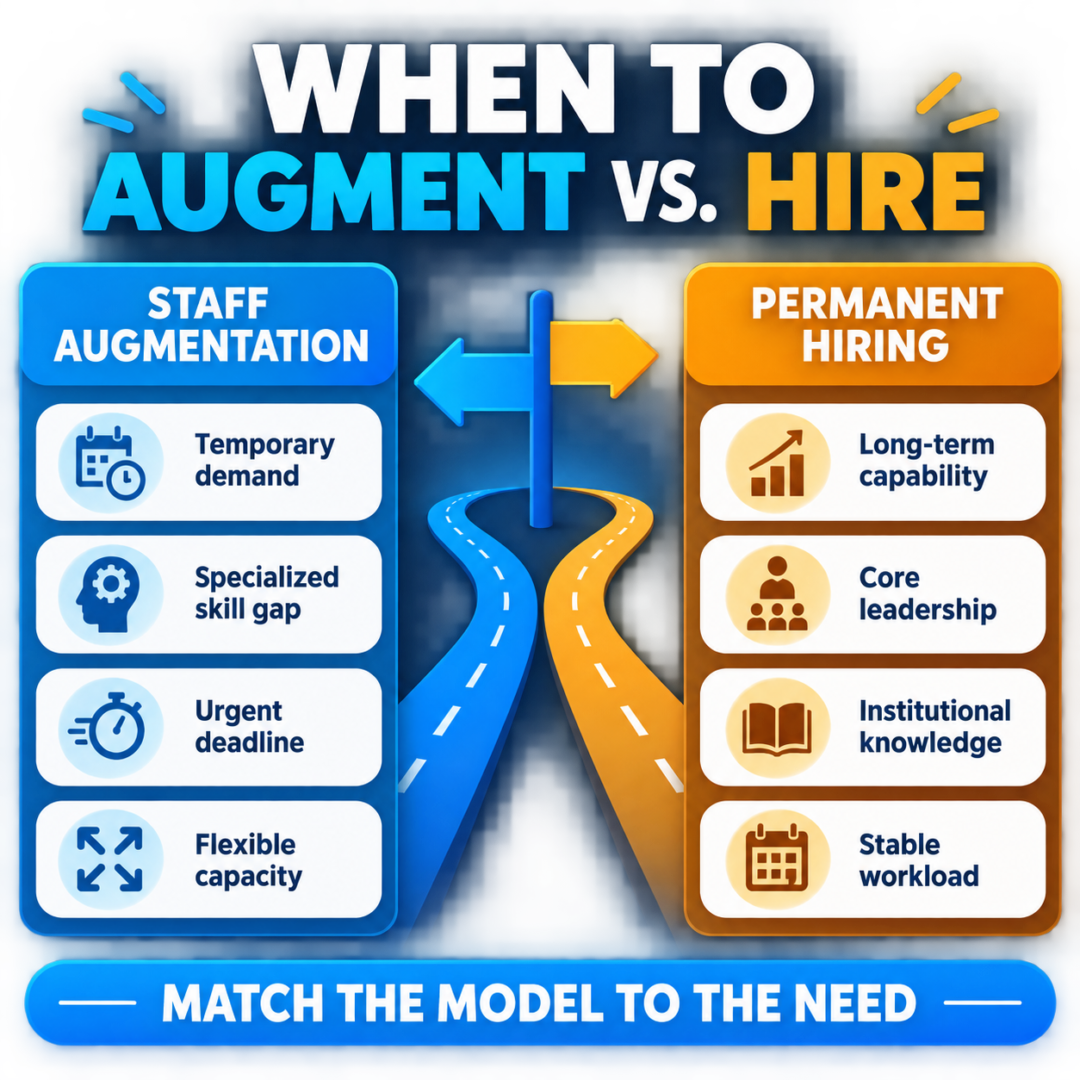
Neither option is universally better. The correct choice depends on how long the requirement will last, how quickly the startup needs support, and how strategically important the role is.
| Consideration | Staff augmentation | Permanent hiring |
| Best suited for | Temporary demand and skill gaps | Stable, long-term capability |
| Commitment | Defined or flexible duration | Continuing employment |
| Talent sourcing | Supported by the provider | Managed by the startup |
| Daily direction | Usually retained by the client | Managed internally |
| Scaling | Relatively easy to adjust | Requires hiring or restructuring |
| Knowledge retention | Requires deliberate handover | More likely to remain internally |
| Long-term leadership | Usually limited | Better suited to leadership development |
Permanent employees can develop deep knowledge of the company, customers, architecture, and historical product decisions. That continuity is valuable for roles that will influence the business for years.
External specialists provide greater flexibility, but knowledge can leave when an engagement ends. Startups should address that risk through shared repositories, code reviews, architecture records, technical documentation, and planned handover sessions.
A hybrid structure is often practical. The company can keep product ownership, technical leadership, and important architectural knowledge in-house while using external specialists to add delivery capacity or complementary expertise.
Businesses evaluating both options can review this detailed comparison of staff augmentation vs in-house hiring.
When Does This Model Make Sense?
Staff augmentation may be suitable when a product deadline cannot move, an internal team is overloaded, or a specific technical skill is temporarily unavailable. It can also work when funding makes future workload uncertain or when a startup wants to test whether a role should eventually become permanent.
The most useful question is not simply, “Is augmentation cheaper?” Instead, founders should ask whether the requirement itself is temporary or permanent.
If the company expects to need the same capability at a consistent level for several years, permanent hiring may provide better long-term value. This is especially true for product leadership, core architecture, engineering management, and roles that require substantial institutional knowledge.
If the requirement is tied to a release, migration, feature, or temporary capacity shortage, a flexible engagement may be more appropriate.
How to Compare the Real Costs
A provider’s hourly rate should not be compared directly with an employee’s salary divided by working hours. This type of comparison excludes important expenses on both sides.
For an employee, the startup should calculate salary, benefits, payroll obligations, recruitment, equipment, software, training, management, and the possible cost of replacing an unsuccessful hire.
For an augmented professional, the calculation should include the contracted rate, required hours, onboarding, internal management, security preparation, and knowledge transfer. The startup should also confirm exactly which sourcing, payroll, replacement, and administrative services are included in the provider’s rate.
The expected duration matters. An external specialist could have a higher effective hourly rate but still create a lower total commitment if the startup only needs that expertise for four months.
The cost of delayed delivery should also be considered. If waiting for a permanent employee postpones revenue, customer commitments, or an important product release, that impact belongs in the financial comparison.
Finally, the lowest quoted rate is not necessarily the least expensive option. Weak communication, poor technical work, missed deadlines, and extensive rework can turn a low-cost resource into an expensive decision.
How to Evaluate a Staff Augmentation Partner
A startup should evaluate the provider’s process and evidence rather than relying on broad marketing claims.
Begin by asking how candidates are assessed for the required technology, seniority, and communication ability. The startup should normally be able to interview and approve each professional before the engagement begins.
The agreement should explain what happens if a resource becomes unavailable or does not meet expectations. It should also clarify working-hour overlap, billing, notice periods, confidentiality, intellectual-property ownership, data handling, subcontracting, and offboarding.
Security should receive particular attention when external professionals need access to source code, production systems, customer information, or cloud infrastructure. Access should be limited according to the individual’s responsibilities and removed promptly when it is no longer needed.
US companies should also seek suitable legal or tax guidance for their arrangement. The IRS explains that worker classification depends on behavioral control, financial control, and the type of relationship between the parties. A contract label alone does not determine the legal status of a worker. IRS worker-classification guidance
How to Integrate an Augmented Team Successfully
Even a highly experienced professional needs sufficient product and business context. During onboarding, explain what the product does, who it serves, what the current priorities are, and how success will be measured.
The professional should also understand the company’s development workflow, coding standards, review process, communication expectations, and security requirements. Assigning an internal onboarding contact gives the new contributor a clear person to approach when questions or access problems arise.
External professionals should participate in relevant planning discussions and technical meetings. Treating them as disconnected task-takers can limit their ability to make informed decisions. At the same time, final product ownership and approval authority should remain clearly assigned.
Documentation must begin during the engagement rather than in its final week. Important decisions, setup instructions, deployment procedures, and architectural information should remain accessible to the internal team.
Security practices should apply equally to internal and external contributors. The NIST Secure Software Development Framework offers established practices that organizations can incorporate into their software development lifecycle.
Mistakes That Can Reduce the Value of Augmentation
One common mistake is recruiting before defining the actual problem. A vague request for “more developers” makes candidate selection difficult. The startup should specify the required technologies, level of experience, expected outcomes, engagement period, and working-hour overlap.
Another mistake is selecting solely on price. Technical ability, communication, reliability, and integration matter because poor work can create delays and costly rework.
Startups should also avoid adding external professionals when nobody internally can direct or review their work. Augmentation adds capacity; it does not automatically provide product leadership.
Finally, temporary arrangements should be reviewed periodically. If a particular capability becomes essential to the company’s long-term operation or competitive advantage, bringing that role in-house may eventually make more strategic sense.
Final Thoughts
Staff augmentation for startups works best as a deliberate scaling strategy rather than an emergency shortcut. It can give a growing business access to specialized talent, increase delivery capacity, and reduce the pressure to create permanent positions before the need is fully established.
However, flexibility does not eliminate the need for good management. Successful engagements require clear responsibilities, realistic expectations, careful candidate evaluation, secure access, internal technical ownership, and continuous knowledge transfer.
The objective is not to replace permanent employees. It is to reserve permanent hiring for roles that genuinely require long-term ownership while using flexible talent for temporary demand, specialist work, and uncertain growth periods.
When the staffing model matches the actual business requirement, a startup can protect its runway, support its internal team, and continue building without taking on unnecessary hiring commitments.

Build Smart with The Right Team.
We bring expertise, technology, and trust you look for in your digital journey.