
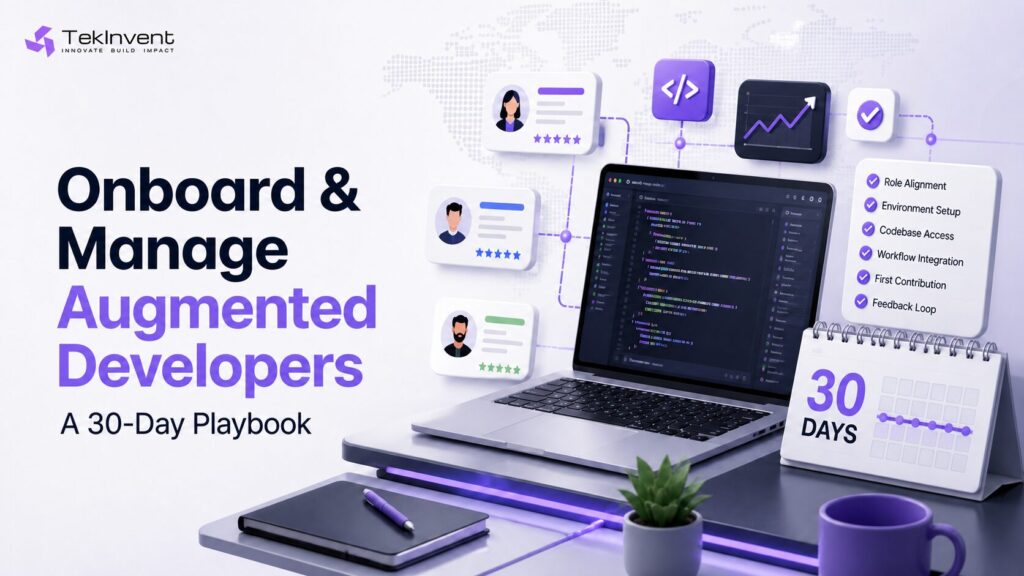
Hiring qualified developers is only the beginning of a successful staff augmentation engagement. The professionals joining your team still need access, product context, technical guidance, clear responsibilities, and a reliable way to receive feedback.
A talented developer can struggle when credentials arrive late, documentation is outdated, priorities are unclear, or nobody has been assigned to answer questions. These problems are often blamed on the developer or staffing provider, even though they originate in the client’s onboarding process.
Learning how to manage augmented teams means treating external professionals as integrated members of the delivery process while maintaining appropriate contractual, security, and access controls.
This guide provides a practical 30-day onboarding and management playbook for US companies. It covers preparation, system access, product orientation, initial assignments, performance measurement, knowledge transfer, security, communication, and offboarding.
The goal is not to make an augmented professional understand the entire company in a few days. The goal is to give that person enough structure to contribute safely, ask informed questions, and become increasingly independent.
Why Augmented Developer Onboarding Is Different
Augmented developers require many of the same things as permanent employees: context, tools, relationships, feedback, and realistic expectations. The difference is that an augmented professional is usually joining for a defined need and may need to create value within a shorter period.
The onboarding process should therefore be focused without becoming superficial.
The developer needs to understand the product, customer, architecture, workflow, and security requirements relevant to the assignment. They do not necessarily need every company presentation or access to every internal system.
A 2026 literature review on software-engineering onboarding describes how newcomers must simultaneously learn technical knowledge, unfamiliar codebases, tools, team culture, workflows, and communication practices. This combination explains why providing repository access alone is not enough. 2026 software-engineering onboarding review
Earlier Microsoft-based research also examined onboarding through interviews with 32 developers moving into new teams and 15 engineering managers. The research reinforces the point that developer onboarding involves technical, organizational, and interpersonal learning rather than a single orientation session. Microsoft onboarding case study
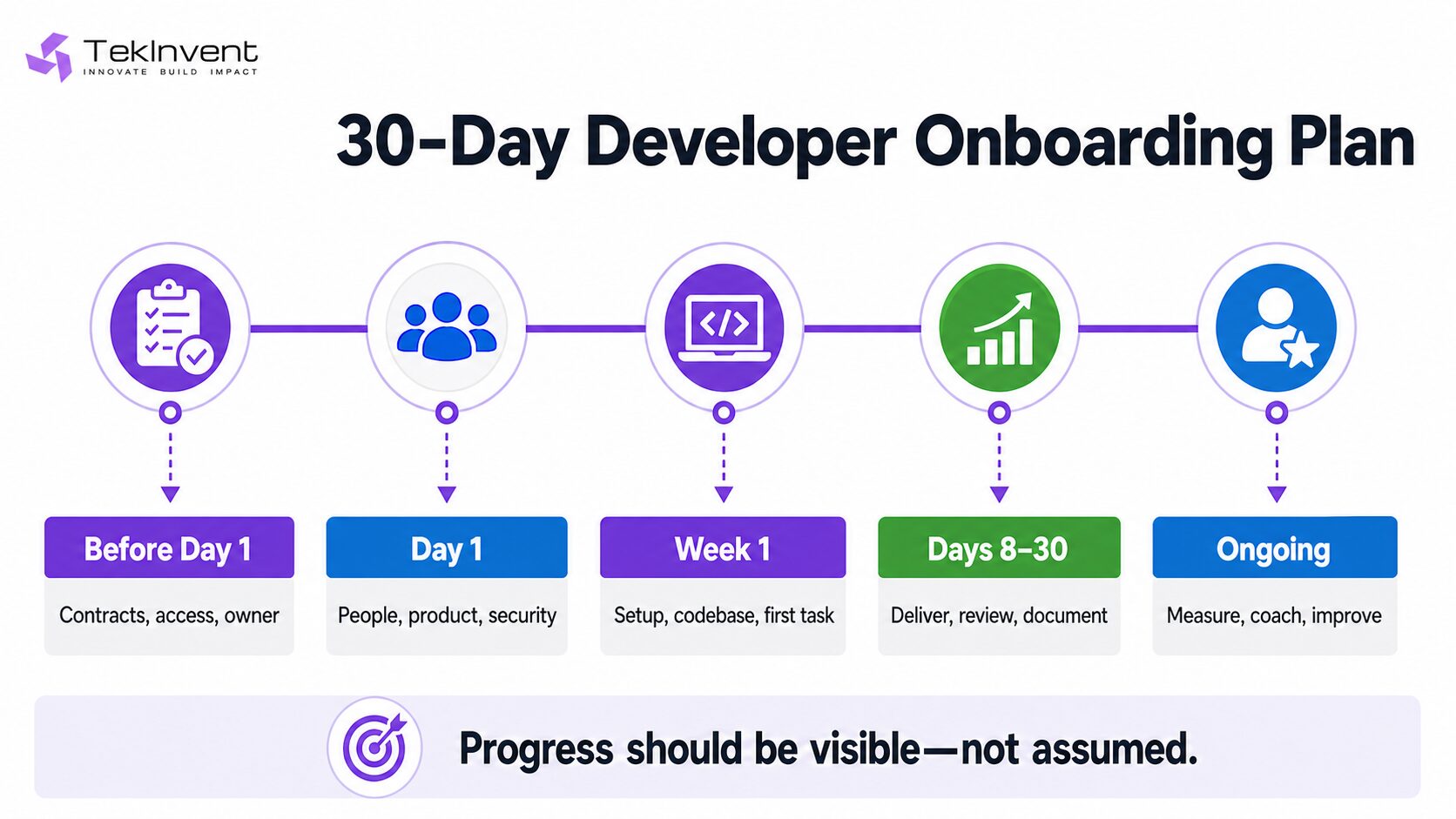
The 30-Day Onboarding Plan at a Glance
| Stage | Primary objective | Expected evidence |
| Before Day 1 | Remove administrative and access blockers | Signed documents, approved role, account plan |
| Day 1 | Introduce the people, product, workflow, and security rules | Confirmed contacts and completed orientation |
| Week 1 | Establish the environment and complete a limited task | Working setup and reviewed first contribution |
| Days 8–14 | Increase technical and product understanding | Independent task progress and useful questions |
| Days 15–30 | Evaluate consistent contribution and integration | Reliable delivery, quality, and documentation |
| Ongoing | Improve performance and preserve knowledge | Regular feedback, metrics, and updated records |
The milestones should be adjusted to the role and project. A senior architect, QA engineer, DevOps specialist, and UI designer will not follow identical paths.
Before Day 1: Prepare the Engagement
Effective onboarding begins before the developer’s first working day.
The contract and statement of work should already define the role, expected schedule, rates, intellectual property ownership, confidentiality, security responsibilities, replacement process, and termination conditions.
If these terms remain unresolved, the project can begin with avoidable uncertainty. TekInvent’s IT staff augmentation contract checklist explains the clauses companies should review before granting access.
The internal manager should confirm exactly what the developer has been hired to do. A vague instruction such as “help the engineering team” does not provide enough direction.
A better role definition identifies the relevant product area, technical responsibilities, expected collaboration, first assignment, and person authorized to approve work.
The company should also decide which accounts and systems the developer needs. Access requests can be prepared before the start date, but permissions should not become active until the appropriate documents and approvals are complete.
Assign One Internal Owner
Every augmented professional needs a clearly identified internal owner.
This person does not have to answer every technical question personally. The owner is responsible for making sure the developer knows where to obtain answers, which work takes priority, and how progress will be evaluated.
Without an internal owner, responsibility becomes fragmented. The staffing provider may assume the engineering manager is directing the developer, while the engineering manager assumes a product owner is handling priorities.
The internal owner should coordinate the developer’s first assignments, introduce relevant stakeholders, remove blockers, review progress, and deliver consolidated feedback.
For a small engagement, the owner may be an engineering lead. For a larger augmented team, the company may require separate product, technical, and operational contacts.
Prepare an Onboarding Brief
Instead of sending the developer into a large collection of disconnected documents, prepare a concise onboarding brief.
The brief should explain what the product does, who uses it, what the current team is building, why the augmented role exists, and how success will be evaluated.
It should also identify the relevant code repositories, environments, communication channels, meeting schedule, documentation locations, escalation contacts, and development standards.
This document does not need to contain every technical detail. Its purpose is to give the professional a map of the project and direct them toward authoritative sources.
The internal owner should verify that links, instructions, and contacts are current before the developer begins.
Day 1: Introduce People Before Processes
The first day should establish relationships as well as systems.
Introduce the augmented developer to the people they will work with directly. Explain each person’s role, decision authority, and preferred communication channel.
The developer should know who owns the product roadmap, who approves architecture, who reviews code, who handles access, and who should be contacted during a security or production incident.
This is especially important for remote and distributed teams. In an office, a new developer may learn these relationships informally. Remote professionals have fewer opportunities to discover them by observation.
Keep the first day focused. Too many meetings can create the appearance of onboarding without producing useful understanding.
The professional should finish Day 1 knowing what the product does, why their role matters, which task they will begin with, and where to ask for help.
Explain the Product and Customer Context
Technical requirements are easier to understand when developers know the business problem behind them.
Explain who uses the product, what customers are trying to accomplish, which workflows matter most, and what happens when the software fails.
For example, a healthcare application may prioritize privacy, availability, and accurate records. A delivery platform may prioritize real-time location updates and operational reliability. A fintech product may place particular emphasis on auditability, security, and transaction accuracy.
Developers who understand this context can make better decisions when specifications are incomplete. They can also identify risks that may not be obvious from an isolated development ticket.
Product context should remain proportional to the assignment. Do not disclose sensitive business information that the professional does not need.
Complete Security Orientation Before Sensitive Access
Security orientation should occur before the developer receives access to sensitive environments.
The professional should understand the company’s requirements for approved devices, passwords, multifactor authentication, VPN use, source-code storage, customer information, external software, and incident reporting.
The Federal Trade Commission advises companies to secure remote access, require appropriate authentication, and include security expectations in vendor contracts. FTC remote-access guidance
Access should be assigned individually rather than through shared credentials. This allows the company to attribute activity to a specific person and remove access without affecting other team members.
The principle of least privilege should apply from the start. NIST describes least privilege as limiting users and system processes to the authorized access required for their duties. NIST access-control guidance
Do not grant broad production access merely to make onboarding faster. Begin with the minimum permissions needed and expand access when a legitimate requirement is demonstrated.
Week 1: Set Up the Development Environment
During the first week, the augmented developer should be able to configure the approved development environment and run the relevant application or service.
Environment documentation should explain dependencies, secrets management, configuration, database access, build commands, testing, and common setup problems.
Secrets should never be copied into ordinary chat messages or stored in unprotected documents. Use approved credential and secrets-management systems.
If environment setup repeatedly depends on one internal engineer manually fixing undocumented problems, treat that as a process issue. Update the setup instructions as blockers are discovered.
A developer’s difficulty during onboarding can reveal weaknesses in the company’s documentation and development experience. The goal should not be to hide those weaknesses; it should be to correct them.
Provide a Guided Codebase Tour
Do not expect a developer to understand a large repository simply by reading it from the first file to the last.
A technical lead should provide a focused tour of the architecture. Explain the main components, data flow, integrations, deployment process, important dependencies, and parts of the system that require particular caution.
The developer should also understand why major technical decisions were made. Architecture documentation is more useful when it captures reasoning, not only diagrams.
Identify the areas relevant to the developer’s initial work. A front-end engineer may need to understand the design system, state management, API layer, test structure, and build process before examining unrelated backend services.
The tour should end with clear recommendations about what to study first and what can be ignored temporarily.
Assign a Safe First Contribution
The first task should be meaningful but limited.
It should allow the developer to experience the complete workflow: understanding a requirement, modifying code or another project asset, running tests, submitting work for review, responding to feedback, and completing the agreed delivery process.
A minor bug, contained improvement, test addition, or documentation correction may be suitable. Avoid assigning a mission-critical architectural change before the professional understands the system.
The first contribution is not merely a productivity test. It reveals whether the developer has the correct access, understands the workflow, follows standards, and communicates effectively.
Managers should review the process as well as the output. If the task is delayed because requirements were unclear or approvals were unavailable, that is not solely a developer-performance problem.
Establish Shared Engineering Standards
Internal and augmented developers should follow the same essential engineering standards.
These standards may cover branching, pull requests, code review, automated testing, documentation, dependencies, security checks, deployment, and incident handling.
Do not assume an experienced developer will automatically follow your preferred approach. Different organizations have different conventions, and none are obvious to someone joining from outside.
Standards should be written and easy to find. If reviewers repeatedly explain the same rule in pull-request comments, add that rule to the project documentation or automate it where possible.
Consistency makes collaboration easier and reduces the risk of external contributions becoming a separate body of work that only the augmented developer understands.
Define Communication Rules
More communication is not always better. The objective is useful communication with appropriate timing and context.
The team should agree on which channel is used for urgent questions, technical decisions, project updates, and formal approvals. Important decisions should not remain buried in private messages.
Daily meetings can help teams coordinate, but they should not become status-reporting rituals. The developer should be able to explain progress, blockers, and decisions without attending unnecessary meetings throughout the day.
For distributed teams, establish a reliable overlap window. Confirm the hours in the client’s time zone and account for daylight-saving changes.
If the developer works primarily asynchronously, requirements and handoffs must be more detailed. The team should define expected response times so that “flexible schedule” does not become “unpredictable availability.”
Days 8–14: Increase Responsibility Gradually
After the first contribution is complete, the developer can begin taking ownership of larger tasks.
This stage should test whether the professional can navigate the codebase, clarify requirements, estimate work, identify risks, and apply feedback with less direct supervision.
The manager should continue providing context without prescribing every implementation step. Excessive control can slow experienced professionals and may also create questions about the actual working relationship.
At the same time, managers should not disappear after the first week. A developer who stops asking questions may be gaining confidence, or they may be avoiding questions because support has been difficult to obtain.
Use short, regular check-ins to identify blockers and verify that priorities remain clear.
Days 15–30: Evaluate Consistent Contribution
By the second half of the first month, management should focus on patterns rather than one isolated task.
Evaluate whether the professional produces maintainable work, communicates delays early, follows security requirements, responds constructively to reviews, and contributes useful documentation.
The developer should understand the product area well enough to recognize obvious gaps or risks. They do not need complete organizational knowledge, but they should be increasingly independent within the agreed role.
At the end of the first 30 days, conduct a structured review involving the developer, internal owner, and provider where appropriate.
The discussion should address what is working, which blockers remain, whether the role has changed, and what support will improve future delivery.
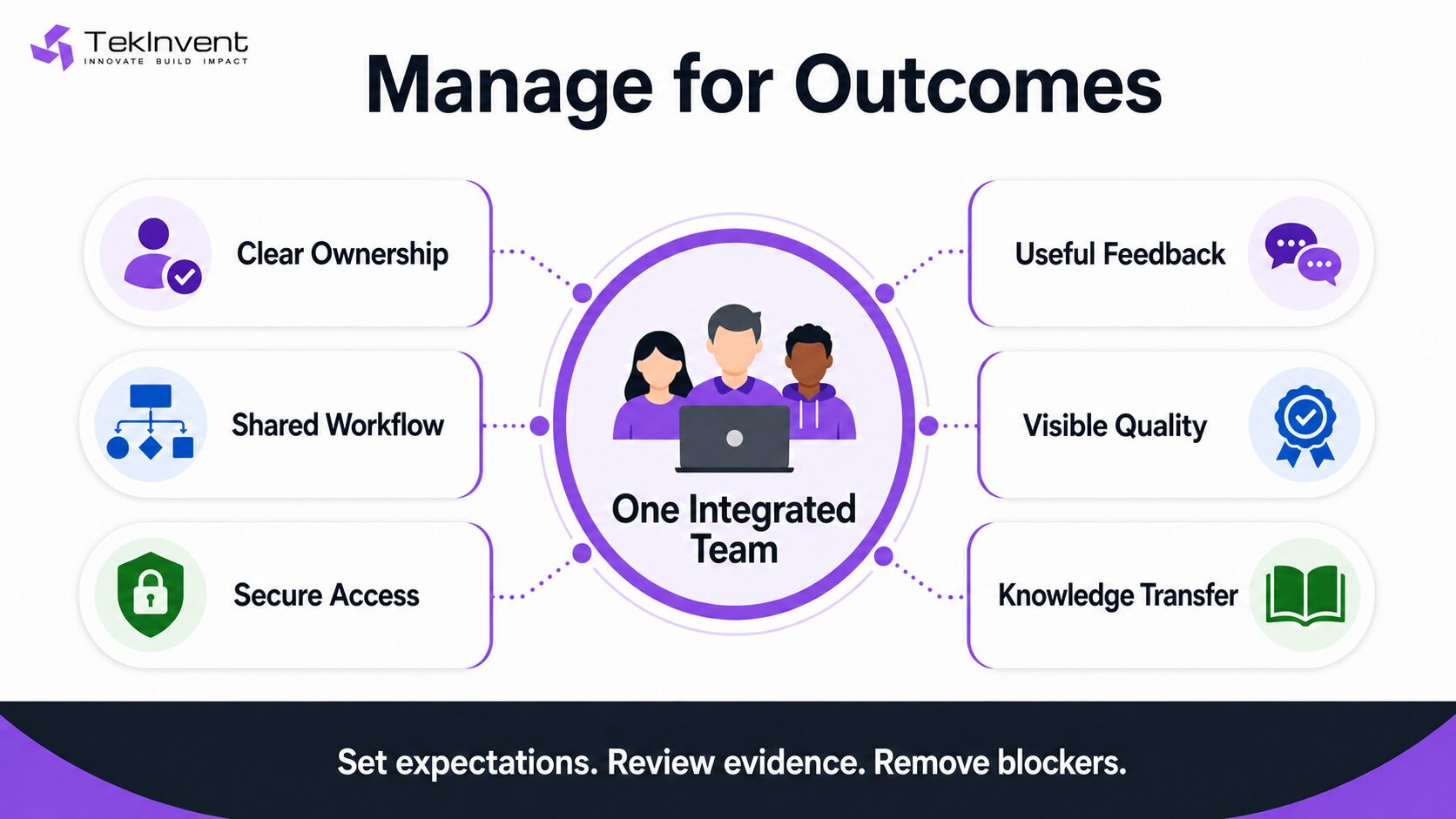
Manage Outcomes, Not Online Presence
Remote management can become overly focused on whether a person appears active in a communication tool.
Presence is not the same as progress. Likewise, raw output measures such as lines of code, number of commits, or tickets closed can reward activity without demonstrating quality.
A better approach connects expectations to evidence.
For a developer, useful evidence may include reviewed functionality, test coverage relevant to the change, defect trends, documentation, delivery predictability, and collaboration.
For a QA professional, it may include risk coverage, useful defect reporting, automation quality, and release confidence.
For a designer, it may include validated user flows, design-system consistency, responsiveness to feedback, and development-ready specifications.
Metrics should support management conversations, not replace judgment.
Use Pull Requests as a Management Tool
Pull requests provide more than a quality checkpoint. They create a visible record of technical decisions, feedback, and knowledge transfer.
Internal reviewers should assess correctness, maintainability, security, testing, and alignment with the existing architecture.
Reviews should be timely. If an augmented developer waits several days for feedback, the delay can reduce the value of adding external capacity.
Feedback should be specific and reusable. Instead of writing “do this differently,” explain the relevant standard or architectural concern. When the same feedback appears repeatedly, update the documentation or add an automated check.
The augmented professional should also be encouraged to review appropriate work from other team members. This can deepen codebase understanding and reduce separation between internal and external developers.
Create a Healthy Feedback Loop
Performance concerns should be communicated early and with evidence.
A manager should describe the observed behavior, its effect, the expected standard, and the support available. Vague feedback such as “be more proactive” is difficult to act on.
For example, a manager might explain that blockers were reported only during the next daily meeting, causing a delay. The new expectation could require posting a blocker in the project channel within a defined period.
Positive feedback should be equally specific. Recognizing a developer for improving documentation or identifying a security concern shows which behaviors the team values.
When a problem involves attendance, availability, or repeated performance issues, follow the escalation process established with the staffing provider.
Preserve Knowledge Throughout the Engagement
Documentation should be a continuous responsibility.
Augmented developers should update technical notes, architecture decisions, setup instructions, testing procedures, and deployment information as the project evolves.
Knowledge should also move through code reviews, pairing, demonstrations, and technical discussions. Important systems should not depend entirely on one external professional.
Keep documentation in client-controlled systems. The company should retain access even if the provider relationship changes.
This practice protects continuity while also improving onboarding for future employees and augmented professionals.
Prevent Common Management Mistakes
One frequent mistake is treating an augmented developer as an outsider. Excluding the professional from relevant discussions deprives them of context and leads to weaker decisions.
The opposite mistake is granting the developer unrestricted access and involving them in every internal discussion. Integration should be relevant and controlled.
Another error is expecting the staffing provider to manage work that the client has agreed to direct. If the company needs a vendor to own delivery rather than provide professionals, a managed or project-based model may be more appropriate.
Companies should also avoid changing the role without updating expectations. A developer hired for implementation should not quietly become responsible for architecture, project management, and production support without a deliberate discussion.
TekInvent’s guide to IT staff augmentation risks explains the security, cost, continuity, and management problems that can result from weak controls.
How to Handle Performance Problems
Begin by determining whether the problem belongs to the professional, the process, or both.
A developer may appear slow because the environment is unstable, requirements conflict, or code reviews are delayed. Conversely, a clear process does not excuse repeated quality issues or poor communication.
Document the specific concern and discuss it directly. Agree on what improvement should look like and when progress will be reviewed.
If the issue continues, involve the staffing provider under the agreed escalation procedure. When replacement is necessary, begin knowledge transfer before access is removed unless the situation requires immediate termination.
The replacement process should protect project continuity while remaining fair and evidence-based.
Offboarding Augmented Developers Securely
Offboarding should be planned when onboarding begins.
For a scheduled departure, confirm that documentation is current and assign any required handover sessions. Review unfinished tasks, known defects, deployment procedures, dependencies, and outstanding decisions.
At the end of the engagement, remove the professional’s accounts and permissions from repositories, cloud systems, databases, project tools, communication platforms, and shared documents.
Rotate any credentials that may have been shared. Confirm the return or deletion of company information and equipment according to the agreement.
For urgent security or conduct concerns, access may need to be removed immediately. The contract and incident-response process should anticipate that possibility.
How TekInvent Can Support Your Augmented Team
TekInvent’s IT staff augmentation services help businesses add developers, designers, QA engineers, project managers, and other technical professionals according to their project requirements.
Before starting an engagement, define the role, required technologies, expected duration, working-hour overlap, access requirements, internal owner, and first-month objectives.
Contact TekInvent to discuss your team requirements and the professionals needed to support your roadmap.
Final Thoughts
Knowing how to manage augmented teams requires more than assigning tickets and checking attendance. Successful integration depends on preparation, context, secure access, clear ownership, shared engineering standards, timely feedback, and continuous knowledge transfer.
The first 30 days should create a path from orientation to increasingly independent contribution. Progress should be visible through completed work, review quality, communication, documentation, and reduced dependence on constant supervision.
Treat augmented developers as part of one delivery team, but apply the contractual, security, and access controls appropriate to an external relationship.
When the client, provider, and professional understand their responsibilities, staff augmentation becomes easier to manage and more likely to produce lasting value.

Build Smart with The Right Team.
We bring expertise, technology, and trust you look for in your digital journey.