


Staff augmentation can help a company add specialized expertise, increase delivery capacity, and respond to changing workloads. However, adding external professionals does not automatically create a positive return.
To understand whether an engagement is worthwhile, decision-makers must compare its complete cost with the value it produces. That value may include faster delivery, improved software quality, access to missing expertise, reduced recruitment pressure, or revenue protected by meeting an important deadline.
Staff augmentation ROI should therefore be measured through financial results, delivery performance, quality, knowledge transfer, and business outcomes. A low hourly rate does not prove value, and a higher rate does not necessarily indicate poor performance. The relevant question is whether the engagement produced outcomes worth more than its total cost.
What Does Staff Augmentation ROI Mean?
Return on investment compares the value created by an engagement with the resources spent to obtain that value.
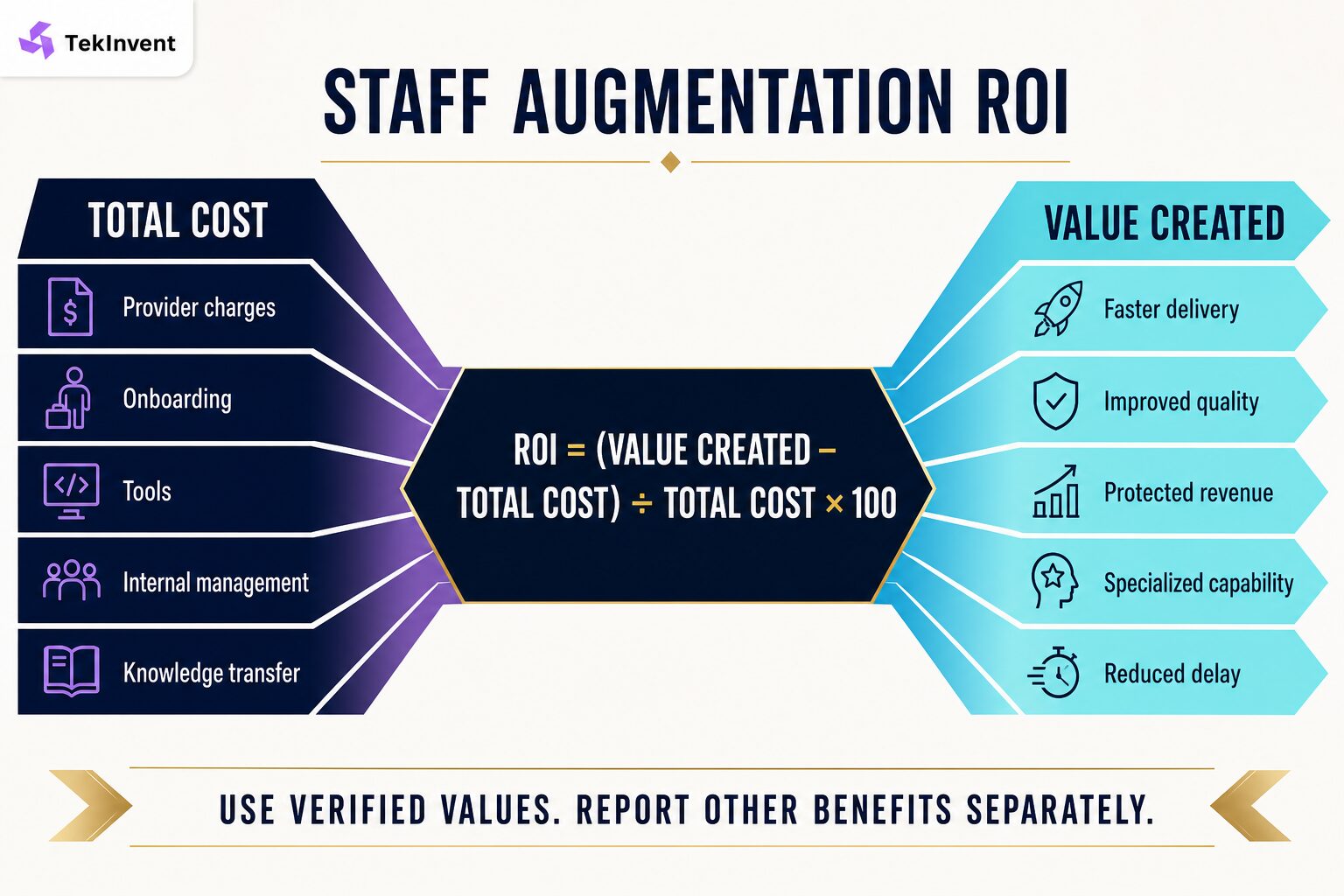
The basic calculation is:
ROI (%) = (Financial value created − total engagement cost) ÷ total engagement cost × 100
Suppose an augmented team costs $100,000 and produces $150,000 in measurable financial value. The calculated return would be 50%. In practice, however, accurately identifying that $150,000 is often the most difficult part.
Some returns are direct. A new feature may generate measurable revenue, or an automated process may reduce a known operating expense. Other benefits are indirect. Faster incident recovery, reduced pressure on internal employees, or improved documentation can create meaningful value without producing an immediate line item in the financial statements.
For this reason, ROI analysis should separate verified financial returns from operational improvements. Combining both provides a more honest view than forcing every benefit into an uncertain dollar estimate.
Companies evaluating external technical talent can use IT staff augmentation services to add professionals according to defined roles, technologies, and project requirements.
Establish a Baseline Before the Engagement
Measurement must begin before the augmented professionals start working. Without a baseline, a company can observe that performance changed but may not be able to determine how much it changed or why.
The baseline should describe the current condition of the work. Depending on the objective, it may include development cycle time, release frequency, defect volume, backlog age, missed milestones, incident recovery time, recruitment expenses, or the duration of an unfilled role.
For example, imagine that a product team releases once every six weeks and has a four-month feature backlog. If the business adds external developers, it can compare subsequent delivery performance with those original conditions.
The baseline must match the engagement’s purpose. If the company brings in a cybersecurity specialist, deployment frequency may be irrelevant. The relevant measures could instead be resolved vulnerabilities, remediation time, compliance readiness, or the adoption of secure development practices.
Document the baseline, expected outcome, measurement period, and data source. This prevents teams from selecting only favorable metrics after the work has started.
Calculate the Complete Cost of Staff Augmentation
Vendor invoices are only one component of total investment. A reliable calculation should include every material cost required to start, manage, and conclude the engagement.
Direct costs normally include contracted rates, approved overtime, provider fees, tools, software licenses, equipment, travel where applicable, and taxes specified by the agreement.
Internal costs can include time spent interviewing candidates, onboarding professionals, providing technical direction, reviewing work, managing access, attending additional meetings, and conducting knowledge-transfer activities. These costs may be smaller than the contracted spend, but ignoring them can overstate the return.
The complete investment can be expressed as:
Total engagement cost = provider charges + onboarding + tools + internal management + security and compliance + knowledge transfer
This total should be compared with the cost of realistic alternatives. TekInvent’s guide to IT staff augmentation costs provides further context on the factors affecting rates and total budgets.
Compare Equivalent Alternatives
Staff augmentation ROI should not be measured in isolation. Decision-makers should compare it with what the company would otherwise have done.
The alternative may be permanent recruitment, delaying the project, training existing employees, outsourcing the work, or deciding not to proceed. Each option has different costs, risks, and timelines.
When comparing augmentation with permanent hiring, salary alone is not an appropriate benchmark. The US Bureau of Labor Statistics reported that private-industry benefits averaged 30.1% of total employer compensation in March 2026. This is an economy-wide figure rather than a software-specific hiring markup, but it shows why wages represent only part of employment costs. BLS employer compensation data
A permanent-hiring estimate may also need to include recruitment, payroll obligations, equipment, training, management, paid leave, and the cost of a position remaining vacant.
The objective is not to make augmentation appear less expensive. It is to compare complete commitments over the same period. A permanent employee may provide greater long-term value when the role requires continuous ownership and institutional knowledge. An external specialist may offer a stronger return for a defined project or temporary skill gap.
Select KPIs Based on the Business Objective
A KPI is useful only when it reflects the outcome the company intended to improve. Tracking many measures can make a dashboard look sophisticated while providing little decision value.
The engagement should normally have a small set of primary indicators supported by diagnostic metrics. A company seeking faster delivery might track cycle time and milestone performance as primary outcomes. It could then use code-review time, blocker age, and backlog flow to explain those results.
Avoid evaluating software professionals solely through individual output measures such as lines of code, tickets closed, or hours logged. These figures can reward activity rather than value and may encourage behavior that reduces quality.
The best measures assess the team and the system in which work is delivered.
Measure Delivery Speed and Predictability
Many companies use augmentation because a project is delayed or an internal team lacks sufficient capacity. In that situation, delivery performance is central to the ROI calculation.
Useful measures include the time required to complete work, the percentage of planned milestones delivered on schedule, and the age of items in the backlog. The company can also compare forecast dates before and after adding external professionals.
Schedule improvement should not be claimed merely because more tickets were closed. The completed work must contribute to an agreed product or business outcome.
For projects using formal cost and schedule baselines, earned value techniques can compare planned work, completed work, and actual expenditure. The Project Management Institute describes the Cost Performance Index and Schedule Performance Index as ways to assess cost and schedule performance against a baseline. PMI guidance on performance baselines
Smaller teams do not need a complex earned value system. They still need a consistent way to compare planned scope, actual completion, schedule, and cost.
Evaluate Software Delivery Performance
When augmented professionals contribute to software development, delivery metrics can reveal whether the team is becoming faster without becoming unstable.
DORA’s current software-delivery framework measures throughput through change lead time, deployment frequency, and failed deployment recovery time. It measures instability through change fail rate and deployment rework rate. DORA software-delivery metrics
These measures should be interpreted together. Increasing deployment frequency while creating more production failures is not a clear improvement. Similarly, a lower failure rate achieved by releasing almost nothing does not demonstrate strong delivery performance.
Compare trends over an appropriate period rather than judging an engagement from one sprint. Team composition, product complexity, inherited technical debt, and release policies can all affect the results.
The purpose is not to hold external professionals responsible for every change in team performance. It is to determine whether the engagement contributed to safer, faster, and more predictable delivery.
Track Quality and Rework
Additional development capacity creates limited value when the resulting work produces defects, security weaknesses, or extensive rework.
Quality measures may include escaped defects, reopened tickets, failed acceptance tests, change failure rate, security findings, review rejection rates, or time spent correcting avoidable problems.
These indicators must be defined consistently. If one team records every minor defect while another records only production incidents, direct comparisons will be misleading.
Code review can also provide useful qualitative evidence. Internal technical leaders should assess maintainability, adherence to architecture, documentation, test coverage, and compliance with security standards.
A short-term increase in review effort is not necessarily a negative outcome. New professionals need time to understand the product and its standards. The important question is whether rework and supervision decrease as the engagement matures.
Account for Time-to-Productivity
Contract start date and productive contribution date are not the same.
An augmented professional may require access provisioning, development-environment setup, product orientation, security training, and familiarity with the codebase. Measure how long it takes before the person can complete meaningful work at the expected quality level.
Time-to-productivity helps companies evaluate both candidate matching and onboarding effectiveness. If qualified professionals repeatedly take too long to become productive, the problem may be missing documentation, slow access approvals, unclear ownership, or an overly complex development environment.
The metric should not be used to pressure people into releasing work before they understand the system. Its purpose is to identify avoidable onboarding delays.
Measure Knowledge Transfer and Reduced Dependency
An engagement can deliver its assigned work and still create long-term risk if critical knowledge remains with external professionals.
Knowledge-transfer outcomes may include updated technical documentation, architecture records, runbooks, shared code ownership, recorded handover sessions, and the internal team’s ability to maintain the completed work.
A practical test is whether an internal employee can explain the solution, deploy it, diagnose common problems, and make a controlled change without depending entirely on the original contributor.
This value is difficult to express financially but important to business continuity. Strong knowledge transfer reduces future onboarding costs and lowers the risk that work becomes difficult to maintain after the engagement ends.
Connect Technical Outcomes to Business Value
Delivery metrics explain what changed in the development process. They do not automatically explain why the change mattered to the business.
A faster release has value when it enables earlier revenue, protects a customer commitment, reduces operational costs, improves retention, or supports a strategic objective. Technical outcomes should therefore be mapped to business outcomes.
Consider these relationships:
| Technical outcome | Potential business value |
| Earlier product launch | Revenue captured sooner |
| Reduced cycle time | Faster response to customer needs |
| Fewer production defects | Lower support and remediation costs |
| Improved system reliability | Reduced disruption and customer risk |
| Specialized capability added | Project proceeds without a permanent hire |
| Better documentation | Lower dependency and future onboarding effort |
Use verified financial data where it is available. When a benefit cannot be monetized reliably, report it as an operational outcome rather than inventing a value.
Include the Cost of Delay
The cost of delay is the economic impact of postponing a business outcome. It may include revenue that cannot begin, customer commitments that cannot be fulfilled, operational savings that remain unrealized, or strategic opportunities that become less valuable over time.
Suppose a feature is expected to generate $40,000 in monthly contribution after launch. If missing technical capacity delays it by three months, the potential cost of delay may be approximately $120,000, subject to the reliability of the forecast.
If augmentation prevents that delay, some of the protected value may reasonably be associated with the engagement. The calculation should be documented transparently and adjusted for uncertainty.
Not every deadline has measurable commercial value. Avoid assigning arbitrary revenue to internal milestones merely to create a favorable ROI result.
Review Benefits and Limitations Together
Positive ROI does not mean an engagement is free from tradeoffs. External professionals still require management, system access, communication, security controls, and knowledge-transfer planning.
Short engagements may produce high onboarding costs relative to productive time. Long engagements may eventually become less efficient than building a permanent internal capability. Poorly defined roles can create duplicate responsibilities and unclear accountability.
Decision-makers should review the wider staff augmentation benefits, use cases, and limitations alongside the financial analysis. This helps prevent a promising percentage from obscuring operational risks.
Use a Balanced ROI Scorecard
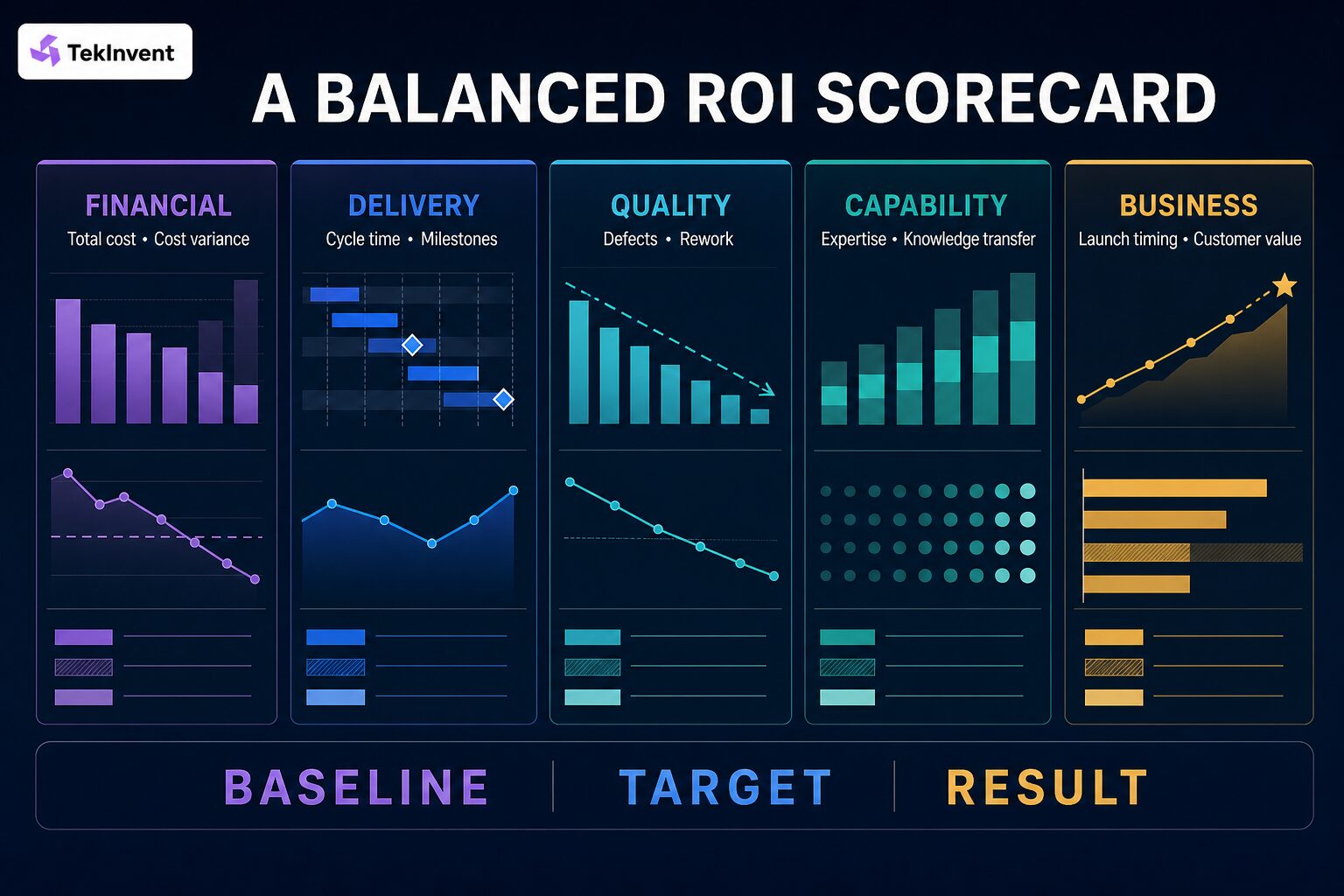
One financial calculation is rarely sufficient for evaluating a technical engagement. A balanced scorecard can combine several categories without pretending that every outcome has an exact monetary value.
A practical scorecard might include:
- Financial: total cost, avoided recruitment expense, protected revenue and cost variance
- Delivery: cycle time, milestone predictability and backlog movement
- Quality: defects, rework, change failures and security findings
- Capability: missing expertise supplied and internal knowledge gained
- Business: launch timing, customer commitments and operational improvement
Each measure should have a baseline, target, owner, data source, and review frequency. Use the same definitions throughout the engagement.
Do not average unrelated metrics into a single artificial score unless the weighting method has a clear business rationale. A dashboard should make tradeoffs visible, not hide them.
Review Performance at Meaningful Intervals
ROI should not be calculated only after the engagement ends. Regular reviews allow the company to identify weak results while there is still time to improve them.
An early review can focus on candidate fit, access, onboarding, and initial contribution. Later reviews can assess delivery, quality, business progress, and knowledge transfer.
The final assessment should compare actual outcomes with the original business case. Document which benefits were verified, which were estimated, which did not occur, and which costs were higher than expected.
This analysis also supports decisions about extending the engagement, changing its composition, converting a role into a permanent position, or selecting another delivery model.
When Another Engagement Model May Produce Better ROI
Staff augmentation generally works best when a company can manage the professionals directly and needs additional skills or capacity.
If the organization wants a provider to own an ongoing function and meet defined service levels, it should compare staff augmentation vs managed services. If it needs strategic recommendations rather than delivery capacity, consulting may be more appropriate.
A dedicated external team can offer stronger continuity for a long-term, cross-functional initiative, while permanent recruitment may produce more value when a capability is central to the company’s competitive advantage.
Choosing the wrong model can reduce ROI even when the people involved perform well. Ownership, scope, duration, management capacity, and expected outcomes should therefore be defined before comparing rates.
Final Thoughts
Measuring staff augmentation ROI requires more than subtracting a vendor invoice from an estimated benefit. A credible analysis begins with a documented baseline, includes all material costs, and connects team performance with outcomes the business values.
Financial return remains important, but it should be considered alongside delivery speed, quality, productivity, knowledge retention, and reduced business risk. These measures provide context that one percentage cannot capture.
The strongest engagement is not necessarily the one with the lowest hourly rate or the largest volume of completed work. It is the one that solves the defined capability or capacity problem, produces maintainable results, and creates value greater than its complete cost.
When objectives and measurements are established before work begins, staff augmentation becomes easier to manage, evaluate, and improve as a business investment.

Build Smart with The Right Team.
We bring expertise, technology, and trust you look for in your digital journey.