
IT staff augmentation can help a business add specialized skills, increase development capacity, and move critical initiatives forward without relying entirely on permanent hiring. However, bringing external professionals into an existing technology team also introduces risks that must be managed deliberately.
Poor candidate screening can produce a technical mismatch. Excessive system access can expose sensitive information. Weak documentation can allow valuable knowledge to leave with a developer. Unclear contracts can create disputes over pricing, intellectual property, performance, and termination.
These concerns do not mean staff augmentation is inherently unsafe or ineffective. Most IT staff augmentation risks arise when a company treats the model as a simple purchasing decision instead of an operational relationship that requires governance.
The goal is not to eliminate every possible risk. It is to identify the risks relevant to your project, establish controls before work begins, and monitor those controls throughout the engagement.
This guide examines 12 staff augmentation challenges and explains how US businesses can reduce them.
This article provides general business information and does not constitute legal, tax, employment, cybersecurity, or regulatory advice. Consult qualified professionals about your organization’s circumstances.
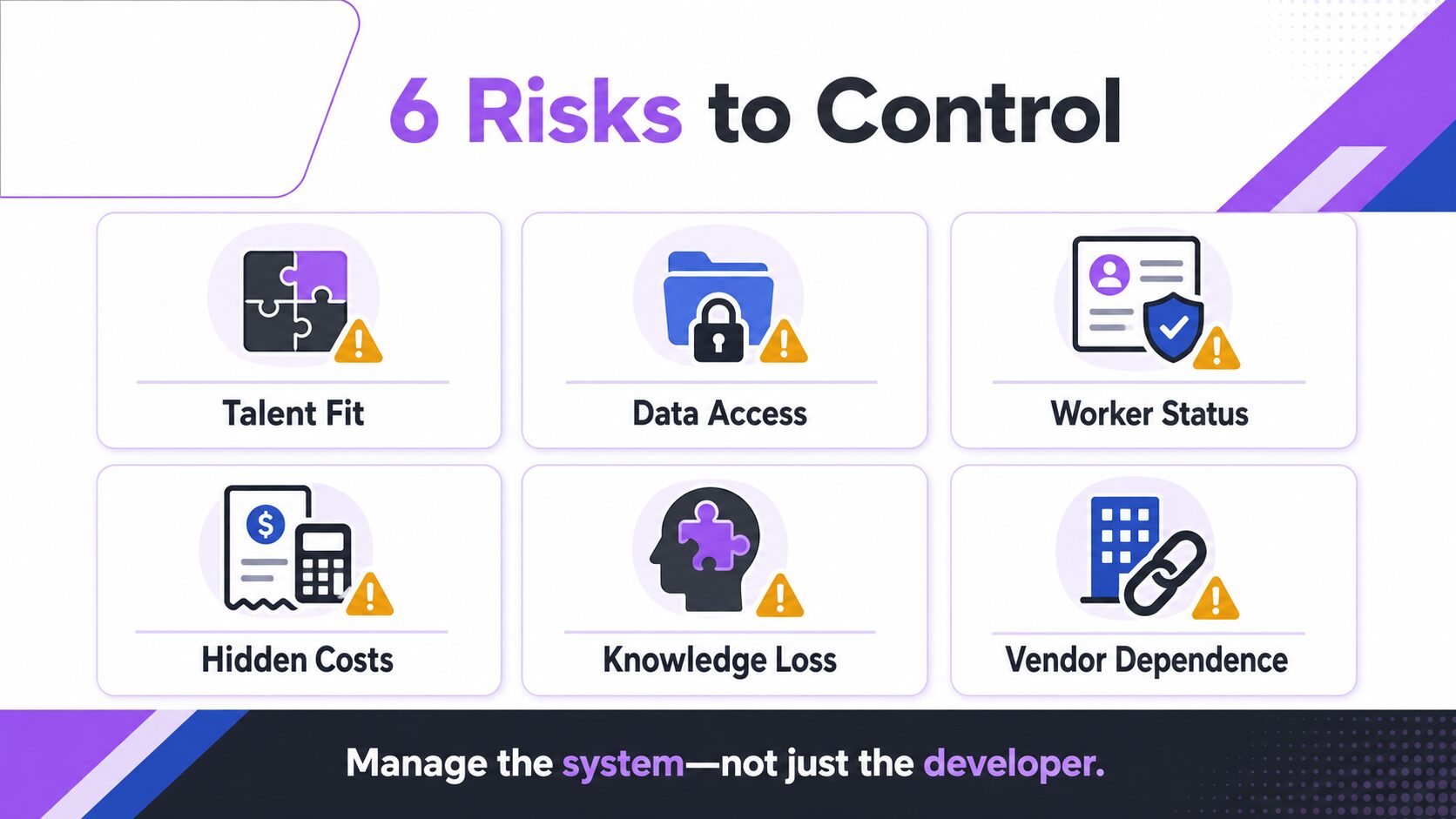
IT Staff Augmentation Risks at a Glance
| Risk | Potential business impact | Primary control |
| Poor technical fit | Delays, defects, and additional supervision | Client interviews and practical assessments |
| Worker-status issues | Tax or employment exposure | Legal review of the actual relationship |
| Unauthorized data access | Data loss or privacy incidents | Least-privilege access |
| Intellectual property uncertainty | Disputes over code ownership | Clear contractual ownership terms |
| Hidden costs | Budget overruns | Total-cost comparison and approval limits |
| Communication gaps | Delayed decisions and rework | Defined overlap and escalation channels |
| Knowledge loss | Difficult maintenance after departure | Continuous documentation and handover |
| Developer turnover | Interrupted delivery | Replacement and transition terms |
| Vendor dependence | Reduced operational control | Client-owned systems and documentation |
| Weak internal management | Poor priorities and inconsistent output | Dedicated internal owner |
| Quality inconsistency | Technical debt and unstable releases | Shared engineering standards |
| Difficult offboarding | Persistent access and incomplete transfer | Formal exit checklist |
Why Risk Management Matters in 2026
Technology teams increasingly depend on external vendors, software suppliers, contractors, and cloud services. That broader reliance creates additional paths into company systems.
Verizon’s 2026 Data Breach Investigations Report found that third-party involvement appeared in 48% of breaches within its dataset, representing a 60% increase from the previous year. This figure covers third-party involvement broadly; it does not mean that 48% of staff augmentation engagements experience a breach. It does, however, show why vendor access and supply-chain controls deserve serious attention. Verizon 2026 DBIR
Risk management should begin before the first developer receives credentials. It should continue through onboarding, daily delivery, performance reviews, access changes, and final offboarding.
Risk 1: Hiring Professionals Who Do Not Match the Role
A candidate can have an impressive résumé without possessing the practical skills required by your project. This becomes especially problematic when a provider uses broad job titles such as “senior developer” without defining what seniority means.
A technical mismatch can create more work for the internal team. Employees may need to rewrite code, explain basic concepts, or supervise tasks more closely than expected.
The solution is to define the role before asking for candidates. Identify the required technologies, years or depth of relevant experience, project responsibilities, working-hour expectations, and communication requirements.
Every proposed professional should be interviewed by the client. For technical roles, use a practical assessment related to the actual work rather than relying only on theoretical questions. A senior backend engineer might be asked to explain an architectural decision, diagnose a performance issue, or review a realistic code example.
The provider should also explain how it verifies employment history, technical ability, availability, and identity. If its screening process cannot be described clearly, the talent pool should not be accepted at face value.
TekInvent’s guide on how to choose an IT staff augmentation company provides a broader vendor-evaluation framework.
Risk 2: Worker Classification and Employment Confusion
Staff augmentation can involve several working arrangements. A professional may be employed by the staffing provider, engaged through a third party, or operating as an independent contractor.
The contract should identify which entity employs or contracts with each professional. It should explain which party handles payroll, taxes, benefits, insurance, and administrative responsibilities.
However, a contract label does not determine a person’s legal status by itself. The IRS explains that worker classification depends on the actual relationship, including behavioral control, financial control, and the relationship between the parties. The substance of the arrangement matters more than the title assigned to it. IRS worker-classification guidance
This issue can become more complex when a client controls detailed working methods, provides equipment, expects an indefinite engagement, or treats an external professional exactly like a permanent employee.
US companies should have qualified legal and tax professionals review the proposed model. State requirements may differ, and cross-border engagements can introduce additional considerations.
The practical control is straightforward: document the operating relationship accurately and avoid assuming that the provider’s standard agreement resolves every classification question.
Risk 3: Excessive Access to Systems and Data
Augmented developers may need access to source-code repositories, project-management platforms, cloud environments, customer information, and internal documentation. Giving them broad access may be convenient, but it also expands the company’s attack surface.
Access should follow the principle of least privilege. Each professional should receive only the permissions necessary for the assigned role and only for the period those permissions are required.
A front-end developer may not need access to production databases. A QA engineer may be able to work with sanitized test data. A temporary designer may not require source-code repository access at all.
Security controls should include unique accounts, multifactor authentication, approved devices, secure remote access, access logging, and periodic reviews. Shared credentials should not be used because they make it difficult to determine who performed a particular action.
The Federal Trade Commission recommends limiting vendor access to a need-to-know basis and including specific security expectations in vendor contracts. FTC vendor-security guidance
Location alone does not determine security. An onshore developer with excessive permissions can create more risk than an offshore developer working within a carefully controlled environment.
Risk 4: Unclear Intellectual Property Ownership
External professionals may create source code, designs, database structures, documentation, test cases, deployment scripts, technical specifications, and product concepts.
If the agreement does not establish ownership clearly, the client may face uncertainty about its right to use, modify, commercialize, or transfer the resulting work.
The contract should explain when ownership transfers and whether payment is a condition of that transfer. It should require the provider to obtain appropriate assignments from employees and approved subcontractors.
Pre-existing tools require separate treatment. A developer may use an existing internal library, framework, template, or process rather than creating every element from scratch. The agreement should identify what remains the provider’s property and what license the client receives.
Open-source components also deserve attention. Teams should follow an approved process for reviewing licenses, monitoring dependencies, and documenting third-party components.
For a complete review of ownership and related clauses, consult TekInvent’s IT staff augmentation contract checklist.
Risk 5: Data Security and Confidentiality Failures
A confidentiality agreement is useful, but it cannot stop a technical security incident by itself.
Security responsibilities should be translated into practical controls. The provider and client should agree on approved devices, encryption, authentication, data storage, credential management, vulnerability reporting, and incident notification.
The FTC advises companies to put security requirements in writing and verify that service providers follow them. Contract language is therefore a starting point rather than the entire control system. FTC guidance on service-provider security
Companies should also decide whether augmented professionals may use generative AI or other external tools. Uploading source code, customer records, or internal documents to an unapproved AI platform can expose sensitive information.
An acceptable-use policy should identify approved tools and prohibited data. It should also clarify whether AI-generated code requires additional review, testing, and licensing checks.
For healthcare, fintech, government, or other regulated work, involve the company’s security, legal, and compliance teams before access is granted.
Risk 6: Hidden and Unexpected Costs
The hourly rate is only one component of the financial decision.
A lower quoted rate may be offset by onboarding, internal management, rework, overtime, software licenses, security reviews, international payments, replacement delays, or knowledge-transfer work.
Contracts should clarify whether meetings, training, approved leave, holidays, onboarding, handover, and overtime are billable. They should also explain who can authorize additional hours and what happens when a monthly limit is reached.
Companies should compare total engagement cost, not isolated hourly rates. The comparison should include the expected duration and the internal effort required to manage the team.
A provider should be able to explain what is included in its pricing and which expenses may arise separately. If the invoice structure is difficult to understand before signing, it is unlikely to become clearer after work begins.
For a detailed cost evaluation, read TekInvent’s guide to IT staff augmentation costs.
Risk 7: Time-Zone and Communication Problems
Time-zone differences can slow delivery when external professionals cannot obtain decisions during their working day.
A developer may discover a blocker shortly after the client’s team goes offline. If nobody can answer the question, work may pause until the next overlap period.
This problem can occur with offshore teams, but it is not limited to them. Onshore and nearshore teams can also struggle when schedules, response expectations, and communication channels are unclear.
Before the engagement begins, agree on a working-hour overlap window. Identify the meetings that require live participation and the issues that may be handled asynchronously.
Written requirements should include acceptance criteria, dependencies, and relevant business context. Technical decisions should be recorded in a system accessible to both internal and augmented professionals.
Teams should also define how urgent issues are escalated. A production incident cannot depend on someone noticing an ordinary chat message several hours later.
If geography is an important factor, review the comparison of onshore, nearshore, and offshore staff augmentation.
Risk 8: Loss of Project Knowledge
Augmented professionals may develop substantial knowledge about architecture, deployment, customer requirements, and historical decisions. If this information remains only in their memory, it may leave when the engagement ends.
Knowledge loss can make future maintenance slower and more expensive. Internal employees may struggle to understand why systems were designed in a particular way or how to deploy critical components.
Documentation should therefore be part of delivery, not an optional final task.
Code should be stored in client-controlled repositories. Architectural decisions, deployment instructions, testing procedures, environment details, and unresolved risks should be documented as the work progresses.
Internal employees should participate in code reviews and important technical discussions. Pairing an augmented professional with an internal counterpart can further reduce dependence on one person.
The final handover should confirm that the company can operate, maintain, and extend the work without relying on inaccessible knowledge.
Risk 9: Developer Turnover and Unexpected Departure
An augmented professional may resign, become unavailable, or need to be replaced. Without a continuity plan, the project can lose momentum while the provider searches for another candidate.
The staffing agreement should define the replacement procedure. It should state how quickly the provider must respond, whether the client can interview the replacement, and how the outgoing professional will transfer knowledge.
The agreement should also clarify whether sourcing or transition time will be charged. Vague promises to replace someone “as soon as possible” may not provide enough certainty for a time-sensitive project.
Clients should avoid allowing one professional to become the sole owner of a critical system. Shared documentation, code reviews, and internal oversight reduce the impact of a sudden departure.
Turnover cannot always be prevented, but the operational disruption can be limited.
Risk 10: Overdependence on One Provider
Vendor dependence develops when a company loses the practical ability to continue without its staffing partner.
This can happen when the provider controls repositories, documentation, credentials, infrastructure, or access to critical professionals. It can also arise when an external team understands the system better than anyone inside the company.
The client should retain ownership and administrative control of core systems. Project documentation should remain available in client-approved tools. Important decisions should include internal stakeholders.
The contract should contain appropriate exit-assistance and knowledge-transfer terms. It should also explain what happens to company information when the relationship ends.
Using several vendors is not automatically safer. Multiple providers can increase coordination and security complexity. The objective is not to avoid every dependency; it is to ensure that the company can operate if a provider relationship changes.
Risk 11: Weak Internal Management
Staff augmentation provides professionals, but it does not eliminate the client’s need for leadership.
An augmented developer cannot succeed when priorities change constantly, requirements remain unclear, system access arrives late, and nobody can approve technical decisions.
Every engagement should have an internal owner. This person should define priorities, remove blockers, review progress, provide context, and coordinate stakeholders.
The company should also establish who evaluates performance and who communicates concerns to the provider. Without a defined process, small issues may continue until they become delivery problems.
If a business lacks internal product ownership or technical leadership, staff augmentation may not be the correct model. A managed team or project-based arrangement may be more suitable.
Understanding the benefits, use cases, and limitations of staff augmentation can help companies determine whether they are ready to manage augmented professionals.
Risk 12: Incomplete Offboarding
Offboarding is often treated as an administrative task, but it is a critical security and continuity control.
When an engagement ends, the company should remove the professional’s access to email, repositories, cloud systems, communication platforms, project tools, and development environments.
The provider should return or delete company information according to the contract. Equipment should be returned where applicable, and shared secrets or credentials should be rotated.
The final handover should cover completed work, open tasks, unresolved defects, documentation, deployments, dependencies, and known risks.
Offboarding should occur immediately for urgent terminations. For planned departures, it should be scheduled early enough to allow meaningful knowledge transfer.
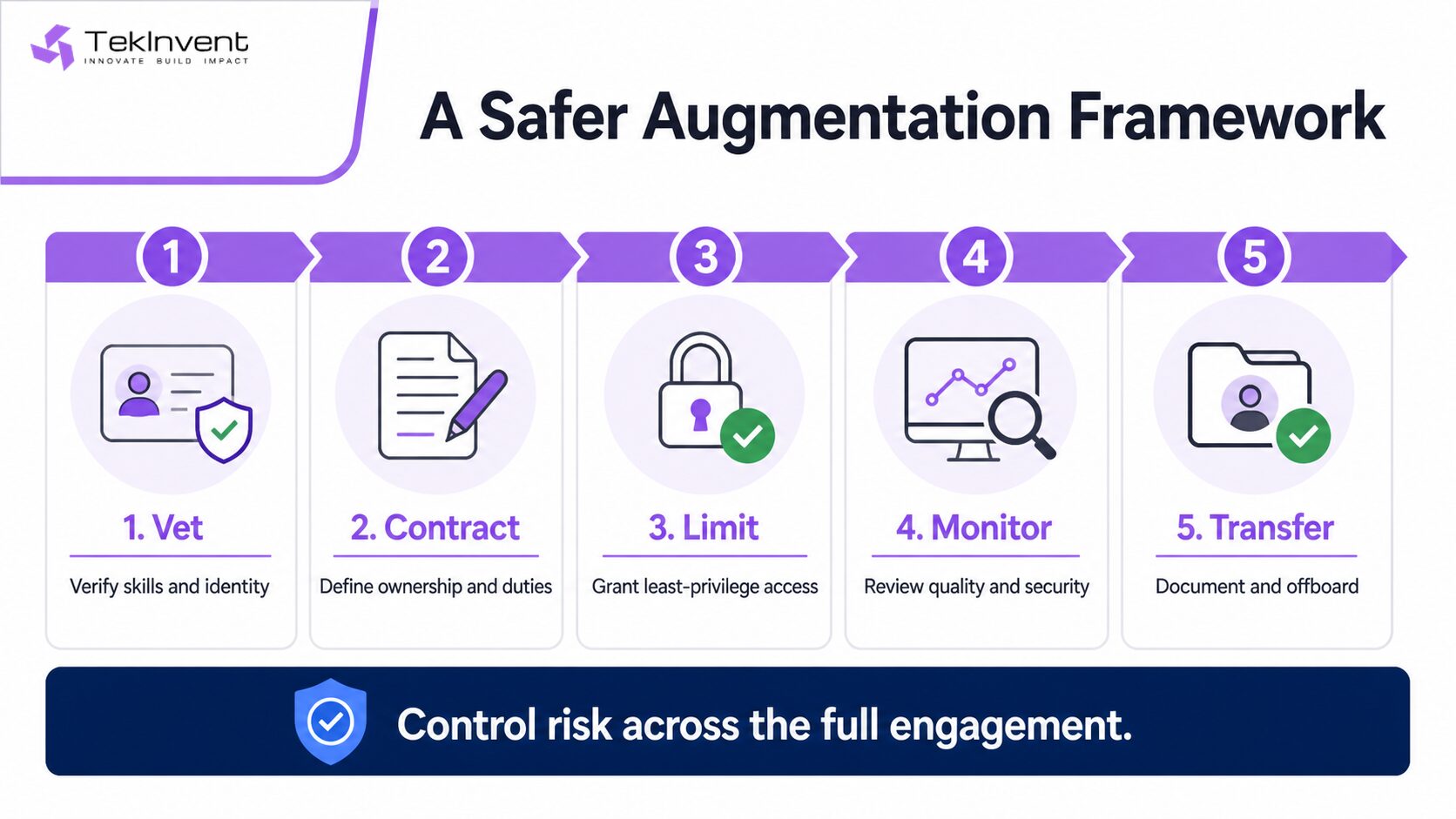
A Five-Layer Risk-Control Framework
A reliable staff augmentation program can be organized around five actions: vet, contract, limit, monitor, and transfer.
Vet means confirming identity, employment history, technical skill, communication ability, availability, and relevant industry experience.
Contract means defining responsibilities, pricing, intellectual property, confidentiality, security, replacement, subcontracting, and termination before work begins.
Limit means granting only the access required for each role. It also means controlling where data is stored and which devices and external tools may be used.
Monitor means reviewing technical quality, system access, performance, security compliance, invoicing, and provider commitments throughout the engagement.
Transfer means keeping documentation current, spreading knowledge across the team, and completing structured handover and offboarding.
These steps create a repeatable system. They are more dependable than assuming that a skilled developer or well-known provider will automatically manage every risk.
How to Evaluate Risk Before Selecting a Provider
Begin by classifying the proposed engagement based on its sensitivity.
A marketing website may represent relatively low risk if the developer has no access to customer records or production infrastructure. A healthcare, fintech, or enterprise platform may represent much higher risk because professionals could access regulated data or critical systems.
Ask the provider to explain its screening, employment structure, security practices, device requirements, subcontractor policy, incident procedure, replacement process, and knowledge-transfer approach.
The Cybersecurity and Infrastructure Security Agency released a software acquisition resource in 2025 to help procurement and IT decision-makers evaluate supplier risk. Its approach reinforces a useful principle: supplier security should be assessed during procurement and monitored across the relationship. CISA software supplier-risk resource
The provider’s answers should be specific enough to verify. Statements such as “we follow industry best practices” are not a substitute for documented controls.
Questions to Ask Before Signing
Use these questions during provider evaluation:
- Who employs or contracts with each proposed professional?
- Can we interview and approve every candidate?
- How are technical skills and identity verified?
- Will subcontractors or affiliated companies be involved?
- Where will professionals work and access our systems?
- What devices, networks, and authentication methods will they use?
- How quickly must a security incident be reported?
- Who owns the source code and related work?
- What happens if a developer leaves or underperforms?
- How are hours recorded and approved?
- What costs are excluded from the quoted rate?
- How will knowledge be documented and transferred?
- How can we reduce or end the engagement?
- What happens to our data after termination?
The answers should be reflected in the final contract where appropriate.
How TekInvent Can Support Your Team
TekInvent’s IT staff augmentation services help businesses add technical professionals according to their required skills, schedule, and engagement goals.
A productive discussion should begin with the roles you need, the technologies involved, the expected duration, required working-hour overlap, systems the professionals may access, and your preferred start date.
Contact TekInvent to discuss your staffing requirements and evaluate an appropriate team structure.
Final Thoughts
The most serious IT staff augmentation risks are rarely caused by geography or the engagement model alone. They usually result from weak screening, excessive access, unclear contracts, poor internal management, incomplete documentation, and ineffective offboarding.
US companies can reduce these risks by treating staff augmentation as a governed relationship. Verify the professionals, define responsibilities in writing, restrict access, monitor performance, protect intellectual property, and maintain knowledge throughout the engagement.
The current cybersecurity environment makes supplier oversight particularly important. Verizon’s 2026 research shows increased third-party involvement in breaches, while US government guidance emphasizes vendor assessment, written security requirements, and ongoing verification.
Staff augmentation can still provide substantial value. The companies most likely to realize that value are those that combine flexible access to talent with disciplined technical, legal, operational, and security controls.

Build Smart with The Right Team.
We bring expertise, technology, and trust you look for in your digital journey.