
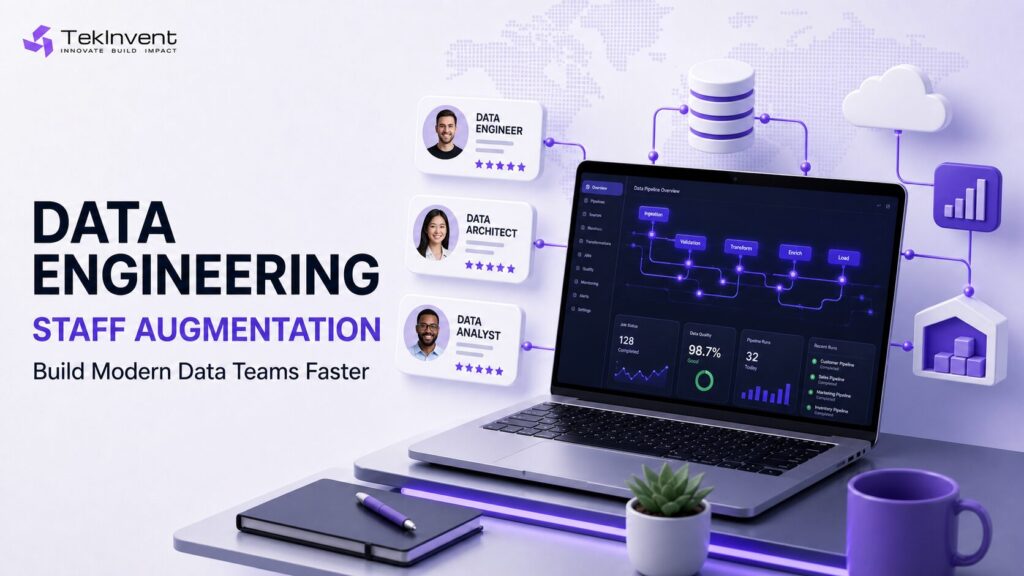
AI, analytics and automation depend on data that is accurate, accessible and governed. Yet many companies discover that their data infrastructure cannot support the business outcomes they expect. Pipelines fail, definitions conflict, reporting remains manual and engineers spend too much time repairing fragile integrations.
Data engineering staff augmentation helps a company add specialized professionals to its existing team without waiting through a lengthy permanent recruitment cycle. The client retains control of architecture, priorities and delivery while augmented engineers provide the skills or capacity needed to move a data initiative forward.
The model can support a cloud migration, warehouse modernization, AI-readiness program or temporary delivery gap. Its value comes from selecting the correct role, setting measurable outcomes and ensuring that knowledge remains with the client.
Why Data Engineering Talent Matters Now
Data engineering is no longer only a reporting function. Modern businesses depend on it to power real-time operations, personalization, machine learning, financial analysis and customer experiences.
The World Economic Forum lists big data specialists among the fastest-growing roles through 2030. Its research also places AI and big data among the skills expected to grow most rapidly. These projections show why companies are competing for professionals capable of building and maintaining modern data environments. World Economic Forum
In the United States, the Bureau of Labor Statistics projects data scientist employment to grow 34% from 2024 to 2034 and expects about 23,400 openings each year. Although data science and data engineering are different disciplines, this projection illustrates the growing demand for professionals who can turn expanding data volumes into reliable business value. US Bureau of Labor Statistics
The pressure is intensified by AI adoption. A model cannot compensate for missing lineage, inconsistent customer identifiers, late-arriving events or weak access controls. Before investing heavily in AI, companies need a data foundation that can deliver trustworthy information repeatedly.
What Is Data Engineering Staff Augmentation?
Data engineering staff augmentation is a flexible engagement in which external data specialists work as part of an organization’s internal team. They follow the client’s priorities and development processes while contributing to architecture, pipelines, platforms, governance and operations.
The engagement can involve one engineer filling a precise gap or several professionals supporting a transformation. A company might add a Snowflake engineer during a warehouse migration, a streaming specialist for real-time events or an analytics engineer to create dependable business models.
This differs from outsourcing a complete data platform. With augmentation, the client normally continues to manage the roadmap and approve technical decisions. That makes the model suitable for companies that have internal ownership but insufficient capacity or specialist knowledge.
When Should a Company Add Augmented Data Engineers?
The strongest signal is a valuable initiative blocked by a specific capability gap. The company may have analysts and software developers but no one with experience designing production-scale data pipelines. A cloud migration may be stalled because the team lacks platform expertise. An AI project may be consuming engineering time cleaning data manually.
Other warning signs include recurring pipeline failures, long report delays, inconsistent metrics, uncontrolled cloud costs and a backlog of integrations that the internal team cannot address.
Augmentation may also be appropriate when a permanent employee leaves during a critical project or when a short-term modernization effort does not justify creating several long-term positions.
Companies should not use augmentation to avoid ownership. An internal leader must remain accountable for business definitions, architecture decisions, data access and long-term operation.
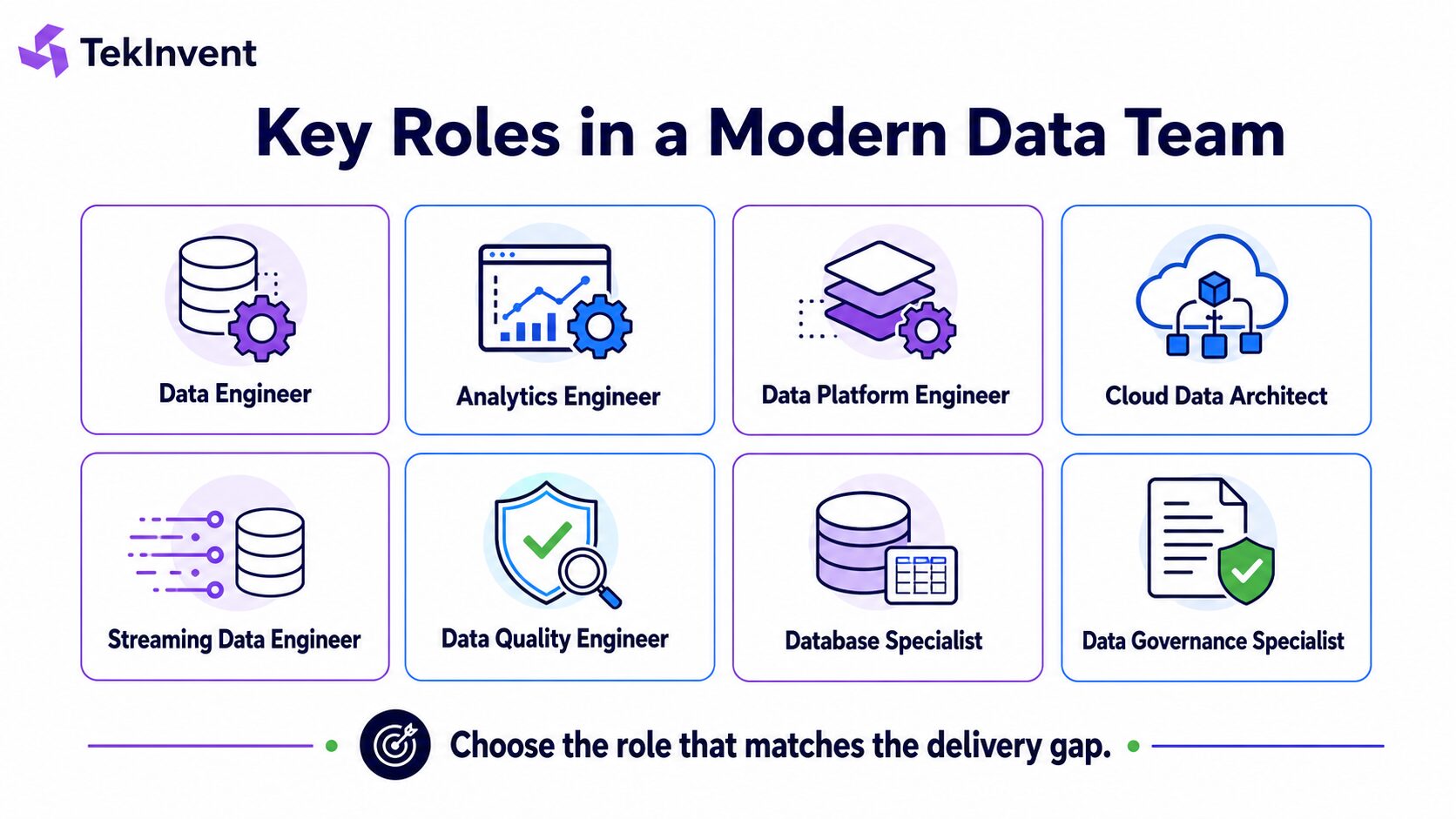
Data Roles That Can Be Augmented
“Data engineer” can describe very different work. Defining the required contribution prevents a company from hiring a strong candidate whose experience does not match the environment.
| Role | Main responsibility | Best used for |
|---|---|---|
| Data engineer | Builds and maintains data-ingestion and transformation pipelines | Integrations, warehouses and dependable data delivery |
| Analytics engineer | Converts raw data into tested, business-ready models | Consistent reporting and self-service analytics |
| Data platform engineer | Builds reusable infrastructure and developer tooling | Scaling data operations across multiple teams |
| Cloud data architect | Designs platform structure, security and integration patterns | Migration or modernization on AWS, Azure or Google Cloud |
| Streaming data engineer | Develops low-latency event pipelines | Fraud detection, telemetry and real-time experiences |
| Data quality engineer | Automates validation, observability and issue response | Reducing unreliable reports and pipeline failures |
| Database specialist | Improves database design, performance and resilience | Transaction systems, migrations and performance bottlenecks |
| Data governance specialist | Establishes ownership, classification, lineage and controls | Privacy, compliance and enterprise data consistency |
A modern initiative may need more than one role. A warehouse migration could require an architect for the target design, engineers for pipeline conversion and an analytics engineer to preserve trusted reporting definitions.
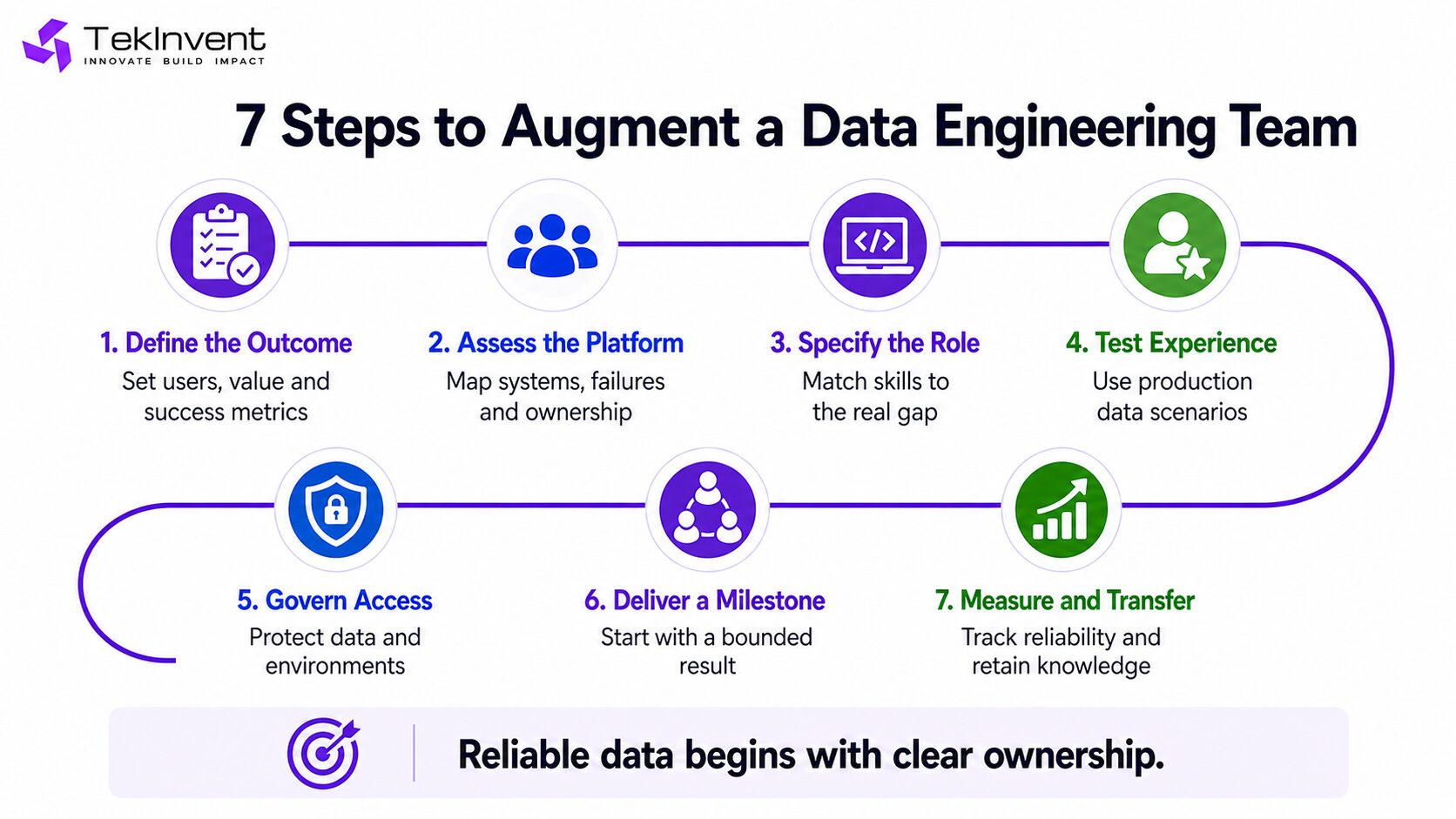
A Practical Data-Team Augmentation Process
1. Define the Business Outcome
Start with what the data must enable. “Move to the cloud” is an activity. “Reduce the time required to produce a reliable daily revenue view from eight hours to one hour” is a measurable outcome.
Document current performance, target performance, users, deadlines and constraints. Include requirements for data freshness, availability, privacy and acceptable operating cost.
These details give potential engineers a clear understanding of what they are expected to improve. They also give the company a meaningful way to evaluate performance after the engagement begins.
2. Assess the Current Platform and Team
Map data sources, pipelines, storage systems, transformations, consumers and ownership. Identify where failures occur and which responsibilities are already covered internally.
This assessment helps isolate the real skill gap. A reporting delay might be caused by ingestion architecture, inefficient warehouse models or unclear business definitions. Each problem requires a different specialist.
Organizations dealing with broader capability shortages can use technical staff augmentation to determine whether the need is specialized expertise, additional delivery capacity or a combination of both.
3. Write a Role-Specific Brief
Describe the first outcomes expected from the engineer rather than producing a long inventory of technologies. List the required cloud platform, data scale, orchestration approach, languages and security context.
Separate essential production experience from skills that can be learned during onboarding. Requiring experience with every available data technology may reduce the candidate pool without improving project fit.
For example, a company moving from an on-premises warehouse to Snowflake may need someone who has managed production migrations, designed incremental data loads and controlled warehouse costs. A general request for a “senior data engineer” would not communicate these priorities effectively.
4. Evaluate Production Experience
Use an architecture or troubleshooting scenario based on the actual environment. Ask candidates how they would make a pipeline idempotent, handle schema changes, monitor data freshness or recover from partial failures.
Strong candidates should explain tradeoffs. They should understand that the most fashionable architecture is not always the most maintainable or cost-effective choice.
Review examples of documentation, testing and collaboration. Data engineers work across application, analytics, security and business teams, so communication is part of the technical role.
A candidate should also be able to explain previous work in practical language. If business stakeholders cannot understand the reason behind an architectural choice, approving and maintaining that architecture becomes difficult.
5. Establish Governance and Access
Data access should follow the principle of least privilege. Define approved environments, sensitive fields, masking requirements, retention rules and production-change procedures before onboarding.
NIST describes data governance as a starting point for organizations seeking value from data while managing privacy risk. Its ongoing Data Governance and Management Profile work is designed to help organizations use multiple NIST frameworks together. NIST Data Governance and Management Profile
An augmented engineer should know who owns each important dataset, how access is approved and where architectural decisions are recorded.
Access should also be reviewed throughout the engagement. Permissions granted for an early migration task may no longer be required after that work has been completed.
6. Start With a Bounded Delivery Milestone
Choose an initial result that exposes real working conditions without risking the entire platform. Examples include migrating one pipeline, creating one governed domain model or introducing observability for a critical data product.
The first milestone provides evidence about technical fit, communication and delivery speed. It also helps the client improve estimates before expanding the engagement.
A bounded milestone is more useful than assigning a large backlog without clear priorities. It creates a specific result that both the company and the engineer can evaluate.
7. Measure, Document and Transfer Knowledge
Track data outcomes rather than output volume. Relevant measures include data freshness, pipeline success rate, incident frequency, recovery time, query performance, cloud cost and adoption of trusted datasets.
Documentation should cover architecture, lineage, data contracts, tests, alerts and operating procedures. Pairing augmented engineers with internal employees reduces dependency and makes knowledge transfer continuous.
Knowledge transfer should not be treated as a final-week activity. Internal team members should participate in reviews, troubleshooting and deployment throughout the engagement.
Technologies to Evaluate Without Creating a Tool Checklist
Technology experience matters, but the hiring process should focus on concepts and comparable production work. Common environments include AWS, Microsoft Azure, Google Cloud, Snowflake, Databricks, BigQuery, Redshift and modern lakehouse platforms.
Pipeline and transformation work may involve Python, SQL, Spark, dbt, Airflow, Kafka or cloud-native services. The exact combination is less important than whether the engineer understands reliability, testing, lineage, performance and cost.
Ask

Build Smart with The Right Team.
We bring expertise, technology, and trust you look for in your digital journey.