

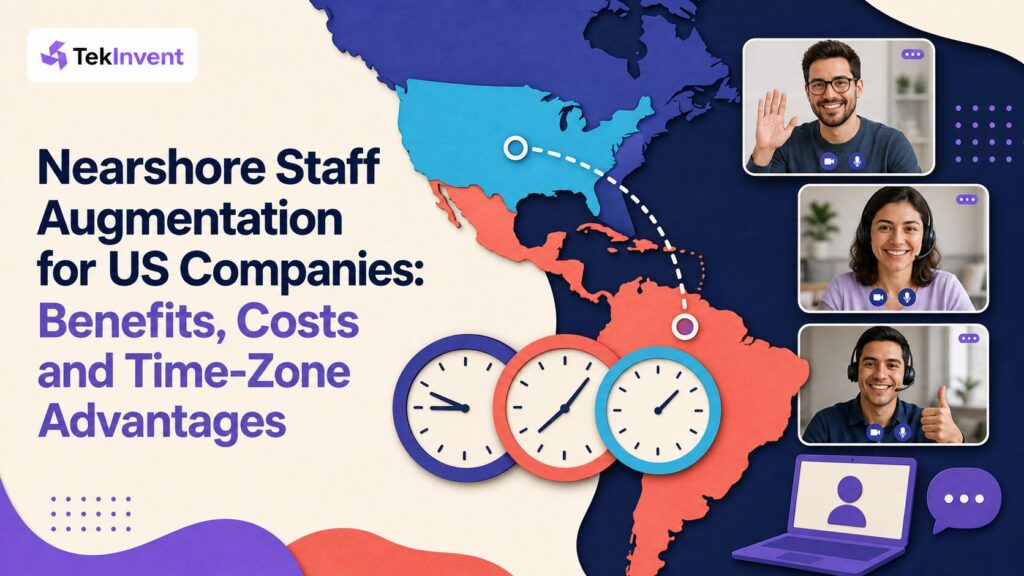
US software companies often need additional development capacity but cannot wait through a lengthy local hiring process.
Offshore talent can expand the available candidate pool, but a significant working-hours difference may slow conversations requiring immediate feedback. Nearshore staff augmentation provides another option by adding external professionals from nearby countries or regions, often with greater overlap during the US workday.
The client continues to manage the roadmap, architecture and day-to-day priorities. The staffing partner recruits or provides professionals who work as an extension of the client’s existing team.
For US companies, nearshore professionals are frequently sourced from Latin America. However, nearshore is a relative description rather than a fixed list of countries.
The model is not automatically cheaper, faster or safer. Its effectiveness depends on talent quality, communication, management, contracts, security and actual time-zone differences.
What Nearshore Staff Augmentation Changes
Nearshore augmentation changes where additional team members are located. It does not automatically transfer ownership of the product.
The client still needs a product owner or engineering leader who can set priorities, make decisions and review completed work.
This differs from project outsourcing, where a supplier may take responsibility for delivering a defined solution through its own management structure.
It also differs from a managed service, which is generally measured against an ongoing operational outcome.
The comparison between staff augmentation and outsourcing can help companies match the engagement model to the responsibility they want the provider to assume.
Nearshore augmentation can work well when an internal team has a clear roadmap but requires additional developers, designers, QA engineers, DevOps professionals or data specialists.
It can support a product launch, modernization initiative, temporary capability gap or backlog-reduction program.
However, it will not automatically fix unclear priorities, weak technical leadership or an approval process that prevents the team from releasing software.
Working-Hours Overlap Can Improve Collaboration
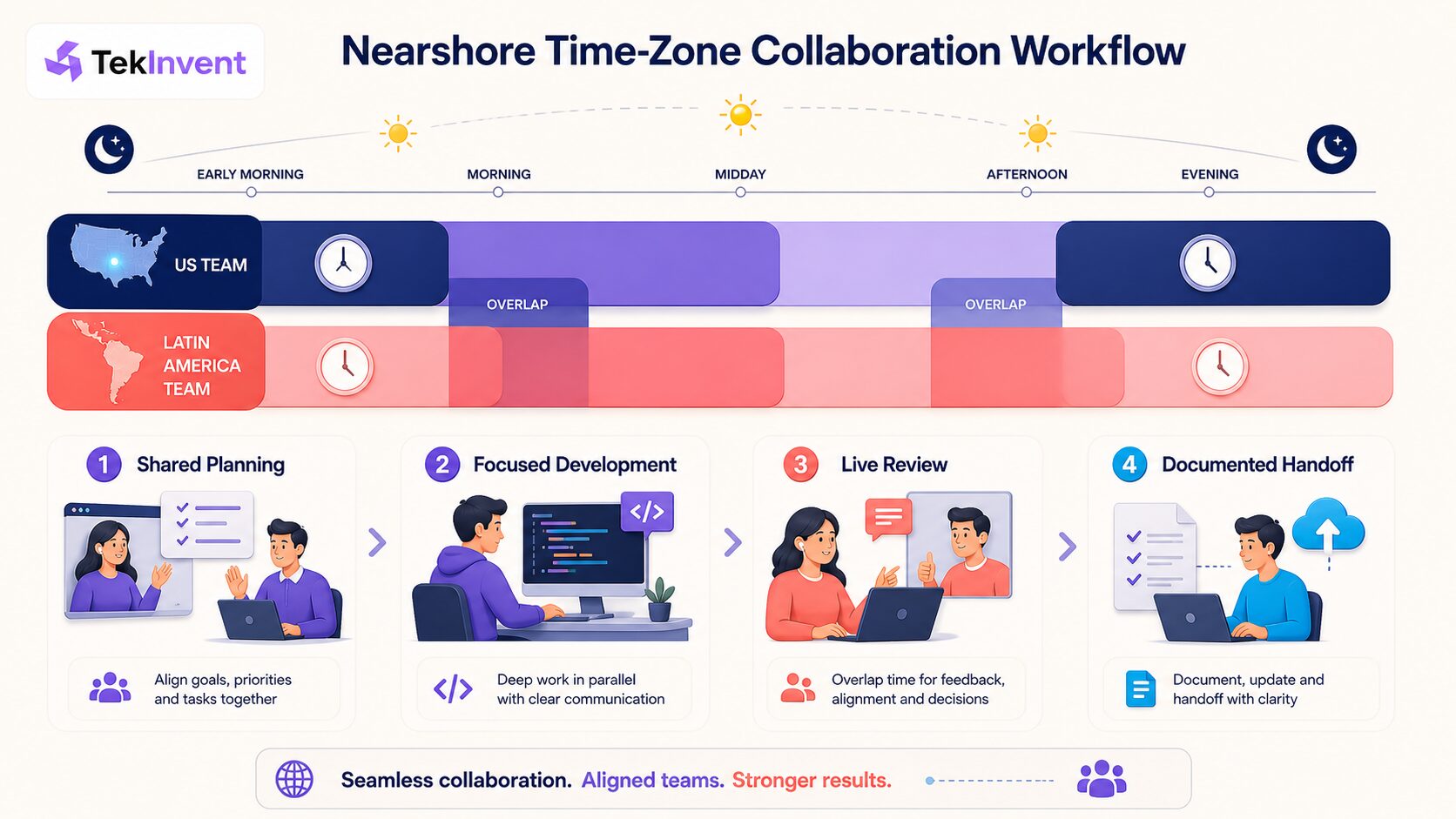
Time-zone alignment matters because software development includes frequent small decisions.
A developer may need clarification from product, design, security or another engineer before continuing. When working hours overlap, the question can be resolved during the same business day instead of waiting for an overnight handoff.
This can make sprint planning, pair programming, incident response and customer-feedback discussions easier.
An internal engineer can review a change while its author is still available. A product manager can demonstrate a workflow and answer questions immediately.
For teams that are still improving their documentation, synchronous access can also reduce the effect of unclear requirements.
However, companies should verify the overlap using the professional’s actual city, schedule and seasonal time changes.
Latin America includes several time zones, and daylight-saving practices vary by country and region. A staffing provider’s headquarters does not prove where the assigned professional will work.
Ask for each team member’s normal working hours relative to the client’s US time zone. Any essential overlap should be recorded in the agreement.
Full-day synchronization is not always necessary. A well-organized team can use several shared hours for important decisions and retain uninterrupted time for development.
Calculate Total Cost Instead of Comparing Rates
Nearshore staff augmentation is often presented as a cost-efficient alternative to local hiring. However, there is no universal percentage that every company will save.
Rates differ according to country, seniority, technical specialization, English proficiency, provider margin, engagement length and current market conditions.
A specialized security engineer may cost more than a general developer regardless of location.
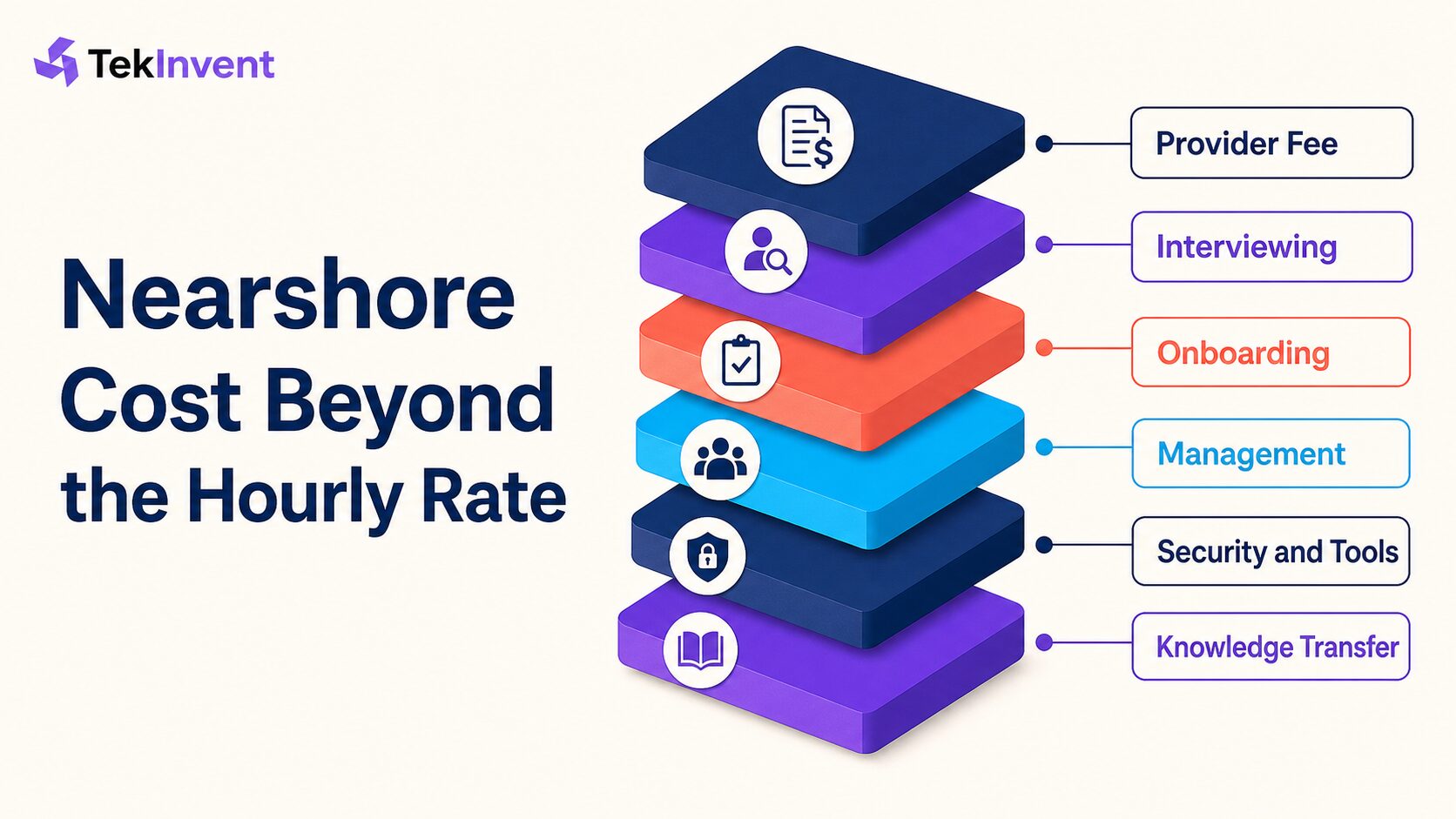
Begin with the provider’s fee, but include the company’s internal expenses. These may cover interviewing, onboarding, engineering management, equipment, software licenses, security controls and travel for in-person meetings.
Payment terms and currency arrangements can also affect the total cost.
Transition expenses are frequently overlooked. Internal engineers must document systems, review early contributions and transfer knowledge before the engagement ends.
A low hourly rate can become expensive when turnover is high, candidates do not match the role or internal developers repeatedly correct poor-quality work.
The business case should compare the total engagement cost with the result achieved. That result might include faster delivery, avoided vacancies, a smaller backlog or access to a specialized capability.
Our guide to IT staff augmentation costs provides a broader framework for evaluating an engagement beyond the advertised hourly rate.
Expand the Talent Pool Without Lowering Standards
Nearshore hiring expands the available talent market, but location is not a professional qualification.
Every candidate should be evaluated against the actual role. Define the technology stack, system environment, expected outcomes, seniority level, communication requirements and working-hours overlap before interviews begin.
Use structured interviews and realistic technical situations.
A senior engineer should be able to explain architectural decisions and trade-offs—not only complete a narrow coding exercise.
A QA professional should demonstrate risk-based testing skills. A DevOps candidate should understand access control, recovery and safe deployment practices in addition to knowing specific tools.
Communication should also be evaluated directly. Ask candidates to explain a previous technical decision, challenge an unclear requirement and write a short project update.
This reveals how they are likely to participate in a distributed team. Accent is not a measure of expertise; clarity, listening and the ability to identify uncertainty are what matter.
Identity verification, references and background screening should follow applicable laws and company policies. The client should understand which checks the provider performs and what evidence will be available.
Protect Systems and Information Across Borders
A distributed engagement makes identity, endpoint and information controls particularly important.
Every professional should receive an individual account, multifactor authentication and least-privilege permissions.
Development and testing should use synthetic or properly masked information whenever possible. Production access should be restricted, approved and logged.
The company should also decide which devices and networks are acceptable.
A client-managed laptop, provider-managed device or secured virtual desktop can each be appropriate when responsibilities are clear and the required controls are enforced.
Security requirements may include storage encryption, endpoint protection, timely software updates, screen locking and restrictions on local data storage.
Contracts should cover confidentiality, intellectual property, security obligations, subcontracting, approved work locations, incident reporting, information handling and termination.
If personal or regulated information may cross national borders, qualified professionals should review applicable privacy, contractual and industry requirements.
Using a nearshore provider does not remove cross-border data considerations.
Do Not Make Worker-Classification Assumptions
US organizations should not assume that hiring through a staffing provider automatically resolves every employment or worker-classification issue.
The legal analysis depends on the actual relationship and applicable jurisdictions.
In the United States, the Internal Revenue Service considers the degree of control and independence in the working relationship. The Department of Labor applies its own analysis under federal wage-and-hour law, while individual states may use different tests.
The agreement should accurately reflect the real working arrangement, but contractual labels alone do not determine a person’s legal status.
Companies should obtain appropriate legal and tax advice based on the provider’s role, location, working structure and engagement duration.
The same diligence applies in the professional’s home country. A credible provider should be able to explain how it employs or contracts professionals, handles payroll and uses subcontractors.
Buyers should request appropriate documentation rather than relying on a generic statement of complete compliance.
Use Shared Hours Effectively
Working-hours overlap creates an opportunity for better collaboration, but the team still needs clear operating rules.
Define where decisions are documented, how blockers are reported, when meetings occur and who approves completed work.
Important decisions should remain in accessible project documentation instead of private messages.
A short daily coordination period can be useful during onboarding. Once professionals understand the system, unnecessary meetings can be reduced in favor of written updates and focused technical sessions.
The objective is not to fill all overlapping hours with calls. It is to ensure that decision-makers are available when real-time discussion provides value.
Each augmented professional should have an internal owner responsible for priorities and feedback.
Initial assignments should be limited enough to reveal code quality, communication and delivery habits without exposing an entire critical system.
Pairing with an internal engineer can accelerate system knowledge and make knowledge transfer part of normal delivery.
Companies can track time to the first approved contribution, development cycle time, review rework, escaped defects, delivery predictability and team retention.
These indicators are more useful than raw activity counts.
If progress is slow, evaluate onboarding, requirement quality and decision delays before assuming the external professional is the only problem.
Evaluate the Nearshore Provider Carefully
Ask the provider to explain how it recruits candidates, verifies seniority and responds when an assigned professional is not suitable.
Review representative profiles and interview the people who would actually join the company’s team. Confirm their location and working schedule instead of relying on a general provider presentation.
Discuss endpoint security, data access, confidentiality, turnover and business continuity.
Ask whether the provider uses subcontractors and how security and confidentiality obligations apply to them.
Reference discussions should cover responsiveness, candidate accuracy and how the provider handled previous challenges—not simply whether a client was satisfied.
Pricing should clearly explain what is included. Understand minimum engagement periods, notice requirements, overtime, holidays, replacement provisions, currencies and possible rate increases.
TekInvent provides IT staff augmentation services for companies that want additional specialists while maintaining control over product delivery.
Before choosing the model, businesses can also review how to know when you need IT staff augmentation to determine whether the underlying challenge is genuinely a capacity or capability gap.
Begin With a Pilot Engagement
Begin with a clearly defined workstream, measurable success criteria and a small number of professionals.
Complete security onboarding, provide the necessary documentation and establish code-review and deployment requirements.
The appropriate evaluation period depends on the complexity of the system and the work assigned.
Review both results and operating quality. Determine whether delivery improved, questions were raised early, internal engineers trusted the work and security requirements were followed.
Use the findings to strengthen onboarding or adjust the role before expanding the team.
Knowledge transfer should begin at the start of the engagement. Architecture decisions, runbooks and component documentation should remain accessible to the client.
Avoid creating a critical part of the product that only one external professional understands.
Make a Balanced Nearshore Decision
Nearshore staff augmentation can give US companies access to a broader talent pool, meaningful working-hours overlap and a flexible alternative to permanent hiring.
Those advantages can be valuable, but geography alone does not guarantee them.
Successful engagements define the capability gap, evaluate the complete cost, verify actual working hours, protect system access and establish clear ownership.
Nearshore professionals should operate as accountable members of the same engineering system while the client preserves documentation and decision-making authority.
When these foundations are present, proximity can become a genuine delivery advantage instead of merely a marketing label.

Build Smart with The Right Team.
We bring expertise, technology, and trust you look for in your digital journey.