
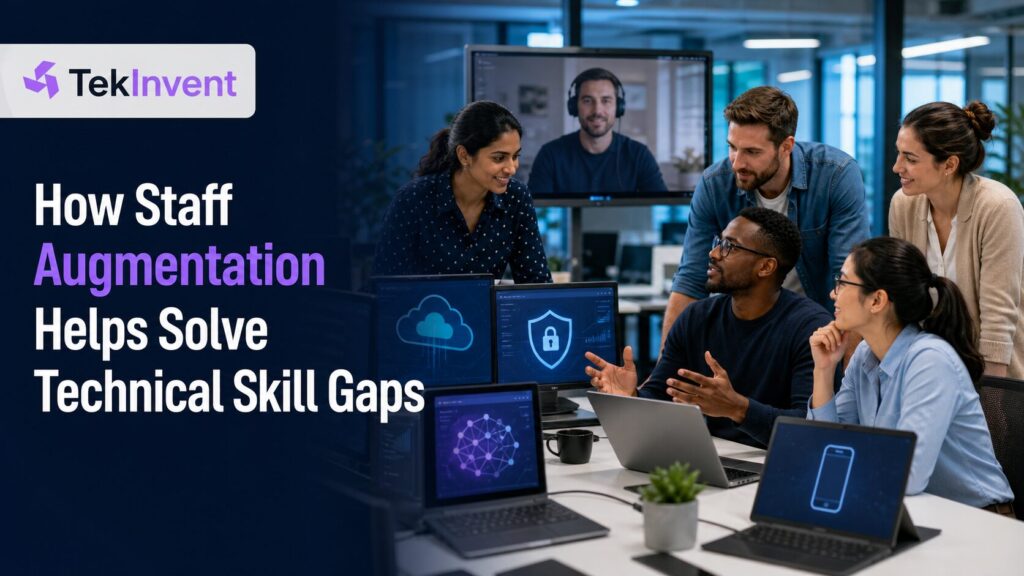
Technology evolves faster than many companies can recruit and develop talent. A development team may be experienced in its current systems but lack the cloud, artificial intelligence, cybersecurity, mobile, or data-engineering expertise required for its next project.
These technical skill gaps can delay releases, increase pressure on existing employees, and cause businesses to postpone valuable initiatives. Permanent recruitment is one possible solution, but it is not always fast or practical—especially when the missing expertise is needed for a limited project or development phase.
Staff augmentation gives companies another option. It enables an organization to add qualified external professionals to its existing team while retaining control over priorities, development processes, and technical decisions. When applied to a clearly defined capability shortage, the model can close an immediate gap without forcing the company to create a permanent position for every specialist requirement.
What Is a Technical Skill Gap?
A technical skill gap is the difference between the capabilities a company needs and the capabilities currently available within its workforce. It can exist at the individual, team, or organizational level.
For example, a software team may be capable of maintaining an existing web platform but lack the expertise to migrate it to a modern cloud environment. A mobile development team may understand application architecture but have limited experience implementing secure payment systems. Another company may have strong developers but no specialist who can establish automated testing or DevSecOps practices.
A genuine gap is more specific than simply being short-staffed. It identifies a capability that is either missing or not available at the required level.
This distinction matters because different problems require different solutions. General capacity shortages may be addressed by adding more developers with familiar skills. A specialized deficit requires professionals with relevant technical experience, domain understanding, and the ability to apply that knowledge in the company’s existing environment.
Why Technology Skills Shortages Are Difficult to Resolve
Modern software products depend on increasingly specialized capabilities. Cloud architecture, machine learning, cybersecurity, data engineering, mobile development, accessibility, and automated testing each require distinct knowledge. One developer cannot be expected to provide expert-level performance across every discipline.
Demand also continues to evolve. The US Bureau of Labor Statistics projects employment for software developers, quality assurance analysts, and testers to grow by 15% between 2024 and 2034. It estimates approximately 129,200 openings across these occupations annually during that period. US Bureau of Labor Statistics occupational outlook
Even when candidates are available, recruiting an appropriate specialist involves more than finding someone with a matching job title. The company must evaluate practical experience, technical depth, communication ability, industry knowledge, and compatibility with its tools and processes.
Training existing employees is essential for long-term workforce development, but it cannot solve every immediate problem. Becoming proficient in a complex discipline takes time and hands-on experience. A short course cannot instantly prepare a generalist to lead a security assessment, design a resilient cloud architecture, or introduce machine-learning functionality into a production system.
The business must therefore decide whether to recruit, train, redesign the project, or obtain external expertise.
How Staff Augmentation Addresses Missing Expertise
It provides access to specialized professionals
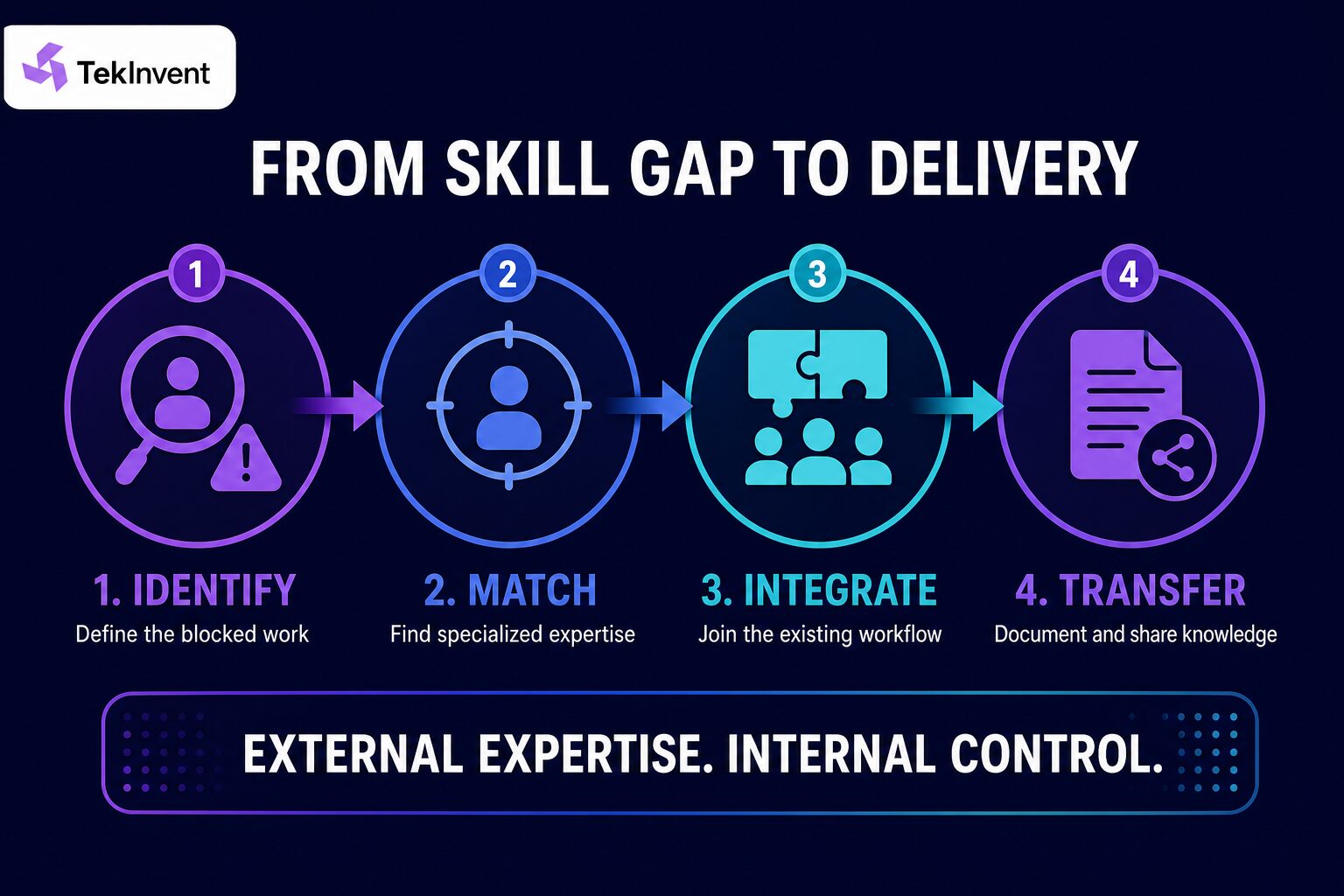
The most direct benefit is access to professionals whose capabilities match a defined technical need. Instead of advertising a broad role and waiting for applicants, a company can work with a provider to identify people who have relevant experience in a particular technology, platform, or development discipline.
A business might augment its team with a cloud engineer for a migration, a QA automation specialist before a major release, or a mobile developer for a new customer application. These professionals join for the period in which their expertise creates value.
Companies considering this approach can use IT staff augmentation services to add technical professionals according to their project requirements and internal delivery structure.
Access alone does not guarantee success. The organization still needs to verify each candidate’s abilities and confirm that the person’s experience is relevant to the actual environment—not merely listed on a résumé.
It reduces the delay between identifying and addressing a gap
A skills shortage often becomes visible when a project is already underway. The team encounters an architectural challenge, a customer requests unfamiliar functionality, or a security requirement appears late in the delivery process.
Starting a permanent recruitment cycle at that point may not align with the project schedule. The business needs expertise while the requirement remains commercially relevant.
A staff augmentation provider may already have access to appropriate professionals or a focused sourcing network. This can reduce the time required to identify candidates because the company is not building the entire search process from the beginning.
However, realistic timelines still matter. Candidate evaluation, interviews, contractual review, security preparation, and onboarding should not be skipped in the pursuit of speed.
It allows the internal team to retain control
Staff augmentation is particularly useful when a company has product and technical leadership but lacks a particular execution capability. The external professional works within the client’s delivery process, while internal leaders continue to control the roadmap and key decisions.
This differs from transferring responsibility for an entire outcome to another company. Organizations uncertain about that distinction can review the differences between staff augmentation vs outsourcing.
Retaining control helps the business ensure that new work aligns with its architecture, coding standards, security policies, and product goals. It also encourages knowledge exchange between internal and external contributors.
That control comes with responsibility. Someone inside the organization must define priorities, review work, answer product questions, and resolve technical disagreements. External expertise cannot compensate for an absence of ownership.
It supports capability transfer instead of temporary task completion
A well-managed engagement should produce more than completed tickets. It should also improve the internal team’s ability to understand, maintain, and extend the work.
Knowledge transfer can happen through code reviews, pair programming, architecture discussions, technical documentation, and recorded decision logs. An external specialist might help establish a cloud deployment process while teaching internal developers how it works. A QA engineer might create an automation framework while showing the team how to add and maintain test cases.
This approach prevents the external professional from becoming the only person who understands a critical system. It also turns short-term access to expertise into a longer-lasting organizational benefit.
Knowledge transfer needs to be included in the scope from the beginning. If it is postponed until the final week, important context may be missed and documentation may be rushed.
Which Technical Skill Gaps Can Be Addressed?
The appropriate roles depend on the company’s products, architecture, industry, and development stage. Common requirements include cloud infrastructure, cybersecurity, data engineering, artificial intelligence, mobile development, UI/UX design, DevOps, test automation, and legacy-system modernization.
Cybersecurity provides a useful example of why precise capability definitions matter. The NIST NICE Framework offers a common language for describing cybersecurity work and the knowledge and skills required to perform it. Organizations can use frameworks like this to define the actual tasks and competencies they need instead of relying on vague job titles. NIST NICE Framework Resource Center
The same principle should be applied to other disciplines. Rather than requesting “an AI developer,” a company should explain whether it needs data preparation, model integration, retrieval-augmented generation, evaluation, infrastructure, or application development. A precise requirement produces a better candidate match.
How to Identify the Real Gap Before Adding Talent
Companies sometimes assume they need more developers when the actual bottleneck is unclear requirements, weak architecture, limited product ownership, or an inefficient review process. Adding people to a poorly defined system can create more communication overhead without increasing delivery speed.
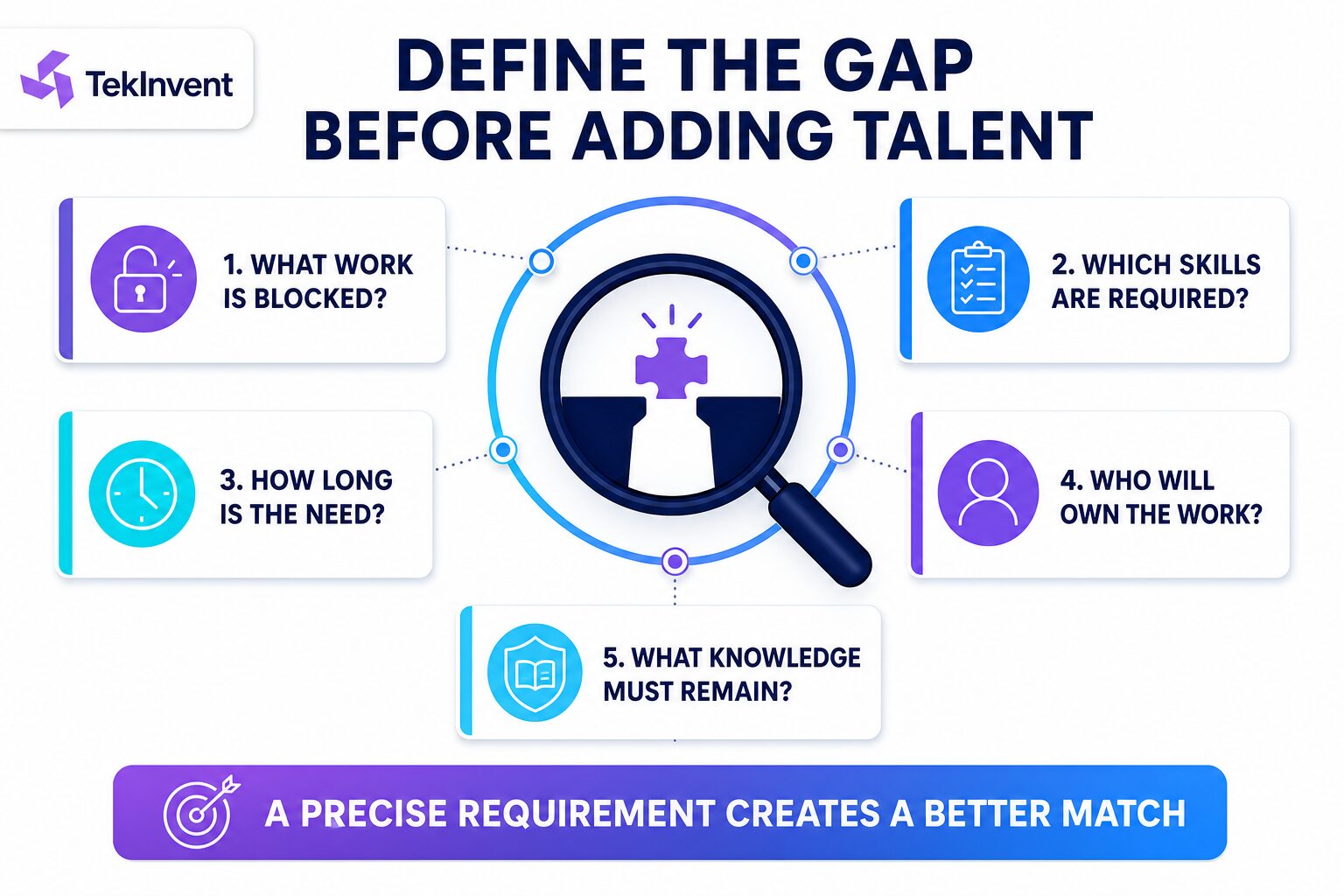
Before sourcing anyone, the company should determine what outcome is blocked, which tasks cannot currently be completed, what expertise those tasks require, and how long the capability will be needed.
A practical assessment should answer five questions:
- What specific work cannot be completed by the current team?
- Which technologies and experience are required?
- Is the need temporary, recurring, or permanent?
- Who will manage and review the external professional?
- What knowledge must remain after the engagement ends?
If the warning signs are still unclear, this guide explains how to know when you need IT staff augmentation.
This assessment may reveal that training, process improvement, consulting, managed delivery, or permanent hiring is more appropriate. Augmentation should be selected because it matches the operating need—not simply because it appears faster.
How to Evaluate Professionals for a Skill Gap
A candidate should be evaluated against the work that must be performed. Years of experience can provide useful context, but they do not prove proficiency in a particular environment.
Ask candidates to explain comparable technical problems they have solved, the decisions they made, the tradeoffs involved, and how they verified the result. Where appropriate, use a focused technical exercise that resembles the role without requiring unpaid production work.
Evaluation should also cover communication. An external specialist must be able to explain decisions, document work, receive feedback, and collaborate with people who may not share the same expertise.
For highly specialized or regulated work, verify relevant credentials, industry experience, security awareness, and familiarity with applicable requirements. Do not accept unverifiable claims merely because a project is urgent.
Integrating External Expertise Into the Existing Team
Even a capable specialist can struggle without sufficient access and context. Effective onboarding should explain the product’s purpose, customer needs, architecture, development workflow, coding standards, security requirements, and decision-making structure.
Assign an internal owner who can answer questions and remove blockers. The external professional should participate in the meetings relevant to their work, but they do not need to attend every company discussion.
Access should follow the principle of least privilege. Provide the systems and data needed for the role, monitor access appropriately, and remove permissions when the engagement ends. Contracts should address confidentiality, intellectual-property ownership, data handling, subcontracting, and offboarding.
Performance should be measured through defined outcomes. Depending on the role, these might include a completed migration phase, reduced deployment failures, improved test coverage, resolved security findings, or delivery of a specified product feature. Avoid measuring contribution only through hours or ticket volume.
Staff Augmentation Should Complement Upskilling
External expertise solves an immediate problem, while internal development builds long-term capability. Strong workforce planning often uses both.
An augmented specialist can help the company meet a deadline and simultaneously mentor internal employees. The organization can then decide whether the capability should remain external, be transferred completely to its team, or become a permanent internal role.
If the same requirement continues across multiple projects, repeated short engagements may become less efficient than hiring or developing someone internally. The company should review the arrangement periodically instead of allowing a temporary solution to continue indefinitely.
Before choosing the model, decision-makers should understand the broader staff augmentation benefits, use cases, and limitations. Flexibility and access to expertise are valuable, but they must be weighed against management requirements, knowledge-retention risks, and long-term costs.
When Another Engagement Model May Be Better
Staff augmentation is not the right answer when the organization cannot manage the work directly. If a company needs a provider to accept responsibility for operating a technical function and meeting service levels, managed services may be more appropriate.
Consulting may be a better fit when leadership needs strategic analysis, architecture guidance, or a transformation roadmap rather than additional delivery capacity. A dedicated team can make more sense when the company needs a stable, cross-functional external unit for a longer initiative.
Permanent recruitment remains valuable when the missing capability supports a core competitive advantage, requires continuous institutional knowledge, or will be needed at a consistent level for years.
The decision should be based on ownership, duration, scope, and expected outcomes—not terminology alone.
Measuring Whether the Skills Gap Has Closed
The goal is not merely to add another person. The business should be able to demonstrate that the capability shortage is no longer blocking important work.
Useful indicators include whether the delayed initiative is moving again, technical risks are declining, internal employees can maintain the delivered work, and the company is less dependent on a single specialist.
At the end of the engagement, review the original gap assessment. Confirm which objectives were completed, which knowledge was transferred, what remains unresolved, and whether the capability should now be developed internally.
This final review helps the organization improve future workforce decisions. It may also reveal process or documentation weaknesses that made the initial gap more damaging than necessary.
Final Thoughts
Technical skill gaps are not solved simply by adding more people. They are solved by identifying the missing capability precisely and selecting an appropriate way to obtain it.
Staff augmentation can give a business timely access to specialized professionals while allowing its internal team to retain product control. It is particularly effective when the requirement is defined, an internal owner can manage the work, and the engagement includes deliberate knowledge transfer.
The model should support—not replace—long-term workforce development. Permanent hiring and employee training remain important for capabilities central to the company’s future. External specialists provide a flexible bridge when the required expertise is urgent, temporary, or difficult to source through the normal recruitment process.
Used with clear objectives, careful evaluation, secure onboarding, and measurable outcomes, staff augmentation can turn a technical capability shortage from a project blocker into a manageable workforce decision.

Build Smart with The Right Team.
We bring expertise, technology, and trust you look for in your digital journey.