
Are you trying to figure out how to finish a software project but don’t have the right people on your team? You are not alone in this. Every business owner or CTO faces this exact problem when they want to build something new. Should you hire more developers to sit with your current team? Or should you just give the whole job to another company that specializes in this work? It’s a really big decision. Getting it right will save you a lot of headaches down the road. It’s not just about the money, you see. It’s about who’s in charge, how the work gets done, and who owns the final product. Let’s talk about this, shall we?
Understanding the Difference: Staff Augmentation vs. Outsourcing
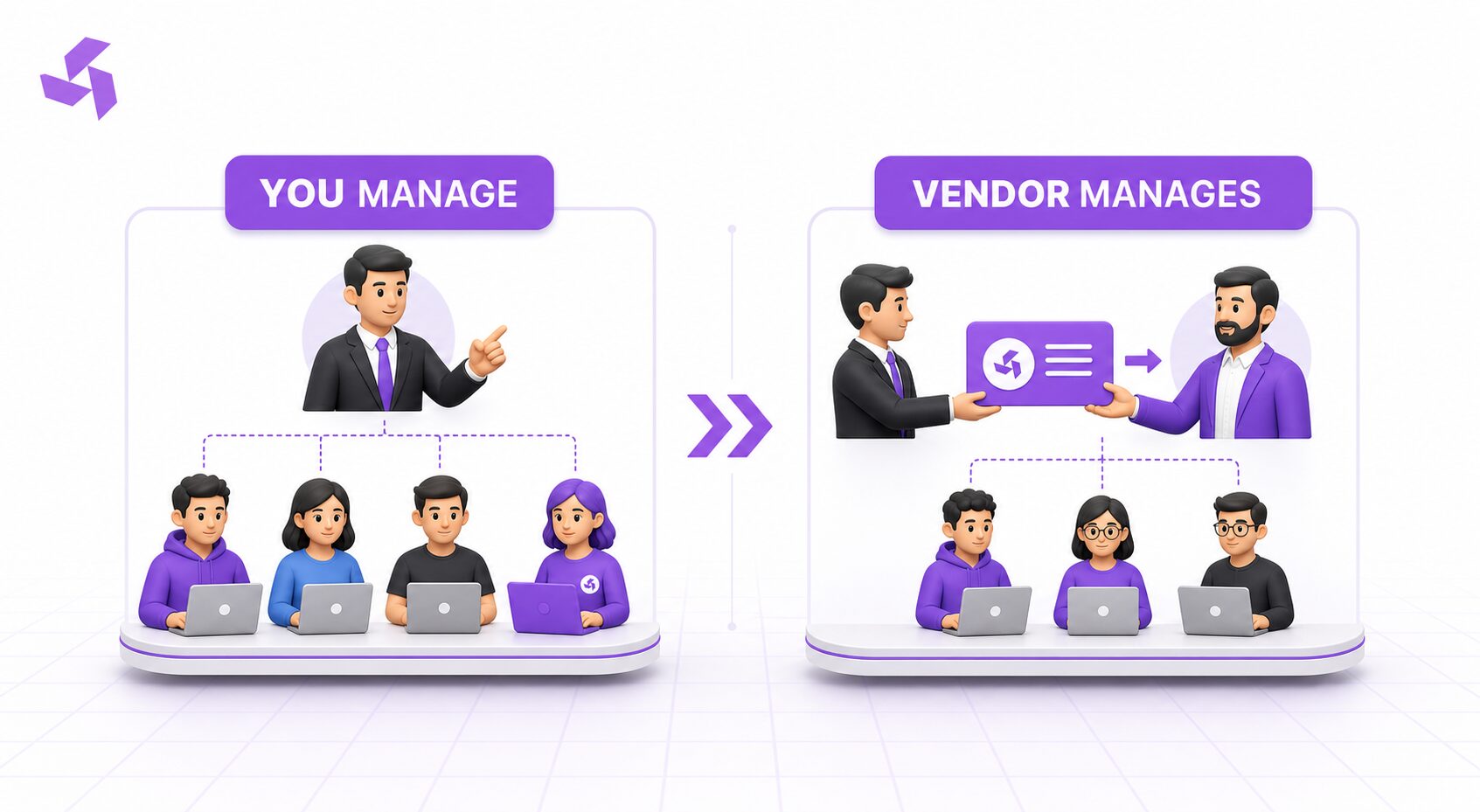
Let’s break it down simply. Both ways let you use people who don’t work for you full-time. That’s the main point. But how they do it is totally different. Staff augmentation is like adding skilled players to the team you already have. You need two Python developers for six months for a big push? You get them through a vendor, but they work right alongside your staff. They use your computers, your chat tools like Slack, and they come to your daily meetings. You tell them what to do every single day. You stay in the driver’s seat. This is great for filling skill gaps quickly.
Outsourcing works differently. With outsourcing, you hand an entire project over to another company. For example, if you are learning how to start an ecommerce business, you might hire an external team to build your mobile app. The vendor uses its own project managers, developers, and processes to complete the work. Instead of managing individual developers, you review progress and approve key deliverables.
A dedicated team offers a middle ground. You get a stable team assigned to your project, while the vendor handles its management. This model is suitable when you need consistent resources without managing their daily activities yourself. Choosing between IT staff augmentation and outsourcing is an important decision for any business owner or CTO planning to scale software development.
The Case for Staff Augmentation: When You Need Immediate Talent
Why should you consider staff augmentation? It is one of the most effective ways for companies to address skill gaps, especially in software development, where deadlines are tight and specialized local talent can be difficult to find. For example, you may need immediate technical expertise from a mobile app development company in Austin. Traditional hiring can take weeks or months, while a staffing partner may provide a qualified, pre-vetted professional within days.
In the staff augmentation model, you hire developers through a vendor, but they work under your management, using your tools, processes, and infrastructure. You retain project control, set daily priorities, and own the intellectual property. This approach is ideal when you need to fill skill gaps quickly or scale your team for a specific sprint without losing visibility into how work gets done. It combines the flexibility of contract work with the control of an in-house team.
When to Choose Outsourcing: A Strategic Approach
Outsourcing, by contrast, follows a model where the vendor takes responsibility for delivering a defined outcome. Whether it’s project outsourcing, which could be a single software build, or IT outsourcing, which is the ongoing management of a function like customer support, the vendor assigns their own team, manages execution, and delivers results against milestones. You define requirements and review deliverables, but you do not manage the developers day-to-day.
This model works well when scope genuinely holds still. For a well-defined MVP with fixed features, project-based outsourcing can deliver predictability. It shifts execution responsibility to the vendor. If your team needs to focus on strategic initiatives instead of managing daily tasks, outsourcing non-core functions can free up valuable bandwidth. You might look to a specialized mobile app development company to deliver a complete product.
A Cost Analysis: Staff Augmentation vs. Software Outsourcing
The decision between staff augmentation vs software outsourcing has real implications for development costs, team scalability, and vendor management. Staff augmentation typically costs 20–40% less than outsourcing for comparable work because you’re paying for talent time without the vendor’s management overhead and SLA risk. For example, a mid-level software engineer via staff augmentation might run $120K–$180K annually, fully loaded in the US, while outsourcing the same function through a BPO or managed services provider can cost $30K–$90K per seat but with bundled management fees that push total project costs 30–50% higher.
It’s worth factoring in reduced recruitment time and no long-term benefits obligations with augmentation. When you look at the total cost of ownership for short-term needs, augmentation often comes out ahead.
Project Control, Communication, and Flexibility
With staff augmentation, communication is more immediate because augmented staff work within your Slack, Jira, and sprint cycles. Augmented staff integrate more seamlessly when your team relies on tight collaboration, pair programming, or frequent standups. You maintain project ownership and can pivot quickly if requirements change. If requirements are likely to change by more than 25%, staff augmentation usually wins.
Outsourcing requires established communication mechanisms and milestone reviews. While this can work well for stable scopes, change orders often add 20–40% to the original quote, and rework can add another 5–15%. Staff augmentation offers high flexibility—you can scale headcount up or down quickly as project needs shift. Outsourcing contracts tend to be longer-term and less agile; scaling up may require contract revisions or additional costs.
Risk, Knowledge Retention, and Project Ownership
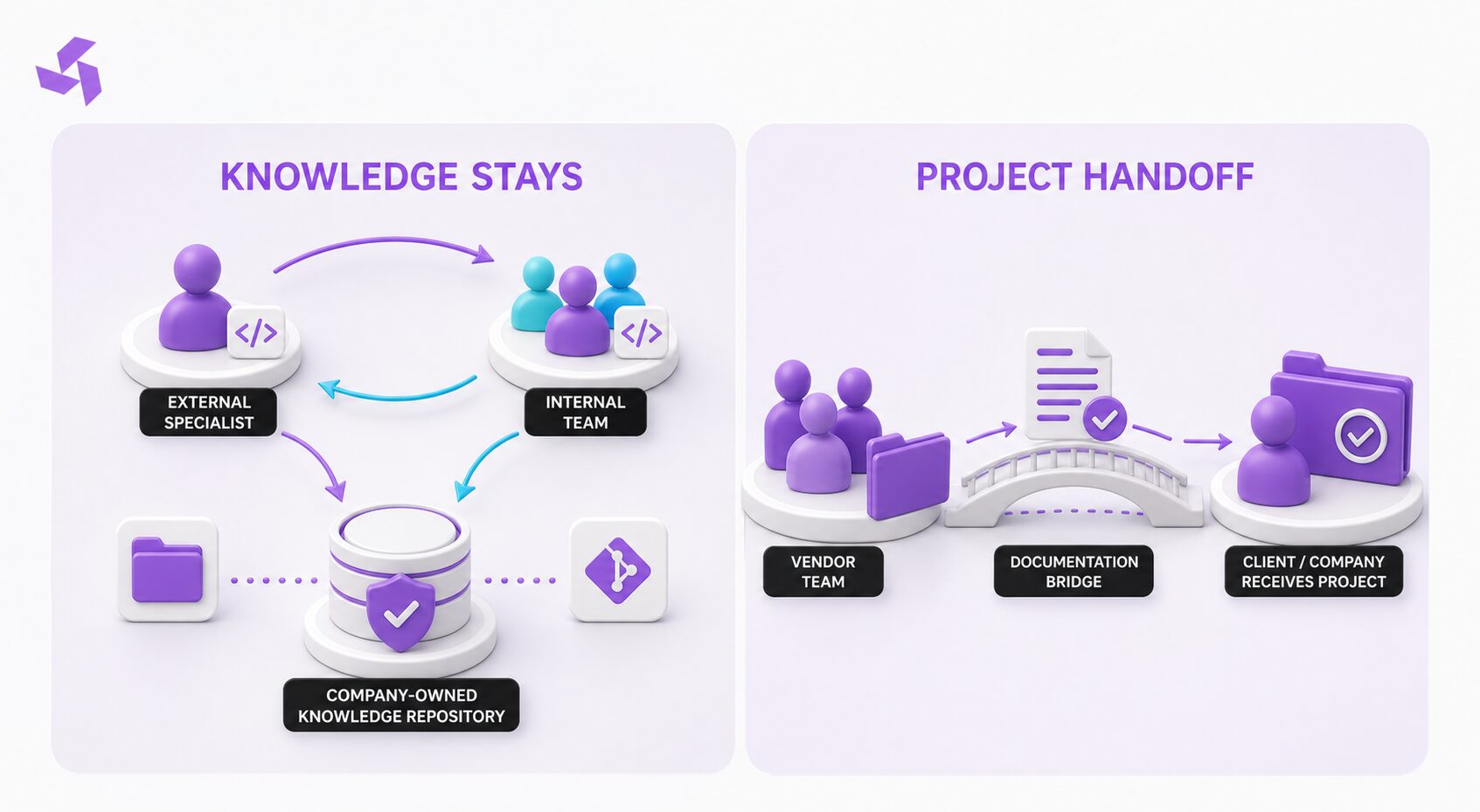
Staff augmentation helps keep institutional knowledge within your company. Because external professionals work directly with your team, their knowledge and expertise can be transferred to your permanent employees. This is particularly valuable when the work is central to your long-term product roadmap.
Outsourcing transfers much of the delivery responsibility to the vendor, but it can also lead to knowledge gaps after the project ends. Even minor updates may require assistance from the original vendor. This can become challenging when you need continued support from an iOS app development company.
Regardless of which model you choose, make sure the vendor follows your security protocols and compliance requirements. Staff augmentation provides more direct oversight, while outsourcing relies more heavily on the vendor’s internal security standards.
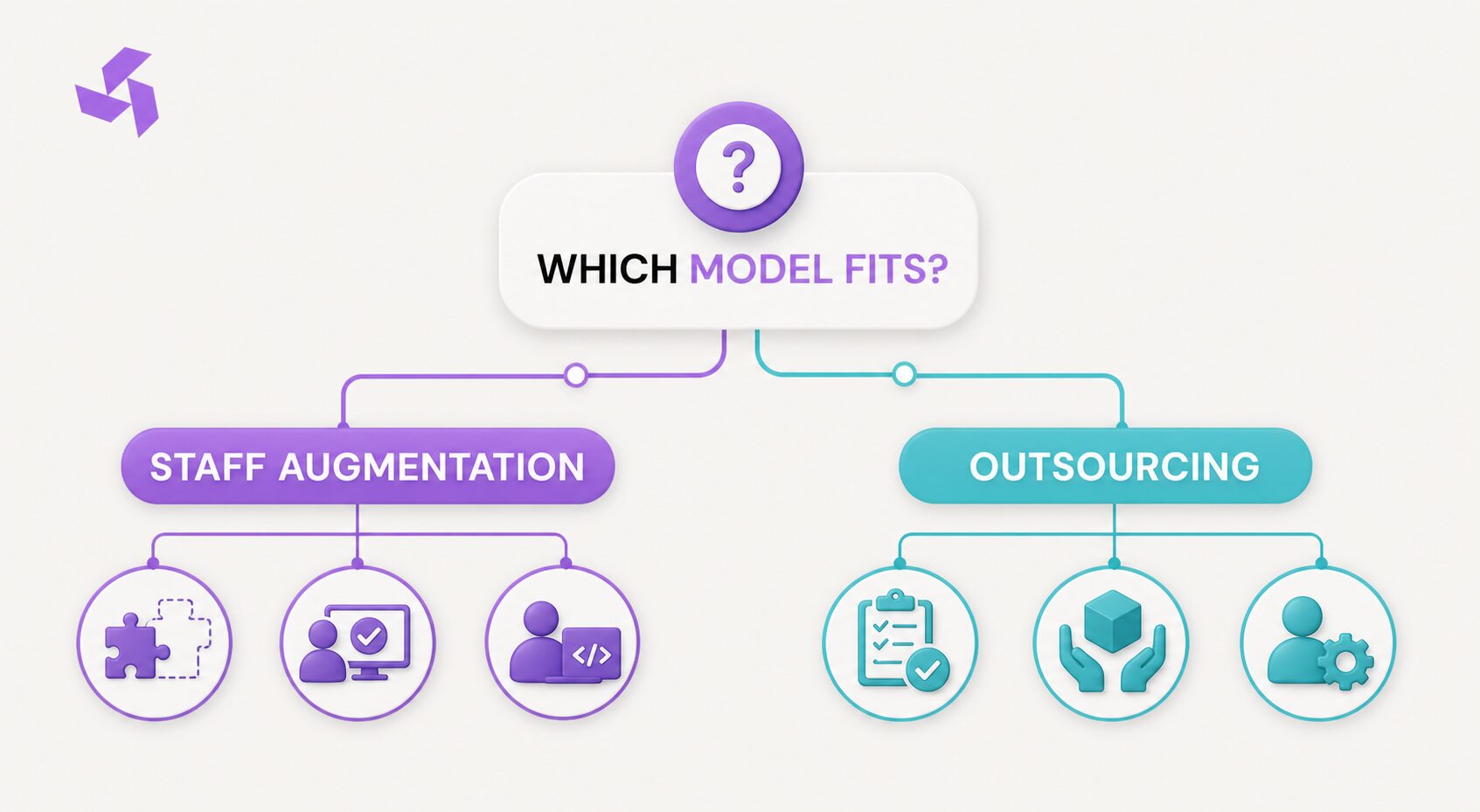
How to Choose the Right Model for Your Project
Use these actionable steps to decide between staff augmentation vs IT outsourcing:
- Map your project scope and stability: If requirements are likely to change, staff augmentation usually wins. Outsourcing works best when scope genuinely holds still.
- Assess your internal management capacity: Do you have a tech lead or PM who can direct daily work? If yes, staff Augmentation lets you leverage that capacity. If you lack internal bandwidth, outsourcing shifts execution responsibility to the vendor.
- Calculate total cost of ownership: Compare fully loaded costs: augmented staff rates plus your management overhead vs. vendor quotes that include hidden markups and change-order risk.
- Evaluate communication and integration needs: If your team relies on tight collaboration, augmented staff integrate more seamlessly. For functions that can run independently, outsourcing may suffice.
- Consider long-term knowledge retention: If the work is core to your product roadmap, staff augmentation ensures you retain expertise. For non-core initiatives, outsourcing can free your team.
- Vet vendors for security and compliance: Ensure the vendor follows your security protocols. Staff augmentation gives you more direct oversight.
Common Mistakes to Avoid in Vendor Engagements
Even smart teams make mistakes when choosing between these models.
- Mistake 1: Comparing only sticker prices: Many teams choose outsourcing based on the lowest bid, only to discover change orders and rework inflate the final cost. Always model total cost of ownership, including potential scope drift.
- Mistake 2: Underestimating management overhead: Staff augmentation requires internal management capacity. If you don’t have a lead to direct augmented staff, you’ll face bottlenecks and delayed delivery.
- Mistake 3: Locking into long-term outsourcing contracts too early: Outsourcing contracts can limit agility. Start with a pilot project or milestone-based engagement before committing to a multi-year deal for complex custom software development company Austin projects.
- Mistake 4: Ignoring cultural and communication fit: Remote software developers must align with your team’s culture and communication style.
- Mistake 5: Treating staff augmentation as a cheap fix: Augmented staff are not a substitute for hiring developers long-term. Use them to fill gaps, but plan for knowledge transfer.
Final Thoughts
Choosing between staff augmentation vs outsourcing isn’t a one-size-fits-all decision. Staff augmentation offers greater project control, lower costs for evolving scopes, and better knowledge retention, but requires internal management capacity. Outsourcing provides convenience, risk transfer, and predictable delivery for stable, well-defined projects, at the cost of higher total expenses and potential knowledge loss. To choose wisely, map your project’s scope stability, assess your team’s management bandwidth, and calculate total cost of ownership—not just sticker prices. Whether you opt for staff augmentation, a dedicated development team, or full project outsourcing, the right model aligns with your business goals, risk tolerance, and long-term roadmap.

Build Smart with The Right Team.
We bring expertise, technology, and trust you look for in your digital journey.