

Healthcare technology teams face a difficult combination of challenges. They must modernize patient experiences, integrate disconnected systems, improve clinical workflows and protect highly sensitive information. At the same time, they must compete for a limited pool of experienced technology professionals.
Permanent hiring can help healthcare organizations build long-term capabilities, but it may not be fast enough when a product launch, system migration or security initiative is approaching. This is where healthcare IT staff augmentation can provide a practical alternative.
Through staff augmentation, a healthcare company adds selected technology professionals to its existing team for a specific project, skill requirement or period. The healthcare organization retains control over priorities, architecture and delivery, while the augmented specialists work within its development processes.
This model can support telehealth development, EHR integrations, cloud migration, security remediation, data engineering and temporary capacity gaps. However, adding external professionals also creates new accounts, devices, repositories and data-access paths that must be managed carefully.
Healthcare staff augmentation should therefore begin with security and compliance planning—not simply a list of available developers.
Why Healthcare Technology Hiring Is Challenging
Healthcare software development requires more than proficiency in a programming language. Engineers may work with patient information, clinical workflows, interoperability standards, complex authorization rules and systems that cannot tolerate extended downtime.
A developer who performs well on a general consumer application may still need additional guidance before working inside a regulated healthcare environment.
The hiring challenge becomes more serious when a company needs a specialized capability. A healthcare team may urgently require a cloud security engineer, FHIR integration developer, healthcare data engineer, accessibility specialist or automation tester. However, it may not need that position permanently.
A conventional recruitment cycle can take weeks or months before onboarding begins. Healthcare IT staff augmentation can provide access to professionals whose experience is already closer to the project’s technical requirements.
Speed, however, should never replace proper screening. Healthcare organizations should evaluate technical expertise, secure development habits, communication skills and relevant industry experience separately.
Previous healthcare experience can be valuable, but it does not automatically make someone qualified for every regulated environment. Similarly, assigning a developer with “HIPAA experience” does not make a project HIPAA compliant.
Define the Data and Compliance Scope First
Before onboarding augmented professionals, determine which systems and information they may access.
In the United States, the HIPAA Security Rule applies to electronic protected health information handled by covered entities and their business associates. It requires appropriate administrative, physical and technical safeguards.
The exact requirements depend on the organization, its relationships and the work being performed. Therefore, legal, privacy and compliance professionals should determine which obligations apply to a particular engagement.
If a staffing or development provider will create, receive, maintain or transmit protected health information on behalf of a covered entity, a business associate relationship and written agreement may be required.
A contract alone is not sufficient. The actual operating model must support the controls promised in that agreement. These may include permitted data use, incident reporting, subcontractor responsibilities and the return or destruction of information after the engagement.
Some health applications and connected devices that fall outside HIPAA may still be subject to the Federal Trade Commission’s Health Breach Notification Rule. State privacy and breach-notification laws may also apply.
This is why organizations should document the regulatory scope before deciding who receives access.
NIST Special Publication 800-66 Revision 2 can also help healthcare organizations connect HIPAA Security Rule requirements with established cybersecurity practices. It does not replace legal advice, but it provides a useful framework for risk analysis and control selection.
Design Access Before Onboarding Developers
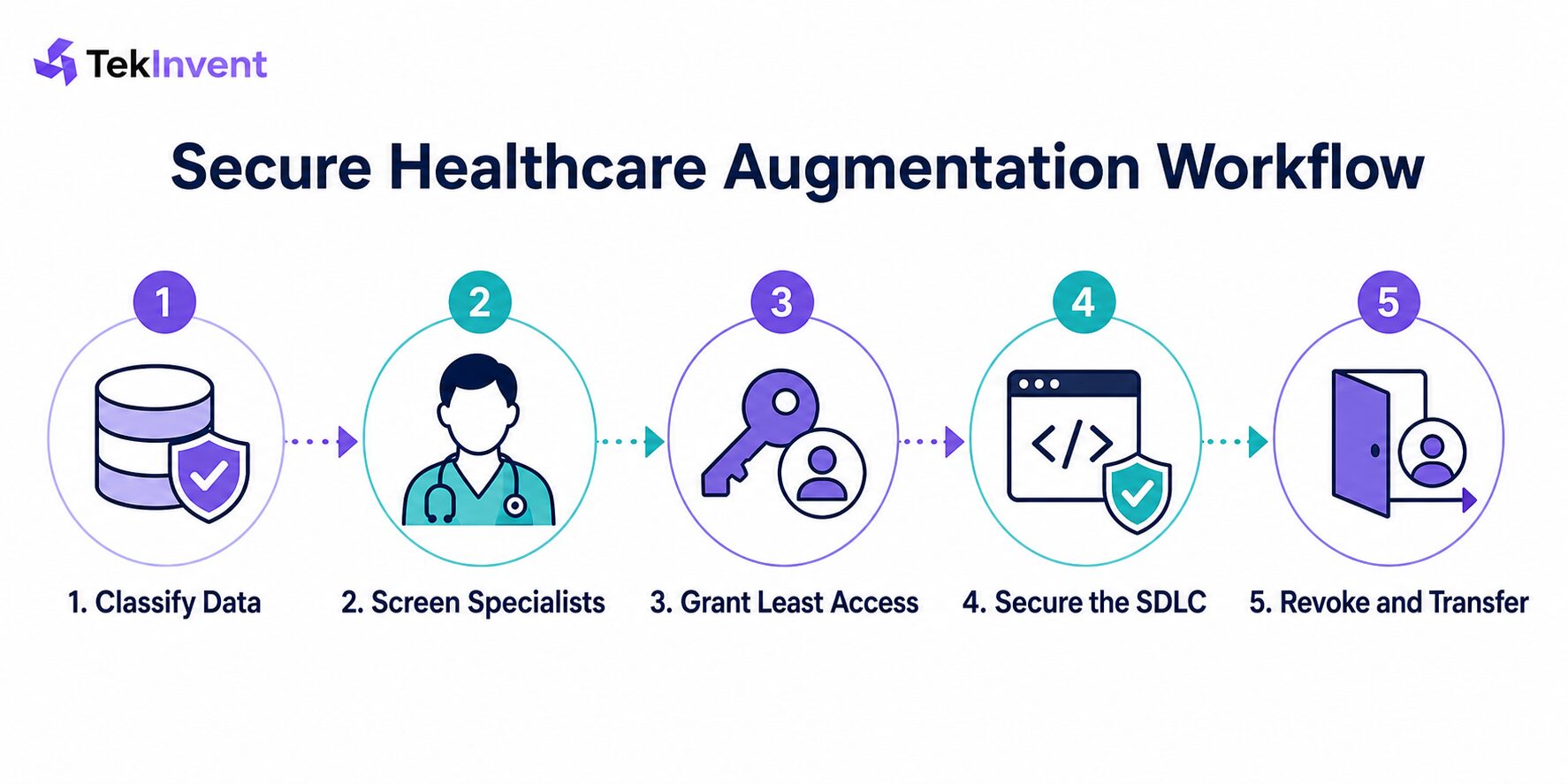
An augmented professional should receive only the access required to perform assigned tasks.
Role-based access should reflect the engineer’s responsibilities, environment and stage of involvement. For example, a front-end developer working with synthetic data should not automatically receive production database credentials.
Healthcare companies should use named accounts, multifactor authentication and centrally managed identities wherever possible. Shared credentials should be avoided because they make it difficult to determine who performed a particular action.
Development, staging and production environments should remain separated. Teams should use synthetic or properly de-identified information when real patient data is not necessary.
If production access is required, it should be approved, time-limited and logged.
Source-control repositories and collaboration platforms must also be considered. Project tickets, screenshots, logs and support conversations can expose patient or operational information even when a developer cannot access the clinical database.
Secure onboarding should therefore cover communication tools, cloud consoles, source control, monitoring platforms and file-sharing systems.
The organization must also plan offboarding. When an engagement ends, accounts should be disabled promptly, active sessions revoked and ownership of repositories, automation and documentation transferred.
Integrate Security Into Everyday Development
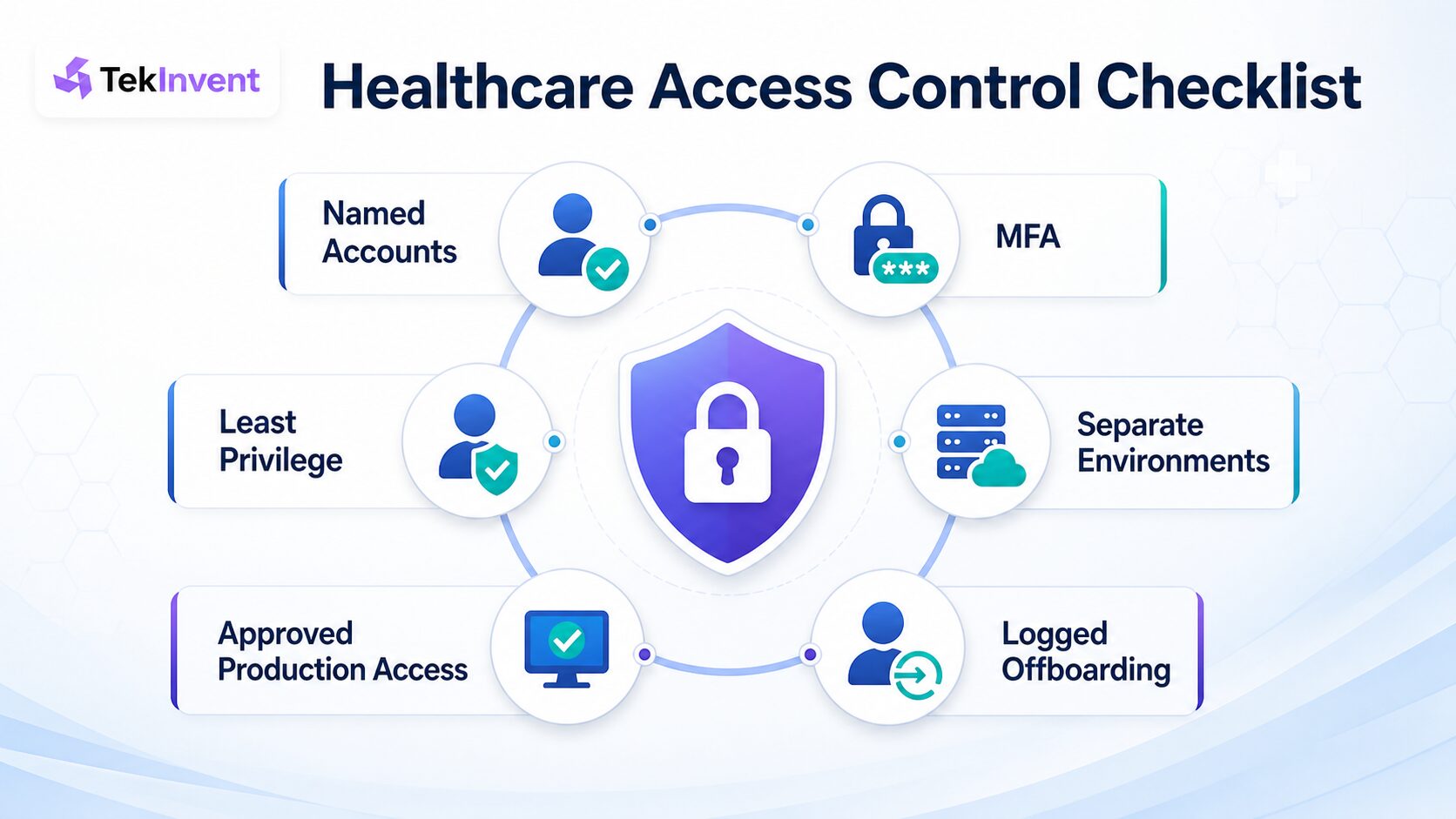
Healthcare security should be part of the normal engineering workflow rather than a final check before launch.
Augmented professionals should follow the same coding standards, branch protections, review requirements and deployment approvals as internal employees. Creating a less controlled development process for external contributors can produce inconsistent quality and unnecessary risk.
Important code changes should undergo peer review and appropriate automated testing. Depending on the project, this may include dependency scanning, secret detection, static analysis and software composition analysis.
Threat modeling is particularly useful when developing features involving:
- Authentication and authorization
- Patient messaging
- File uploads
- Telehealth sessions
- Payment processing
- Third-party healthcare integrations
Logging must support troubleshooting and investigations without unnecessarily recording protected health information.
The organization should also document how potential vulnerabilities are reported. Augmented engineers need to know whom to contact, how severity is determined and when work should stop for a security review.
Generic security training cannot replace project-specific instructions. Developers must understand the healthcare company’s architecture, data classifications and escalation procedures.
Hire for Evidence Instead of Labels
A reliable hiring process starts with the actual work.
Instead of requesting a “senior healthcare developer,” define the technology stack, expected outcomes, integration landscape, data sensitivity and communication requirements.
Candidates should then be assessed against that environment.
Technical interviews should use realistic scenarios without exposing confidential company information. For example, an integration engineer could explain how they would handle an unreliable healthcare API. A cloud engineer could design least-privilege access across different environments.
A QA specialist could demonstrate how they would test authorization boundaries while preventing sensitive information from entering screenshots and reports.
Domain questions should test judgment rather than knowledge of acronyms. Ask candidates what they would do after discovering patient information in an application log or how they would handle an unclear security requirement.
Strong candidates should demonstrate a willingness to document, escalate and verify—not simply move faster.
Reference checks, identity verification and background screening should follow applicable laws and company policies. If a certification is important, verify both its authenticity and relevance.
Select the Appropriate Engagement Model
Staff augmentation works best when a healthcare company already has product and engineering leaders who can direct the work.
If the organization wants a vendor to control the roadmap and take responsibility for an entire outcome, outsourcing or a managed service might be more appropriate. Our comparison of staff augmentation vs managed services explains how these engagement models differ.
For a defined capability gap, TekInvent’s IT staff augmentation services can provide selected technology professionals while the healthcare company retains delivery control.
Organizations seeking broader product development support can also explore TekInvent’s healthcare app development services.
The agreement should clearly address confidentiality, intellectual-property ownership, security responsibilities, permitted work locations, equipment, subcontracting, incident reporting and termination.
Make Onboarding a Controlled Process
Good onboarding gives an augmented professional enough context to contribute without providing access to every system on the first day.
Begin by explaining the product, users, architecture, data classifications and security expectations. The professional can then receive a limited initial assignment that allows the internal team to assess communication and engineering quality.
Every augmented contributor should have an internal owner. That person should answer questions, review early work and confirm that important decisions are documented.
Project documentation should explain how code reaches production, who approves security exceptions and how incidents are reported.
Performance can be evaluated through meaningful indicators such as time to the first approved contribution, review rework, escaped defects, security findings and delivery predictability.
Avoid relying on superficial activity measures such as the number of commits or lines of code.
Organizations should also consider the complete financial effect. The IT staff augmentation cost framework can help teams compare vendor fees, onboarding, internal management and delivery impact.
Close Healthcare Skill Gaps Responsibly
Healthcare IT staff augmentation can help US healthcare companies access specialized skills and move important initiatives forward without turning every temporary capability gap into a permanent hire.
Its value comes from precision: the right professional, a clearly defined outcome, appropriate access and accountable oversight.
The strongest healthcare organizations treat security and compliance as ongoing operating requirements. They classify information before granting access, screen candidates for real evidence, include augmented professionals in the secure development process and remove access properly when the engagement ends.
With these foundations, augmented professionals can become a controlled extension of the internal technology team instead of an unmanaged source of risk.

Build Smart with The Right Team.
We bring expertise, technology, and trust you look for in your digital journey.