
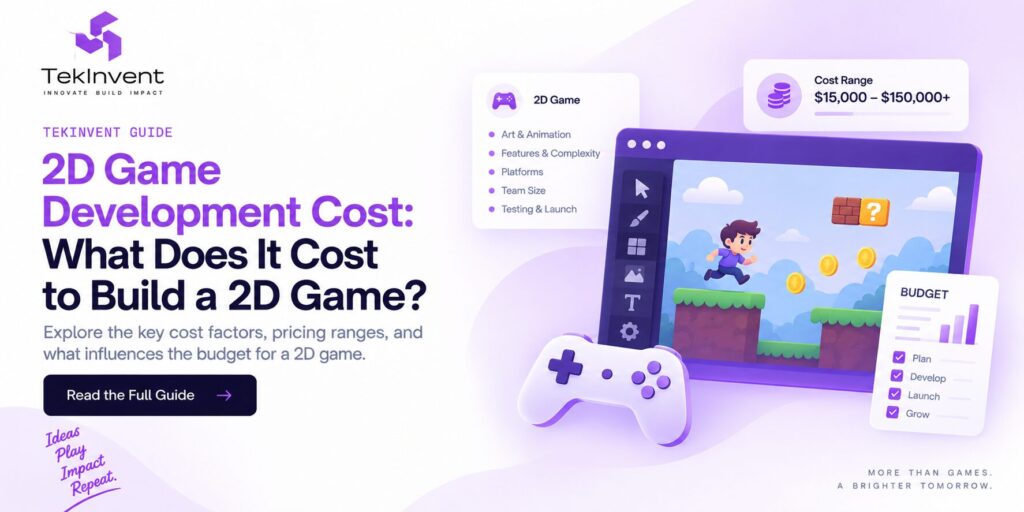
The 2D game development cost can range from a relatively modest investment for a simple mobile or casual game to a six-figure budget for a polished commercial title with custom artwork, extensive animation, multiplayer functionality, and large amounts of content.
For a basic 2D game, a reasonable early planning range in 2026 can start around $15,000 to $50,000. More developed commercial 2D games may move into roughly $50,000 to $150,000, while larger PC, console, multiplayer, or content-heavy projects can go beyond that. These are planning ranges rather than fixed market prices. Recent industry pricing guides show similarly wide variation because the final budget depends much more on scope than simply whether a game is 2D. coherent lab llp
Two games can both use 2D graphics while requiring completely different budgets.
A simple puzzle game with a few mechanics and limited artwork is not comparable to a hand-animated RPG containing dozens of characters, hundreds of animations, large environments, quests, inventories, dialogue, multiplayer systems, and continuous updates.
That is why asking “How much does a 2D game cost?” is only the beginning.
A useful estimate starts by understanding exactly what needs to be built.
How Much Does 2D Game Development Cost in 2026?
For early budgeting, a relatively simple 2D mobile or casual game can fall around $15,000 to $50,000 depending on the team, artwork, mechanics, platform, and level of polish. Current 2026 pricing research from multiple development studios places entry-level commercial projects around this general area, although methodologies and included services differ between providers. coherent lab llp
A more sophisticated 2D title can cost significantly more.
Once the project requires substantial custom artwork, numerous levels, detailed character animation, backend functionality, multiplayer, advanced AI, monetization, multiple platforms, or LiveOps, the budget can move well beyond $50,000.
Instead of thinking about one universal price, it is more useful to think in terms of three broad scopes.
A simple 2D game may include one core gameplay loop, limited levels, straightforward UI, basic animation, single-player functionality, and one or two platforms.
A mid-level 2D game may contain more characters, custom environments, progression systems, achievements, monetization, substantial animation, analytics, cloud functionality, and considerably more content.
An advanced commercial 2D game might include sophisticated gameplay systems, multiplayer, large amounts of original art, complex animation, backend infrastructure, cross-platform releases, ongoing events, and post-launch content.
The visual dimension may remain 2D across all three projects, but their production requirements are completely different.
Why Does the Cost of a 2D Game Vary So Much?
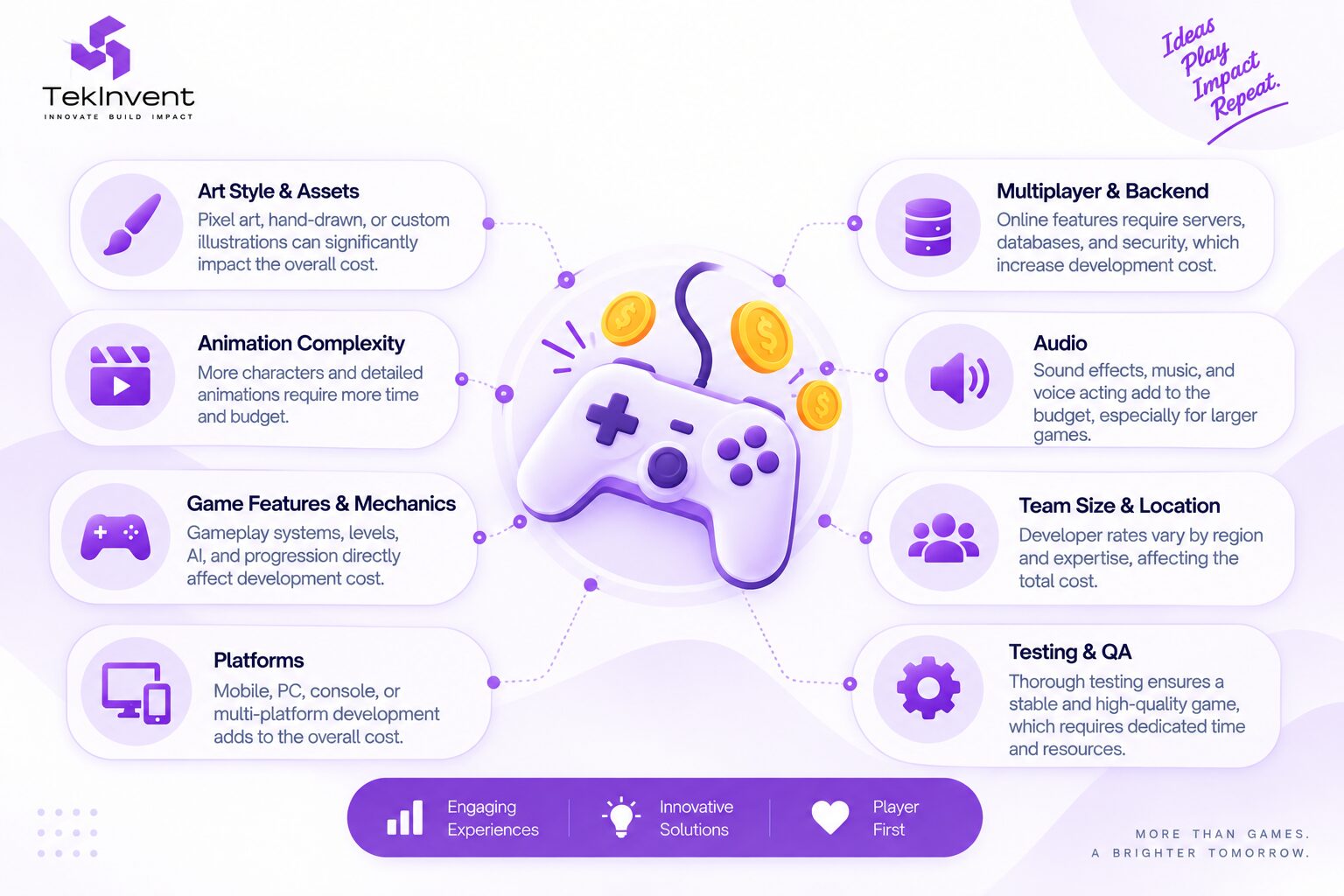
The biggest misconception is that 2D automatically means inexpensive.
It can reduce certain production requirements compared with comparable 3D development, but it does not eliminate the work required to create a polished game.
A 2D project still needs game design, programming, UI and UX, artwork, animation, level design, audio, testing, optimization, store preparation, and potentially backend infrastructure.
Content volume can become particularly expensive.
Imagine two platformers.
The first contains ten short levels, one playable character, five enemy types, and a simple progression system.
The second contains 100 levels, six playable characters, dozens of enemies, hand-drawn environments, boss fights, character upgrades, achievements, cloud saves, leaderboards, and seasonal content.
Calling both projects “2D platformers” tells you almost nothing useful about their actual development budgets.
Scope is the better starting point.
Game Complexity Has the Biggest Impact on Budget
The number and complexity of gameplay systems directly affect development hours.
A basic endless runner may need movement, obstacles, scoring, progression, advertisements, and a straightforward interface.
A strategy game may require resource management, enemy AI, multiple unit types, progression, maps, inventories, skill systems, save functionality, and complicated balancing.
An RPG can introduce dialogue, quests, character statistics, equipment, inventories, combat, NPC behavior, progression, maps, and potentially hundreds of content dependencies.
Every system needs to be designed, programmed, integrated, tested, and polished.
This is why businesses should define the core gameplay loop before requesting a final quote.
The clearer the mechanics become, the more credible the cost estimate becomes.
Art Style Can Change the Cost Dramatically
2D art is not one production method.
Pixel art, flat vector graphics, digital illustration, hand-painted artwork, frame-by-frame animation, and skeletal animation require different workflows.
A minimalist puzzle game may use relatively few visual assets.
A narrative adventure could require dozens of unique environments and hundreds of character illustrations.
A hand-drawn action game might need thousands of animation frames.
Even pixel art should not automatically be considered cheap. Detailed pixel animation created by experienced artists can require considerable production time.
Current 2026 cost analysis also identifies art complexity and asset volume as major 2D cost drivers, particularly when comparing flat artwork with detailed hand-drawn production and different animation methods. Galaxy4Games
The right question is therefore not simply, “Is the game 2D?”
It is, “How much original 2D content needs to be produced, and how difficult is each asset to create?”
Animation Can Become One of the Largest Expenses
A character illustration is not necessarily a playable character.
The character may need idle, walking, running, jumping, attacking, taking damage, dying, interacting, celebrating, and other animations.
Now multiply that requirement across multiple characters and enemies.
Animation strategy therefore matters.
Frame-by-frame animation can create a distinctive handcrafted appearance, but producing large numbers of unique frames can require substantial artist time.
Skeletal animation can allow certain assets and movements to be reused more efficiently, depending on the game’s visual style.
Neither method is universally better.
The budget should reflect the quality and quantity of animation the game actually requires.
Number of Characters and Environments Affects Cost
Content multiplies quickly.
Adding another playable character may create requirements for concept design, sprites, animation, sound, interface elements, balancing, programming, and testing.
Adding another environment may require backgrounds, tiles, props, effects, level layouts, audio, interactions, and optimization.
That is why a project with five environments and three characters cannot simply be scaled to fifty environments and thirty characters without changing the production budget considerably.
Before development begins, estimate the approximate quantity of major assets.
This gives the art and development teams something concrete to scope.
2D Mobile Game Development Cost
Mobile is a natural platform for many 2D games because puzzle games, platformers, card games, casual titles, strategy games, and other genres can work effectively with touch controls and relatively lightweight graphics.
But mobile introduces its own requirements.
The game may need to support different screen sizes, device capabilities, operating-system versions, touch interactions, in-app purchases, advertisements, analytics, notifications, cloud saves, and store requirements.
A small 2D mobile title with straightforward mechanics may stay near the lower end of the budget range.
A commercial free-to-play mobile game containing sophisticated progression, monetization, analytics, LiveOps, social systems, and large amounts of content can cost far more.
If you’re planning specifically for smartphones, TekInvent’s guide to the >mobile game development process explains the journey from idea and prototyping through production, testing, store preparation, launch, and post-launch improvement.
The important distinction is that “mobile” describes the platform, not the complexity.
Does 2D Cost Less Than 3D?
For comparable projects, 2D can often require a smaller production pipeline.
A 3D character can require modeling, topology work, UV mapping, textures, materials, rigging, animation, lighting considerations, and optimization.
Traditional 2D production can avoid several of those stages.
However, comparing a simple 2D puzzle game with a massive 3D open-world game does not tell you much.
A highly polished hand-animated 2D RPG could cost considerably more than a tiny low-poly 3D prototype.
The deciding factor remains scope.
If you are still deciding which visual direction fits your concept, TekInvent’s 2D vs 3D game development guide covers the differences in asset pipelines, performance, gameplay, team requirements, and production complexity.
This article, however, stays focused specifically on budgeting for 2D production
Platform Choice Changes the Development Budget
Building for one platform is generally easier to budget than simultaneously supporting several.
A mobile-only game may initially target Android and iOS.
A broader commercial title might also require Windows, macOS, web, or consoles.
Every additional platform can create more development, testing, interface, performance, input, build, and release requirements.
Console development can introduce additional certification and platform-specific work.
Cross-platform functionality can also affect architecture if player accounts, progression, saves, or multiplayer need to work consistently across devices.
Businesses should therefore decide whether every platform is necessary for version one.
Launching on fewer platforms first and expanding later can sometimes reduce initial scope.
Multiplayer Can Increase 2D Game Development Cost Significantly
A game does not become technically simple just because its graphics are flat.
Multiplayer is a perfect example.
A 2D multiplayer game may still require networking, matchmaking, player accounts, synchronization, backend services, databases, leaderboards, server infrastructure, reconnection handling, security measures, and ongoing monitoring.
Real-time multiplayer can be particularly demanding because players need to experience consistent game states despite network latency.
The system also needs significantly more testing.
Developers must consider what happens when players disconnect, lose packets, reconnect, attempt exploits, or interact under unusual network conditions.
For a budget-sensitive project, deciding whether multiplayer is truly necessary for the initial release can therefore have a major financial impact.
Backend Features Add Costs Players May Never See
Some of the most expensive systems are almost invisible to players.
User accounts, cloud saves, analytics, inventories, remote configuration, leaderboards, payments, databases, server infrastructure, and admin dashboards may not change the visual appearance of a screenshot.
They still require development.
This is one reason estimating costs from reference screenshots alone can be misleading.
Two games may look almost identical but have completely different infrastructure behind them.
A meaningful estimate needs both the visible requirements and the systems operating underneath them.
Game Engine Choice Usually Is Not the Main Cost Driver
Teams commonly consider engines such as Unity, Godot, or other technologies when planning 2D production.
The engine matters, but it usually should not be treated as the primary explanation for the project’s budget.
Developer expertise matters more.
If the team can implement the required mechanics efficiently using a familiar engine, that can be more valuable than selecting technology simply because it appears less expensive.
Engine choice should account for 2D tooling, supported platforms, performance, workflow, integrations, team experience, and long-term maintenance.
The cheapest technology on paper is not necessarily the cheapest technology to build and maintain the product with.
Team Structure Influences Pricing
A 2D game may require a game designer, programmer, 2D artist, animator, UI and UX designer, QA specialist, sound professional, producer, or other specialists depending on its scope.
Smaller teams often combine roles.
Larger projects may require dedicated specialists.
Team location also affects pricing because development rates differ substantially across markets.
But hourly rate should not be evaluated independently from productivity.
A lower hourly rate does not automatically create a lower final budget if development requires significantly more hours or creates expensive rework.
The useful metric is the total cost of producing a stable game that meets the agreed scope.
How Does the Development Timeline Affect Cost?
Time and budget are closely connected because much of game development is skilled labor.
A project that requires a team for three months will generally cost less than a comparable project requiring the same team for twelve months.
But trying to force an unrealistic deadline can create different costs.
More developers may be needed.
Quality assurance may be compressed.
Technical debt may increase.
Important design decisions may not receive enough validation.
Instead of selecting an arbitrary launch date first, scope the product and build the schedule around actual production requirements.
For a deeper breakdown of concept, pre-production, prototyping, production, alpha, beta, testing, and launch, read TekInvent’s game development timeline
Testing and QA Need Their Own Budget
Testing is not something that should happen only when development is almost complete.
Every new system can interact with existing systems in unexpected ways.
QA may need to evaluate controls, gameplay, progression, interfaces, saves, achievements, advertisements, payments, different resolutions, performance, and device compatibility.
Multiplayer increases the testing matrix further.
Fixing bugs also consumes developer time.
The larger the game becomes, the more possible interactions need to be tested.
A budget that funds development but leaves almost nothing for QA can produce a game that technically contains every promised feature but is not ready for players.
Audio Is Small Visually but Important Financially
Sound effects, music, ambient audio, and voice acting contribute heavily to how polished a game feels.
A simple mobile title might use a relatively small audio library.
A narrative game could require original music, hundreds of effects, and substantial voice work.
Voice acting can become particularly expensive when the game contains extensive dialogue, multiple characters, localization, and repeated recording sessions after script changes.
Audio requirements should therefore be identified during pre-production rather than treated as an afterthought.
Monetization Features Also Require Development
If the game will generate revenue through advertisements, in-app purchases, premium upgrades, subscriptions, cosmetic items, or another model, those systems need to be designed and implemented.
An advertisement is not simply placed on a screen.
Developers may need mediation, rewarded-ad logic, frequency controls, analytics, consent management, and failure handling.
In-app purchases require product configuration, transaction handling, restoration, verification, interfaces, testing, and platform compliance.
Monetization therefore belongs in the original budget.
Adding it shortly before launch can create avoidable rework.
Do You Need to Budget for Post-Launch Support?
Yes, particularly for commercial games.
Players will discover issues after launch that internal testing did not reproduce.
Operating-system updates may affect compatibility.
Stores can change requirements.
Balance adjustments may be necessary.
Developers may need to release new levels, characters, events, fixes, or monetization updates.
Online games also have infrastructure costs.
The development budget should therefore distinguish between the initial build cost and the ongoing operating cost.
A game that costs $40,000 to reach version one does not necessarily cost only $40,000 throughout its commercial life.
How Can You Reduce 2D Game Development Cost?
The most effective cost reduction strategy is usually scope control.
Start by identifying the one experience that makes the game worth playing.
Prototype that experience before producing large quantities of final artwork.
Limit the number of launch characters, environments, and game modes.
Reuse systems and assets where doing so does not damage the player experience.
Avoid adding multiplayer simply because competitors have it.
Select the initial platforms strategically.
Choose an art style the team can produce consistently at the required scale.
Separate launch requirements from features that can arrive later.
Most importantly, validate expensive assumptions early.
Discovering during a prototype that the core mechanic needs to change is manageable.
Discovering the same problem after hundreds of final assets have been created is much more expensive.
MVP vs Full Game: Which Is Better for Your Budget?
For a new concept, building a focused MVP or vertical slice can reduce financial risk.
Suppose the complete concept includes 100 levels.
Instead of immediately funding all 100, the team could build several representative levels containing the core mechanics, intended visual quality, UI, progression, sound, and important technical systems.
That version can answer valuable questions.
Is the gameplay enjoyable?
Does the art pipeline work?
Can the target devices handle the game?
How long does producing one level actually take?
Does the development architecture support expansion?
Those answers improve the accuracy of the full production estimate.
The purpose of an MVP is not necessarily to make the final game cheap.
It is to avoid spending the full budget before the most important assumptions have been tested.
What Should Be Included in a 2D Game Development Quote?
A useful quote should explain what is included rather than presenting only a final dollar amount.
The scope should clarify gameplay systems, number of levels, approximate asset quantities, characters, animations, platforms, backend requirements, monetization, integrations, QA, deployment, and post-launch support.
Milestones should also be clear.
You should understand what will be delivered at each stage and what assumptions the estimate depends on.
For example, a quote based on 20 levels cannot reasonably remain unchanged if the scope later expands to 60.
Likewise, adding multiplayer after architecture has already been designed for a single-player experience can substantially affect both cost and timeline.
Clarity protects both the client and development team.
When Should You Hire a 2D Game Development Company?
You do not need a finished game design document before speaking with developers.
You should, however, have a reasonably clear concept.
Know the genre, target audience, intended platforms, core gameplay loop, preferred visual direction, major features, and approximate amount of content.
A specialized 2D game development company can then translate those requirements into development stages, art requirements, technical architecture, team composition, milestones, and a more reliable budget.
The initial discussion should focus on scope before price.
If a studio gives a precise quote without understanding characters, levels, mechanics, platforms, animation, multiplayer, backend requirements, and expected quality, that number has very little context behind it.
What Should You Expect From a Game Development Company?
When evaluating a game development company, look beyond the headline price.
The development partner should be able to explain how the game will be scoped, which assumptions affect the estimate, how prototypes will be validated, how artwork and animation will be produced, how testing will happen, and what occurs when requirements change.
A lower quote is not automatically a better quote.
One proposal may exclude QA, backend infrastructure, deployment, audio, post-launch support, or substantial content that another proposal includes.
Compare scope with scope.
The most useful proposal is the one that makes the relationship between features, resources, schedule, and cost understandable.
Is a Cheap 2D Game a Good Idea?
A small-budget 2D game can absolutely be a good product.
The problem is not having a small budget.
The problem is designing a project whose scope does not fit that budget.
A focused puzzle game with excellent mechanics and a consistent art style can provide a much stronger player experience than an overambitious RPG where every system feels unfinished.
Recent industry discussion continues to highlight how increasing visual complexity contributes to escalating production costs, even as development tools improve. PC Gamer
That reinforces an important budgeting principle.
Spend where players will actually experience the value.
How to Estimate Your 2D Game Budget Before Contacting Developers
Start with a one-page description of the game.
Define the genre.
Describe the core gameplay loop.
Identify the target platform.
Estimate the number of levels or environments.
List the playable characters and important enemies.
Describe the desired art style.
Determine whether multiplayer is necessary.
Identify backend requirements.
Choose the monetization model.
Separate launch features from future ideas.
Then provide those requirements to the development team.
You still will not have a perfect estimate, but the conversation will be dramatically more useful than simply asking, “How much does a 2D game cost?”
Final Thoughts
So, what is the 2D game development cost in 2026?
A relatively simple commercial 2D game may begin around $15,000 to $50,000, while more polished mid-level projects can move beyond that and larger commercial titles can reach six figures. Current published pricing ranges vary substantially between studios, reinforcing why these figures should be treated as early planning references rather than guaranteed quotes. coherent lab llp
The final price depends on what players can actually do inside the game.
Gameplay complexity matters.
Art volume matters.
Animation matters.
Platforms matter.
Multiplayer matters.
Backend infrastructure matters.
Testing matters.
And the amount of content matters enormously.
The most reliable way to control the budget is not to search for the cheapest possible development rate. It is to define a focused version of the game, prototype the riskiest assumptions, establish realistic content requirements, and only then estimate full production.

Build Smart with The Right Team.
We bring expertise, technology, and trust you look for in your digital journey.