
Choosing between 2D and 3D is one of the earliest decisions in game development, but it should not be treated as a simple choice between basic and advanced graphics.
Both approaches can produce commercially successful and memorable games. The better option depends on the gameplay experience, target platform, art direction, development resources, performance requirements, and audience you want to reach.
Games such as Stardew Valley demonstrate how a 2D visual direction can support deep gameplay and long-term player engagement. At the other end, games such as Fortnite use 3D environments to support movement, exploration, combat, and spatial interaction that depend heavily on three-dimensional worlds.
There are also games that blur the distinction. A title can restrict gameplay to two dimensions while using 3D models and environments, commonly described as 2.5D. Unity’s official documentation specifically recognizes this approach, showing that the decision does not always have to be purely 2D or purely 3D. Unity Documentation
So, when considering 2D vs 3D game development, the right question is not which format is universally better. It is which format best supports the game you are actually trying to build.
What Is 2D Game Development?
2D games primarily operate on two axes, usually horizontal and vertical.
Characters, environments, objects, and effects are commonly represented through sprites or other flat graphical assets. Unity describes full 2D games as experiences built with flat graphics without three-dimensional geometry, while engines such as Godot provide dedicated 2D rendering, physics, lighting, TileMap, animation, and particle systems. Unity Documentation
This makes 2D suitable for genres such as platformers, puzzle games, card games, side-scrollers, visual novels, strategy games, and many casual mobile experiences.
However, 2D does not mean visually simple.
Modern 2D games can include sophisticated animation, dynamic lighting, shaders, particle effects, complex physics, and detailed hand-drawn environments.
The difference is primarily how the game world and gameplay are represented, not how much creative effort goes into it.
What Is 3D Game Development?
3D games build characters, environments, and objects using three-dimensional geometry.
Objects have depth in addition to height and width, allowing players and cameras to move through three-dimensional spaces.
According to Unity’s current documentation, 3D development commonly involves meshes, materials, textures, lighting, visual effects, animation, environments, and a perspective camera. Platform and render-pipeline choices can also influence the technical approach. Unity Documentation
This makes 3D particularly useful for first-person shooters, racing games, open-world adventures, realistic simulations, sports titles, and games where exploration or spatial movement is central to the experience.
The additional dimension also introduces additional production requirements.
Models must be created and textured. Characters may require rigging. Animations have to work from different camera angles. Lighting, cameras, collision, rendering, and performance require careful attention.
Therefore, 3D can provide possibilities that 2D cannot easily reproduce, but those possibilities come with additional production complexity.
The Biggest Difference Between 2D and 3D Games
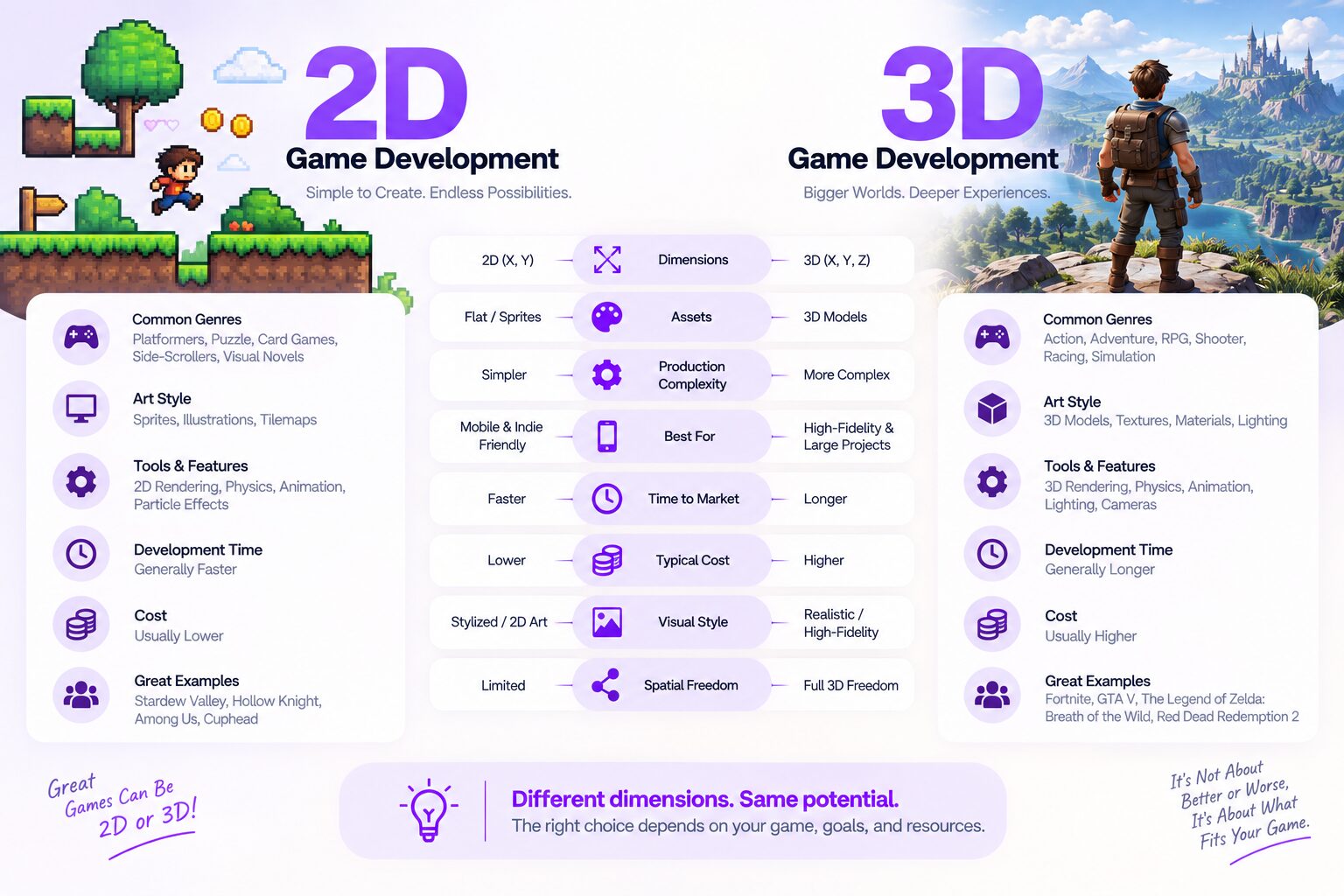
The clearest difference is dimensional freedom.
A traditional 2D character might move left, right, up, and down across a flat plane.
A 3D character can potentially move forward and backward through depth, rotate through an environment, interact with objects from multiple directions, and be viewed from different camera positions.
That difference influences almost every part of production.
In 2D development, artists may work primarily with sprites, illustrations, tiles, and frame-based or skeletal animation.
In 3D development, artists may need modeling, UV mapping, texturing, materials, rigging, lighting, and three-dimensional animation.
The code is not necessarily simple in either case.
A complicated 2D simulation can be more technically demanding than a basic 3D game. Game mechanics, multiplayer systems, AI, procedural generation, networking, and backend infrastructure can dominate development regardless of visual dimension.
That is why judging project complexity purely by “2D” or “3D” can be misleading.
Is 2D Game Development Easier?
For a relatively small game, 2D can reduce several layers of production complexity.
Developers do not necessarily need complete 3D models, realistic materials, skeletal rigs, complex 3D cameras, or sophisticated lighting environments.
Level creation can also be more straightforward for certain genres.
Unity’s dedicated 2D workflow, for example, covers sprites, 2D physics, character animation, environments, graphics, UI, optimization, testing, and publishing as a specialized production pipeline. Unity Documentation
This can make 2D attractive for indie teams, startups, prototypes, and games where mechanics matter more than spatial immersion.
But “easier” should not be interpreted as easy.
High-quality pixel art requires skill. Hand-drawn animation can require enormous amounts of work. Sophisticated 2D physics or multiplayer systems can be technically demanding.
The art style and game design matter as much as the dimension.
Does 3D Development Take More Resources?
In many comparable projects, yes.
A 3D character may require concept design, modeling, topology work, UVs, textures, materials, rigging, and animation before it behaves correctly inside the game.
A 3D environment can require models, terrain, lighting, materials, collision, effects, and optimization.
The game also needs to render those assets efficiently on the intended hardware.
This often creates a larger production pipeline than an equivalent small 2D project.
However, modern engines, asset libraries, reusable systems, procedural tools, and established production pipelines can reduce this burden significantly.
The important phrase is comparable projects.
A simple low-poly 3D game can be considerably easier to produce than a highly detailed hand-animated 2D title.
2D vs 3D Game Development Cost
There is no reliable universal price difference because development cost depends on scope.
A simple 2D mobile game will usually require fewer art and production resources than a realistic 3D multiplayer game.
But that comparison is not especially useful because the two projects are fundamentally different.
A better estimate begins with the features.
How many characters are required?
How many environments?
Does the game need multiplayer?
Will it have an inventory or progression system?
Does it need custom animations?
How sophisticated is enemy AI?
How many platforms need to be supported?
Does the game require a backend?
Will new content be added after launch?
These questions reveal much more about cost than the 2D or 3D label alone.
A business planning development should therefore define the gameplay and content scope before asking for a final estimate.
2D Can Be a Strong Choice for Smaller, Focused Games
Current industry behavior makes this particularly relevant.
Unity’s 2026 Game Development Report is based on a survey of 300 developers across multiple regions and additional data from nearly five million developers who interacted with Unity’s ecosystem in 2025. The report found that 52% of surveyed developers said their teams were focusing on smaller, more manageable projects, while 20% said development cycles were becoming more condensed. Unity
This does not mean those developers are specifically choosing 2D.
It does show that scope control has become an important production strategy.
For a game concept that works equally well in 2D, choosing a focused visual approach can allow a team to spend more resources on mechanics, content, polish, testing, and player experience instead of building unnecessary visual complexity.
The key is choosing the smallest production scope that still delivers the intended experience.
3D Makes Sense When Depth Is Part of the Gameplay
There are situations where 3D is not simply a visual upgrade. It is fundamental to the game design.
Imagine a racing game where players need to navigate realistic tracks.
Consider a first-person shooter where positioning, cover, aim, elevation, and line of sight are essential mechanics.
Think about an exploration game where players need to move freely through buildings, landscapes, or open worlds.
In these cases, three-dimensional space contributes directly to gameplay.
Using 2D simply to reduce development effort could compromise the concept itself.
This is when working with a specialized 3D game development company can make sense, particularly if the project requires modeling, rigging, advanced animation, lighting, physics, environment design, and optimization in addition to programming.
Real Game Example: Stardew Valley
Stardew Valley is a useful example because it demonstrates why graphical dimensionality does not determine gameplay depth.
Its presentation is fundamentally 2D, but the game combines farming, exploration, relationships, crafting, progression, combat, resource management, and long-term player goals.
The visual direction supports the experience rather than limiting it.
A farming game does not automatically become better because every crop, building, and character is rendered as a detailed 3D model.
If the design objective is readability, charm, accessibility, and systems-driven gameplay, 2D can be a deliberate creative decision rather than a technical compromise.
This principle applies far beyond farming games.
Real Game Example: Fortnite
Fortnite demonstrates the opposite situation.
Its core experience relies heavily on three-dimensional environments.
Players navigate terrain, buildings, elevation, cover, and open spaces while constantly changing camera direction and spatial position.
Here, depth is not simply graphical presentation.
It is part of the gameplay.
Building a comparable experience as a conventional 2D game would fundamentally change how players move, aim, explore, and compete.
This is an important lesson for businesses deciding between the two formats: choose the dimension that supports the core interaction.
What About 2.5D Games?
You are not limited to two extremes.
2.5D development can combine elements of both.
A game might use three-dimensional characters and environments while restricting player movement to a two-dimensional plane.
Unity officially describes this pattern as 2D gameplay using 3D graphics and notes that such projects are generally developed using 3D assets and tools even though gameplay movement remains constrained. Unity Documentation
This can create visual depth while preserving simpler side-scrolling or platforming mechanics.
It is useful when a team wants a particular 3D aesthetic without designing gameplay around completely free three-dimensional movement.
However, 2.5D should not be chosen merely as a compromise.
It should fit the game’s art direction and mechanics.
Which Is Better for Mobile Games?
Both can work well on mobile.
The decision depends on audience, genre, devices, download size, battery use, performance targets, and gameplay.
Current industry data reinforces the continuing importance of mobile. Unity’s 2025 gaming report found that 90% of the surveyed developers said their most recent games launched on mobile. In its 2026 report, mobile remained one of the leading platforms developers planned to target for expansion. Unity
2D can be particularly practical for casual games, puzzles, card games, platformers, and titles intended to run smoothly across a broad range of devices.
3D is appropriate when the mobile experience genuinely benefits from spatial environments, such as racing, action, simulation, or certain multiplayer games.
Optimization matters either way.
A poorly optimized 2D game can perform badly, while a carefully optimized 3D game can run effectively on modern mobile hardware.
Do Players Prefer 2D or 3D Games?
There is no universal player preference.
Players generally care about the complete experience.
Art direction, controls, mechanics, progression, performance, story, social systems, and overall polish can matter more than whether assets contain polygons or sprites.
Current Unity data illustrates how diverse development remains. In its 2026 report, RPGs appeared in 55% of surveyed studios’ catalogs, strategy in 53%, and action/adventure in 52%. At the same time, 73% reported developing casual games. Unity
Those categories can support very different visual styles.
Instead of asking whether players generally prefer 2D or 3D, ask what the target audience expects from your specific genre.
Which Option Is Better for Indie Developers?
2D can be attractive to small teams because a focused project may require fewer types of production work.
A solo developer who can code and create sprite art may be able to handle much of the project independently.
3D often requires a broader production skill set, particularly when visual quality expectations are high.
That does not mean indie developers should avoid 3D.
Low-poly art, stylized environments, reusable assets, and carefully controlled scope can make 3D practical for small teams.
The 2026 Unity report provides an important lesson here. 67% of surveyed developers reported prototyping for three months or less, and 52% said their teams were focusing on smaller projects. Unity
For an indie project, validating the gameplay quickly may therefore be more valuable than choosing a visually ambitious format before the core mechanics have been proven.
Art Style Should Influence the Decision
A game’s identity is often more important than technical realism.
Pixel art creates a completely different feeling from hand-painted illustrations.
Low-poly 3D produces a different identity from photorealistic environments.
Neither is inherently superior.
Before production, teams should create concept art and prototype the visual direction.
Ask whether the style is recognizable.
Ask whether the team can produce enough content consistently.
Ask whether animations can be created within the available budget.
Ask whether the art will remain readable on the target screen.
A visually ambitious style that cannot be produced consistently can become a larger problem than choosing a simpler direction from the beginning.
Performance and Target Hardware Matter
Performance requirements should be established before production.
A desktop gaming PC, modern console, low-end Android phone, web browser, and VR headset have very different constraints.
3D projects can require careful management of polygons, textures, materials, lighting, shaders, draw calls, effects, and rendering.
Unity’s current 3D workflow explicitly requires developers to consider target platforms and rendering pipelines early because not every rendering approach is appropriate for every platform. Unity Documentation
2D games generally have a different rendering workload, but they still need profiling and optimization.
Large textures, excessive particles, inefficient scripts, physics calculations, and poor memory management can still hurt performance.
Platform should therefore influence the technical strategy from the start.
Multiplayer Complexity Is Not Determined by 2D or 3D
A common mistake is assuming a 2D multiplayer game will automatically be simple.
Networking complexity depends on what needs to be synchronized.
Real-time player movement, physics, combat, matchmaking, inventories, leaderboards, anti-cheat systems, voice communication, and persistent player data can all create substantial backend requirements.
The same applies to 3D games.
If multiplayer is central to the product, networking architecture should be considered during early technical planning rather than added after the core game is finished.
The visual dimension does not remove that requirement.
When Should You Choose 2D Game Development?
Choose 2D when the gameplay naturally operates on a flat plane and additional depth would not meaningfully improve the experience.
It can be particularly suitable for platformers, puzzles, card games, visual novels, strategy titles, casual games, and certain mobile experiences.
It is also worth considering when the team has strong illustration or sprite-animation capabilities, when the project needs to remain tightly scoped, or when broad device compatibility is important.
If the concept depends on distinctive 2D artwork, working with a 2D game development company can also help align sprite production, animation, level design, physics, programming, and optimization around the same visual direction.
2D should be selected because it suits the product, not simply because it appears cheaper.
When Should You Choose 3D Game Development?
Choose 3D when spatial movement and depth are important parts of the experience.
Racing, first-person action, open-world exploration, many simulations, realistic sports titles, and immersive adventure games commonly benefit from three-dimensional environments.
3D is also appropriate when the intended art direction, camera system, character interaction, or environmental design requires it.
However, businesses should be realistic about production.
If the concept needs dozens of detailed environments, realistic characters, hundreds of animations, complex effects, and several target platforms, the team must budget for the production pipeline those requirements create.
The decision should therefore connect creative ambition with available resources.
How to Decide Before Full Production
The most reliable approach is to prototype the core gameplay.
Do not begin by creating hundreds of final assets.
Build enough of the game to answer the most important questions.
Is movement enjoyable?
Does the camera work?
Is the core mechanic understandable?
Does depth actually improve gameplay?
Can the art direction be produced consistently?
Does the game perform properly on its target device?
Can the team realistically produce enough content?
This approach aligns with current industry behavior. Unity reports that studios have become more selective about prototypes, with 48% saying they pursue prototypes more selectively, 26% emphasizing rapid low-fidelity prototypes, and 17% shortening prototyping specifically to reduce upfront cost or risk. Unity
A small prototype can reveal that a planned 3D game works perfectly well in 2D, or that a concept initially imagined in 2D becomes significantly more enjoyable with three-dimensional movement.
Finding that out before full production can save substantial time and money.
Choosing the Right Development Partner
Once the concept, platform, art direction, and core mechanics are defined, the development partner should be selected based on relevant production experience rather than a generic promise to build games.
A capable game development company should be able to challenge unnecessary complexity, recommend an appropriate engine and architecture, prototype risky mechanics early, plan asset production, test performance on target hardware, and explain how the project can move from prototype to launch.
The team should also understand the difference between building a technically functional game and building one that feels good to play.
Before signing a full production contract, businesses should ask to see relevant work, understand who will actually work on the project, clarify ownership of code and assets, define milestones, and establish how testing and post-launch support will work.
Final Thoughts
The choice between 2D vs 3D game development should begin with gameplay, not graphics.
Choose 2D when flat movement, stylized artwork, focused mechanics, efficient content production, or broad device compatibility supports the experience you want to create.
Choose 3D when depth, camera freedom, exploration, realistic environments, or spatial interaction is fundamental to the game.
And consider a hybrid 2.5D approach when the gameplay benefits from two-dimensional constraints but the visual direction benefits from three-dimensional assets.
Current industry data also reinforces the value of controlled scope. Unity’s 2026 research found that 52% of surveyed developers are focusing on smaller, more manageable projects, while rapid prototyping has become an important method for reducing upfront risk. Unity
That leads to a practical development strategy: define the audience, choose the target platform, identify the core gameplay loop, prototype it quickly, and only then commit to the full visual and production pipeline.
The best choice is not the format with the most impressive technology.
It is the one that gives your game the strongest experience while remaining realistic for your team, budget, platform, and production goals.

Build Smart with The Right Team.
We bring expertise, technology, and trust you look for in your digital journey.