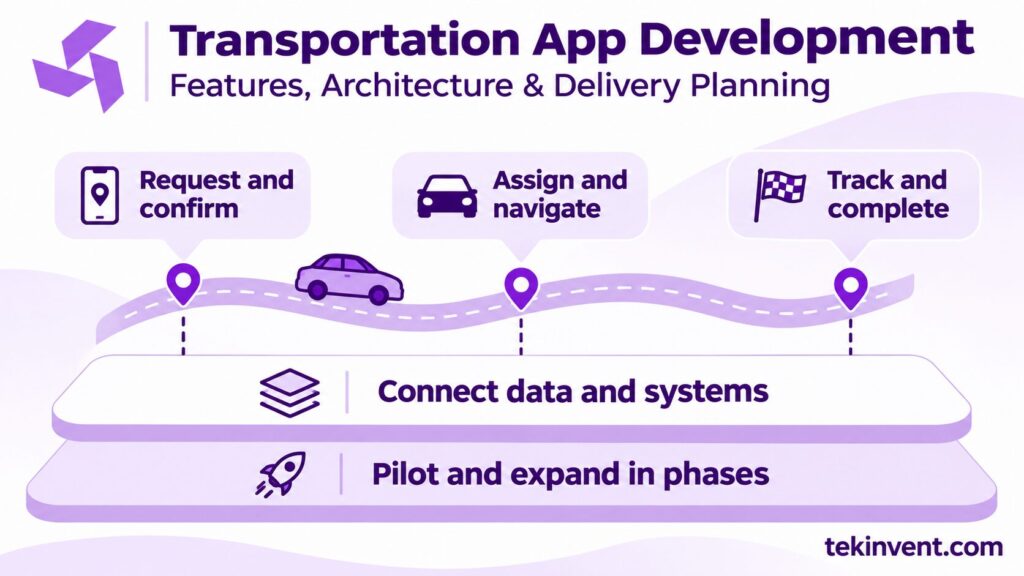
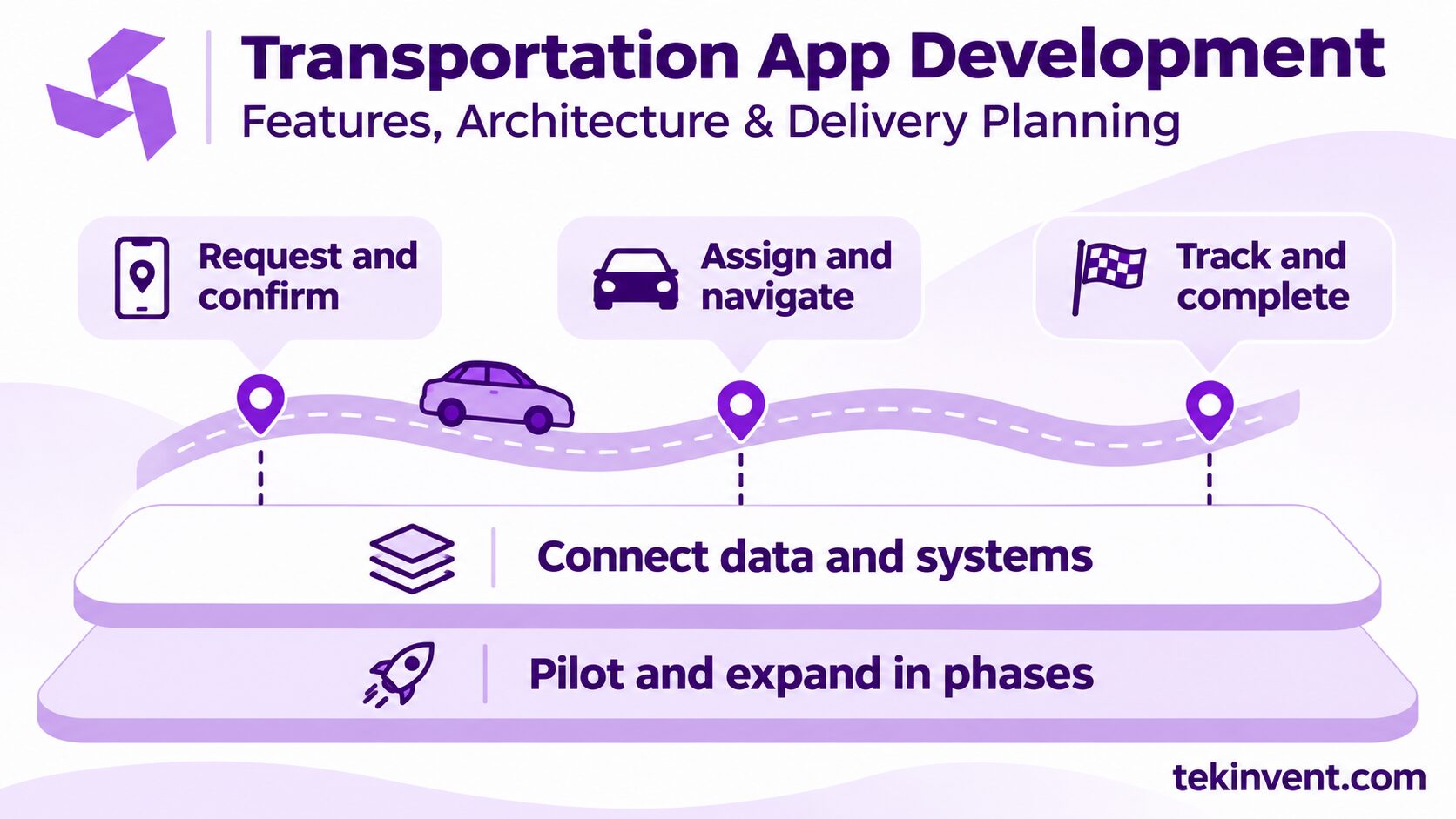
Transportation app development begins with the service model: who is moving, what is being moved, who assigns the trip, and what happens when plans change. A rider app, fleet dispatch system, school transportation tool, and accessible paratransit service need different workflows. Define those differences before selecting features or estimating the build.
The most reliable first release supports one complete operational journey. It should help users request or receive a trip, help operators coordinate it, and make exceptions visible. Mapping that journey early keeps the product grounded in daily work instead of a generic checklist of maps, payments, and notifications.
Choose the transportation model first
Clarify whether the product serves individual riders, businesses, fleet operators, drivers, or a public service. A ride-hailing marketplace must coordinate supply and demand. A company shuttle may need employee reservations and route schedules. A delivery fleet may need dispatch, proof of service, and exception reporting.
Write down who can create, accept, assign, change, and cancel a trip. Then define what information each role needs. Riders may need pickup details and trip status; dispatchers may need capacity and driver availability; drivers need a clear route and a safe way to report a delay. Do not assume the same interface can serve every role equally well.
Identify service boundaries. Will the app serve one region, a fixed set of routes, scheduled trips, on-demand requests, or a mix? What service hours and eligibility rules apply? These constraints influence dispatch logic, location handling, pricing, and support needs.
Map the trip from request to completion
Draw the real workflow before designing screens. A trip may include a request, eligibility check, quote or confirmation, driver assignment, arrival, pickup, route progress, drop-off, payment, and a receipt. Add the people and systems involved at each stage.
Plan for cases that interrupt the normal path: a rider changes the pickup point, a driver cannot reach the location, a vehicle becomes unavailable, a trip is canceled, or a location signal is inaccurate. Decide who can make the change and how every affected person learns about it.
If the service involves scheduled or assisted rides, include the needs of people who may not use a smartphone. A dispatcher or support agent may need to create or update a trip on a rider’s behalf. Accessibility, language, and alternate booking channels should be requirements from the start.
Prioritize features by role
Rider or customer experience
The customer side may include account setup, pickup and destination entry, trip requests, fare or service details, status updates, payment, receipts, and support. Include enough information for a customer to understand what was booked and what happens next. Clear cancellation rules can reduce disputes and calls.
Driver experience
Drivers may need trip offers, acceptance or rejection, navigation handoff, contact procedures, status changes, and an issue-reporting path. Keep interactions simple while a vehicle is moving. Define whether the app is expected to operate in low-connectivity areas and how a driver can continue when data service drops.
Dispatch and administration
Dispatchers need an operational view of pending trips, assignments, vehicle or driver availability, delays, and exceptions. Administrators may manage service areas, users, policies, and reports. Decide which actions require an audit trail and which staff roles can perform them.
Trying to include all possible functions in the first release can delay learning. Choose one service area and a coherent workflow, then add functionality based on actual operational needs.
Plan location and dispatch carefully
Location data can support pickup coordination and trip progress, but it introduces design and privacy considerations. Define when location is collected, who can see it, how frequently it updates, and when tracking stops. Explain this clearly to users and avoid collecting location when the service does not need it.
Dispatch can be manual, rule-assisted, or automated. A small operation may begin with dispatchers assigning trips from a clear queue. Automation becomes more useful when the business has stable rules for eligibility, capacity, proximity, schedule, and priority. If those rules are not explicit, an algorithm can reproduce inconsistency faster.
Test for GPS drift, inaccurate addresses, indoor pickup points, route changes, and delayed updates. Give users a way to confirm a location or contact support. A map marker should not be treated as proof that a rider or driver is at the correct entrance.
Design an architecture that supports the workflow
A transportation product commonly includes mobile or web interfaces, backend services, databases, mapping or routing tools, notifications, payment services, and an operations console. The architecture should make responsibilities clear: trip state, user identity, payment status, and location events should not conflict across components.
Define the source of truth for important records. If a payment provider confirms a charge but the app does not receive its response, the system needs a way to reconcile the transaction rather than charging the user again. If a driver’s status changes offline, decide how the update is queued and synchronized.
Plan monitoring and recovery. Operators need to know when dispatch, location updates, or notifications stop working. Establish backups, error logging, role-based access, and a support process appropriate to the service. Capacity planning should reflect expected trip patterns and peak periods rather than an abstract claim that the app will “scale.”
Connect the systems the business already uses
Possible integrations include payment processing, maps, fleet or vehicle systems, identity checks, customer support, accounting, and enterprise resource planning tools. For each integration, list the data shared, the system that owns it, expected timing, vendor access, and failure behavior.
Do not treat a vendor API as a complete integration plan. Confirm the available documentation, credentials, sandbox, rate limits, and support arrangements. Test what happens when a service is unavailable or sends incomplete information. If operators need a manual fallback, document it before launch.
Address privacy, accessibility, and safety
Collect only the information needed to provide and support the trip. Limit access to location history and personal details based on role and business need. Set retention policies, protect accounts, and give customers a clear way to reach support or request help.
Accessibility affects booking, pickup, and communication. Test with people who use assistive technology or have mobility, vision, hearing, or language needs. For accessible transportation, include vehicle capability, assistance requirements, and pickup instructions in the operational workflow—not only as profile fields.
Safety procedures also need an owner. Decide how users report an incident, how operators escalate it, and what information is available to the people responding. The app can support a process; it cannot replace the business’s responsibility to define and staff that process.
Build and launch in phases
Start with discovery, workflow mapping, and a prototype. Test request, assignment, and completion tasks with customers, drivers, and dispatchers. Use the feedback to resolve confusing steps before building full integrations.
Pilot in a bounded service area or with one operator group. Measure completion, canceled trips, assignment delays, support contacts, and exceptions that require manual intervention. The right measures depend on the business problem. Review them with operations staff instead of relying only on app usage totals.
Before expanding, verify support coverage, monitoring, staff training, and recovery procedures. A successful pilot under close supervision does not automatically demonstrate that a larger service can operate with the same staffing model.
What to put in a development brief
Include the service model, user roles, service boundaries, trip workflow, exception cases, location needs, integrations, privacy requirements, pilot plan, and operating responsibilities. Ask development teams to identify assumptions and exclusions clearly. Compare proposals against the same workflow and acceptance criteria.
When the service depends on freight, warehousing, or delivery coordination, TekInvent’s logistics app development services may also be relevant. A mobile app development company can help estimate the rider, driver, and operator experience against the requirements you have defined.
Plan a Transportation App Around Real Trips
TekInvent can help scope dispatch, rider, and driver workflows for a practical first release.
Define what the service promises customers
The app’s status labels and notifications should match the operation’s actual commitments. “Driver assigned,” “arriving,” and “trip complete” need consistent definitions. Decide which event triggers each message and which system records it. If drivers can update a status without dispatch approval, document the process for correcting an inaccurate event.
Set expectations for delays and changes. A customer needs to know whether a trip is still scheduled, whether a new pickup time is being estimated, or whether staff must contact them. Avoid displaying false precision when location or routing data is incomplete. Give operators a way to override an automated estimate and explain the change.
Design the support path with the same care as the booking flow. A customer should be able to report a missed pickup, incorrect address, or accessibility problem and have the request reach someone who can act. Define urgency levels, response ownership, and what trip information support staff can see.
These service rules can be reviewed with a short tabletop exercise before development. Walk through a late driver, a canceled trip, and a customer who cannot use the app. If staff disagree about who acts next, the workflow needs clarification before the software encodes it.
Prepare for data review and accountability
Decide which trip events need to be retained for customer service, billing, safety review, or operational planning. Keep an event history that shows when a request changed, who made the change, and whether the affected user was notified. This can help an operator resolve a dispute without relying on a driver’s memory or several disconnected messages.
Reports should reflect the service’s actual workflow. A route marked complete may still have an unresolved issue, such as a missing item or a rider who needs follow-up. Give staff a way to flag and assign those cases rather than treating every completed trip as identical.
Set access rules for reports and location history. Managers may need a broader view than customers or drivers. Review access when roles change and make sure support staff see only the details required to answer a question.
Keep operations in the product plan
Transportation software succeeds when its trip flow matches the service people can actually deliver. Decide how requests, assignments, delays, and support work before relying on live location or automated dispatch. Those decisions produce a more useful estimate and a product that operations teams can evaluate.
Use a pilot to learn where the process needs improvement. Then expand only when the service model, staffing, and technology can support the next step.

Build Smart with The Right Team.
We bring expertise, technology, and trust you look for in your digital journey.