
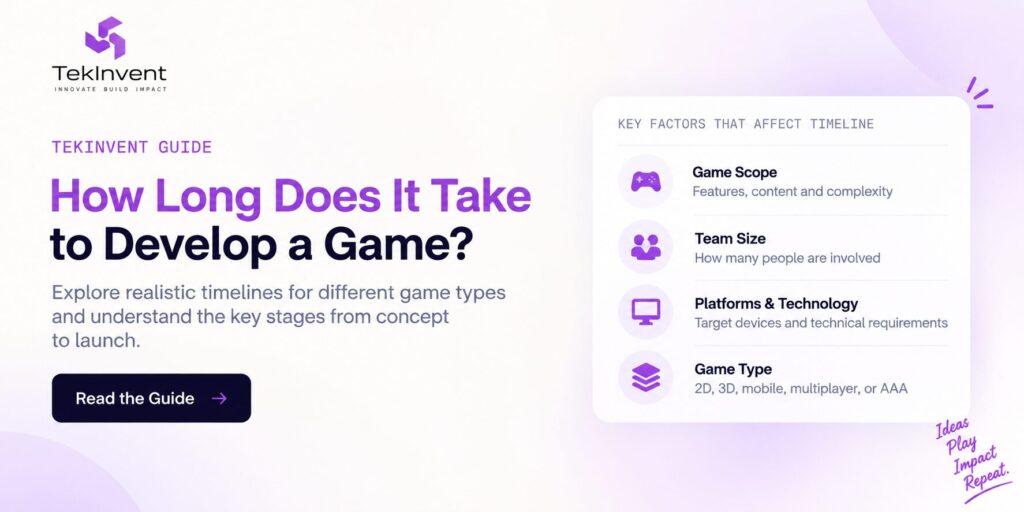
How long does it take to develop a game? A focused mobile or casual game may be completed within a few months, while a more sophisticated indie or mid-core game can take six months to well over a year. Large multiplayer, console, or AAA-style projects can require several years.
There is no universal game development timeline because games that look similar from the outside can have completely different production requirements.
A simple puzzle game with 30 levels is not comparable to an online multiplayer game requiring matchmaking, servers, character progression, live events, and continuous content. Similarly, creating one stylized 3D environment is very different from building an open world containing hundreds of characters, animations, objects, and locations.
A useful timeline therefore starts with scope.
The team needs to understand what players will do, how much content needs to be created, which platforms will be supported, what art style is required, whether online systems are involved, and how much testing will be necessary.
Once those decisions are made, the development schedule becomes much easier to estimate.
What Is the Average Game Development Timeline?
A small casual or mobile game can sometimes move from planning to release in roughly two to six months. A mid-sized indie project may take around six to eighteen months, while large, content-heavy commercial games can require multiple years. One recent industry timeline guide gives approximately 2 to 6 months for simple mobile games, 6 to 18 months for mid-sized indie titles, and 3 to 5 years for large AAA games. These should be treated as broad planning ranges rather than promises. Algoryte
The range becomes clearer when the project is divided into stages.
A typical development cycle includes concept and discovery, pre-production, prototyping, production, testing and optimization, launch preparation, and post-launch support.
Not every project spends the same amount of time at each stage.
For a small mobile game, production might take a few months. For a large game containing hundreds of assets, environments, missions, and gameplay systems, production itself can continue for years.
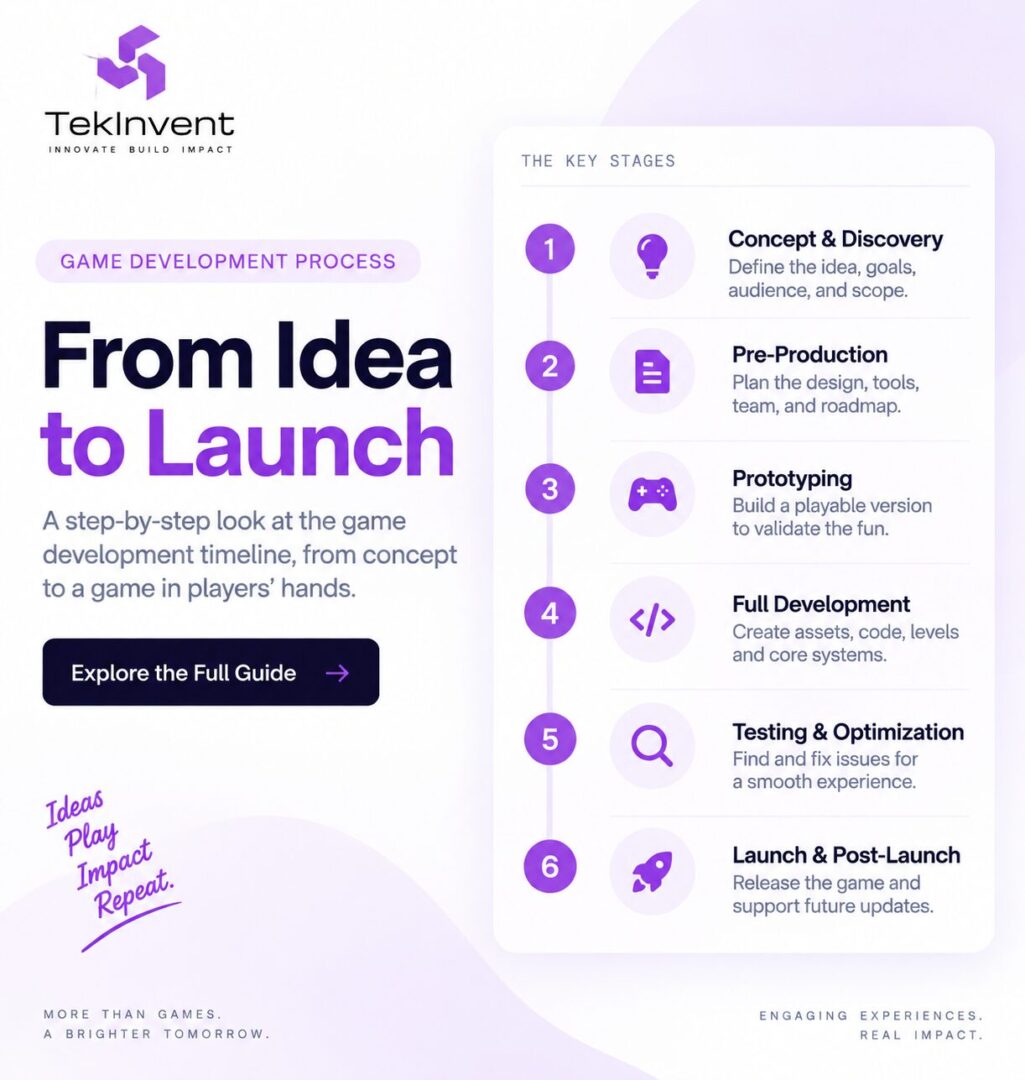
Stage 1: Concept and Discovery
Every game begins with an idea, but an idea is not yet a production plan.
During discovery, the team needs to determine what the game actually is.
The core gameplay loop should be defined first. Developers need to understand what players repeatedly do and why that activity should remain engaging.
The team also needs to identify the genre, target audience, intended platforms, art direction, monetization model, major features, technical requirements, and approximate production scope.
A mobile puzzle game might have a relatively straightforward discovery process.
A cross-platform multiplayer RPG requires considerably more planning because decisions about networking, backend architecture, progression, economies, character systems, content, and infrastructure can affect the entire project.
A strong discovery stage prevents the team from spending months developing a game whose fundamental requirements are still changing.
Stage 2: Pre-Production
Pre-production turns the concept into something the team can realistically build.
This stage may involve a Game Design Document, technical planning, early art direction, level concepts, interface planning, engine selection, production scheduling, and identification of technical risks.
The team may also determine which features belong in the initial release and which can wait.
That distinction matters.
A common reason game projects become difficult to finish is that every interesting idea becomes a launch requirement.
Additional characters require art and animation.
Additional environments require assets, lighting, level design, sound, and testing.
Additional game modes may require separate rules, interfaces, balancing, and QA.
Scope can therefore expand much faster than expected.
Good pre-production establishes boundaries before full production begins.
Stage 3: Game Prototyping
A prototype answers one of the most important questions in development:
Is the game actually enjoyable?
It does not need final graphics or polished animations.
A racing prototype might contain a basic vehicle and an unfinished track. A platformer may use simple shapes instead of final characters. A combat game might initially test only movement, attacks, damage, and enemy behavior.
The objective is to validate the core experience before committing large amounts of time and money to production.
Current industry research strongly supports this approach. Unity’s 2026 Game Development Report says 67% of surveyed developers keep prototyping to three months or less. Of those surveyed, 46% reported spending one to three months on prototyping and 21% less than a month. Unity
Unity also reports that 48% of surveyed studios have become more selective about which prototypes they pursue, while 26% increased their focus on rapid, low-fidelity prototypes. Unity
This makes prototyping a risk-management stage, not wasted development time.
Discovering after four weeks that a mechanic needs redesigning is far less expensive than discovering the same problem after twelve months of production.
Stage 4: Full Game Production
Production is usually the longest stage of the video game development timeline.
This is where the prototype becomes a complete game.
Programmers build gameplay systems, interfaces, AI, physics, progression, saving, networking, backend functionality, and platform-specific systems.
Artists create characters, environments, props, textures, animations, effects, and interfaces.
Designers build levels, missions, economies, progression systems, tutorials, encounters, and other player experiences.
Sound designers and composers create effects, music, dialogue, and environmental audio.
For larger projects, these activities happen simultaneously.
The duration depends heavily on how much content needs to be produced.
A game containing ten small levels requires a different schedule from one containing a large open world with dozens of quests.
This is why estimating a game from its genre alone is unreliable.
How Long Does a Simple Mobile Game Take?
A relatively focused casual mobile game may take around two to six months from planning through release, depending on its features and level of polish. Algoryte
A simple puzzle or hyper-casual concept can sometimes move faster, especially if the gameplay loop is straightforward and online functionality is limited.
However, “mobile” does not automatically mean simple.
A mobile game may still contain multiplayer functionality, social systems, payments, advertisements, progression, cloud saves, analytics, leaderboards, live events, and substantial content.
Each requirement adds development and testing.
The target devices also matter because developers need to make sure the game performs reliably across the intended hardware range.
How Long Does an Indie Game Take?
An indie game can take anywhere from several months to several years.
The term indie describes the production environment more than project complexity.
One indie developer might build a small puzzle game alone.
Another independent studio might create a large RPG with dozens of hours of content.
Recent industry guidance places a mid-sized indie game roughly in the six-to-eighteen-month range, although projects can fall well outside it. Algoryte
Team size also changes the equation.
A solo developer may personally handle programming, design, art, testing, marketing, and release management. A ten-person team can perform several of those tasks simultaneously.
However, adding people does not reduce development time proportionally.
Larger teams also require management, communication, asset pipelines, version control, reviews, and coordination.
Does 2D Game Development Take Less Time?
It can, particularly when the project has a focused art style and straightforward mechanics.
A small 2D game may avoid some production work associated with 3D modeling, materials, rigging, complex lighting, and three-dimensional environments.
However, 2D should not automatically be treated as faster.
A hand-animated game containing thousands of unique frames can require enormous artistic effort. Complex AI, procedural generation, multiplayer functionality, or large numbers of levels can also make a 2D project lengthy.
If a project is specifically planned around a flat visual style and the team needs dedicated production expertise, a 2D game development company may structure the art, animation, programming, level design, and testing pipeline around those requirements.
For a detailed comparison of the two formats, read TekInvent’s 2D vs 3D game development guide. This keeps the dimension-comparison intent on that article rather than duplicating it here.
Does 3D Game Development Take Longer?
Comparable 3D projects often have a larger asset pipeline.
A character may require modeling, UV work, texturing, materials, rigging, animation, effects, and optimization before it is ready for gameplay.
Environments can require models, terrain, textures, lighting, collision, effects, and level design.
The camera can also introduce requirements that do not exist in traditional 2D games.
For projects where three-dimensional environments are fundamental to the experience, an experienced 3D game development company can plan these dependencies before production begins.
But 3D does not automatically mean years of development.
A focused low-poly game with a small environment can be completed much faster than a huge, content-heavy 2D title.
Scope remains the more useful predictor.
How Much Time Does Multiplayer Add?
Multiplayer can significantly affect the game production timeline because developers are no longer designing only what happens on one device.
Players need to communicate with servers or other clients.
The project may require matchmaking, lobbies, synchronization, authentication, player accounts, leaderboards, inventories, anti-cheat measures, server infrastructure, and reconnection handling.
Developers also need to consider latency.
Something that works perfectly in local testing may behave differently when players are hundreds or thousands of miles apart.
Testing requirements increase because developers need to reproduce network conditions, simultaneous players, server failures, exploits, and unusual gameplay situations.
A multiplayer feature should therefore be included in architecture and scheduling from the beginning rather than added shortly before launch.
How Much Time Do Art and Animation Add?
Art production is one of the easiest parts of a game schedule to underestimate.
Imagine that a game needs 20 playable or important characters.
Creating a character does not necessarily end when the artwork or model is finished.
Characters may require multiple outfits, expressions, movement animations, combat animations, effects, sounds, collision setup, and testing.
Environments have similar dependencies.
One additional location can create work for concept artists, environment artists, level designers, programmers, lighting artists, sound designers, and testers.
The visual ambition of the game therefore needs to match the production resources available.
Stylized art can sometimes reduce certain production requirements, but even stylized games need consistency and polish.
Stage 5: Alpha Development
Alpha is an important milestone because the major systems of the game should now exist, even if they are not fully polished.
At this point, the team can begin evaluating the game as a complete experience rather than as separate systems.
Developers may discover that mechanics that worked independently do not work as well together.
Progression might feel too slow.
Enemies may be too easy.
Levels may need redesign.
Performance problems may appear once the complete environment and assets are loaded.
Alpha therefore begins an intensive period of integration, iteration, balancing, and bug fixing.
Teams should not assume that reaching feature completion means the game is ready to ship.
Stage 6: Beta, QA, and Optimization
Testing can occupy a significant part of development, especially for complex games.
QA teams look for crashes, progression blockers, graphical issues, broken interactions, save problems, performance drops, control issues, and unexpected combinations of gameplay systems.
Players can behave in ways developers never anticipated.
A door that works correctly during normal play might break when a player approaches it while carrying a particular object after completing a specific mission.
The larger the game becomes, the number of possible interactions increases.
Optimization also becomes important.
Developers may need to reduce memory usage, improve frame rates, optimize assets, reduce loading times, and test different hardware configurations.
Cutting QA to meet an unrealistic deadline can simply move problems from development into launch.
Platform Choice Changes the Timeline
Developing for one platform is generally easier to schedule than releasing simultaneously across several.
PC development needs to account for different hardware configurations.
Mobile development may need testing across numerous screen sizes and device capabilities.
Console releases introduce platform-specific requirements and certification processes.
Cross-platform multiplayer adds another layer because gameplay, networking, accounts, and updates need to behave consistently across different environments.
This does not mean a project should avoid multiple platforms.
It means platform strategy should be established during planning rather than near release.
A team may also choose a staged rollout, launching on one platform first and expanding after the initial version becomes stable.
Why Scope Creep Delays Games
Scope creep happens when the project keeps growing after production begins.
A team starts with ten levels and decides to build twenty.
One multiplayer mode becomes three.
A basic customization system expands into hundreds of items.
The game now needs crafting.
Then someone suggests vehicles.
Every addition sounds manageable when viewed individually.
Together, they can change the entire production schedule.
Unity’s current industry research shows why studios are becoming more cautious. In its 2026 report, 52% of surveyed developers said they were prioritizing smaller-scale projects as a way to reduce risk. Unity
A smaller game that reaches players and receives meaningful polish can be more valuable than an ambitious project that continually expands without reaching launch.
Changing the Core Mechanic Can Reset Months of Work
Some changes are much more expensive than others.
Changing a menu icon late in production may be manageable.
Changing the fundamental movement system can affect animation, level design, enemy behavior, camera systems, controls, and testing.
Changing from single-player to multiplayer can require major architectural changes.
Changing art direction after hundreds of assets have been produced can also create substantial rework.
The earlier the team validates high-risk decisions, the more predictable the timeline becomes.
This is another reason prototyping deserves its own development stage.
How Can You Shorten the Game Development Timeline?
The most effective way to reduce development time is usually not adding more developers.
It is reducing uncertainty and unnecessary scope.
Start with one clear gameplay loop.
Create a prototype before producing large amounts of final content.
Separate launch requirements from ideas that can become future updates.
Select platforms early.
Choose an art direction the team can realistically produce at scale.
Identify technically risky systems before full production.
Review development builds regularly rather than waiting until the end.
The current industry trend toward rapid prototyping supports this approach. Unity reports that only 9% of surveyed developers spend more than three months prototyping, while 67% keep it within three months. Unity
Fast development should come from better decisions, not from removing necessary testing.
Should You Develop an MVP or the Complete Game?
For new concepts, an MVP or vertical slice can significantly reduce risk.
An MVP tests whether the core mechanics work.
A vertical slice usually goes further by presenting a small portion of the game at something closer to final quality.
For example, instead of immediately producing 50 levels, the team might create one highly representative level containing the main gameplay, final-style artwork, enemies, interface, audio, and progression elements.
That build can reveal whether the project is technically feasible and whether the production assumptions are realistic.
It can also help stakeholders understand what the finished product may feel like before funding full production.
This does not necessarily shorten every calendar schedule.
It can prevent the much larger delay caused by discovering fundamental problems halfway through production.
Realistic Scheduling Is Better Than Promising the Fastest Launch
A game can technically be developed quickly if scope is aggressively reduced.
That does not mean every game should be rushed.
Players experience the complete product, not the production schedule.
Broken controls, crashes, poor performance, repetitive content, bad balancing, and unfinished systems can damage the launch even if the project technically meets its deadline.
A useful schedule therefore includes time for iteration.
Games are interactive products. Developers often need to play them repeatedly before they understand what needs to change.
The timeline should provide room for those discoveries.
How Should Businesses Estimate Their Game Development Time?
Start by writing down the game in concrete terms.
Define the genre, platforms, visual direction, core mechanics, multiplayer requirements, number of characters, approximate number of environments or levels, progression systems, monetization, backend requirements, and launch expectations.
Then identify what must exist for version one.
Separate that from what would simply be nice to have.
The development team can break the remaining scope into systems, assets, content, integrations, and milestones.
Dependencies can then be identified.
For example, level designers may need certain gameplay systems before they can finalize levels. Animators need character rigs. Multiplayer testing requires networking functionality. Final optimization needs representative game content.
A schedule based on these dependencies is much more credible than choosing a release date first and forcing every development task into it.
When Should You Approach a Development Partner?
You do not need every level or character designed before discussing the project with developers.
You should be able to explain the idea, target audience, intended platform, main gameplay loop, visual direction, and major features.
An experienced game development company should then help turn those requirements into technical scope, production milestones, resource requirements, and a realistic timeline.
A good estimate should also explain its assumptions.
If the estimate assumes single-player gameplay and the project later becomes multiplayer, the schedule will change.
If five environments become twenty, the schedule will change.
If a mobile-only game becomes a simultaneous mobile, PC, and console release, the schedule may change.
Transparency about these assumptions is more valuable than an unrealistically precise launch date at the beginning of the project.
Planning for Launch Is Part of the Timeline
Development does not end when the final feature is coded.
Teams need to prepare store assets, descriptions, screenshots, trailers, age ratings where applicable, analytics, crash reporting, backend monitoring, release builds, and platform submissions.
Multiplayer or live-service games also need operational preparation.
Servers must be monitored.
Support processes need to exist.
The team may need the ability to deploy urgent fixes.
Marketing also needs to align with development so that promotional activity does not promise a release the production team cannot support.
Launch should therefore be treated as a development milestone rather than an administrative task added at the end.
The Timeline Continues After Release
For many modern games, launch is not the end of development.
Players discover bugs that internal testing did not reveal.
Balance changes may be necessary.
New devices or operating-system updates can create compatibility issues.
Developers may introduce new levels, characters, events, features, or downloadable content.
Live-service games require even more continuous work because players expect regular updates and stable online systems.
Businesses should therefore distinguish between the time to launch and the total product lifecycle.
A game may take eight months to release but continue receiving development work for years.
Final Thoughts
So, how long does it take to develop a game?
A tightly scoped casual or mobile game may take a few months. A more substantial indie or mid-sized project can require six months to well over a year. Large multiplayer, console, and AAA-style games may require several years. Industry estimates vary because scope, team structure, platform, art requirements, networking, and content differ dramatically from one project to another. Algoryte
A useful game development timeline should therefore be built around the actual production process rather than a generic number.
Concept and discovery establish what the team is building. Pre-production defines how it will be built. Prototyping proves that the core gameplay works. Production creates the complete experience. Alpha and beta expose problems that need iteration. QA, optimization, and launch preparation turn the project into something players can reliably use.
Current industry behavior also shows the value of controlling scope early. Unity’s 2026 research found that 52% of surveyed developers are prioritizing smaller-scale projects, while 67% keep prototyping within three months. Unity
For a new game, the most useful first question is therefore not “How quickly can we build everything?”
It is “What is the smallest version that proves this game is worth building?”
Once the core experience works, the team can expand content and features with far greater confidence.

Build Smart with The Right Team.
We bring expertise, technology, and trust you look for in your digital journey.