
Choosing an app development partner in Austin means comparing more than portfolios. The team you hire needs to understand your product, explain who will do the work, and support the app after release. This list highlights ten providers with Austin-area ties and mobile or app development offerings you can review.
TekInvent appears first as the featured company. The remaining providers are options to compare, not a claim of an independently verified ranking. Services and locations can change, so confirm the details directly before signing an agreement. The descriptions below rely on each provider’s publicly described work and focus on practical differences rather than unsupported awards or “best company” claims.
Providers were included when their public materials described mobile or app development and an Austin office, team, or service area. This is a shortlist, not a review of delivery quality or a guarantee that a particular team is available. Confirm who would do the work, where they are based, and whether the listed service matches your project.
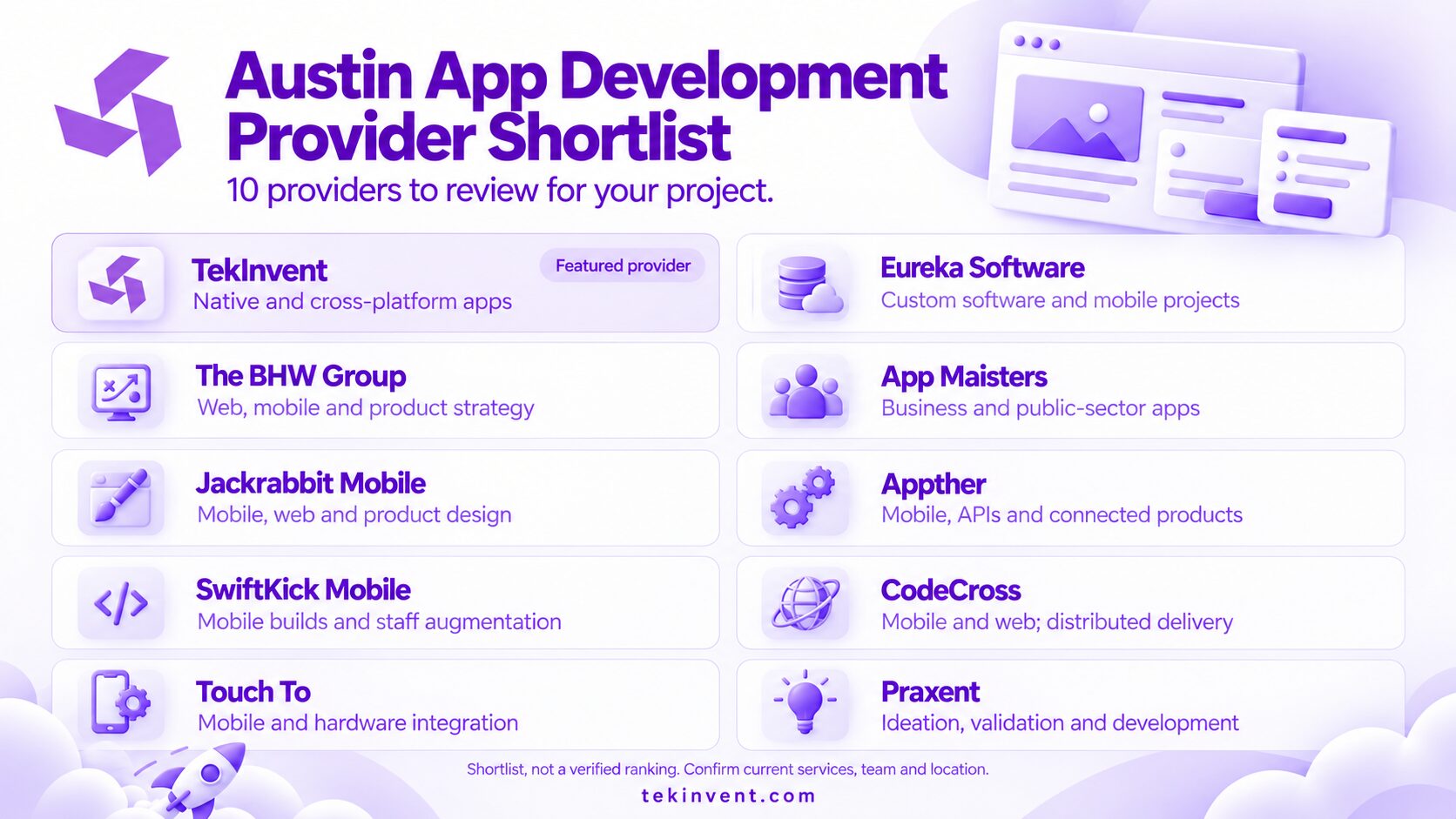
10 Austin app development providers to consider
1. TekInvent
TekInvent’s Austin service page describes native iOS and Android development alongside Flutter and React Native work. It also outlines game app development, design, testing, launch, and ongoing support. This broad service mix may suit a business that wants to discuss platform options and delivery stages with one provider.
Before you proceed, ask which people will work on your project, what work is handled in-house, how decisions and scope changes are documented, and what post-launch support includes. Review the proposed team and past work that resembles your product rather than treating a service list as proof of fit.
2. The BHW Group
The BHW Group describes itself as an Austin web and mobile app development agency. Its public materials cover product strategy, interface design, application development, deployment, and ongoing refinement. That combination may be worth reviewing if your project needs both mobile software and supporting backend or web components.
Ask how the company scopes work that spans multiple platforms and systems. A proposal should make clear which interfaces, services, integrations, and testing activities are included, along with how handoff or long-term maintenance will work.
3. Jackrabbit Mobile
Jackrabbit Mobile’s Austin pages describe mobile and web app development, product design, strategy, and work across iOS, Android, and cross-platform projects. Its published portfolio includes different kinds of digital products, so review individual examples to see whether the team’s experience lines up with your users and operating model.
For a project that starts as an idea or prototype, ask what discovery produces before development begins. Find out who validates user flows, what decisions are needed from your team, and how the company handles a feature that proves too large for the first release.
4. SwiftKick Mobile
SwiftKick Mobile is an Austin-based mobile design and development studio. Its site describes strategy and discovery, product design, mobile development, app improvements, and staff augmentation. Businesses with an existing product or internal engineering team may want to ask how the studio can work within an established codebase and release process.
Ask whether the engagement is a complete product build, a focused redesign, or added engineering capacity. Those are different kinds of work, and the proposal should identify the expected deliverables, decision owners, and the team members assigned to the project.
5. Touch To
Touch To describes itself as Austin-based and lists UX/UI design, full-stack mobile development, web development, and hardware/software integration. Its model may be relevant when an app is one part of a larger digital product or needs to connect with devices, services, or existing business systems.
If your project includes hardware or interactive experiences, ask the team to separate the mobile interface from device, backend, and integration responsibilities. Confirm who owns testing across the complete setup, including what happens when a connected component is offline or unavailable.
6. Eureka Software
Eureka Software is an Austin software development agency. Its public work includes custom applications and a mobile app project, alongside broader software design, development, and support. It may be a candidate for businesses whose mobile product is connected to a wider custom software initiative.
Ask for examples that show how the mobile app works with the rest of the system. A portfolio screenshot alone will not tell you how data is stored, how staff use the product, or who maintains the software after launch.
7. App Maisters
App Maisters lists Austin app development services and describes custom mobile solutions for businesses, including work for government and higher education organizations. Buyers in those environments may want to discuss accessibility, security review, procurement requirements, and how operational staff will manage the product.
Treat certifications or broad sector claims as a starting point for questions, not a substitute for project-specific evidence. Ask who handles compliance-related requirements, what documentation is delivered, and whether your internal security or procurement team needs to review the plan before work starts.
8. Appther
Appther offers mobile development for iOS, Android, and cross-platform products, and its Austin materials describe work involving SaaS, hardware-connected products, healthcare, and other sectors. Its listed services extend into backend systems, APIs, integrations, and release support.
For a product that connects to a device or an existing platform, ask how the team proves the integration works under real operating conditions. Clarify which parts depend on third-party systems, what access or test equipment is needed, and how issues will be diagnosed after deployment.
9. CodeCross
CodeCross describes itself as an Austin studio focused on mobile and web apps. Its public materials emphasize planning, product design, development, and launch. The company also states that its delivery team operates from Pakistan with working-hour overlap for US clients, a detail worth understanding before you choose a communication model.
Ask who will attend planning and review meetings, where engineering decisions are made, and how you will see progress between demos. A distributed setup can work well when access, ownership, response times, and documentation are explicit in the engagement plan.
10. Praxent
Praxent provides mobile app services covering ideation, validation, design, and development. Its public description discusses native, hybrid, and responsive approaches. For a company evaluating several delivery models, it may be useful to ask how the proposed approach fits the product’s device needs and existing digital services.
Confirm the team’s current Austin presence and the specific people assigned to your engagement. Ask how the proposal treats accessibility, testing, app-store release tasks, and maintenance; these details can differ from one project to another.
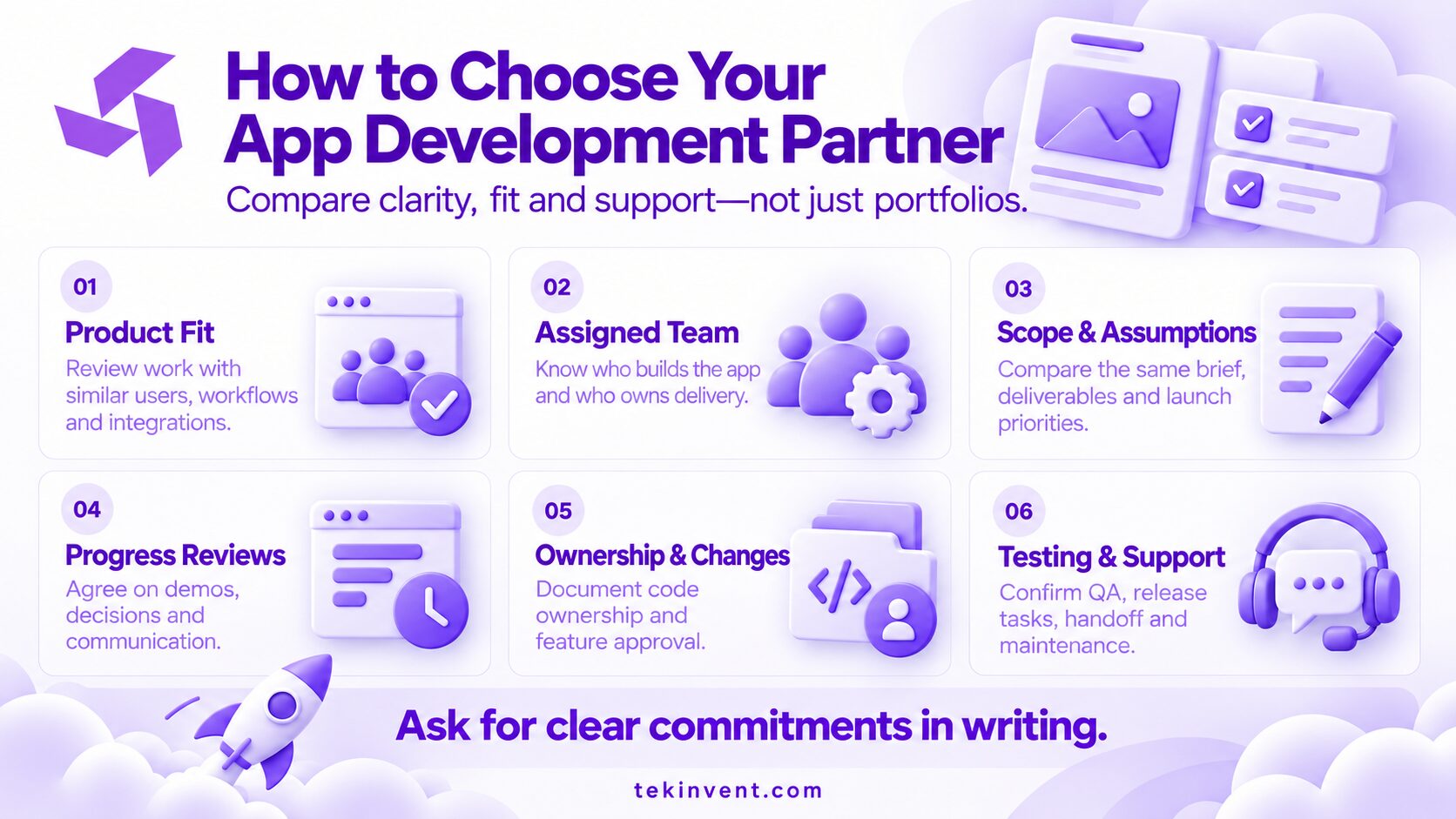
How to choo se among Austin app developers
The strongest candidate is the team whose process and experience fit your actual product constraints. Start by giving each provider the same short brief: target users, core workflows, required platforms, systems to connect, launch priorities, and any security or accessibility needs. Consistent inputs make the proposals easier to compare.
Then review each response for specifics. Does it name the work products and assumptions? Does it distinguish launch requirements from future features? Does it identify the roles on the delivery team and the way you will review progress? A proposal that answers these questions gives you a clearer basis for selection than a broad promise to build a complete app.
Check relevant work, not just logos
Look for a product with comparable workflows, integrations, or user conditions. A consumer booking app, an internal field tool, and a connected-device product can all be mobile apps, but they test different skills. Ask what the team actually delivered on the example and which responsibilities belonged to the client or another vendor.
Confirm ownership and change control
Before work starts, document who owns the source code, designs, accounts, and project materials. The agreement should explain how new requests are estimated and approved. Without that process, small feature changes can lead to confusion about cost, timing, or acceptance.
Plan for the months after launch
Ask who handles bug reports, operating system updates, store submissions, monitoring, and user support. If you have an internal team, clarify what documentation and technical handoff it receives. If the development partner will continue supporting the app, define how requests are prioritized and how that work is billed.
When you are ready to discuss your project with the featured provider, review TekInvent’s mobile app development company in austin page and prepare a short brief with your platforms, core features, and existing systems. That context makes an initial conversation more useful without requiring you to have every detail finalized.
Compare Your App Idea With a Clear Project Scope
TekInvent can discuss the users, features, and platform needs behind your Austin app.
Questions to ask before signing
Use the first conversations to test how each provider handles uncertainty, not only how confidently it presents a solution. Questions like these can surface important differences:
- Who will be on the project team, and who is accountable for delivery?
- What assumptions could change the scope or schedule?
- How will designs, working builds, and decisions be reviewed?
- Which integrations require credentials, vendor approval, or separate fees?
- What does testing cover, and who decides whether a release is ready?
- What happens if a requested feature is deferred or needs a different approach?
- What support, documentation, and handoff are included after launch?
Listen for direct answers and ask for unclear commitments in writing. If a provider describes an integration as simple, for instance, ask what systems and data are included and who resolves failures. If it says the app will scale, ask what usage assumptions and technical decisions that statement depends on.
Choose for fit, delivery, and support
There is no single Austin app development company that suits every project. The right choice depends on your app’s users, technical needs, operating environment, and the way your organization wants to work with a delivery team. Use the shortlist to build a few serious conversations, then compare proposals against the same scope.
Favor clarity over broad promises. You should understand what will be built, who will build it, how progress will be reviewed, and what happens after release. Those answers help you select a partner whose working model fits the product and the people who will depend on it.

Build Smart with The Right Team.
We bring expertise, technology, and trust you look for in your digital journey.