Restaurant app development cost in Dallas depends on what the restaurant needs the product to do. A branded menu and pickup form is a smaller project than a multi-location platform with loyalty, payments, delivery dispatch, and point-of-sale (POS) integration. The first step is to decide which operational problem the app should solve and what the restaurant can support after launch.
There is no reliable estimate from a feature name alone. “Online ordering” can mean a simple request sent to staff or an order that syncs with inventory, payment, kitchen operations, and delivery. Define the workflow and assumptions before comparing proposals.
Choose the restaurant’s operating model
Start with how customers will use the app. Will they order for pickup, delivery, dine-in, catering, or a combination? Is the product for one location or multiple Dallas-area locations? Will delivery be handled by restaurant staff, a third-party service, or both?
These decisions affect menus, availability, taxes and fees, delivery zones, kitchen timing, and customer communication. Map an order from browsing through completion. Include who accepts it, who prepares it, how changes are handled, and how staff close the order.
The app should fit the restaurant’s existing service flow. If the kitchen does not have a reliable process for seeing digital orders, a customer interface alone may create missed tickets. Include the people who handle orders during busy periods when defining requirements.
Features that affect project scope
Menu and ordering
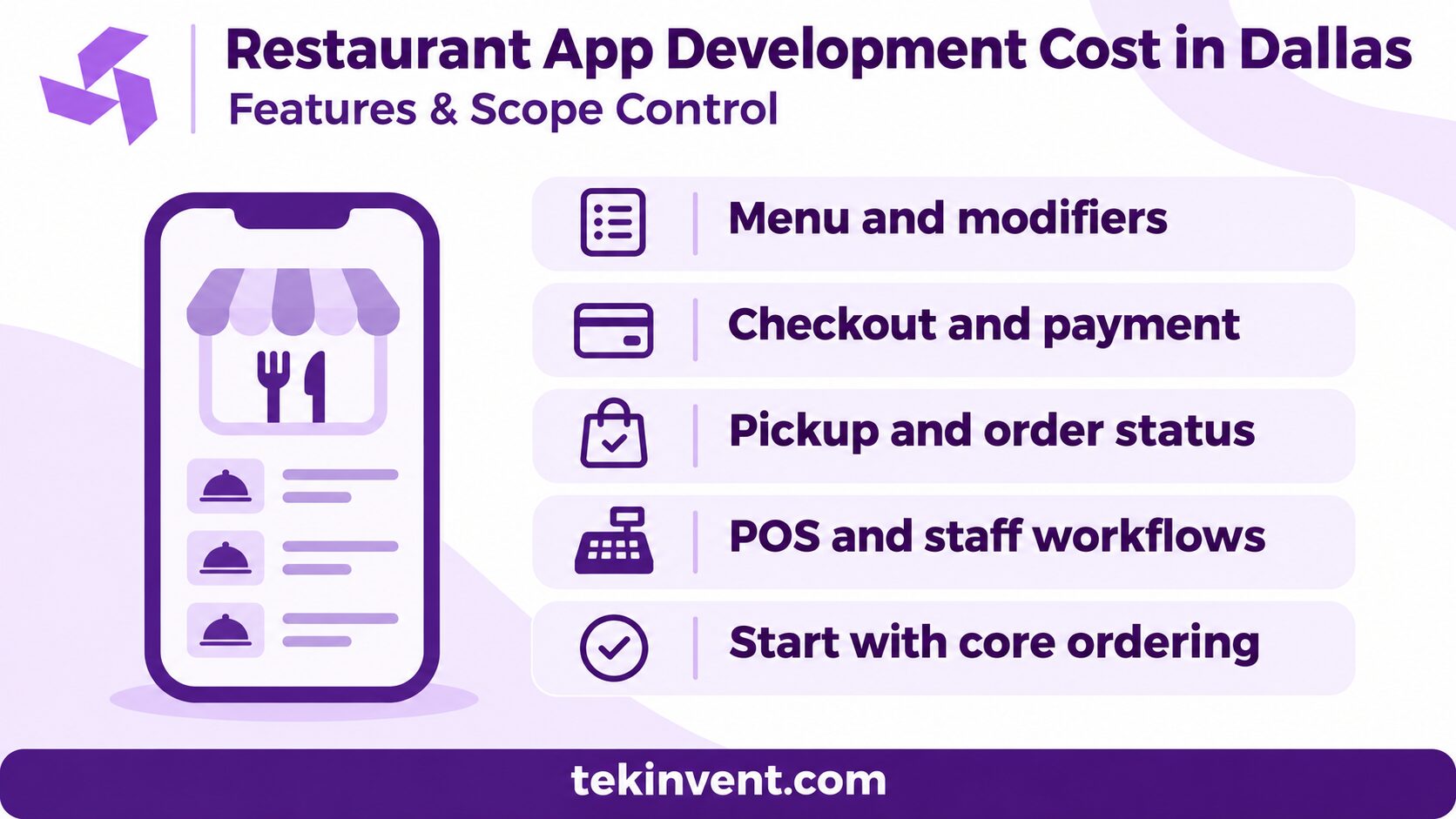
Menu features may include categories, item descriptions, photos, modifiers, dietary details, add-ons, combos, and time-based availability. Complex customization requires clear rules. For example, a meal may require a side, allow a limited number of toppings, or restrict substitutions. Staff need a manageable way to update those rules.
Checkout and payment
Checkout can include saved details, taxes, tips, service fees, coupons, gift cards, receipts, and refunds. Define when a payment is authorized or captured and how order cancellation affects it. Payment providers have their own technical requirements and recurring fees, which should be included in planning.
Pickup, delivery, and order status
Pickup requires realistic preparation estimates and instructions. Delivery can add dispatch, addresses, delivery zones, driver status, contact procedures, and proof of completion. If third-party couriers are used, confirm what their integration can send and receive.
Loyalty and customer accounts
Accounts can support order history and saved preferences, while loyalty may involve points, rewards, tiers, expiration rules, and redemption. A simple promotion may not need a full loyalty engine. Add complexity only when it supports a clear retention or service goal.
Staff and administration
Restaurant teams need tools for menu updates, order status, location hours, refunds, user access, and issue resolution. Staff controls are easy to overlook because they are not part of the customer demo, but they are essential to daily operation.
POS and other integrations
Connecting to a POS system can reduce manual order entry, but the effort varies by provider, configuration, and available API access. The project needs to define what information moves, when it moves, and which system remains the source of truth for menu and order status.
Ask the POS vendor about documentation, credentials, sandbox access, approval, support, and any integration fees. Test item availability, modifier rules, duplicate orders, delayed responses, and outages. A connection that works only for a clean sample order may fail when the restaurant is busy or a menu item is unavailable.
Other integrations may include payment services, delivery platforms, accounting, marketing tools, and customer support. List each required connection before requesting an estimate. Treat optional integrations as later scope if the first release can operate safely without them.
Dallas-specific planning considerations
The location matters through the restaurant’s actual service area and operating conditions, not through a generic city surcharge. A restaurant serving downtown pickup traffic may need different instructions and timing from one with suburban delivery zones. Define the locations, hours, and delivery rules that the app must support.
For a multi-location business, confirm whether menus and prices differ by location, whether orders can be routed to another kitchen, and how staff permissions work. Decide how the product handles location-specific closures and sold-out items. These questions help prevent one-size-fits-all assumptions in the design.
How to keep the project within scope
Choose one core outcome for the first release. A restaurant may focus on direct pickup ordering, reliable menu updates, or a smoother loyalty redemption process. Support the complete path for that goal and postpone features that do not contribute to it.
Separate requirements into launch needs and later options. For example, launch with one location and payment method before expanding to catering, subscriptions, and advanced promotions. This controls effort without leaving the first release unable to serve a real customer task.
Use a prototype to test menu discovery and checkout with customers. Ask staff to test the order queue and menu editor. Fix confusing steps before implementation. A short usability test can reveal that customers cannot find pickup timing or that staff need a faster way to pause an item.
Compare estimates by workstream
Ask each development partner to separate discovery, design, customer app or website, staff tools, integrations, testing, deployment, and post-launch support. The estimate should state the number of locations, platforms, payment flows, and order types included.
Look for assumptions about menu entry, data migration, POS access, delivery provider setup, copywriting, photos, and training. Confirm who is responsible for each. If an estimate excludes these tasks, include their cost and staff time in the restaurant’s own plan.
Budget for the ongoing costs too: hosting, payment processing, SMS or push notifications, maps, maintenance, support, and vendor updates. Assign someone to manage menu changes, access, and customer issues. A one-time build price does not represent the full cost of running the product.
Test operations before public launch
Run a staff pilot with realistic orders, including unavailable items, late preparation, refunds, and duplicate submissions. Confirm that the kitchen and front-of-house teams know where orders appear and who owns each status change.
Then launch with a defined audience or a limited set of locations. Track order completion, errors, support contacts, abandoned checkouts, and staff rework. If customers call to confirm every order, the status messages may be unclear. Use observed issues to adjust the flow before adding features.
Document a fallback if the app or integration is unavailable. Staff should know how to continue taking orders and how to reconcile them when service returns. Practice the procedure rather than leaving it in an operations manual no one has tested.
For broader commerce requirements, TekInvent’s ecommerce app development services may be useful to review. A mobile app development company Dallas can help scope the customer and staff workflows around the restaurant’s operating model.
Scope a Restaurant App Around Service Needs
TekInvent can help prioritize ordering, integrations, and staff tools for your first release.
Set clear order-state and kitchen rules
Give each order state a plain meaning: received, accepted, preparing, ready, out for delivery, or completed. Decide who is allowed to move an order to each state and whether the customer sees the update immediately. If a kitchen uses a separate ticket system, identify whether status changes come from that system or from staff in the app.
Think through timing under pressure. If a restaurant pauses online orders during a rush, staff need a quick way to do it. If the kitchen cannot meet the displayed preparation time, the product should let the team adjust the estimate and notify customers. Build these controls into the staff workflow instead of relying on a manager to contact every customer individually.
Use test orders to walk through the process at a realistic pace. Include a dine-in order if it is in scope, an item that becomes unavailable, a customer who requests a change, and a refund. Confirm that the kitchen receives the right details and that customer support can see the order history.
Plan multi-location management deliberately
For a restaurant group, decide which settings are shared and which vary by location. Brand content may be common, while hours, menu availability, prices, taxes, pickup instructions, and delivery areas may differ. Define whether customers choose a location before browsing or whether the site recommends one based on their address.
Staff permissions should reflect these boundaries. A manager may need to update one store’s menu, while a central administrator can manage all locations. Test that a location-specific change does not unintentionally affect every store. Also decide what the customer sees when the nearest location is closed or has paused orders.
This detail matters when estimating because the admin model affects data structure, interface behavior, and testing. A multi-location rollout may be easier when the first version supports a small group of stores with the same menu rules, then expands after staff have learned the process.
Plan content and menu maintenance
Menu information changes throughout the year. Decide whether staff can update items from a phone, tablet, or desktop, whether changes need approval, and whether the POS remains the source of truth. Include a preview so staff can check prices and modifiers before publishing an update.
If the restaurant relies on photos, establish a consistent way to crop, compress, and replace them. Give content editors clear fields for item names, descriptions, and dietary information. This can prevent a future developer from becoming the bottleneck for ordinary menu maintenance.
Coordinate the app with front-of-house service
Decide how staff will recognize online orders, answer customer questions, and distinguish pickup from dine-in or delivery tickets. Make the order identifier easy to find across the customer confirmation and staff tools. If employees need to search by name, phone number, or order number, specify which lookup is reliable and appropriate.
Make the estimate reflect how the restaurant works
Restaurant app development cost becomes easier to compare once the business has mapped its ordering model, locations, staff workflow, and integrations. Give each partner the same requirements and ask for assumptions in writing. That helps the restaurant see what is included and what it will need to operate itself.
Control scope by making the first release useful, not by removing basic reliability or testing. A complete workflow for a smaller service can teach the business more than a broad feature set that staff cannot support.

Build Smart with The Right Team.
We bring expertise, technology, and trust you look for in your digital journey.