Food delivery app development cost depends on the service the business wants to operate. A customer ordering interface is only one part of the product. Restaurants need a way to receive and manage orders, drivers need dispatch and delivery workflows, and operators need tools for support, payments, and exceptions.
There is no useful project price without a defined scope. The number of roles, ordering rules, integrations, delivery model, and support requirements all affect effort. Break those pieces down before comparing estimates so the budget reflects the complete service rather than a set of customer-facing screens.
Decide how the delivery business will work
Start with the operating model. Will the app serve one restaurant, a restaurant group, or a marketplace? Will merchants use their own drivers, the platform’s fleet, or a mix? Will customers order for pickup, scheduled delivery, or immediate delivery? These choices affect the feature set and who is responsible when an order is delayed or incomplete.
Map an order from menu selection to completion. Include menu availability, taxes and fees, payment authorization, restaurant acceptance, preparation status, driver assignment, pickup, delivery confirmation, refunds, and customer support. Identify where a person needs to intervene.
Write down the business rules before estimating. How are unavailable items handled? Can a customer change an order after acceptance? What happens if the merchant rejects it? Which party receives a refund? Unclear policies become expensive rework when they are discovered during implementation.
Customer features and their cost implications
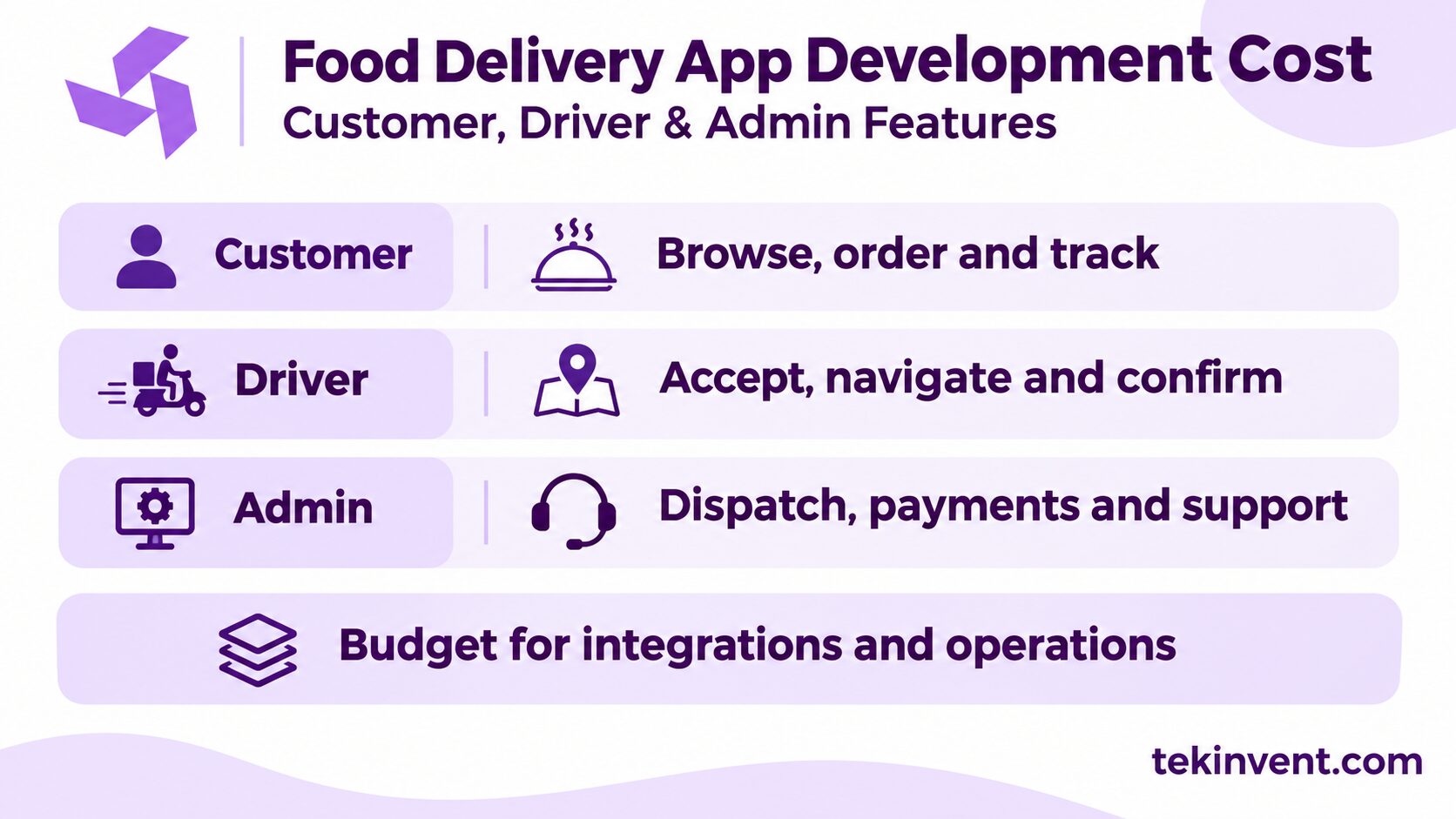
The customer experience may include browsing, search, dietary filters, item customization, cart management, checkout, delivery instructions, order status, ratings, and support. Each adds design and testing work, especially when menu data, location, payment, and notifications must stay in sync.
Prioritize the core path first: find an available item, place the order, pay, and understand the status. Add personalization or advanced loyalty only after the ordering workflow is clear. If customers must create an account before browsing, test whether that requirement fits the business; every extra step can affect completion.
Menu customization can be complex. A product may have required options, optional add-ons, item limits, combos, substitutions, and time-based availability. Define these rules in a way restaurant staff can manage without developer help for every menu change.
Restaurant and merchant tools
Restaurants need accurate menus, opening hours, item availability, incoming order alerts, acceptance controls, preparation status, and an order history. If the product serves multiple merchants, each needs permission to manage only its own locations and menu data.
Consider how the app connects to existing point-of-sale or order management tools. A direct integration can reduce re-entry, but the effort depends on vendor access, data formats, and menu rules. If no reliable connection is available, plan a manual order workflow and measure the added labor.
Restaurant operations need an exception path. Staff should be able to flag an item as unavailable, request a substitution, or notify the customer of a delay according to agreed policies. Test those cases before launch, not only a successful order with a perfect menu.
Driver and dispatch functionality
The driver workflow may include availability, trip offers, pickup details, navigation handoff, delivery instructions, status changes, proof of delivery, and issue reporting. Dispatchers may need a view of active orders, unassigned deliveries, driver capacity, and delays.
Location tracking should have a defined purpose. Decide when collection starts and stops, who can see the location, and how frequently it updates. Drivers should have a safe way to report a problem without interacting with a screen while driving. Consider low connectivity and how status changes are synchronized later.
Automated assignment can be postponed until dispatch rules are clear. A manual process may be more appropriate for a limited pilot. If automation is part of the first release, define constraints such as delivery zones, vehicle capacity, pickup timing, and fairness across drivers.
Admin, payment, and support work
An admin console can manage merchants, users, delivery areas, fees, promotions, refunds, and customer issues. Admin features are often underestimated because they are less visible to customers but necessary to operate the service. Define who can perform sensitive actions and what records the business needs to review them.
Payment processing adds integration and reconciliation work. Specify when a payment is authorized or captured, how cancellation and refund rules work, and how disputes are handled. The payment provider’s APIs and policies affect implementation, so confirm them before finalizing the scope.
Customer support needs access to the right order details and a reliable way to correct errors. Establish whether support can adjust an order, issue a refund, or contact a restaurant or driver. Build only the permissions that match the policy.
Integrations and data shape the estimate
Potential integrations include maps, payment processing, restaurant POS systems, SMS or push notifications, customer support, identity services, and accounting. For every connection, document the data exchanged, the system of record, credentials, testing access, and behavior when the service is unavailable.
Third-party tools may charge recurring fees based on transactions, users, messages, or usage. These are operating costs, not necessarily part of the software build quote. Ask for a list of vendors and pricing assumptions so the business can plan the total cost of ownership.
Protect customer addresses, payment-related records, and driver information. Use a payment provider’s supported flow rather than storing card data directly without a justified reason and appropriate expertise. Set role permissions, retention rules, monitoring, and account recovery procedures.
How to estimate the project responsibly
Ask vendors to separate the estimate into discovery, design, customer app or website, restaurant tools, driver experience, admin console, integrations, testing, deployment, and support. Include the platforms to be supported and the workflows covered. A proposal should make exclusions visible.
The most useful cost factors to compare include:
- Number of user roles and interfaces
- Menu complexity and merchant self-service
- Delivery zones, dispatch rules, and tracking needs
- POS, payment, maps, and notification integrations
- Refund, substitution, cancellation, and support workflows
- Accessibility, localization, and device coverage
- Data migration, testing, and launch training
Do not reduce cost by removing the testing that confirms an order reaches the right merchant, payment status is accurate, and the driver receives correct instructions. Instead, reduce initial scope by supporting fewer order types, locations, or integrations while preserving a complete workflow.
Include operating costs after release
After launch, the business may pay for hosting, maps, messaging, monitoring, payment services, support, and software maintenance. It also needs staff to onboard restaurants, keep menus current, resolve disputes, and support customers. Estimate these responsibilities before deciding whether the business model can sustain the service.
Plan for ongoing changes to mobile operating systems, vendor APIs, menu rules, and delivery policies. Assign an internal product owner who can prioritize improvements and coordinate with engineering. Without an owner, routine operational issues may accumulate until a larger rebuild is needed.
A practical way to control scope
Choose a specific market or merchant group for the initial release. Support the core menu, checkout, merchant acceptance, dispatch, delivery status, and help path. Keep unusual promotions, complex memberships, and advanced route optimization for a later phase unless they are necessary to test the business model.
Before development, test menu and order flows with restaurant staff and representative customers. Verify how unavailable items, delayed orders, failed payments, and delivery problems are handled. Document who makes each decision and how the user is informed.
If the delivery product needs a broader commerce foundation, TekInvent’s ecommerce app development services may be useful to review. A mobile app development company can help scope the customer, driver, and merchant experiences against the chosen operating model.
Estimate the Full Delivery Workflow
TekInvent can help break down customer, merchant, driver, and admin requirements.
Connect features to the business model
The app’s fees and incentives should match how the service earns revenue and pays its partners. Decide whether revenue comes from merchant commissions, delivery charges, subscriptions, or another model. Specify who pays a promotion or refund and how the order record shows the breakdown. These policies influence checkout, merchant statements, and customer support tools.
Consider how the business will onboard restaurants and maintain menus. If every menu change requires a developer, the model may become difficult to operate across many merchants. A self-service editor can help, but it needs permissions, validation, previews, and a way to reverse mistakes. Include the training and support needed for restaurant teams to use it.
Track operational measures that affect both service and cost: order acceptance time, preparation delays, delivery exceptions, refunds, and support contacts. Decide which party can resolve each issue and what information they need. These signals can show whether a new feature reduces friction or merely shifts work from one group to another.
Design the customer communication rules
Customers need clear updates at meaningful points, not a notification for every internal event. Decide which messages are sent by push, text, or email; what information each contains; and how customers change their preferences. Keep sensitive account or payment details out of notification previews where possible.
Make the message match the actual order state. If a restaurant has not accepted the order, do not imply it is being prepared. If a driver is delayed, provide an updated expectation or a support option. Test messages for canceled orders, substitutions, partial refunds, and failed delivery so the customer does not receive contradictory updates.
Define merchant onboarding and content ownership
Set out how a restaurant joins the service, verifies its location, uploads a menu, and receives test orders. Decide who checks that prices, options, hours, and photos are accurate before customers can order. A self-service onboarding flow can reduce repeated setup work, but it needs validation and a support path for merchants who get stuck.
Clarify who can approve a menu change and when it takes effect. For a restaurant group, determine whether a central team controls shared items while local staff manage availability. These rules affect administration screens, permissions, and training, so include them before the platform is designed.
Compare proposals against the same service
Food delivery app estimates only become comparable when each describes the same operational model. Give every team the same role definitions, order flow, exception rules, integrations, and launch expectations. Ask what ongoing support and third-party fees are excluded.
That process makes it easier to choose a first release that is affordable to build and realistic to operate. It also helps the team learn from customer and restaurant use before expanding to more merchants or delivery areas.

Build Smart with The Right Team.
We bring expertise, technology, and trust you look for in your digital journey.