
Most app quotes are almost useless without the scope behind them.
One Houston company may be pricing a focused field-inspection app that works on a single platform. Another may need patient scheduling, payments, staff permissions, offline records, and connections to three existing systems. Both projects get called “a mobile app,” but they should not carry the same budget or schedule.
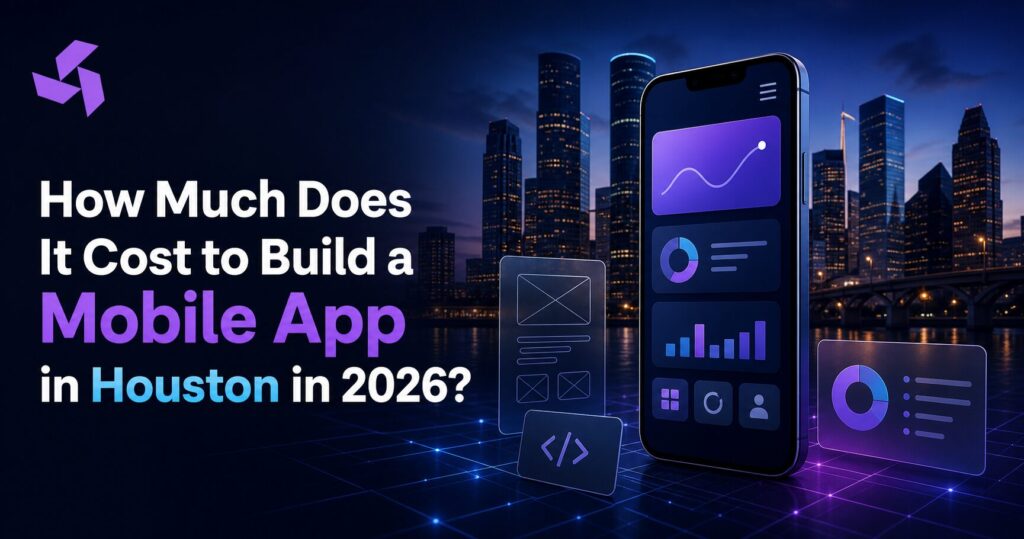
For planning purposes, a custom mobile app can range from roughly $25,000 for a tightly scoped first release to $300,000 or more for a complex platform. The number becomes meaningful only after you define the users, workflows, platforms, integrations, security requirements, and launch plan.
This guide breaks those decisions down so Houston founders and business teams can build a budget they can defend—not just collect a stack of unrelated estimates.
Mobile App Development Cost in Houston: Quick Planning Ranges
The ranges below are starting points for early budgeting. They are not fixed quotes, and they do not represent every agency, freelancer, or product team in Houston.
Prototype or discovery engagement: $5,000–$20,000
This stage commonly takes two to six weeks. It may include requirements, user flows, a clickable prototype, technical planning, and an initial release roadmap.
Focused MVP: $25,000–$60,000
A focused MVP often takes two to four months. The scope usually centers on one core workflow, a basic backend, authentication, and a limited number of integrations.
Mid-complexity business app: $60,000–$150,000
Projects in this range may take four to eight months. They often include multiple user roles, payments, an administration portal, API integrations, analytics, and broader testing.
Complex or regulated platform: $150,000–$300,000+
These products may require eight to fifteen months or longer. Typical requirements include enterprise integrations, compliance controls, offline workflows, advanced security, and large-scale operational features.
A useful quote should explain where the project sits within a range and why. If an estimate shows one large total without assumptions, deliverables, exclusions, and milestones, the comparison is not ready.
TekInvent’s Houston mobile app development team can turn an early idea into a scoped roadmap before full production begins.
Why App Development Prices Vary So Much
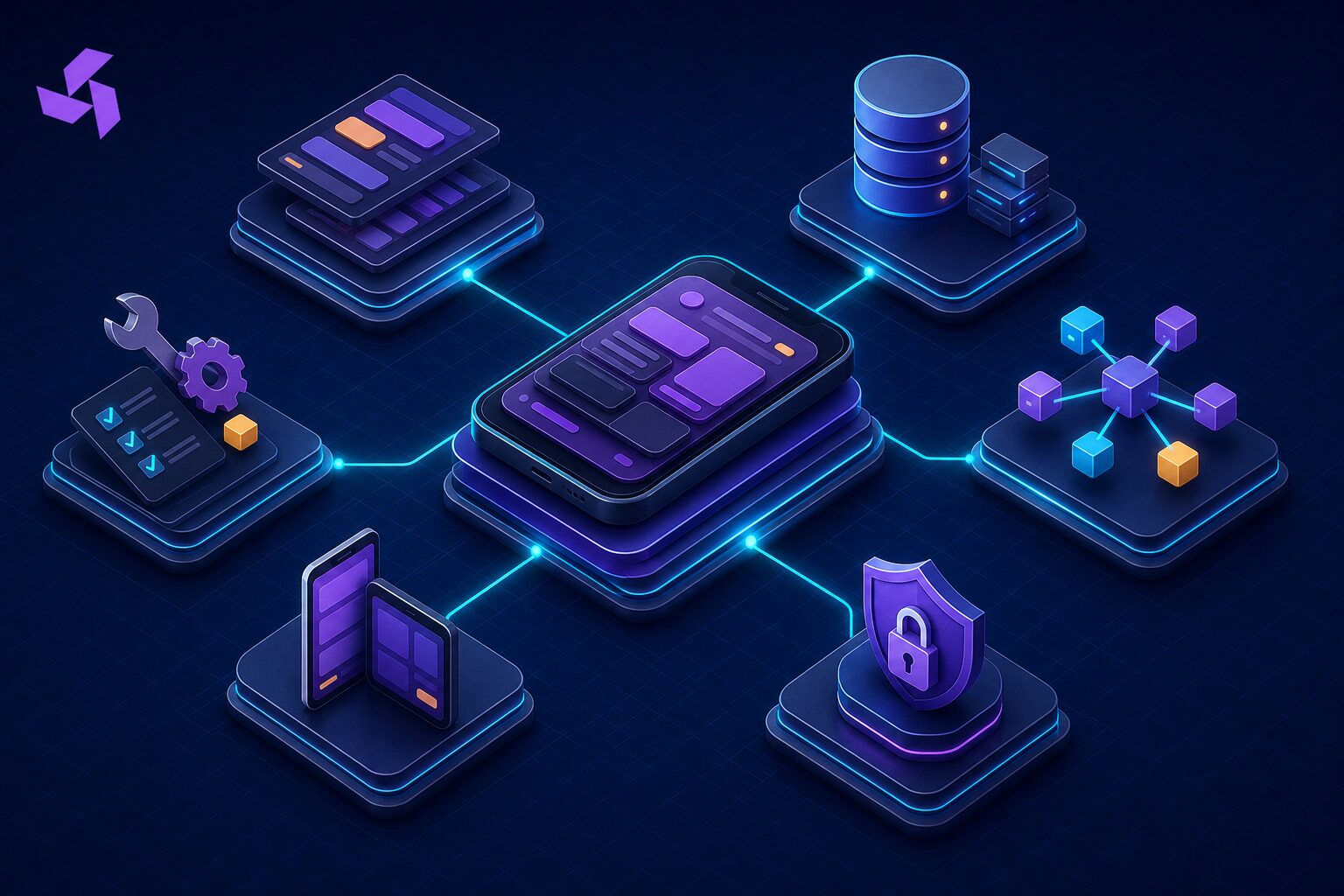
The cost is not determined by the number of screens alone. Ten screens connected to a complicated insurance workflow may require more work than fifty content screens.
The real drivers sit underneath the interface.
Product definition
Teams often start with a feature list but no agreement about who can do what, what happens when a step fails, or how an existing business process will change. Developers then have to resolve those questions during production, when every change is more expensive.
A short discovery phase can produce:
- Defined user roles
- Prioritized workflows
- Wireframes or a clickable prototype
- Integration requirements
- Technical risks
- A release plan
- Acceptance criteria for major features
Discovery is not paperwork for its own sake. It is a way to stop uncertain decisions from leaking into every sprint.
UI and UX design
A basic internal tool can use a restrained interface and familiar controls. A consumer product competing for downloads may need brand exploration, custom interactions, motion, accessibility work, usability testing, and several design rounds.
Design cost rises when the app serves different user groups. A logistics platform, for example, may need one experience for drivers, another for dispatchers, and a third for managers. Those are connected products, not one screen set copied three times.
Platform choice
Building separate native iOS and Android apps usually requires more platform-specific work than a cross-platform release. Native development can still be the right decision when the app relies heavily on device capabilities, demanding performance, platform-specific UI, or a long-term roadmap that justifies separate codebases.
Cross-platform development with Flutter or React Native may reduce duplicated work for many business apps, but it does not make the backend, product design, testing, or integrations disappear.
Compare TekInvent’s iOS app development services, Android app development services, and cross-platform app development options before choosing based on price alone.
Backend and administration
The mobile app is often the visible edge of a larger system. User accounts, permissions, notifications, reporting, content management, audit logs, and business rules usually live in backend services.
An admin portal can become a substantial part of the project. A clinic may need to manage providers and schedules. A field-service company may need to assign work, review submissions, and export reports. An ecommerce team may need inventory, refunds, promotions, and customer support tools.
If those operational screens are absent from a proposal, ask who is expected to run the app after launch.
Third-party integrations
Integrations are easy to name and difficult to estimate casually.
Payments, maps, identity providers, EHR systems, CRM platforms, ERP software, shipping services, analytics tools, and messaging providers all have different APIs and constraints. The cost depends on documentation quality, sandbox access, data mapping, error handling, security, and how much control the business has over the external system.
“Connect to our existing software” needs to become a specific technical task before the quote is reliable.
Security and compliance
Authentication is not the same as security.
Projects that handle protected health information, financial data, employee records, or sensitive industrial information may require encryption, role-based permissions, audit trails, retention rules, vendor reviews, threat modeling, and incident procedures. Compliance affects product design, infrastructure, QA, documentation, and ongoing operations.
Houston’s economy includes major healthcare, energy, manufacturing, logistics, and professional-services activity. Greater Houston Partnership publications identify these as significant regional industries, which helps explain why local mobile projects often involve operational systems rather than simple marketing apps.
Testing and release work
Testing should be visible in the estimate.
Apple recommends a mix of unit, integration, UI, and performance testing. Its App Store pathway also includes TestFlight for beta feedback before release. Android’s current architecture guidance similarly emphasizes testable components, persistent data models, and controlled testing of external dependencies.
That work includes more than finding obvious bugs. The team may need to test:
- Supported phones and operating-system versions
- Slow or missing connections
- Interrupted payments
- Push-notification behavior
- Permission changes
- Background and lifecycle events
- Accessibility
- Data migration after updates
- App Store and Google Play release builds
Skipping this work can make a quote look attractive right up to launch.

What Houston Businesses Commonly Need From a Mobile App
The city does not have one “typical” app. A useful estimate starts with the operating environment.
Healthcare and life sciences
A healthcare app may support appointments, intake, secure messaging, remote monitoring, care coordination, or internal clinical workflows. Costs increase when the product handles protected data, connects to health systems, or requires detailed access controls and audit records.
The expensive part is rarely the appointment calendar by itself. It is the surrounding responsibility: identity, consent, data exchange, exceptions, support, and documentation.
Energy and field operations
Field teams may need inspections, job assignments, safety checklists, photo capture, asset histories, or offline data collection in places with unreliable reception.
Offline support changes the architecture. The app must store work safely on the device, queue changes, resolve conflicts, and explain synchronization status without confusing the user. That is more involved than caching a few screens.
Logistics and transportation
Dispatch, route updates, proof of delivery, barcode scanning, location tracking, driver communication, and customer notifications create a network of related workflows. Real-time tracking also introduces battery, privacy, accuracy, and infrastructure decisions.
Professional services
Law firms, consultancies, property teams, and other service businesses often need client portals, document exchange, scheduling, approvals, billing, and status updates. These projects can begin with a narrow workflow and expand after adoption, which makes a well-defined MVP especially useful.
Native or Cross-Platform: Which Costs Less?
The honest answer depends on the product.
For many business apps serving both iOS and Android, a cross-platform approach can reduce duplicate interface and business-logic work. It may be a sensible route for an MVP or a product with conventional forms, accounts, content, payments, and API-driven workflows.
Native development may be worth the additional effort when the product needs:
- Heavy platform-specific functionality
- Advanced graphics or demanding performance
- Deep background processing
- Extensive Bluetooth or hardware integration
- Distinct iOS and Android experiences
- A roadmap where platform independence matters more than initial speed
Do not ask only, “Which option is cheaper?” Ask what will be cheaper to maintain after two years of feature requests, OS updates, and team changes.
How Features Change the Budget
Below are common features and the work hidden behind them.
User accounts
Email login is straightforward compared with enterprise single sign-on, social login, multi-factor authentication, delegated access, account recovery, and organization-level roles.
Payments and subscriptions
Payment screens are only one part of the workflow. The system also needs transaction state handling, receipts, refunds, failed payments, entitlements, reconciliation, and support tools.
Chat and real-time updates
Real-time communication adds infrastructure, message status, notifications, moderation choices, attachment handling, and offline behavior. A basic support inbox and a large-scale social chat product are not comparable features.
Maps and location
A map pin is simple. Live tracking, route optimization, geofencing, location history, offline maps, and dispatcher tools are separate capabilities with different costs.
Artificial intelligence
An app that sends a prompt to an existing AI service is different from a product with retrieval, private data, evaluation, guardrails, human review, model monitoring, and usage controls.
Ask what the AI feature must do when it is uncertain. That answer often reveals more scope than the demo.
Offline functionality
Offline access requires decisions about local storage, synchronization, conflict resolution, security, and recovery. It should be designed at the start, not attached after the online version is complete.
Costs That Often Sit Outside the Initial Build
A production budget should reserve money for the product after version 1.0.
Common ongoing or separate costs include:
- Cloud hosting and storage
- Email, SMS, maps, analytics, and other usage-based services
- Apple and Google developer accounts
- Monitoring and error reporting
- Security reviews
- Customer support
- Content and administration
- OS compatibility updates
- Bug fixes and performance work
- New features based on real usage
- App Store optimization and launch marketing
A common planning allowance for maintenance is roughly 15%–25% of the original build cost per year, but usage, compliance, integrations, and release frequency can push the figure in either direction. Ask vendors what “maintenance” includes; some plans cover only defects, while others include infrastructure, OS updates, monitoring, and a defined amount of product work.
How Long Does Mobile App Development Take?
A focused MVP often needs two to four months after requirements are stable. A mid-complexity business app may take four to eight months. A regulated or integration-heavy platform can take eight months or longer.
Schedule depends on more than development speed. Delays often come from:
- Slow stakeholder decisions
- Missing access to third-party systems
- Unresolved compliance requirements
- Late design changes
- Content that was never assigned to an owner
- External vendor approvals
- Inadequate testing time
A credible schedule names those dependencies and identifies who owns them.
For a closer look at the stages, see TekInvent’s guide to the mobile app development process for Houston businesses.
Freelancer, Local Agency, or Distributed Product Team?
Each model can work. The risk is choosing one that does not match the project.
Freelancer
A strong freelancer can be a good fit for a prototype, a narrow feature, or a product led by an experienced technical founder. The weakness is capacity: design, backend, mobile development, QA, DevOps, and product management may depend on one person or an informal network.
Local agency
A Houston agency can offer face-to-face discovery and familiarity with regional businesses. Local presence does not automatically prove technical depth, so evaluate the people assigned to the project, not just the office address.
Distributed team
A distributed company can combine US-facing product leadership with specialists in other markets. This may improve capacity and budget flexibility, but communication, ownership, documentation, and time-zone overlap need to be explicit.
Whatever model you choose, ask who will design the product, write the mobile and backend code, test releases, manage infrastructure, and support the app after launch.
What Should Be Included in a Mobile App Quote?
Before approving a proposal, look for:
- Scope and user roles: Who uses the product, and which workflows are included?
- Deliverables: Are design files, mobile apps, backend services, admin tools, and documentation named?
- Platform strategy: Native iOS, native Android, cross-platform, or a phased release?
- Integration assumptions: Which APIs are included, and who provides credentials and documentation?
- Security responsibilities: What controls, reviews, and compliance work are covered?
- Testing plan: Which devices, test types, environments, and acceptance steps are included?
- Release support: Does the team handle store preparation and submission?
- Source-code ownership: When and how does ownership transfer?
- Change process: How are new requirements estimated and approved?
- Post-launch coverage: What happens when users find an issue after release?
If two proposals cannot be compared against this list, the cheaper one may simply contain more omissions.
How to Reduce Cost Without Weakening the Product
Cut uncertainty and low-value scope before cutting quality.
Start with one measurable workflow
Choose the action that proves the product’s value. For a field app, that might be completing and submitting an inspection. For a clinic, it might be intake and appointment management. Build the smallest reliable loop around it.
Prototype risky interactions
A clickable design costs less to change than finished code. Use it to test navigation, roles, forms, and edge cases with actual users.
Delay features that do not validate the business
Advanced dashboards, broad customization, referral systems, and elaborate automation may be useful later. They do not all belong in the first release.
Use established services carefully
Payments, identity, notifications, and analytics often have proven services. Using them can reduce custom engineering, although vendor fees and long-term dependency still matter.
Protect testing time
Removing QA rarely removes cost. It moves the cost into production, where fixes compete with customer support and reputation.
A Better Way to Request an Estimate
You do not need a perfect specification before contacting a development team. You do need enough context for a useful conversation.
Prepare a one-page brief with:
- The business problem
- The primary user
- The most important workflow
- Required platforms
- Existing systems that must connect
- Sensitive data or compliance needs
- Target launch window
- Available budget range
- What success should look like six months after launch
A capable team will challenge assumptions, identify missing decisions, and explain tradeoffs before presenting a final number.
Plan the Budget Around Evidence, Not a Headline Price
The right mobile app budget is not the lowest number you can collect. It is the smallest responsible investment that can produce evidence: users can complete the key workflow, the technology can support it, and the business can operate it after launch.
For many Houston businesses, that means funding discovery and a focused MVP first. Complex integrations, broader automation, and additional platforms can follow once the team has real usage data.
If you want a scope-based estimate, speak with TekInvent’s mobile app development company in Houston or request a project discussion. Bring the one-page brief above; it will make the first conversation much more productive.

Build Smart with The Right Team.
We bring expertise, technology, and trust you look for in your digital journey.