
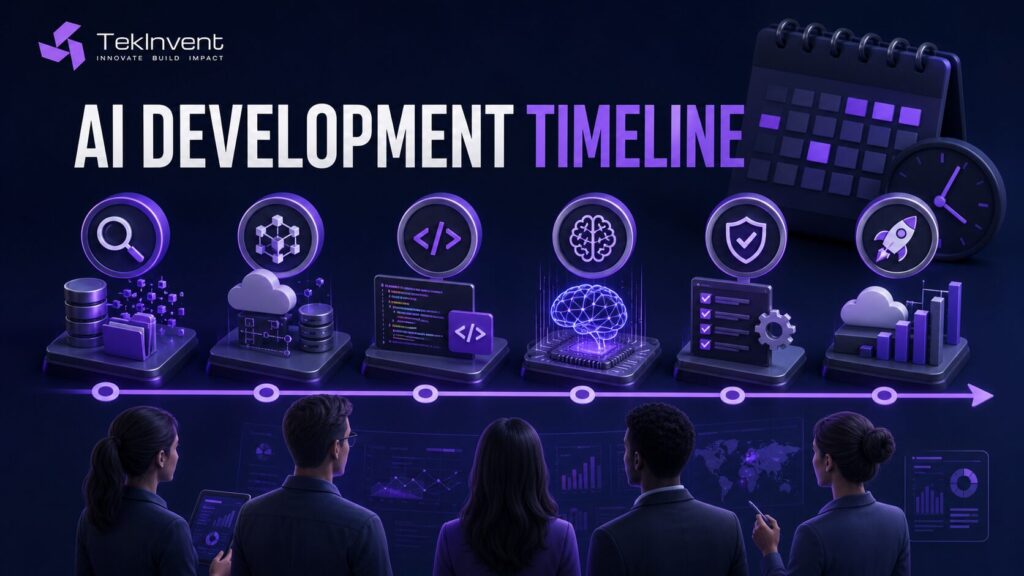
An AI development timeline can range from a few weeks for a focused prototype to nine months or longer for a secure enterprise platform.
The exact duration depends on the problem being solved, the condition of the data, the number of integrations, the required accuracy, the product platforms, and the consequences of an incorrect output.
A small internal assistant that summarizes approved documents is considerably easier to build than an AI platform that processes regulated information, supports several user roles, integrates with legacy systems, and takes actions across business workflows.
Businesses often underestimate AI projects because a basic demonstration can be created quickly. A demo, however, is not the same as production software. A deployable AI product requires authentication, permissions, evaluation, security, analytics, monitoring, and a dependable user experience.
A realistic timeline should therefore show not only how long coding takes, but also how the project moves from a business idea to a controlled, measurable capability.
How Long Does AI Development Take?
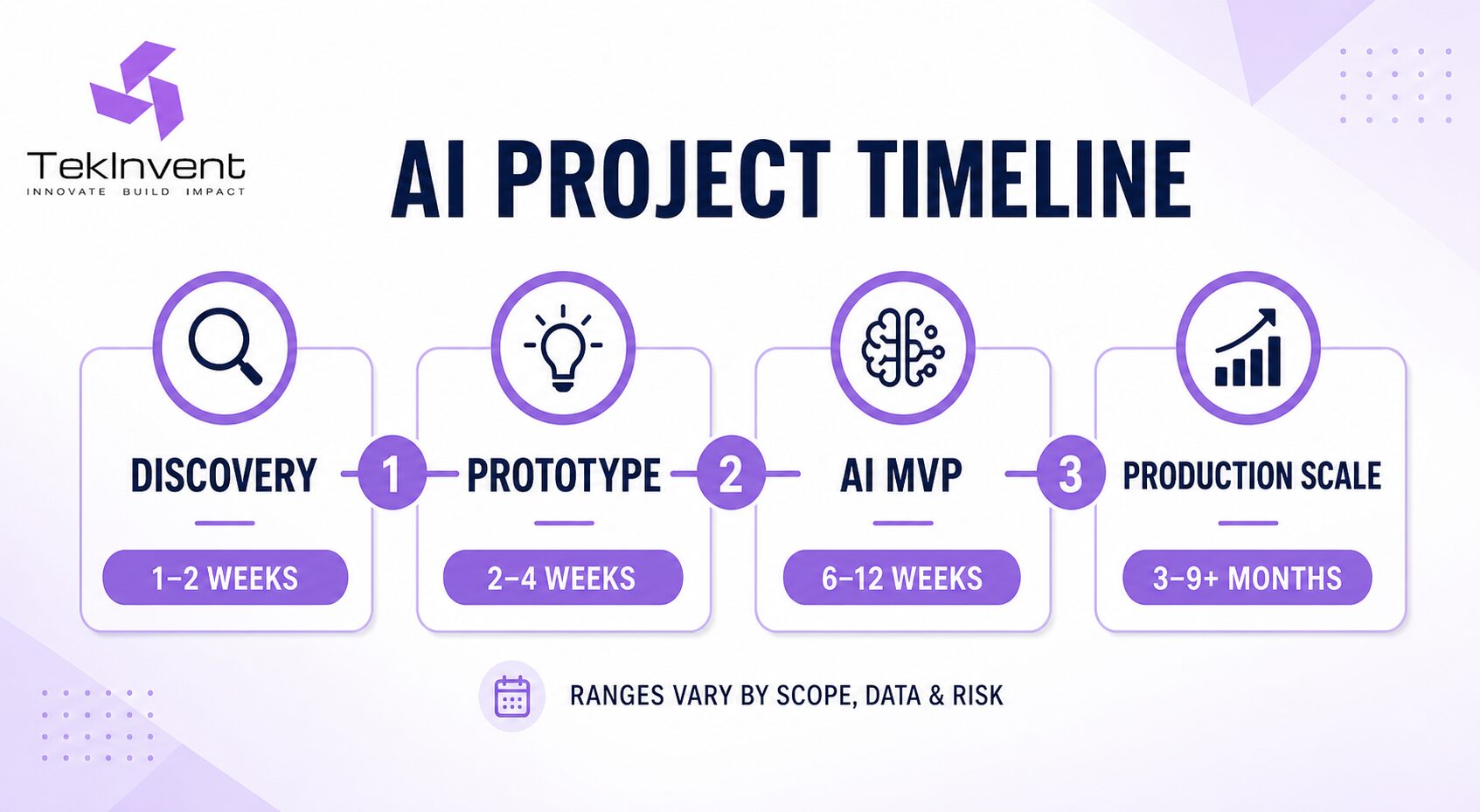
A discovery engagement commonly requires one to two weeks. A technical prototype may take another two to four weeks. A focused AI MVP generally takes approximately six to twelve weeks, while a production application can require three to six months.
An enterprise or regulated AI platform may take six to nine months or longer because the team must address complex integrations, data governance, security reviews, scalability, compliance, and organizational rollout.
These periods can overlap. Designers may begin testing workflows while data engineers prepare information, and software developers may build the application while AI engineers evaluate models.
The fastest project is not necessarily the best project. A compressed schedule only creates value when the team understands the requirements and can validate the system without skipping essential safeguards.
Phase 1: Discovery and Product Definition
Estimated duration: One to two weeks
Discovery establishes what the product should achieve and whether AI is appropriate.
The team examines the current workflow, intended users, business constraints, available information, and consequences of failure. Stakeholders should define a measurable target, such as reducing document-processing time or improving the number of support requests resolved successfully.
This phase also determines what will not be included in the initial release. Scope control is one of the strongest predictors of whether an AI project can reach users on schedule.
Discovery deliverables usually include a problem statement, prioritized use case, user journey, success metrics, risk assumptions, preliminary architecture, and MVP scope.
A project should not proceed merely because a model produces an impressive response. The team must determine whether the proposed system can improve a real business outcome.
Phase 2: Data and Feasibility Assessment
Estimated duration: Two to four weeks
The feasibility phase tests whether the necessary technology and information can deliver an acceptable result.
Developers may compare existing models, retrieval approaches, machine-learning techniques, or conventional automation. They test representative examples and identify the most likely failure modes.
Data engineers examine where information is stored, how accurate it is, who owns it, and whether the business has permission to process it. Documents may require extraction, cleaning, restructuring, metadata, and access controls.
For predictive machine learning, historical records may need labeling, feature preparation, and checks for missing or unrepresentative data.
The main deliverable is a feasibility decision supported by evidence. The business should understand the expected quality, technical limitations, estimated operating cost, data gaps, and major risks before approving full MVP development.
Poor data readiness can extend this stage significantly. When information is scattered across old systems or contains conflicting versions, data work may become the longest part of the project.
Phase 3: Experience and Architecture Design
Estimated duration: Two to four weeks
AI must be designed as part of a complete product rather than an isolated model connection.
The product team defines how users will provide information, review results, correct mistakes, and request human assistance. The interface should clearly communicate when content is generated and when the system lacks sufficient evidence.
Technical architecture covers the model, backend services, databases, integrations, authentication, cloud infrastructure, logging, analytics, and security controls.
Model selection should consider output quality, response time, privacy, reliability, cost, and provider flexibility. Choosing the largest available model without testing smaller alternatives can unnecessarily increase operating expenses.
TekInvent’s software development company services can support the application architecture surrounding the AI capability, including scalable backend systems and secure business integrations.
Architecture deliverables may include interface designs, system diagrams, data flows, permission models, integration specifications, and an evaluation plan.
Phase 4: AI MVP Development
Estimated duration: Six to twelve weeks
The MVP phase creates the first complete version of the product that can be tested with real users.
An effective AI MVP concentrates on one valuable workflow. It should include enough functionality to test the full experience without attempting to deliver every future feature.
The development team builds the user interface, backend services, model integration, data pipelines, permissions, feedback controls, and essential business integrations.
AI engineers refine prompts, retrieval settings, model configurations, or prediction pipelines. Software engineers add error handling, retries, timeouts, validation, and fallback behavior.
A cross-platform product may require additional work to ensure consistent functionality across devices. TekInvent’s cross-platform app development expertise can help businesses deliver an AI experience across multiple platforms without creating completely separate products.
The main deliverable is not simply a working screen. It is a controlled MVP connected to realistic information, user accounts, evaluation tools, and analytics.
Phase 5: Testing and Evaluation
Estimated duration: Two to four weeks for an MVP, longer for regulated systems
AI testing should begin during development rather than after every feature has been completed.
The team creates an evaluation dataset containing common requests, difficult cases, ambiguous language, missing information, unsafe instructions, and situations where human escalation is required.
Evaluation measures qualities relevant to the workflow. A knowledge assistant may require factual accuracy and citation support, while a predictive system may require precision, recall, and performance across different customer groups.
The complete application also needs security, integration, accessibility, usability, performance, and recovery testing.
A system that produces a correct answer but exposes information to an unauthorized user has failed. Similarly, an accurate feature that takes too long to respond may not be usable in the intended workflow.
Testing deliverables include evaluation results, resolved defects, known limitations, security findings, acceptance criteria, and a launch recommendation.
Phase 6: Pilot Deployment
Estimated duration: Two to six weeks
A controlled pilot exposes the product to a limited group before a full launch.
This phase shows how the system performs with genuine user behavior. People may ask questions differently from the development team, provide incomplete information, or use the product for purposes that were not anticipated.
The team monitors answer quality, failed requests, response time, model usage, user corrections, security events, and cost per completed task.
High-impact actions should initially require human approval. The system can prepare a recommendation or draft an action while an authorized employee remains responsible for the decision.
Pilot deliverables include user feedback, production performance data, revised evaluation results, operational documentation, and a decision about wider deployment.
Phase 7: Production Scale and Continuous Improvement
Estimated duration: Three to nine months and ongoing
Scaling an AI product involves more than increasing server capacity.
The team may expand the system to additional users, departments, regions, languages, and workflows. Each expansion introduces new information, permission requirements, edge cases, and evaluation needs.
Monitoring becomes a permanent product capability. The organization should track model failures, unsupported responses, cost, latency, human overrides, integration errors, and changes in business outcomes.
Models and source information evolve. Every meaningful change should trigger regression testing before it reaches all users.
The deliverables at this stage include monitoring dashboards, incident procedures, model and prompt versioning, update processes, cost controls, and a prioritized product roadmap.
The Team Required for AI Development
An AI product requires more than one AI engineer.
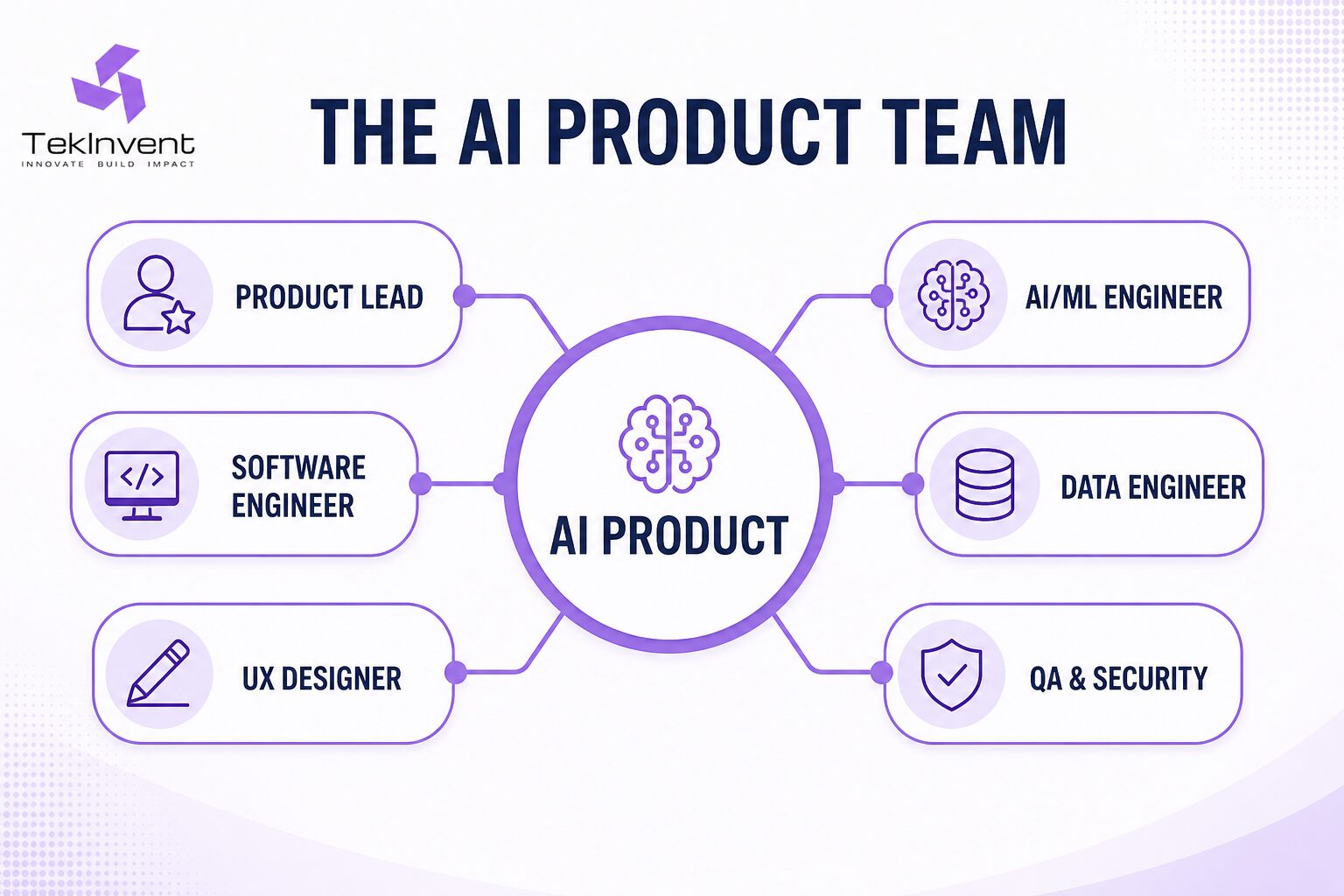
The product lead connects the technical work with the business outcome. AI or machine-learning engineers develop and evaluate the intelligent capability. Data engineers prepare information and create reliable pipelines.
Software engineers build the backend, interface, integrations, permissions, and cloud systems. UX designers make the product understandable and usable. Quality assurance and security specialists test failures, access controls, and real-world performance.
Subject-matter experts are equally important. They define what a correct result looks like and identify situations where the system requires human judgment.
Smaller projects may combine several responsibilities within one experienced team member. Complex products usually need greater specialization.
What Can Delay an AI Project?
Unclear requirements create the most preventable delays. When stakeholders continue adding workflows during development, the architecture and evaluation plan may need repeated changes.
Data problems are another major source of delay. Missing access, outdated documents, poor labels, and conflicting business definitions can block development.
Integrations may also take longer than expected when legacy systems have limited documentation or unstable APIs.
Security and compliance should be planned early. Discovering privacy, hosting, or audit requirements shortly before launch can force significant redesign.
Decision-making speed matters as well. Projects slow down when no stakeholder has authority to approve scope, designs, data access, or launch criteria.
How to Keep the Timeline Under Control
Start with one complete and valuable user journey. Establish success metrics and project boundaries before development begins.
Give the team early access to representative data and integration documentation. Identify security, privacy, and compliance requirements during discovery rather than treating them as final-stage checks.
Review working software throughout the project. Short feedback cycles reveal misunderstandings before they become expensive.
An experienced AI development company should provide phase-specific deliverables, explain dependencies, and make timeline risks visible instead of offering an unrealistic guaranteed launch date.
Moving From Speed to Sustainable AI Delivery
The purpose of an AI development timeline is not to force every project into the same calendar. It is to create a sequence in which uncertainty is reduced before the business makes a larger investment.
Discovery confirms that the problem is worth solving. Feasibility verifies that the data and technology can support it. An MVP turns the idea into a testable experience, while evaluation and pilot deployment provide evidence from real use.
This structured progression helps businesses move quickly without confusing speed with readiness. The result is an AI capability that can earn trust, demonstrate value, and scale without requiring the organization to rebuild its foundation after launch.

Build Smart with The Right Team.
We bring expertise, technology, and trust you look for in your digital journey.