

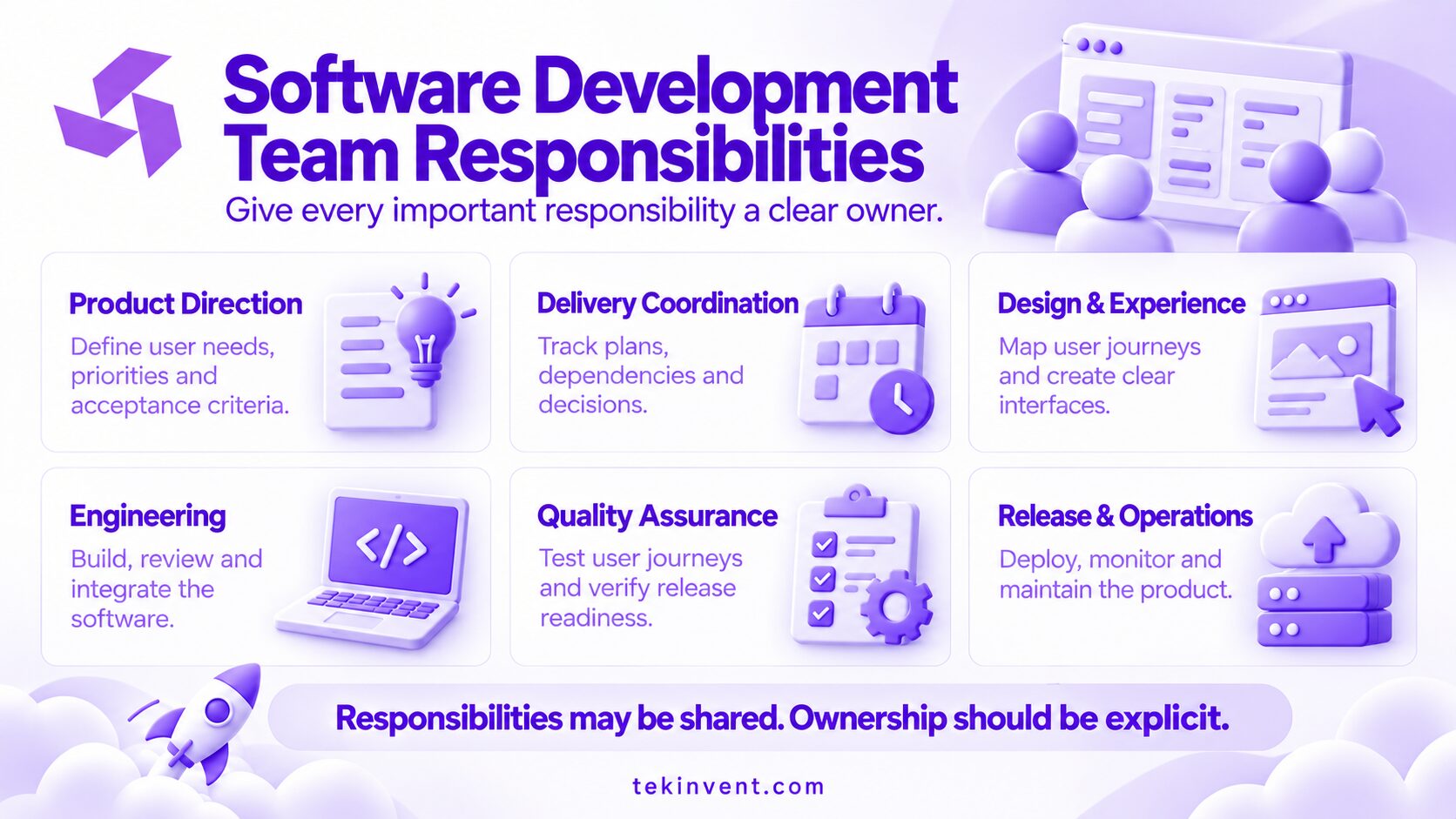
A software development team structure should give every important project responsibility a clear owner. The exact roles depend on the product, risk, and stage of development. A small internal tool may need a product decision maker, an engineer, and access to quality assurance. A product with complex workflows, sensitive data, and several integrations may require more specialized design, security, testing, and operations support.
The goal is not to fill a standard org chart. It is to make sure someone can set priorities, understand users, design the workflow, build and test the system, and prepare it for use. One person can hold more than one role on a small team, but the responsibilities still need to be covered.
Start with responsibilities, not titles
Before choosing team size, list the work the project needs. Who decides what to build? Who understands user needs? Who makes technical decisions? Who checks that the product works? Who manages deployment and support? Assign an owner to each responsibility, even if that owner is also doing other work.
This avoids a common gap: everyone assumes someone else will handle a task. For example, a developer may build a feature while stakeholders disagree about its expected behavior. Without a clear product decision maker, the team can spend time implementing conflicting requests.
Core roles in a software development team
Product owner or product manager
This role connects business goals, user needs, and delivery decisions. A product manager may research the market, shape the roadmap, and coordinate stakeholders. A product owner often focuses on the backlog and clarifies what the development team should build next. In smaller organizations, one person may handle both sets of responsibilities.
The key requirement is decision authority. The team needs someone who can prioritize requests, define acceptance criteria, and make trade-offs when time or information is limited. If several executives share the role, agree on who makes the final call and how disagreements are resolved.
Project manager or delivery lead
A project manager organizes work, dependencies, communication, and risk. A delivery lead may also guide the team’s working process and help remove blockers. The exact title varies, but someone should maintain a shared view of decisions, upcoming work, open questions, and schedule changes.
The project manager coordinates delivery; the product owner decides which outcome has priority. On a small project, one person may cover both responsibilities.
UX and product designer
A designer studies how users complete tasks and translates that understanding into information architecture, flows, and interface details. Design work includes more than visual styling. It covers navigation, forms, empty states, error messages, accessibility, and how the product behaves on different screen sizes.
Bring design in before implementation decisions become difficult to change. Research and prototype testing can expose problems while they are easier to address.
Software engineers
Engineers implement the product and make technical decisions within their areas. Frontend engineers build the user-facing interface. Backend engineers work on services, databases, APIs, and business rules. Mobile engineers develop for iOS or Android, while full-stack engineers may work across application layers.
Define who owns each component and how code is reviewed. For outside or internal systems, identify the integration owner and who can provide access.
Technical lead or software architect
A technical lead guides implementation choices, reviews design decisions, and helps keep the system coherent. An architect may focus more on structure, integrations, data, and long-term technical constraints. Smaller projects may not need a separate architect, but they still need a clear technical decision maker.
The role is especially useful when the product has several systems, substantial data requirements, performance constraints, or security concerns. Ask how technical decisions will be documented and who approves trade-offs that affect maintainability or future work.
Quality assurance engineer
Quality assurance (QA) checks whether the product meets requirements and behaves reliably. QA may include exploratory testing, automated tests, accessibility checks, compatibility testing, and verification of error cases. Developers also test their work; a QA role provides a separate view of the full user journey and release conditions.
The right amount of QA depends on product risk. An internal tool with a small user group has different testing needs from software that handles customer accounts, payments, or important operational decisions. Define which devices, browsers, workflows, and failure cases must be tested.
DevOps or platform engineer
DevOps and platform work covers environments, deployment, monitoring, infrastructure, backups, and release automation. Some projects use managed cloud services that reduce the amount of custom infrastructure work. Someone still needs to configure access, understand deployment steps, and respond when production behavior changes.
Assign operations before launch, including deployment, monitoring, production access, and urgent issue response.
Specialized roles you may need
Some projects need additional expertise for a defined period or throughout delivery:
- Security specialist: reviews threat models, access controls, secure implementation, or incident readiness.
- Data engineer or analyst: designs data pipelines, reporting, and measurement where those are central to the product.
- Database specialist: helps with complex data structures, performance, migration, or recovery requirements.
- Content designer or technical writer: prepares interface language, onboarding, help content, and technical documentation.
- Accessibility specialist: reviews product behavior against the needs of people using assistive technology.
- Domain expert: explains industry workflows, terminology, and operational requirements.
- Legal or compliance advisor: helps determine obligations for the product and organization.
These specialists can be part-time. Involve them when input may change scope, architecture, or acceptance criteria. For sensitive data, get qualified advice early.
How team structure changes by project stage
Discovery and planning
During discovery, product leadership and domain knowledge are central. A designer can map user journeys, while a technical lead assesses feasibility and dependencies. The goal is to make the product question, first scope, and major unknowns clear enough for planning.
You may not need a full engineering team during this stage. However, technical input should be available before decisions about data, integrations, and platform are treated as final. A short technical review can identify constraints that product and design work should account for.
Design and development
As implementation begins, engineers need access to product decisions and design feedback. The project manager or delivery lead coordinates work and dependencies; QA should help shape acceptance criteria before features are considered complete. Design continues as the team reviews real implementation and uncovers edge cases.
Avoid separating design, engineering, and QA into disconnected handoffs. A shared review helps the team catch differences between the planned workflow and working software. It also gives stakeholders a chance to resolve questions before they create rework.
Release and ongoing support
Before release, confirm who handles deployment, monitoring, user issues, and decisions about fixes. Product ownership remains important after launch because feedback needs to be prioritized. Engineering and QA need a process for assessing defects, while operations needs clear escalation paths.
If the original project team will move on, document the system, deployment process, integrations, and support ownership. Knowledge should not exist only in one person’s memory or an inaccessible vendor account.
Example: structuring a small project team
Suppose a company needs a web application that replaces an internal approval process. The team might assign a department manager as product owner, a delivery lead to coordinate milestones, a designer to map the approval journey, and a full-stack engineer to build the interface and service. A QA engineer could test permissions, notifications, and rejected requests. An operations owner would manage deployment and user support.
The team may bring in a security specialist to review access controls if the records are sensitive. It may not need separate frontend, backend, mobile, and data roles if the scope does not require them. The point is to cover the needed responsibilities with the smallest practical set of people.
As the product expands to other departments, the structure may change. Additional product owners or domain experts might help define different workflows. More engineering specialization may be useful if the system adds integrations or separate applications. Add roles in response to work and risk, not because a larger org chart appears more established.
Decide what to hire, assign, or outsource
For each responsibility, determine whether it belongs with an internal employee, a contractor, a specialist advisor, or a development partner. Internal product ownership can help preserve business context and speed decisions. Outside teams can contribute design and engineering capacity when the company does not have those skills in-house.
If you work with an external team, identify who will represent your business and who owns delivery on the provider side. Clarify access to code, documentation, accounts, and credentials. A custom software development company can provide development capacity, while your organization still needs someone to make product decisions and accept the work.
Build a Team Around Your Software Project
TekInvent can help identify the product and engineering roles your scope requires.
Prevent responsibility gaps
Create a simple responsibility map for recurring decisions and deliverables. It does not need a complicated framework. For each item, name who does the work, who approves it, and who must be consulted. Include scope changes, design approval, technical decisions, testing acceptance, deployment, and support.
Review the map when the project changes. A team that adds payment processing or sensitive data handling may need new security, legal, and QA responsibilities. A product that expands to more user groups may need more product and domain input. The structure should follow the product’s actual risk and coordination needs.
Common team-structure mistakes
Hiring titles before defining work
Two companies can use the same title for very different responsibilities. Describe the work and decisions the project needs before recruiting for a role. This makes interviews and vendor discussions more grounded.
Leaving product decisions to the whole team
Collaboration is useful, but a product team needs a final decision maker. Without one, priorities can shift with each meeting and developers may receive conflicting direction. Set a clear path for recommendations and approval.
Treating QA as a final handoff
If QA enters only after development, missing requirements and difficult test cases may surface late. Include QA in planning and feature review so tests reflect intended user behavior and failure conditions.
Assuming the developer owns operations
The person who writes code may not own production accounts, backups, support, or incident response. Name these responsibilities and agree on access before release. A working product still needs an operating model.
Adding specialists without a clear purpose
Specialists are valuable when their work changes an important decision. Define the question they will answer, the input they need, and the deliverable you expect. That keeps advice connected to the project rather than adding another uncoordinated workstream.
A practical team-planning checklist
Before work begins, confirm:
- One person can make product priority decisions.
- Delivery coordination and escalation have an owner.
- Design responsibilities cover user flows and accessibility.
- Technical decisions and code review have clear owners.
- QA is involved in acceptance criteria and release checks.
- Security, data, or domain specialists are included where needed.
- Deployment, monitoring, and support are assigned.
- Internal and external team members know how decisions are approved.
- Code, documentation, accounts, and credentials remain accessible.
The software development team structure that works best is the one that covers the project’s real responsibilities without obscuring ownership. Start with the product outcome, identify the work and risks, then assign people to the decisions and delivery tasks. As the product grows, revisit the structure based on what the team must build, operate, and support.

Build Smart with The Right Team.
We bring expertise, technology, and trust you look for in your digital journey.