Logistics app development should begin with the movement of goods and the decisions people make along the way. A dispatcher assigning local deliveries, a warehouse coordinating orders, and a carrier tracking shipments need different software. Austin businesses should map the process, identify where information is delayed or re-entered, and define what a first release must improve before choosing a technology partner.
The city name does not determine the app’s features. The operating model does: service area, facilities, vehicle types, shipment volume, customer expectations, and existing systems. A clear requirements brief helps Austin teams compare partners on their ability to solve the real workflow.
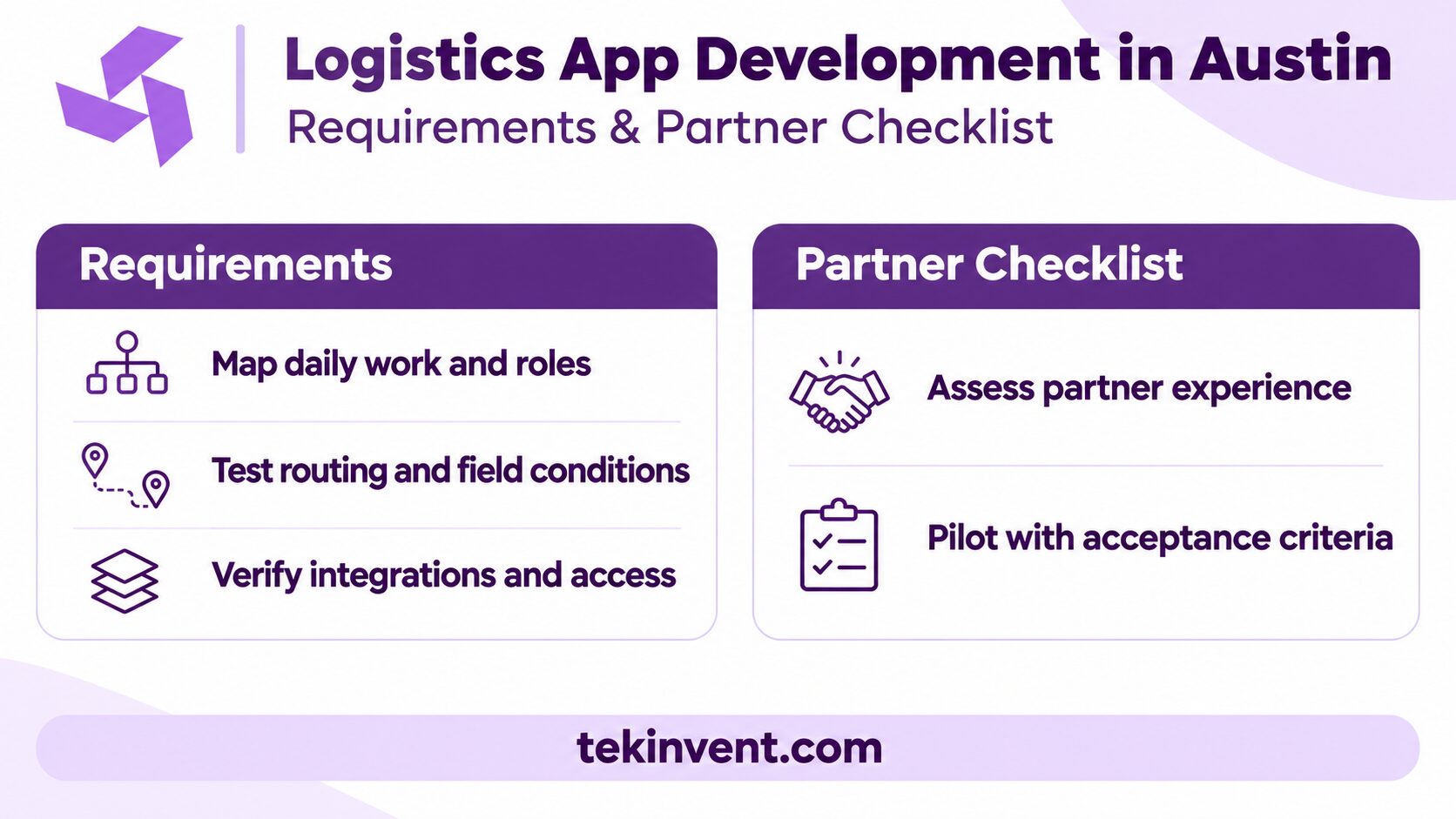
Map how work moves today
Follow an order or shipment from creation through delivery. Document who enters the details, who confirms availability, how a load is assigned, what drivers receive, and how completion is recorded. Include returns, failed deliveries, damaged goods, and address corrections.
Talk with dispatchers, warehouse staff, drivers, customer service, and managers. Each group sees different failure points. A dispatcher may need accurate availability; a warehouse lead may need a reliable pick status; customers may want a realistic delivery window. Record which system currently owns each piece of information.
Choose one operational outcome to improve, such as fewer status calls, less re-entry, or quicker identification of a delayed order. Establish how the business can measure the current process. That gives the team a way to evaluate the app after a pilot.
Decide which users and functions belong in the first release
Common roles include administrators, dispatchers, drivers, warehouse teams, merchants, and customers. Avoid designing one crowded dashboard for everyone. Define each role’s most common task and the information needed to complete it.
A focused first release might include order intake, assignment, driver status updates, proof of delivery, and an exception queue. Inventory management, route optimization, customer billing, and analytics may be valuable, but should be included only if they are part of the problem being tested.
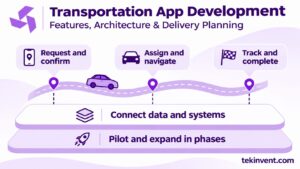
For a delivery operation, the end-to-end workflow might look like this:
- An order enters from a source system or an operator.
- Staff confirm the shipment details and service requirements.
- A dispatcher assigns a driver or carrier.
- The driver receives the stop sequence and instructions.
- Status changes and proof of delivery return to operations.
- Exceptions are assigned for resolution.
Decide who can change an order after dispatch and how affected people are notified. These rules matter as much as the visible screens.
Treat location and route planning as operational tools
Location updates can help staff answer “where is the driver?” but they should be tied to a clear operational need. Define when tracking starts and ends, who can view it, and how often updates are needed. Explain location use to drivers and consider battery and connectivity constraints.
Route planning should account for the business’s actual constraints: time windows, vehicle capacity, pickup priorities, required equipment, and delivery instructions. A map provider can supply routing information, but dispatch rules and exception handling still require product decisions.
Do not rely on a route estimate as a service promise without operational review. A driver may need to wait for loading, take a permitted break, or handle a customer issue. Provide a way to report delays and update expected arrival information.
Identify required integrations
List the systems involved, such as order management, warehouse management, enterprise resource planning, accounting, mapping, telematics, customer support, and payment services. For each one, define the information exchanged, direction, timing, and system of record.
Before estimating, confirm API access, technical documentation, test credentials, and the vendor’s approval process. If a system cannot integrate, decide whether staff will upload a file, enter data manually, or use another workflow. Make the fallback explicit so it does not become a launch-day surprise.
Test duplicate orders, missing addresses, delayed status events, and service interruptions. Decide what operators see when data stops synchronizing. A useful integration makes failure visible and gives staff a safe way to continue essential work.
Plan data security and access
Logistics apps can contain customer addresses, contact details, shipment records, and driver information. Collect what the operation needs, restrict access by job role, and determine how long records should be retained. Protect accounts and define what happens when an employee or contractor leaves.
Location history deserves particular attention. Determine whether the business needs live tracking, historical routes, or only status events. Avoid retaining detailed location records indefinitely without a business or legal reason. Consult appropriate privacy and legal advisors about obligations for the specific workforce and service.
Include backups, monitoring, incident response, and recovery in the operating plan. Confirm who receives an alert when a dispatch integration or notification service fails and how work continues while it is restored.
How to evaluate a development partner
Ask a potential partner to explain how it would learn the workflow before proposing architecture. Strong discovery should produce requirements, process maps, integration assumptions, user roles, risks, and a prioritized release plan. A feature estimate created without those details may conceal important unknowns.
Use questions such as:
- How will you observe and validate dispatcher and driver workflows?
- What information do you need from our system vendors before estimating integrations?
- How will you handle offline updates and duplicate status events?
- What will the first release leave out, and why?
- Which team owns code, cloud accounts, and documentation?
- What testing and support are included after launch?
- How will you communicate risks, changes, and schedule dependencies?
Ask for examples of similar technical workflows only when the partner can substantiate them. Do not rely on broad claims about having “logistics expertise.” Evaluate how clearly the team explains trade-offs and assumptions.
Compare total effort, not just initial build quotes
Compare proposals using the same workflow and acceptance criteria. Separate discovery, design, user interfaces, backend work, integrations, testing, deployment, and support. Check whether the proposal includes training, data migration, vendor coordination, monitoring, and post-launch fixes.
Include recurring costs in the comparison: hosting, mapping or messaging services, third-party licenses, maintenance, support, and future integration changes. Also consider internal time for operations staff to test the app and change procedures. A low initial estimate may omit work that the business still needs to complete.
Pilot before expanding across operations
Select a bounded pilot, such as one delivery workflow, customer group, or operating team. Train the people involved and define a fallback if the app becomes unavailable. Track measures connected to the goal—assignment time, unresolved exceptions, customer status requests, or manual corrections.
Review outcomes with dispatchers and drivers. If the app shows a package as delivered before proof is captured, update the process before expanding. If staff continue maintaining a spreadsheet because the new status view is incomplete, learn which information they still need.
Expand only after the workflow, training, and support model are ready. Adding more facilities or service types can create new rules and integrations; a successful small pilot is evidence for planning the next phase, not proof that every operation is identical.
Businesses comparing local implementation options can review TekInvent’s logistics app development services. For a broader city-specific mobile product, a mobile app development company can help translate the operational brief into a phased scope.
Build a Logistics App Around Your Operations
TekInvent can help clarify dispatch needs, integrations, and the right pilot scope.
Write acceptance criteria for daily work
An acceptance criterion describes an observable result, not just a feature name. Instead of “add delivery tracking,” define that an assigned driver can update a stop, dispatch can see the new status, and the customer receives the approved update. Include what should happen when the driver is offline or the event arrives twice.
Use a small set of realistic scenarios to review the product with staff. A route may include a missed delivery, a changed address, or a shipment that needs a signature. Make sure the app preserves enough information for operations to resolve the issue and explain it to the customer. If different customers have different service rules, document how the system identifies them.
Acceptance criteria make proposals easier to compare. One partner may assume a dispatcher handles every exception manually, while another may include a queue and notifications. The business can see the difference before selecting a plan rather than discovering it during user acceptance testing.
Check the field conditions
Drivers and warehouse teams may use devices in vehicles, loading areas, or locations with limited connectivity. Test the app on the devices the business plans to issue or support. Check whether buttons are easy to use, text remains readable, and key tasks can be completed without excessive typing.
Decide which information must remain available offline and which actions can wait until the network returns. Queue status changes with timestamps, prevent duplicates during sync, and show when an update has not reached dispatch. Do not promise live visibility where the device cannot reliably send updates.
Plan device enrollment, app updates, lost-device handling, and staff turnover. A logistics product can have sound software and still create risk if a former contractor keeps access or an unpatched device remains active. Assign responsibility for device and account administration before rollout.
Establish a rollout plan for the people doing the work
Introduce the app to one team with time to practice before it becomes the only way to complete a task. Provide drivers and dispatchers with short instructions for common actions, offline updates, and exception reporting. Keep a channel open for feedback during the first weeks and tell staff which issues are being addressed.
Watch for workarounds such as duplicate spreadsheets, personal text messages, or repeated calls to dispatch. These behaviors often indicate that the product is missing a field, the training is unclear, or the process itself needs adjustment. Review the cause with users before prohibiting a workaround that may be keeping operations moving.
Make requirements the basis for partner selection
Austin logistics teams can get more useful proposals by defining the workflow, integrations, exceptions, and operating responsibilities first. That brief helps a partner estimate the actual work and helps the business spot gaps before development begins.
Treat the app as one part of the operating system. Staff training, vendor access, support, and clear data ownership are necessary for the product to improve day-to-day coordination.

Build Smart with The Right Team.
We bring expertise, technology, and trust you look for in your digital journey.