
One of the first questions businesses ask before starting a website project is simple:
How much will it cost?
The answer depends on what the website needs to do.
A five page business website, an ecommerce store, and a custom web platform may all be called “websites,” but the work behind them is completely different.
That is why website development cost should never be estimated only by page count.
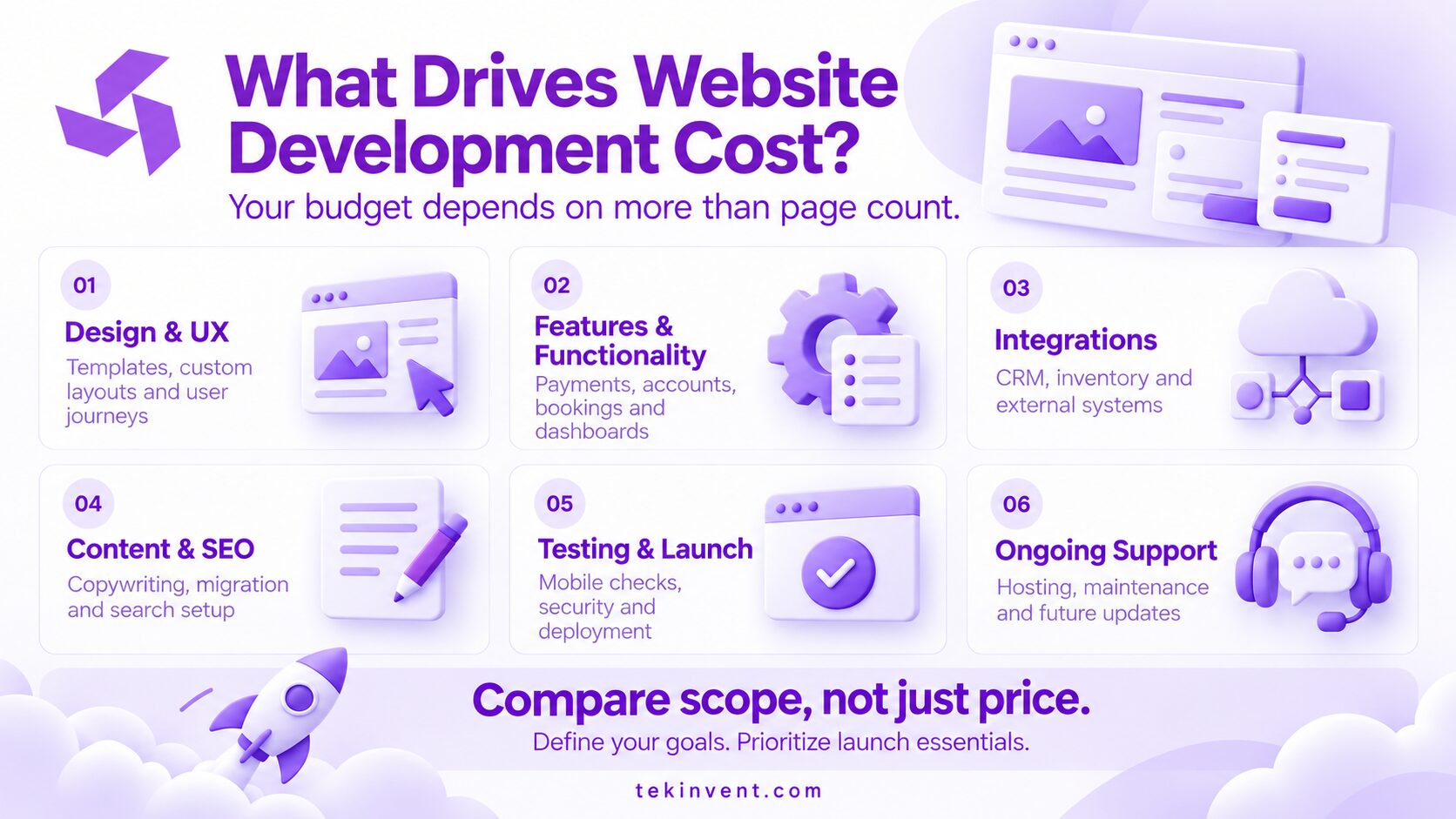
Design quality, features, integrations, content, platform, security, performance, testing, and post launch support all affect the final budget.
In the USA, a basic website may cost a few thousand dollars, while a large custom website or web platform can reach tens of thousands or more. Current Clutch data shows that many reviewed web development projects cost under $10,000, while more complex custom projects can move well beyond that depending on scope.
This guide explains the real factors behind website pricing so businesses can build a more realistic budget before speaking with a development team.
What Is the Average Website Development Cost in the USA?
There is no single average cost for website development that fits every business.
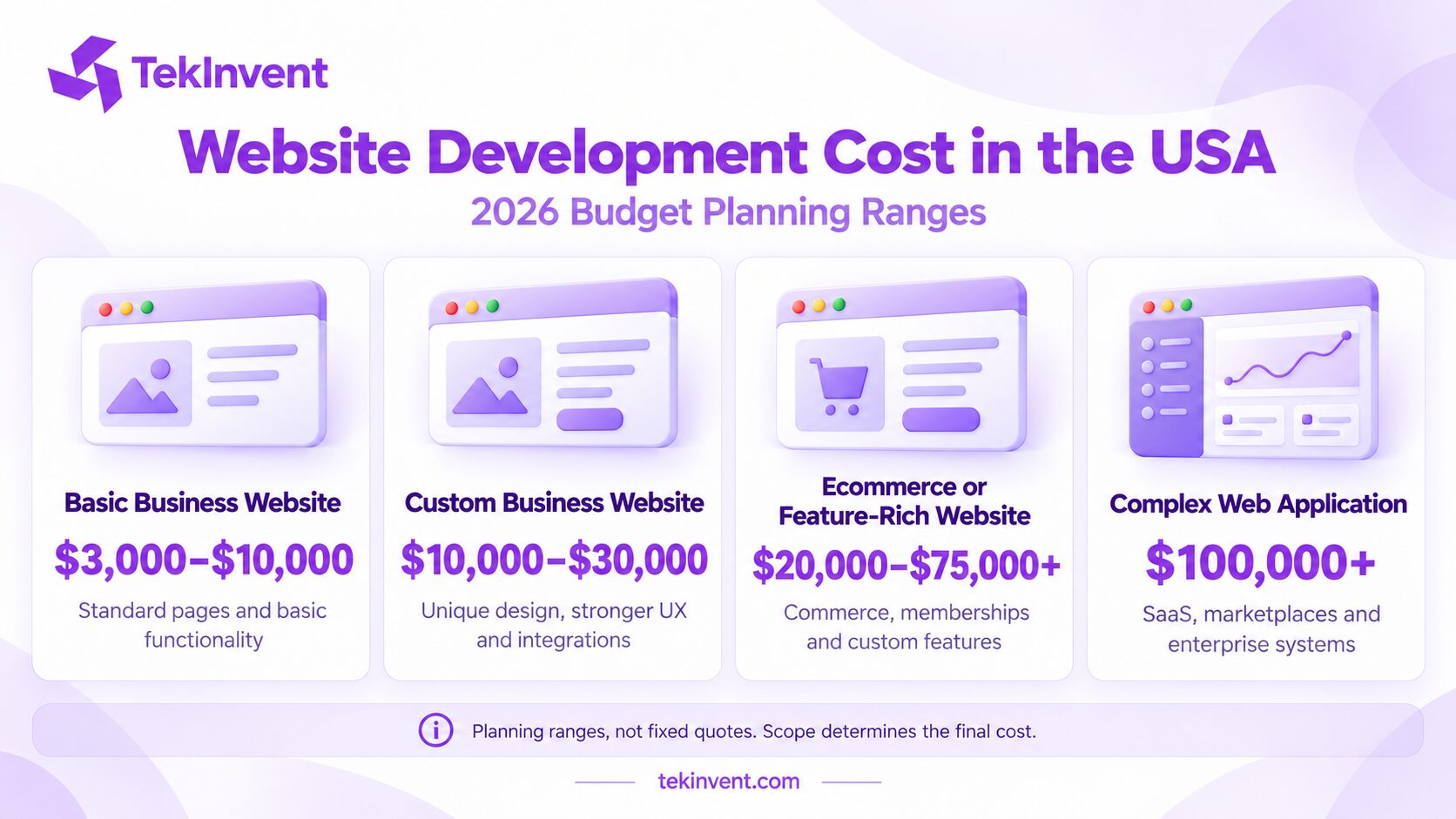
For practical planning, businesses can think in broad ranges.
A simple small business website with standard pages and basic functionality may fall around $3,000 to $10,000.
A more customized business website with unique design, stronger UX, integrations, and additional page types may move into the $10,000 to $30,000 range.
A larger ecommerce website, membership platform, portal, or feature rich custom site may require $20,000 to $75,000 or more.
Complex web applications, SaaS platforms, marketplaces, or enterprise systems can move beyond $100,000 depending on technical requirements.
These are planning ranges, not fixed quotes.
Clutch’s 2026 pricing data shows that most listed web development companies charge around $25 to $49 per hour globally, while US based agencies can often charge significantly more depending on expertise and project type.
The important question is not simply, “What does a website cost?”
It is:
What type of website does your business actually need?
Why Website Development Prices Vary So Much
Two companies can ask for a business website and receive completely different estimates.
That does not automatically mean one developer is overpriced.
The two teams may be estimating different levels of work.
One quote may include custom UX design, responsive development, content migration, SEO setup, integrations, testing, analytics, and post launch support.
Another may include only a template setup and basic development.
This is why website development prices should always be compared against scope.
The cheapest proposal is not necessarily the cheapest project in the long term.
If important requirements are missing from the original quote, they may become additional costs later.
Small Business Website Development Cost
A small business website is usually the most straightforward type of project.
It may include a homepage, about page, service pages, contact page, blog, and a lead form.
If the design is simple and the business already has content prepared, development can remain relatively affordable.
A reasonable planning range is often around $3,000 to $10,000.
The lower end may involve a customized template or existing design system.
The higher end may include more original design, better UX planning, custom sections, stronger SEO foundations, and additional functionality.
The final website developer cost will depend on how much custom work is required.
A local service business does not need to pay for complicated functionality it will never use.
The goal should be to invest in what supports actual business goals.
Custom Business Website Cost
A custom business website usually requires more planning.
Instead of adapting the business to an existing template, the design and structure are built around the company’s audience, services, conversion goals, content, and future growth.
This often includes custom page layouts, UX planning, stronger branding, animations, integrations, advanced forms, content management, and more detailed testing.
A custom business website may cost around $10,000 to $40,000 or more, depending on scale.
If you are deciding whether that investment makes sense, the custom website development vs templates comparison explains when a template may be enough and when custom development becomes more valuable.
Custom development costs more because more of the website is being planned and built specifically for the business.
Ecommerce Website Development Cost
Ecommerce websites usually require more work than standard business websites.
The website may need product management, categories, search, filters, payments, customer accounts, order management, shipping rules, taxes, discounts, inventory, and third party integrations.
A smaller ecommerce website may start around $5,000 to $15,000.
A more customized store can move into the $15,000 to $50,000+ range.
Large ecommerce platforms with custom checkout flows, ERP integrations, advanced inventory systems, multi vendor features, or complex business logic can cost considerably more.
The number of products alone does not determine the cost.
The real difference comes from the systems that manage those products and the customer journey around them.
Web Application Development Cost
A custom web application is different from a normal marketing website.
The user may need to create an account, manage information, upload files, make payments, communicate with other users, view dashboards, or complete workflows.
Examples include customer portals, booking systems, SaaS products, marketplaces, internal tools, and management platforms.
The cost of developing website functionality at this level is usually much higher because the project behaves more like software.
A simple web application may begin around $20,000 to $40,000.
Larger platforms can easily move beyond $50,000 to $100,000, while complex enterprise systems can cost much more.
This is where a business should stop thinking in terms of pages.
Features, user roles, workflows, data, security, and integrations become the real cost drivers.
How Design Affects Website Development Cost
Design has a direct impact on the budget.
A template based website already has much of the layout created.
A custom website requires designers to plan the structure around the business.
That may include wireframes, user journeys, responsive layouts, typography, visual hierarchy, calls to action, forms, icons, and interactive elements.
The more unique page types the website needs, the more design work is required.
A ten page website does not necessarily need ten separate designs.
Several pages may use the same layout.
This is why the number of unique page templates matters more than total page count in many projects.
Features Have a Bigger Impact Than Page Count
This is one of the most important things to understand about website development costing.
A 30 page informational site may be easier to build than a five page site containing complex functionality.
Features such as customer accounts, advanced search, payment systems, booking tools, calculators, live chat, API connections, dashboards, membership systems, or custom databases require additional development and testing.
Every feature should therefore be evaluated based on business value.
If it does not help customers, sales, operations, or another clear objective, it may not belong in the first version.
Removing unnecessary features is one of the easiest ways to control website development cost.
Platform Choice Also Changes the Budget
Businesses can build websites using platforms such as WordPress, Shopify, Webflow, custom frameworks, or headless architectures.
The correct platform depends on the project.
WordPress can work well for many content heavy business websites.
Shopify may be more suitable for ecommerce businesses that want a structured commerce platform.
A custom framework may make sense when the website requires specialized workflows or application level functionality.
The platform itself does not determine whether a website will be good.
What matters is whether the technology supports the current requirements without creating unnecessary limitations.
A professional website development company in USA should be able to explain why a specific platform fits the project instead of recommending the same technology for every business.
Website Development Charges for Integrations
Modern websites rarely operate completely alone.
A business may need the website to connect with a CRM, email marketing system, payment provider, analytics platform, booking tool, inventory software, ERP, customer support system, or internal database.
Simple integrations may require little additional work.
Custom integrations can become expensive.
The team may need to understand another system’s API, manage authentication, map data, handle errors, test data synchronization, and maintain the integration after launch.
Before development begins, make a list of every external system the website needs to communicate with.
This makes website development charges much easier to estimate.
Content Can Affect the Final Cost
Content is sometimes forgotten during website budgeting.
A development quote may not include copywriting.
If the business needs new service pages, product copy, case studies, images, illustrations, or video, those assets require additional work.
Content also affects design.
A page containing a short paragraph needs a different structure from a detailed service page containing several sections, case studies, FAQs, and calls to action.
Businesses should decide early whether content already exists or needs to be produced as part of the project.
That avoids delays and unexpected costs later.
SEO Setup Should Be Planned Before Development
SEO should not be added only after the website is finished.
Important technical decisions happen during development.
These include URL structure, internal linking, page templates, headings, structured data, redirects, crawlability, mobile experience, page speed, and analytics setup.
A redesign also needs careful migration planning.
If important URLs change without redirects, existing search visibility may be damaged.
SEO work can increase the initial website development pricing, but fixing a poorly planned site after launch can cost more.
For businesses that already receive organic traffic, protecting existing performance should be part of the project scope from the beginning.
Turn Your Idea Into a Working Product
Share your goals with TekInvent. Get a tailored project estimate.
How Much Does Web Development Cost Based on Timeline?
Time and cost are closely connected.
A simple website may take only a few weeks.
A larger custom website can take several months.
Longer projects require more design, development, testing, project management, and revisions.
If you want to understand how the work is distributed across discovery, design, development, testing, and launch, the website development timeline gives a more detailed view of the process.
A clear timeline also helps businesses understand why two proposals may have different prices.One team may be planning only basic development.
Another may be including deeper discovery, UX design, QA, migration, and launch support.
Freelancer vs Agency Website Developer Cost
The person or team you hire also affects the budget.
A freelancer may have lower overhead and can be a good option for straightforward projects.
A small agency may provide design, development, QA, and project management together.
A larger agency may provide specialized teams for strategy, UX, development, SEO, testing, and long term support.
The right choice depends on project complexity.
A basic website may not require a large agency.
A business critical platform may be risky to place entirely with one person if the project needs several different skills.
Instead of asking only about web developer cost, businesses should ask what expertise is included in the price.
What Ongoing Website Costs Should You Budget For?
The launch budget is not the full website budget.
Websites have ongoing costs.
These may include hosting, domain renewal, security tools, plugin or software licenses, maintenance, backups, monitoring, content updates, and technical support.
Ecommerce websites may also have payment processing costs and platform fees.
More complex websites may need ongoing development.
WebFX’s current 2026 pricing research notes that maintenance costs vary heavily by website size and complexity, especially for larger professional websites. WebFX
The easiest way to avoid surprises is to ask before signing the development agreement:
What will I continue paying after launch?
Hidden Costs Businesses Often Forget
A quote can look affordable until additional work appears.
Common overlooked costs include content migration, premium plugins, stock photography, custom illustrations, additional integrations, website accessibility work, legal or compliance tools, advanced analytics, training, and ongoing maintenance.
Revisions can also increase cost.
If the project starts without clear requirements, design and development may need to be changed several times.
That is why discovery is valuable.
Spending time defining the project usually creates a more reliable budget.
How to Build a Realistic Website Budget
Start with the business goal.
Do not start by asking how many pages you can buy for a certain amount of money.
Ask what the website needs to achieve.
Does it need to generate leads?
Sell products?
Book appointments?
Support customers?
Provide an internal portal?
Once the goal is clear, define the essential functionality.
Then separate launch requirements from future improvements.
This prevents the first version from becoming unnecessarily large.
It also gives development companies enough information to provide a meaningful estimate.
How to Compare Website Development Quotes
Do not compare proposals using only the final price.
Compare what is included.
Check whether both companies are quoting the same number of page templates.
Check whether design is custom.
Check whether mobile development is included.
Check whether content migration is included.
Check whether QA, SEO setup, analytics, integrations, deployment, and post launch support are included.
A $7,000 proposal and a $15,000 proposal may not be offering the same project.
If you compare price without comparing scope, the numbers have very little meaning.
When Is a Higher Website Development Cost Worth It?
Spending more makes sense when the website has a bigger role in the business.
If the site is responsible for generating leads, processing orders, supporting customers, or connecting internal systems, quality becomes more important.
A cheap website that creates technical limitations can become expensive later.
However, higher cost does not automatically mean better quality.
The investment should be connected to clear requirements.
A business should pay more because it needs more strategy, design, functionality, scalability, or technical quality.
Not simply because an agency has a higher rate.
How Can Businesses Reduce Website Development Cost?
The easiest way to reduce cost is to control scope.
Start with the features required for launch.
Prepare content early.
Give clear feedback.
Avoid changing the main direction after development begins.
Use proven platforms when custom technology is unnecessary.
Reuse page structures where practical.
Prioritize features based on business value.
A smaller first version can always grow later.
The goal is not to make the website as cheap as possible.
The goal is to avoid paying for work that does not improve the business.
Website Development Cost vs Long Term Value
A website should not be judged only by its launch price.
Consider what the website will do over the next several years.
Will it generate qualified leads?
Will it support sales?
Will it reduce manual work?
Will it make marketing easier?
Will the company be able to add new services and content?
Will it integrate with future systems?
Sometimes a cheaper build becomes more expensive because the business needs to replace it quickly.
A slightly higher initial investment may provide more value if the website remains useful for longer.
That is why website development pricing should always be considered alongside business value.
Turn Your Idea Into a Working Product
Share your goals with TekInvent. Get a tailored project estimate.
What Should Your Website Budget Include?
A realistic website budget should cover more than coding.
It should account for planning, design, development, content, integrations, testing, deployment, and ongoing costs.
The exact balance depends on the project.
A simple marketing site may spend more of the budget on content and design.
A custom portal may spend much more on backend development.
An ecommerce website may require extra investment in product management, checkout, payments, and integrations.
Once those requirements are written down, website development costing becomes much easier to understand.
Final Thoughts
The website development cost in the USA can range from a few thousand dollars for a straightforward business website to $100,000 or more for complex custom platforms.
That wide range exists because websites serve very different purposes.
A simple service business does not need the same development budget as an ecommerce platform or SaaS product.
Instead of searching for one universal website development price, define what your business needs.
Clarify the audience.
List the essential pages.
Identify required features.
Document integrations.
Decide whether you need a template or custom design.
Include testing, SEO, migration, and maintenance in the budget.
Then compare development proposals based on the same scope.
The better question is not simply how much does web development cost.
It is:
What investment is required to build the website your business actually needs without paying for unnecessary complexity?
When that question is answered clearly, it becomes much easier to choose the right scope, development approach, and budget.

Build Smart with The Right Team.
We bring expertise, technology, and trust you look for in your digital journey.