
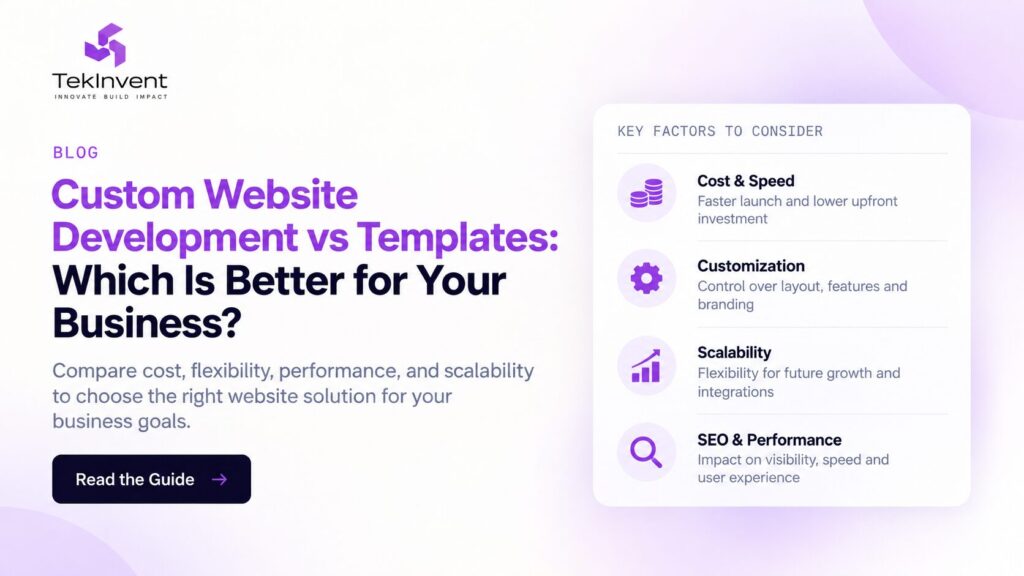
Building a new business website often starts with one important decision. Should you use an existing website template or invest in a website created specifically for your business?
At first, the decision may look simple. A template is usually easier to launch and requires less work in the beginning. A custom website requires more planning, design, development, and testing. But when the website is expected to generate leads, support marketing, integrate with business systems, or grow with the company, the decision becomes more important.
The custom website development vs template discussion should not be reduced to which option looks better. Both approaches can produce a professional website when used correctly.
The real question is whether the website fits what your business needs today and what it may need two or three years from now.
A small business that only needs a few informational pages may be completely satisfied with a quality template. A growing company that needs custom user journeys, integrations, advanced functionality, stronger branding, or greater control may benefit much more from custom development.
Understanding that difference can prevent a business from spending too much on features it does not need or building something too limited to support future growth.
What Is a Template Website?
A template website starts with an existing design structure.
Instead of creating the entire website layout from the beginning, the business selects a predefined design and adjusts it using its logo, colors, images, content, and branding.
Platforms such as WordPress, Shopify, Wix, Webflow, Squarespace, and other content management systems provide templates or themes businesses can use as a foundation.
This approach can work very well when the requirements are straightforward.
Imagine a local service business that needs a homepage, service pages, an about page, a blog, and a contact form. If the website does not require complicated functionality, starting with a carefully selected template may be practical.
The important thing to understand is that using a template does not automatically mean the website will be low quality.
A good developer can optimize a template, improve its layout, remove unnecessary functionality, enhance performance, and customize important sections.
Problems usually begin when businesses try to force complicated requirements into a template that was never designed to support them.
What Is Custom Website Development?
Custom website development involves designing and developing the website around the specific needs of a business rather than adapting the business to an existing layout.
The process normally starts with understanding the company, target audience, website goals, content requirements, customer journey, technical requirements, and future plans.
Designers can then create layouts around those requirements. Developers build the required functionality and connect the website with the necessary systems.
This gives businesses much more control over how the website looks, behaves, performs, and evolves.
Custom development does not necessarily mean that every single line of code must be created without using frameworks or existing technologies. Professional developers still use reliable frameworks, libraries, content management systems, and development tools.
The difference is that those technologies are selected and configured around the project instead of allowing an existing template to dictate how the website must work.
If your business needs that level of control, working with experienced website development services can help you plan the structure, user experience, functionality, and technical foundation before development begins.
Custom Website Development vs Template: What Is the Main Difference?
The biggest difference is control.
A template asks you to work within an existing structure. Custom development allows the structure to be created around the business.
That difference affects almost everything that comes later.
With a template, you might find a layout that includes most of what you need. You can change images, colors, typography, content blocks, and other visual elements. However, deeper changes can become difficult because the original structure was created for a broad range of users rather than your specific company.
Custom website development starts from the opposite direction.
Instead of asking, “What can this template do?” the development team asks, “What does this business need the website to do?”
That difference becomes increasingly important as the website becomes more valuable to the company.
Which Option Is Better for Branding?
Templates have improved significantly. A professionally customized template does not have to look generic.
However, there is still a limit to how far many templates can be customized before developers begin fighting against the original design.
This matters when the website needs to communicate a strong brand identity.
Visitors may not consciously recognize that a website uses a popular template, but they notice when a website feels similar to dozens of others.
A custom website gives designers more freedom to build a visual language around the business.
The page hierarchy, navigation, imagery, typography, content presentation, calls to action, interactive elements, and overall experience can all support the brand.
This becomes particularly valuable in competitive industries where several companies offer similar services.
If your website is one of the first interactions someone has with your company, it should communicate why your business is different rather than simply showing that your business exists.
What About Website Performance?
Performance depends more on how the website is built than whether it is custom or template based.
A well optimized template can perform extremely well. A poorly developed custom website can be slow.
That is why businesses should avoid assuming custom automatically means faster.
The advantage of custom development is greater control.
Many commercial templates include features designed to satisfy thousands of possible customers. Your website may only use a small portion of them, but some unnecessary scripts, styles, plugins, and components may still remain.
Custom development allows the development team to build around the actual requirements of the project.
This can make it easier to control page weight, scripts, image loading, database queries, third party integrations, and other factors that influence website performance.
For businesses investing heavily in SEO, paid advertising, content marketing, or lead generation, website performance deserves attention because every marketing channel eventually sends visitors to the website.
Is Custom Website Development Better for SEO?
Custom development can provide greater SEO flexibility, but using a custom website does not automatically produce higher rankings.
Search engines do not reward a website simply because it was custom coded.
SEO performance depends on many factors, including content quality, site architecture, crawlability, internal linking, page experience, authority, relevance, and technical implementation.
A quality template can support SEO perfectly well when it is configured correctly.
The potential limitation appears when the template restricts important technical changes.
For example, a growing website may eventually need more control over page templates, structured data, internal linking, URL structures, programmatic pages, content sections, page speed improvements, or technical SEO elements.
Custom development can give SEO teams and developers greater flexibility to make those changes without rebuilding large parts of the website.
Businesses planning to rely heavily on organic traffic should therefore consider not just current SEO requirements but how easily the website can evolve as the SEO strategy becomes more advanced.
How Do Templates and Custom Websites Affect Conversion Rates?
A website should not only attract visitors. It should help them take the next step.
That may mean requesting a quote, booking a consultation, buying a product, creating an account, scheduling a demo, or contacting the sales team.
Templates normally use common conversion patterns. This can actually be useful because familiar layouts make websites easier to understand.
The problem appears when your customer journey does not match the template.
Suppose your service requires visitors to understand a complicated process before contacting the company. You may need educational sections, comparison content, case studies, trust signals, interactive features, qualification forms, and carefully placed calls to action.
Trying to squeeze that journey into a predefined template can create unnecessary compromises.
Custom design allows the website structure to follow the buying journey.
A visitor who is still researching can receive the information needed to understand the service. A visitor who already understands the solution can quickly reach a conversion point.
That flexibility is one of the strongest reasons growing businesses eventually move toward custom website development.
Which Is More Affordable?
Templates generally have a lower initial cost because much of the design and development work already exists.
For businesses with limited requirements, this can make financial sense.
There is little reason to build an expensive custom system if the company only requires a straightforward website with standard functionality.
However, businesses should think beyond launch cost.
A website that looks affordable initially can become expensive if developers continuously need to modify the template, replace incompatible plugins, solve performance problems, or build workarounds for features the original structure does not support.
Custom development normally requires a larger investment at the beginning because discovery, UX planning, design, development, testing, and deployment require more time.
The advantage is that the architecture can be planned around expected requirements.
The better question is therefore not, “Which website is cheaper?”
Ask, “Which approach creates the lowest cost for the functionality and growth we actually need?”
That question produces a much more useful answer.
Which Option Can Be Launched Faster?
Templates usually win when speed is the main priority.
If the content is ready and the requirements are simple, a template based website can move from planning to launch much faster because the design foundation already exists.
Custom websites require additional stages.
Business requirements must be understood. User journeys must be planned. Designs must be created and approved. Development must be completed. Features need testing. The website must then go through quality assurance before launch.
That additional time is not necessarily wasted.
It is being used to create something more closely aligned with the business.
Still, a company that needs a basic website immediately may not benefit from delaying launch for extensive custom development.
This is why the correct choice depends heavily on the business situation.
What Happens When Your Business Starts Growing?
Scalability is where the differences between custom website development vs template websites often become easier to see.
A basic website may begin with six or seven pages.
Later, the business might introduce new services, locations, customer portals, ecommerce functionality, CRM integrations, payment systems, calculators, multilingual content, personalization, advanced analytics, or automated workflows.
Some templates can support these changes.
Others become increasingly difficult to maintain as additional plugins and custom modifications are added.
Eventually, developers may spend more time working around the original structure than improving the website.
A properly planned custom website can create a stronger foundation for growth because future requirements can be considered during architecture planning.
Of course, no developer can predict every feature a company will need five years from now.
Good scalability simply means the website is structured so future changes can be introduced without unnecessarily rebuilding everything that already works.
Do You Really Need a Custom Website?
Not every company does.
This is an important point because businesses sometimes assume that custom automatically means professional.
A company should not invest in custom development simply because it sounds more advanced.
If you are launching a small business, testing a new idea, creating a temporary website, or building a simple informational presence, a good template may provide everything you need.
It allows you to launch faster, reduce the initial investment, and validate whether the website supports your business.
Custom development becomes more valuable when the website plays a deeper role in business growth.
If your site needs specialized features, advanced integrations, unique user journeys, strong brand differentiation, high scalability, complex content structures, or greater technical control, the investment becomes easier to justify.
The website requirements should determine the technology, not the other way around.
When Does a Template Start Becoming a Problem?
A template becomes a problem when the business repeatedly has to compromise because of it.
You may notice that simple changes require unusual workarounds. New functionality may depend on additional plugins. Page layouts may become inconsistent. Performance may decline as more tools are added. Developers may warn that changing one part of the website could break another.
Those are signs that the existing foundation may no longer match the needs of the business.
This does not mean the original decision to use a template was wrong.
The website may simply have outgrown it.
Many successful businesses begin with relatively simple websites and move toward custom development only after their requirements become clearer.
That can actually be a sensible approach because real customer behavior helps inform the next version of the website.
Should a Startup Choose Custom Development or a Template?
A startup should think carefully before choosing either extreme.
Building an expensive custom website before validating the business can consume budget that may be more valuable elsewhere.
At the same time, using an extremely restrictive template for a product that depends heavily on digital functionality can create problems very quickly.
The best decision depends on what is being validated.
If the startup only needs to explain the idea and collect early leads, a professional template may be enough.
If the website itself is part of the product, customer experience, or business process, custom development may be required from the beginning.
The goal should be to invest enough to test the business properly without building unnecessary complexity.
How Should an Established Business Decide?
Established companies should look at the website as part of their broader business infrastructure.
Ask how visitors currently use the website.
Consider where leads come from, which pages influence conversions, what systems need to communicate with the website, what problems employees face when managing content, and what the company expects to add in the future.
If the existing website already generates meaningful traffic and leads, decisions should also consider migration risk.
A redesign or rebuild should protect valuable URLs, content, internal links, tracking, SEO signals, analytics configuration, and conversion paths.
This is where experienced planning matters.
The objective should not simply be to make the website look newer.
The objective should be to build a stronger digital asset without damaging what is already working.
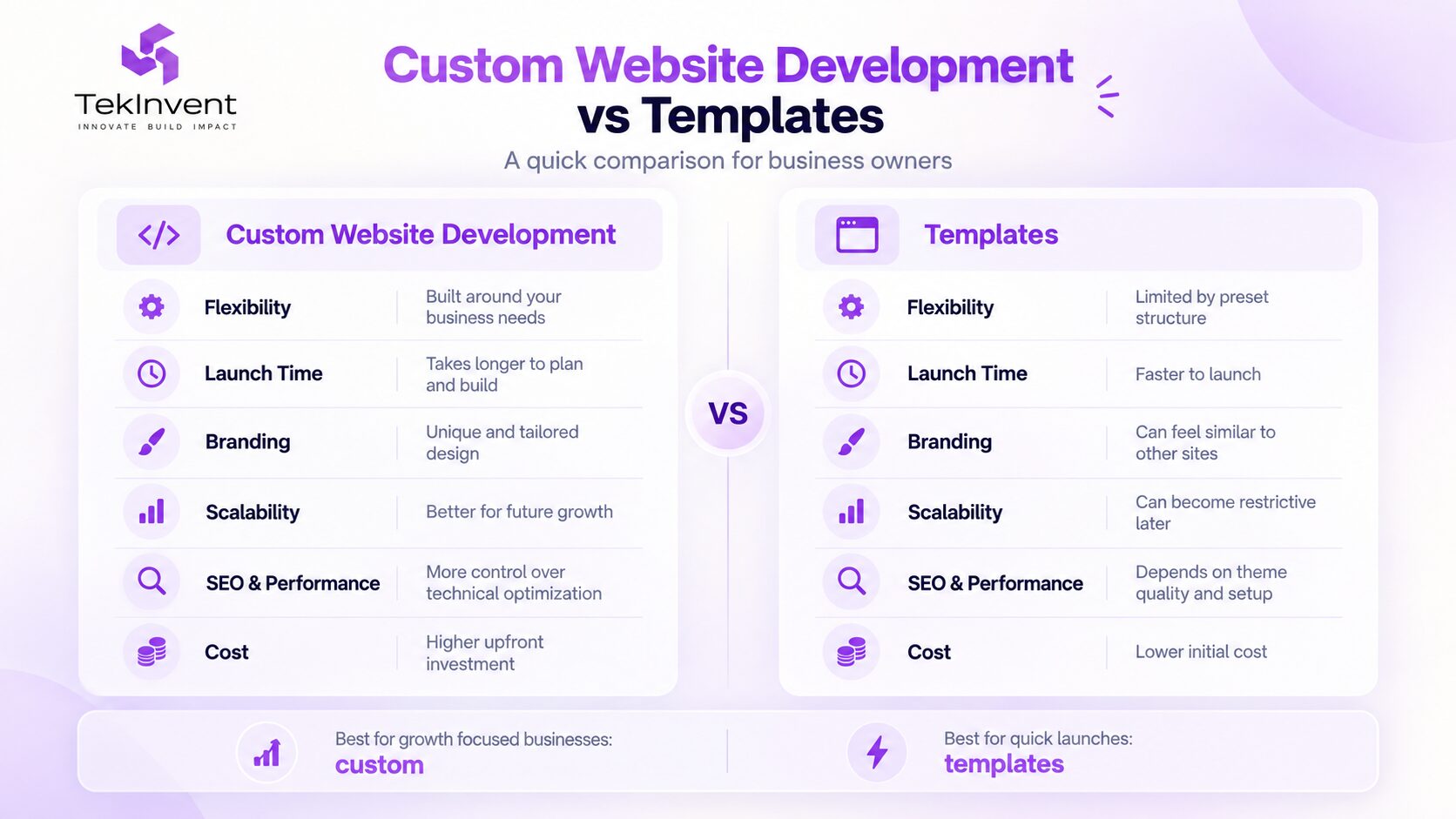
Custom Website Development vs Template: Which Should Your Business Choose?
There is no universal winner in the custom website development vs template debate.
A template is often the smarter choice when requirements are simple, budget is limited, and getting online quickly is more important than building specialized functionality.
Custom website development becomes more valuable as the website becomes more connected to revenue, operations, customer experience, marketing, and long term growth.
The easiest way to make the decision is to stop thinking about design first.
Start with the business.
What should visitors accomplish on the website? What information do they need before contacting you? Which systems need to connect with the site? How important is organic search? How often will the website change? What new functionality might the business require later?
Once those questions are answered, the right development approach usually becomes much clearer.
Final Thoughts
Your website should fit your business rather than forcing your business to fit the website.
Templates can be excellent for straightforward websites. They reduce development time, make launching easier, and can provide everything a small business needs.
Custom development becomes valuable when flexibility, scalability, performance control, brand experience, integrations, and conversion strategy become more important.
The important thing is not choosing the most expensive solution. It is choosing a foundation that supports what you are trying to achieve.
If your business has reached the point where an existing theme or website builder is limiting performance, functionality, customer experience, or future expansion, TekInvent can help evaluate those requirements and build a website around your actual business goals.
A good website should solve today’s problems without creating tomorrow’s limitations.

Build Smart with The Right Team.
We bring expertise, technology, and trust you look for in your digital journey.