


One of the first questions business owners ask before starting a website project is simple: how long will it take?
The answer is not always as simple.
A basic business website may be completed in a few weeks, while a larger custom website with advanced features, integrations, and multiple approval stages can take several months. The website development timeline depends on the size of the project, how quickly decisions are made, the amount of content required, the level of customization, and the technical complexity involved.
For most businesses, understanding the timeline before development starts is important because a website project usually connects with other activities such as marketing campaigns, product launches, SEO plans, paid advertising, hiring, sales goals, or investor presentations.
If the website is delayed, those plans can also be affected.
A realistic timeline does not mean rushing development. It means understanding each stage, knowing what can create delays, and organizing the project so the website can move from idea to launch without unnecessary problems.
This guide explains how long business website development normally takes, what happens during each stage, and what businesses can do to keep a project moving efficiently.
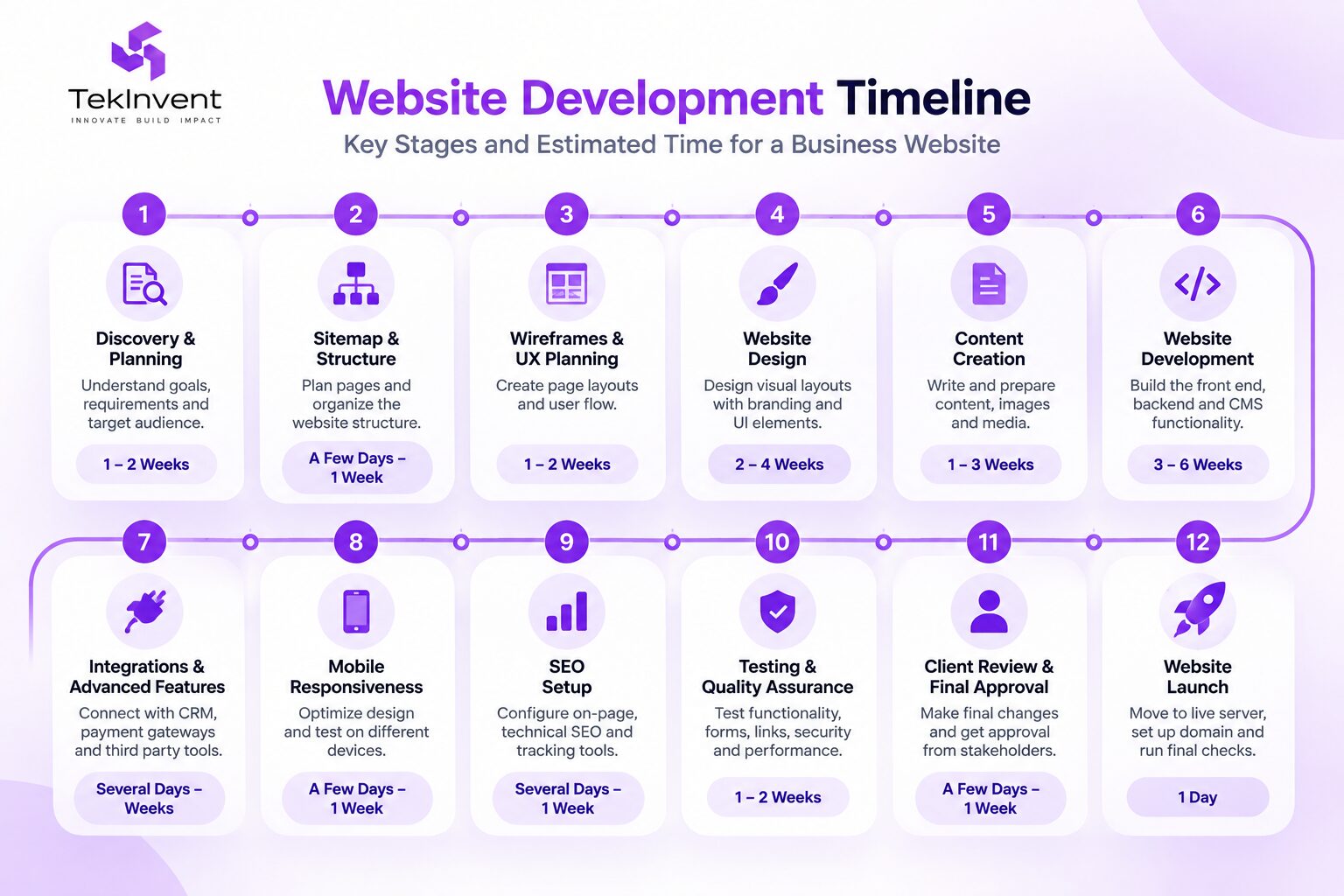
What Is a Typical Website Development Timeline?
A typical business website may take around six to twelve weeks from initial planning to launch.
That estimate can be shorter for a simple website and much longer for a complex custom project.
For example, a small informational website with a homepage, about page, several service pages, a contact page, and a basic content management system may be completed relatively quickly.
A larger business website may require custom page designs, advanced forms, customer accounts, API integrations, databases, ecommerce functionality, calculators, dashboards, multilingual content, or other specialized features. Those requirements naturally increase the timeline.
The development schedule also depends on whether the website is being created from scratch or replacing an existing site.
A redesign may involve reviewing current pages, preserving SEO value, migrating content, maintaining URLs, redirecting outdated pages, transferring analytics, and making sure existing functionality continues working after launch.
This is why two websites with a similar number of pages can still have completely different development timelines.
Why Is It Difficult to Give One Exact Timeline?
Websites are not identical products.
A business website should be developed around the purpose it needs to serve.
A local service company may mainly need visitors to understand its services and submit inquiries. A SaaS business might require product pages, integrations, demo forms, customer resources, and sophisticated conversion tracking.
An ecommerce business may need hundreds of products, filters, payment processing, shipping rules, customer accounts, order management, and inventory integrations.
All three businesses need websites, but the work behind those websites is completely different.
This is why a realistic website development timeline should be based on requirements rather than a fixed number of days.
When businesses begin a project with experienced web development services, the planning stage should clarify what needs to be built before a reliable timeline is created.
The clearer the project scope becomes, the more accurate the schedule can be.
Stage 1: Discovery and Website Planning
Most successful website projects begin with planning rather than design.
This stage commonly takes around one to two weeks depending on the size of the project.
During discovery, the development team needs to understand the business, website goals, target users, required pages, current problems, technical requirements, competitors, conversion goals, and future growth plans.
If an existing website is being replaced, this stage may also include reviewing analytics, current traffic, ranking pages, customer behavior, conversion paths, content performance, and technical issues.
The purpose is to answer an important question before design starts.
What exactly should this website achieve?
Without a clear answer, businesses often begin designing pages before understanding what those pages need to accomplish.
That usually creates revisions later.
A good discovery process reduces that risk because the team agrees on the direction before major development work begins.
Stage 2: Sitemap and Website Structure
Once the requirements are understood, the next step is organizing the website.
For a small website, this may take only a few days. For a larger site, planning the structure can take one or two weeks.
The sitemap determines which pages will exist and how users will move between them.
This step also matters for SEO.
The structure should help visitors understand the website while making it easy for search engines to discover important pages and understand how different topics are connected.
For example, a service based company may have a homepage, main service pages, individual subservice pages, industry pages, case studies, blog content, company information, and contact pages.
Those pages should not exist randomly.
They should form a logical structure.
When this work is completed early, designers, writers, developers, and SEO teams can all work from the same plan.
That reduces confusion later in the project.
Stage 3: Wireframes and User Experience Planning
Before visual design begins, many custom website projects use wireframes.
Wireframes are simplified page layouts that show where important content and functionality will appear.
They do not focus heavily on colors, photography, or final visual details. Instead, they focus on structure and user flow.
This stage may take one to two weeks depending on how many unique page types are required.
A business website might not need a completely different design for every page.
Instead, it may use several reusable page structures such as a homepage layout, service page layout, industry page layout, blog layout, landing page structure, and contact page.
Wireframing these page types helps the team decide where headlines, supporting content, trust signals, forms, calls to action, testimonials, case studies, and other elements should appear.
It is much easier to change the structure during the wireframe stage than after full development has started.
Stage 4: Website Design
The visual design phase often takes around two to four weeks.
During this stage, the website begins to look like the final product.
Designers establish the visual direction using the company’s branding, typography, colors, imagery, page layouts, icons, spacing, and interactive elements.
The amount of time required depends heavily on how custom the website is.
A website using an existing design system or template may move quickly.
A fully custom website requires more design work because the layouts are created specifically for the brand and customer journey.
Approval speed is also important here.
If stakeholders provide clear feedback quickly, the project can move forward without much interruption.
If several decision makers provide conflicting feedback or approvals take many days, the website development timeline can extend considerably.
This is one of the most common reasons projects take longer than originally expected.
Stage 5: Content Creation
Content is often one of the biggest causes of website delays.
Businesses sometimes focus heavily on design and development while assuming content can be written later.
In reality, the website cannot be completed properly without knowing what each page needs to communicate.
Content creation may happen alongside design and development, but it still needs to be planned early.
For a smaller website, content may take one to three weeks. A larger website with dozens of service pages, industry pages, case studies, and supporting content can take considerably longer.
The timeline depends on whether the business already has usable content.
If existing website content is strong, some of it may only need editing.
If the site is being repositioned or expanded, many pages may need to be written from the beginning.
Content also affects page design.
A page created around a short paragraph will look different from one containing detailed explanations, examples, FAQs, case studies, comparison sections, and calls to action.
This is why content and design should not operate completely separately.
Stage 6: Website Development
Once the approved designs and technical requirements are ready, developers begin building the website.
For many business websites, this stage takes around three to six weeks.
More complex development can take several months.
Development usually includes creating the front end users interact with and configuring the backend systems required to manage the website.
Developers may also set up the content management system, responsive behavior, navigation, forms, integrations, animations, tracking capabilities, security configurations, and other functionality.
The development timeline depends heavily on customization.
Building a standard contact form is straightforward.
Building a multi step quotation tool connected with a CRM, internal database, email automation system, and customer account portal is a completely different project.
This is why page count alone should never be used to estimate development time.
Functionality matters just as much.
Stage 7: Integrations and Advanced Features
Some websites need to communicate with other software.
This can include CRMs, payment gateways, booking systems, email platforms, analytics tools, inventory systems, ERP software, customer support platforms, marketing automation tools, or third party APIs.
Integrations can add anywhere from several days to several weeks to the website development timeline.
The complexity often depends on how well the external platform supports integration.
A commonly used service with clear documentation may be relatively easy to connect.
An older internal system or custom platform may require significantly more development and testing.
Businesses should identify these integrations during the planning stage.
Discovering an important technical requirement halfway through development can affect both timeline and budget.
Stage 8: Mobile Responsiveness
A business website cannot be treated as a desktop only project.
Pages need to work properly across different screen sizes.
Responsive development usually happens throughout the build process rather than being added at the end.
However, the website still needs specific testing on mobile phones, tablets, laptops, and larger screens.
Layouts may need adjustments so text remains readable, forms remain easy to complete, navigation works properly, images resize correctly, and calls to action stay accessible.
A design that looks excellent on a large monitor can become difficult to use on a small screen if responsiveness is not considered carefully.
This is why responsive behavior should be part of the original website development process rather than a final correction.
Stage 9: SEO Setup
Search engine optimization should also be considered before launch.
The amount of SEO work varies by project, but basic technical and on page setup may take several days to one or two weeks.
Important elements can include page titles, meta descriptions, headings, internal linking, URL structures, canonical settings, image optimization, structured data, sitemap configuration, indexing controls, redirects, and analytics tracking.
If the website replaces an existing site, migration planning becomes especially important.
Changing URLs without proper redirects can damage traffic.
Removing valuable content without reviewing performance can also create problems.
The development team and SEO team should therefore coordinate before launch rather than trying to fix everything afterward.
Stage 10: Testing and Quality Assurance
A website should never move directly from development to launch without testing.
Quality assurance commonly takes around one to two weeks.
The team checks pages, forms, links, navigation, mobile layouts, browser compatibility, integrations, images, content, tracking, functionality, and performance.
Testing becomes more important as website complexity increases.
A basic informational website may have relatively few things that can break.
An ecommerce or custom web platform may have hundreds of possible user actions.
The goal is not just to confirm that the homepage loads.
The team needs to test how real users may interact with the site.
Can visitors submit forms?
Do confirmation messages work?
Do emails reach the correct team?
Are buttons sending visitors to the right pages?
Do integrations pass information correctly?
Can content be updated without creating layout problems?
These details matter because even a small issue can reduce conversions after launch.
Stage 11: Client Review and Final Approval
Before launch, the business usually completes a final review.
This can take several days or much longer depending on how the approval process is managed.
The most efficient projects normally have one primary person responsible for collecting internal feedback.
Without that process, different departments may send separate revision requests at different times.
This can result in repeated changes and extend the project unnecessarily.
Feedback should also distinguish between real problems and personal preferences.
If every stakeholder redesigns pages based on individual taste, a project can remain in revision for weeks.
The final review should focus on whether the website meets the agreed business, user, content, and technical requirements.
Stage 12: Website Launch
Once testing and approvals are complete, the website can be launched.
The launch itself may happen within a day, but preparation often begins earlier.
The team may need to configure hosting, domain settings, SSL, redirects, backups, analytics, tracking scripts, search engine tools, caching, security settings, and other technical elements.
Existing websites require additional care.
Before replacing the old site, the team should confirm that important URLs, redirects, forms, analytics settings, and SEO elements are correctly transferred.
After launch, the site should be checked again.
A website that worked perfectly in a staging environment may behave differently once moved to production.
Post launch checks help identify those issues quickly.
What Can Make a Website Project Take Longer?
The development work itself is not always the biggest cause of delays.
Many timeline problems happen because information or approvals are not available when the team needs them.
Content delays are common.
The design may be ready, but development cannot be finalized because page copy, images, team information, case studies, or legal content have not been approved.
Changing requirements can also increase the timeline.
A business may initially request a simple contact form and later decide it needs a customer dashboard or automated quotation system.
That new feature requires additional planning, development, and testing.
Slow approvals have a similar effect.
If every stage waits a week for feedback, even a relatively small website can quickly become a long project.
Technical integrations, content migration, legacy systems, and unexpected issues with the existing website can also create delays.
How Can Businesses Speed Up the Website Development Timeline?
Speed does not come from asking developers to work faster.
It comes from reducing uncertainty.
Businesses that prepare their content, goals, branding materials, technical requirements, and decision making process before development begins usually move through projects more efficiently.
Having one clear project owner helps considerably.
That person can collect internal feedback, approve decisions, answer questions, and keep communication moving.
Businesses should also finalize the essential requirements before development begins.
This does not mean every future idea needs to be included in the first release.
In many cases, launching the most important functionality first and adding secondary features later can reduce both risk and development time.
Clear priorities make the project easier to manage.
Should You Launch Everything at Once?
Not always.
A website does not have to include every possible future feature on launch day.
For many businesses, a phased development approach makes more sense.
The first version can focus on the pages and functionality required to support the immediate business goals.
Later phases can introduce advanced features based on real customer behavior and business needs.
This approach is especially useful when companies are trying to launch before an important campaign or market opportunity.
Instead of delaying the entire website because one secondary feature is not ready, the business can launch the core experience and continue improving it afterward.
The important point is that the website architecture should support those future additions.
How Long Should a Small Business Website Take?
A small business website can often be completed within four to eight weeks when requirements are straightforward.
That timeline assumes the business provides feedback, content, images, and approvals without major delays.
A typical project may include a homepage, several service pages, an about page, blog, contact page, and standard inquiry forms.
If a template or existing design framework is being used, development may move even faster.
Custom design usually adds time because the user experience and visual system need to be planned individually.
Small businesses should avoid focusing only on launching quickly.
A website that is rushed into production and then requires constant corrections may ultimately cost more time than a properly planned project.
How Long Should a Custom Business Website Take?
A custom business website commonly takes around eight to sixteen weeks.
More advanced projects may take longer.
The additional time usually comes from custom UX planning, design, development, content preparation, integrations, testing, and multiple page types.
The benefit is greater control.
The website can be created around the brand, customer journey, marketing strategy, business operations, and future requirements.
For organizations where the website is a major lead generation or sales channel, spending additional time on this planning can be worthwhile.
How Long Does an Ecommerce Website Take?
Ecommerce projects are usually more complex than standard business websites.
A smaller ecommerce website may take two to four months, while a large custom store can take much longer.
The timeline can be affected by the number of products, payment setup, shipping logic, inventory systems, filters, product variations, customer accounts, promotions, subscriptions, integrations, and checkout requirements.
Content migration can also become a major task.
Moving hundreds or thousands of products from an old website requires careful planning to ensure product information, images, URLs, customer data, and other important information are preserved correctly.
How Long Does a Website Redesign Take?
A website redesign can take anywhere from several weeks to several months.
The timeline depends on whether only the visual design is changing or whether the entire website architecture and technology are also being rebuilt.
A visual refresh may be relatively quick.
A complete redesign involving new content, navigation, SEO structure, CMS, functionality, and integrations is effectively a full website development project.
Businesses should therefore avoid assuming that redesigning an existing website will always be faster than building a new one.
Sometimes the existing system actually adds complexity.
What Is a Realistic Website Development Timeline for Your Business?
The easiest way to estimate your website timeline is to define the project before asking for a completion date.
Start by identifying what pages are required.
Then define the functionality.
Consider whether content already exists, whether the website needs integrations, how many people need to approve decisions, and whether an existing site needs to be migrated.
A simple website with prepared content and fast approvals may move quickly.
A custom platform with advanced functionality, multiple stakeholders, integrations, and extensive content will naturally require more time.
Neither situation is necessarily better.
The timeline should reflect the actual work needed to create a reliable website.
Final Thoughts
The website development timeline is usually determined long before developers begin writing code.
Clear requirements, prepared content, quick approvals, realistic expectations, and good project management can make a major difference.
A simple business website may take several weeks. A custom website may take several months. The important thing is not making the timeline as short as possible.
The goal should be creating a website that works properly, supports the business, and provides a solid foundation for future growth.
If your business is planning a new website, TekInvent can help define the requirements, organize the development process, and create a realistic roadmap before the build begins.
That planning gives your team something more useful than a quick completion promise.
It gives you a clear understanding of what will be built, how it will be developed, and what needs to happen before your website is ready to launch.

Build Smart with The Right Team.
We bring expertise, technology, and trust you look for in your digital journey.