
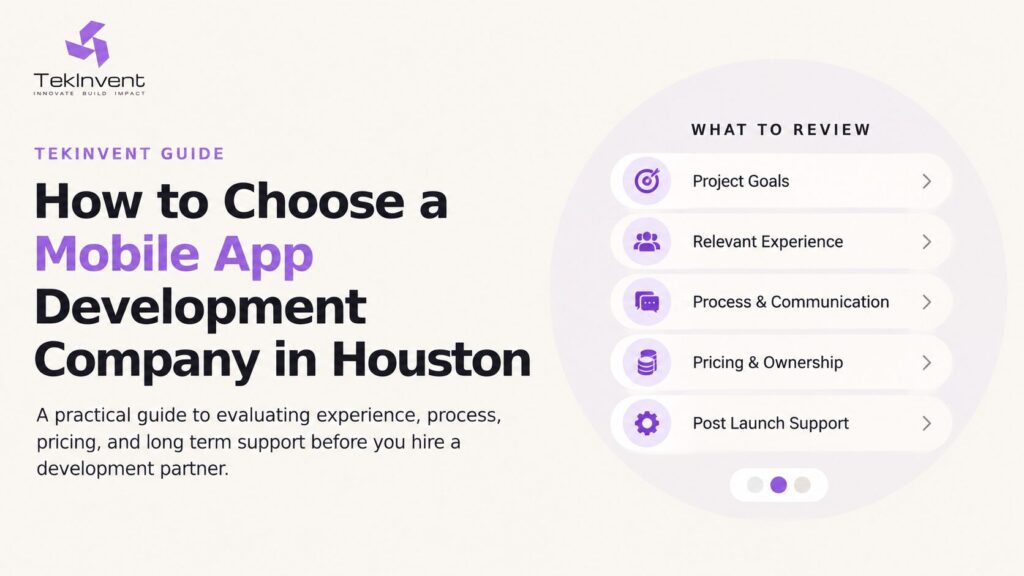
Choosing the right company to build your mobile app can have a major impact on what happens after development starts.
A good development team does more than write code. It helps you understand what should be built, which features are actually necessary, what technology makes sense, how the app should be tested, and what will happen after launch.
A poor choice can create the opposite experience. Requirements may remain unclear, deadlines may keep moving, communication may become difficult, and the final application may need expensive changes before it is ready for real users.
This is why understanding how to choose a mobile app development company is important before signing a contract.
For Houston businesses, startups, and founders, location may be useful, but it should not be the only factor. The better approach is to evaluate the company based on product understanding, relevant experience, technical capability, communication, process, testing standards, ownership, and long term support.
This guide explains what to check before choosing a development partner and which questions can help you make a more informed decision.
Start With Your App Idea Before Comparing Companies
Before contacting development companies, first define what you are trying to build.
You do not need a complete technical document or every screen designed in advance. However, you should be able to explain the business problem your app will solve.
Think about who will use the app.
Consider what users should be able to do when they open it.
Identify the most important features.
Decide whether the application is for customers, employees, partners, or a combination of users.
You should also think about whether the first version needs to support iOS, Android, or both.
For example, a Houston healthcare business may want an app for appointment booking, secure communication, and patient access.
A logistics company may need location tracking, job assignments, driver updates, and reporting.
A startup may only need a simple MVP that validates one core idea before a larger investment.
These projects require different skills and different development plans.
If your requirements are unclear, companies will often give very different estimates because they are pricing different versions of the same idea.
A clear project brief makes choosing a mobile app development company much easier because you can compare companies against the same basic requirements.
Look for a Company That Understands the Business Problem
A development company should not start the first conversation by pushing a particular programming language or framework.
Technology matters, but it comes after understanding the product.
A useful development partner will ask why the application is being built.
They may ask what problem users currently face, who the users are, how the business operates today, which features are essential, and what result the company expects from the application.
These questions matter because the technically most impressive solution is not always the right business solution.
Imagine that a startup asks for twenty features in the first release.
A strong development partner may identify that only six of those features are necessary to test whether users actually want the product.
That can reduce the initial development effort and make it possible to collect real feedback earlier.
A weaker company may simply agree to build everything because a larger scope means a larger contract.
When learning how to hire an app development company, pay attention to how much effort the team puts into understanding the business before discussing development.
Review Relevant Experience, Not Just the Size of the Portfolio
Most app development companies have portfolios.
The number of projects in the portfolio is less important than how relevant those projects are to your needs.
If you are building a healthcare app, experience with secure user data, appointment systems, integrations, and regulated workflows may be more useful than experience building ten simple ecommerce apps.
If you are building a marketplace, look for experience with user roles, payments, notifications, search, reviews, and backend management.
If your app needs real time location tracking, ask whether the team has built similar functionality before.
Do not expect every project to match your idea exactly.
Instead, look for evidence that the company has solved similar technical or product problems.
You should also ask what role the company actually played in the projects shown.
Sometimes a portfolio includes a project where the company only redesigned a few screens. That is very different from managing strategy, UX, backend development, mobile development, QA, deployment, and maintenance.
Relevant experience gives you a better indication of whether the team understands the type of problems your product is likely to face.
Do Not Choose Based on Design Screens Alone
A beautiful application screenshot can make a portfolio look impressive.
But screenshots tell you very little about how the application actually works.
A mobile application also needs stable backend systems, secure authentication, clean architecture, reliable APIs, good performance, proper error handling, and effective testing.
When reviewing previous work, try to understand what happens behind the interface.
Ask whether the company developed the backend.
Ask whether third party systems were integrated.
Ask how the team handled performance.
Ask how the application was tested across devices.
Ask whether the product is still active and supported.
This helps you separate a company that can design attractive interfaces from a mobile app development partner capable of building and maintaining a complete product.
Check Whether Their Technical Skills Match Your App
Different mobile applications require different technical expertise.
Some products need deep native functionality.
Others can be built efficiently using a shared cross platform codebase.
A simple content application has different technical needs from a fintech product, healthcare platform, marketplace, or real time communication app.
The development company should be able to explain why it recommends a particular approach.
It should not simply say that one technology is always better.
For example, native development may make sense when the application relies heavily on platform specific features or requires very specific performance characteristics.
Cross platform development may be a better option when a business wants to reach Android and iOS users efficiently using a largely shared development approach.
If you are still deciding between these approaches, the native vs cross platform app development comparison can help you understand how the two options differ in cost, performance, maintenance, development speed, and platform access.
The important point is that technology should follow product requirements.
Your development company should be able to explain the tradeoffs in simple language.
Understand Who Will Actually Work on Your Project
One common mistake is evaluating the sales team instead of the development team.
The person who sells the project may not be the person managing it.
Before signing the agreement, understand who will actually be involved.
Find out who will manage the project.
Understand who is responsible for UX and UI.
Ask who will build the mobile application and backend.
Find out who handles testing.
Understand who communicates with you when a technical decision is required.
You should also know whether the company uses an internal team, contractors, or a combination of both.
Using contractors is not automatically a problem.
The important issue is accountability.
You should know who owns the result and who is responsible when something needs to be fixed.
A clear team structure reduces confusion after development begins.
Ask How the Development Process Works
A reliable company should be able to explain its development process without making it unnecessarily complicated.
The project will usually move through discovery, requirements, UX planning, design, development, testing, deployment, and post launch support.
However, the exact workflow may vary.
What matters is that there is a clear system for turning requirements into working software.
Ask how features are documented.
Ask how progress is reviewed.
Ask how often builds will be shared.
Ask how changes are approved.
Ask how bugs are tracked.
Ask when testing begins.
Ask what happens if requirements change during development.
You should also understand how you will know whether the project is on schedule.
A process does not need to involve endless meetings.
It needs to make responsibilities and progress visible.
Transparency is one of the strongest indicators that a development relationship will be manageable.
Understand Their Approach to Product Discovery
Discovery is sometimes treated as unnecessary work before development.
In reality, it can save significant time.
During discovery, the team may clarify user roles, features, workflows, technical requirements, integrations, platform decisions, and project risks.
This is particularly important when the initial app idea is broad.
Consider a startup that says:
“We want to build an app where users can book local services.”
That single sentence leaves many unanswered questions.
Who provides the services?
How are providers verified?
How do users search?
Will payments happen inside the app?
Can users cancel?
How are refunds handled?
Does the app need real time availability?
Will providers have a separate interface?
What happens when a service is completed?
Discovery helps turn an idea into something developers can estimate and build.
If a company offers to provide an exact price for a complex application after a ten minute conversation, the estimate may be based on assumptions rather than a properly understood scope.
Evaluate Communication Before You Sign the Contract
Communication problems are one of the easiest risks to identify before development begins.
Pay attention to the way the company communicates during the sales process.
Do they answer the actual question?
Do they explain technical topics clearly?
Do they provide realistic responses?
Do they follow up when promised?
Do they ask questions before making recommendations?
If communication is difficult before the contract is signed, it is unlikely to become easier after development starts.
You should also understand how communication will work during the project.
Some teams use scheduled weekly meetings.
Others provide written updates through project management platforms.
Some use both.
The specific system matters less than consistency.
A good mobile app development partner should make it easy for you to understand what has been completed, what is being worked on, what decisions are required, and whether anything is blocking progress.
Ask How They Handle Changes in Scope
Almost every app changes during development.
You may discover that a planned feature is unnecessary.
Testing may reveal that a workflow needs to change.
Users may respond differently than expected.
A third party integration may introduce limitations.
The problem is not that changes happen.
The problem is when nobody understands how those changes affect budget and timeline.
Before hiring a company, ask how change requests are handled.
A professional development team should explain the impact before implementing a major change.
You should know whether additional work is charged separately, included within a flexible engagement, or exchanged against lower priority features.
This reduces disputes later.
It also helps protect the project from uncontrolled scope growth.
Compare Estimates by Scope, Not Just Price
When businesses receive several proposals, it is tempting to compare only the final number.
That can be misleading.
One company may include design, backend development, testing, deployment, and project management.
Another company may only include mobile development.
One estimate may include both iOS and Android.
Another may include one platform.
One company may include several months of post launch support.
Another may charge separately from the first day after release.
Before comparing prices, compare what is actually included.
Make sure the proposals are based on similar assumptions.
If one quote is dramatically lower, understand why.
It may reflect a more efficient approach.
It may also mean that important work has been excluded.
Price matters, especially for startups, but the lowest initial estimate is not always the lowest total cost.
Poor architecture, weak testing, and incomplete documentation can create expensive problems later.
Be Careful With Very Precise Estimates Too Early
A development company cannot reliably estimate a complex app without understanding the scope.
Early estimates are often ranges.
That is normal.
As requirements become clearer, estimates can become more specific.
You should be cautious when a company gives a fixed number very quickly for a complex project involving custom backend systems, several user roles, third party integrations, real time features, and multiple platforms.
Either the company has made many assumptions or important details have not been considered.
A strong estimate should explain what is included and what assumptions it depends on.
This gives you something meaningful to evaluate instead of just a number.
Check Their Testing Process
Testing should not happen only a few days before launch.
A reliable development team tests throughout production.
Different types of testing may be required depending on the product.
The team should verify whether features work correctly.
It should test different screen sizes and devices.
It should check how the app behaves when internet connections are weak.
It should test integrations.
It should check important user flows repeatedly after changes.
Security sensitive functions may require additional testing.
Ask who is responsible for QA.
Some companies expect developers to test their own work.
Developer testing is important, but independent QA can often identify issues that the original developer overlooks.
You should also know how bugs are reported, prioritized, fixed, and retested.
A polished interface cannot compensate for an unstable application.
Ask How Security Is Handled
Security should be discussed during development planning, not added after the app is finished.
The exact requirements depend on what the application does.
An app storing general preferences has different risk levels from an application handling financial information, healthcare information, private messages, or sensitive business data.
Ask how user authentication will work.
Ask how sensitive data will be stored.
Ask how API access will be protected.
Ask how credentials and secrets will be managed.
If third party services are used, understand how access is controlled.
You do not need to become a security engineer.
However, the company should be able to explain how it approaches security and why particular controls are necessary.
Answers such as “we will make it secure” are not enough for a product handling sensitive information.
Clarify Source Code and Intellectual Property Ownership
Ownership should be clear before development begins.
You should understand who owns the source code, application designs, backend code, documentation, and other project assets.
You should also know whether you will receive access to the source code repository.
If the company uses third party services, libraries, templates, or proprietary components, those dependencies should be visible.
This becomes particularly important if you later decide to work with another development team.
A business should not discover after launch that important parts of its product cannot be transferred.
The agreement should describe ownership clearly rather than leaving it to assumptions.
Understand Hosting and Infrastructure Ownership
The same principle applies to infrastructure.
If your application uses cloud hosting, databases, analytics, notifications, payment services, or other external systems, understand whose accounts will be used.
Whenever practical, important business infrastructure should not exist only inside a vendor controlled account.
You should know how access will be transferred if the development relationship ends.
This is not about distrusting a development partner.
It is basic operational planning.
Businesses change vendors, employees leave, companies restructure, and products evolve.
Clear ownership keeps those changes manageable.
Evaluate the Company’s Approach to Post Launch Support
Launching an app is not the end of its lifecycle.
Users will encounter new devices.
Operating systems will change.
Dependencies will be updated.
Bugs may appear under conditions that were not discovered during testing.
New features may be needed.
Usage may grow.
Ask what happens after launch.
Does the company provide a warranty period for bugs?
Is ongoing maintenance available?
How are urgent problems handled?
Who monitors crashes?
How are operating system updates handled?
How are new features estimated?
A mobile app development partner should be able to explain what ongoing support looks like before the first version is released.
This is particularly important for business critical applications where downtime can directly affect customers or operations.
Decide Whether You Need In House Development or Outsourcing
Some businesses are not only deciding between development companies. They are also deciding whether to build internally.
Both approaches can work.
An internal team provides direct control and can be useful when mobile development is a permanent part of the company’s core operation.
Outsourcing can reduce the need to recruit designers, engineers, QA specialists, and project managers individually.
It can also give businesses access to a complete team for a defined project.
The right choice depends on your existing resources, budget, product roadmap, and long term hiring plans.
If you are still comparing the two models, the guide to mobile app development outsourcing explains the practical differences between building with an internal team and working with an external development partner.
This decision should be made before comparing vendors because it changes what type of relationship you need.
Choosing an App Development Company for Startups
Startups often need a different approach from established enterprises.
An early stage company may have limited budget, incomplete requirements, and assumptions that still need market validation.
In that situation, an app development company for startups should understand how to reduce initial scope without damaging the core product idea.
The first version should normally focus on the smallest useful experience that can test the product.
That does not mean building something low quality.
It means avoiding features that do not need to exist before real users provide feedback.
For example, a startup may initially request advanced reporting, multiple payment options, social features, extensive customization, and several user roles.
Some of these may eventually be valuable.
But they may not all be required to answer the first question:
Will users actually use the core product?
A strong development company should be comfortable discussing priorities rather than simply agreeing to every requested feature.
Do You Need a Local Houston Development Partner?
A local relationship can be helpful for some businesses.
Businesses may prefer a partner that understands the local market, works within compatible time zones, or makes communication easier.
However, geography should not replace proper evaluation.
A nearby company with the wrong technical experience is not automatically better than a team with stronger relevant expertise.
If Houston based collaboration is important for your project, you can evaluate a mobile app development company in Houston while still applying the same standards around technical expertise, communication, security, ownership, QA, and post launch support.
The location should support the relationship.
It should not be the only reason for choosing the company.
Ask What Happens If the Project Does Not Go as Planned
Good project planning also includes difficult scenarios.
Ask what happens if milestones are missed.
Ask how disagreements about functionality are resolved.
Understand how incomplete work is handled if the contract ends early.
Know whether you can receive the current source code and documentation.
Understand how outstanding invoices affect access to the project.
These topics may seem uncomfortable during early conversations, but clear agreements protect both parties.
A professional company should not be uncomfortable discussing them.
Watch for Warning Signs Before Hiring
Certain patterns should make you investigate further.
Be cautious when a company promises an unusually short timeline without understanding your requirements.
Be cautious when every question receives the answer “yes, we can do that” without any discussion of tradeoffs.
Be cautious when technical recommendations cannot be explained in plain language.
Be cautious when source code ownership is unclear.
Be cautious when testing is described as something that happens only at the end.
Be cautious when there is no clear project manager or communication process.
Be cautious when the team cannot explain what happens after launch.
None of these signs automatically prove that a company cannot deliver.
They are reasons to ask more questions before committing.
What Should a Good Proposal Include?
A useful proposal should make the project easier to understand.
It should explain the expected scope.
It should identify the main features.
It should describe the proposed development approach.
It should explain which platforms are included.
It should provide an estimated timeline.
It should explain pricing assumptions.
It should describe testing.
It should clarify delivery and deployment.
It should mention ownership and support where relevant.
The proposal does not need to answer every technical question before discovery is complete.
But it should give you enough information to understand what you are buying.
If a proposal consists mainly of a price and a promised launch date, you may still have too many unanswered questions.
How to Compare Two Mobile App Development Companies
When two companies both appear capable, go back to the fundamentals.
Which team understands the problem more clearly?
Which team has experience relevant to the product?
Which company explains technical decisions better?
Which process gives you more visibility?
Which proposal defines scope more clearly?
Which team appears willing to challenge unnecessary features?
Which company has a stronger testing plan?
Which agreement provides clearer ownership?
Which company has a realistic plan for what happens after launch?
The decision becomes easier when you compare the working relationship rather than marketing claims.
The company you choose will make hundreds of small decisions during development.
You need confidence in how those decisions will be made.
Should You Hire the Company With the Lowest Price?
Sometimes the lowest priced company can be the right choice.
But price alone should not make the decision.
A low quote may come from a genuinely efficient team.
It may also come from missing requirements, less testing, inexperienced developers, limited project management, or post launch costs that have not yet been discussed.
Instead of asking which company is cheapest, ask which proposal gives you the clearest understanding of what will be delivered.
A more expensive proposal can still be poor value if the scope is weak.
A lower priced proposal can still be excellent if the team has a focused approach.
Value comes from the relationship between scope, quality, risk, timeline, and price.
What to Do Before Signing the Agreement
Before signing, review the final scope carefully.
Make sure both sides agree on what the first version includes.
Confirm the platforms.
Confirm the payment structure.
Confirm milestone expectations.
Confirm how scope changes will be handled.
Confirm source code ownership.
Confirm infrastructure access.
Confirm testing responsibilities.
Confirm deployment responsibilities.
Confirm what post launch support includes.
If something important was discussed verbally, make sure it appears in the written agreement where appropriate.
Many project problems begin because two parties remember the same conversation differently.
Clear documentation reduces that risk.
How to Choose a Mobile App Development Company With Confidence
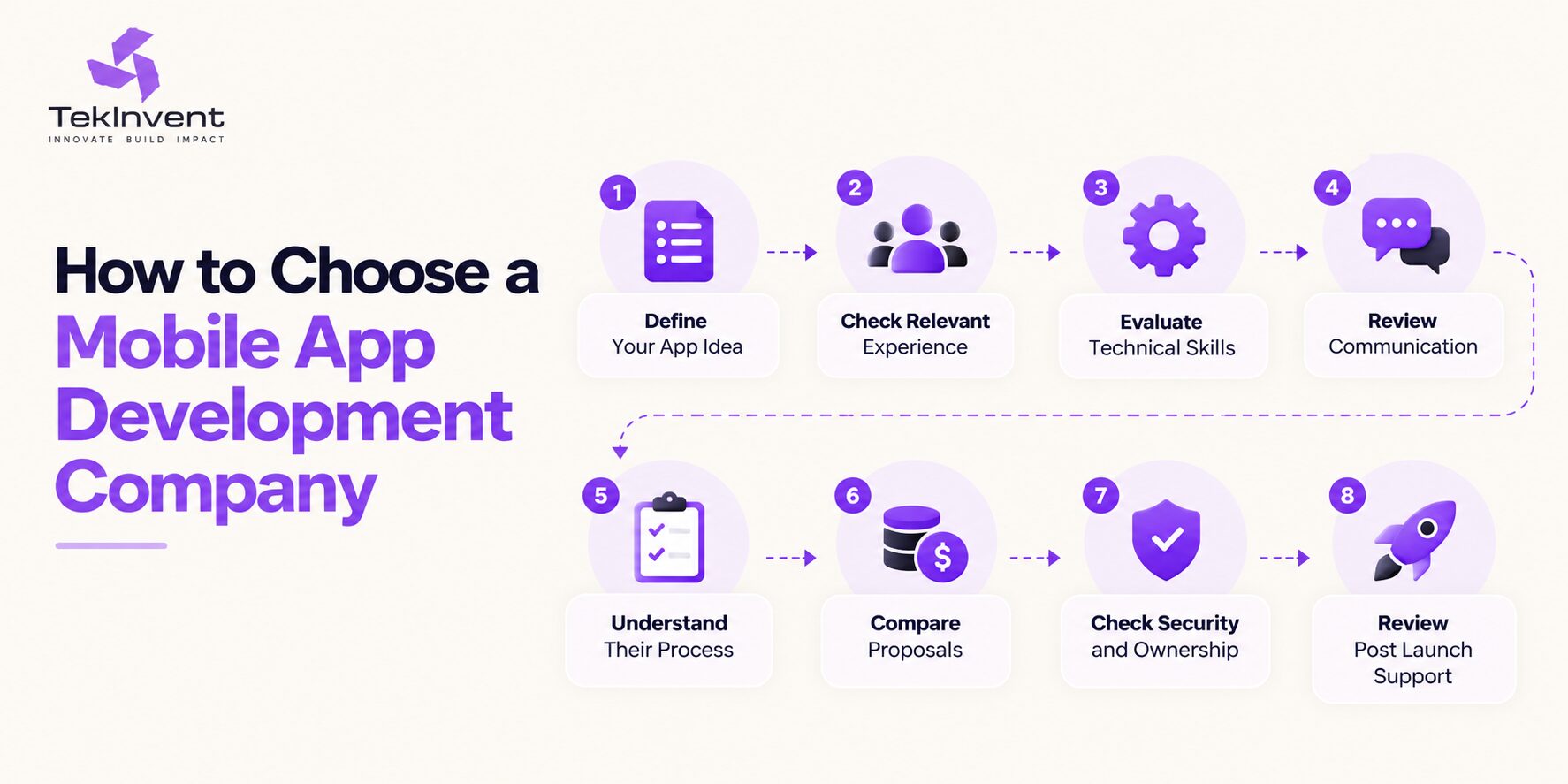
Understanding how to choose a mobile app development company comes down to reducing uncertainty before development begins.
You should know what you want to build.
The company should understand why you want to build it.
Its technical experience should match the product.
Its portfolio should show relevant problem solving rather than only attractive designs.
Its process should make progress visible.
Communication should be clear.
Pricing should be tied to scope.
Testing should happen throughout development.
Security should match the sensitivity of the product.
Ownership should be documented.
Post launch support should be discussed before launch.
These factors provide a much better basis for choosing a development partner than price, company size, or sales promises alone.
Final Thoughts
Choosing the company that will build your application is not simply a vendor selection exercise.
You are choosing the team that will translate a business idea into a working product.
That team will influence architecture, user experience, feature priorities, performance, security, testing, launch readiness, and future maintenance.
Take enough time to evaluate how the company works before evaluating only what it promises.
Define the product first.
Review relevant experience.
Understand the team.
Ask how decisions are made.
Compare proposals carefully.
Clarify ownership.
Discuss what happens after launch.
If you are choosing a mobile app development company for a startup, keep the first version focused and make sure the team understands validation as well as development.
If you are building a larger business application, pay particular attention to scalability, security, integrations, documentation, and long term support.
The right development relationship should give you more clarity as conversations continue, not less.
That is ultimately the best way to approach how to choose a mobile app development company: select a partner based on how well they understand the product, manage risk, communicate decisions, and support the application throughout its lifecycle.

Build Smart with The Right Team.
We bring expertise, technology, and trust you look for in your digital journey.