
Choosing between iOS and Android is one of the first important decisions a business needs to make before building a mobile app.
Both platforms are strong. Both have large user bases. Both can support business applications, ecommerce apps, healthcare apps, marketplaces, booking platforms, internal tools, and many other products.
The real question is not which platform is better overall.
The better question is which platform makes more sense for your audience, budget, product requirements, launch strategy, and long term business goals.
That is why iOS vs Android app development should be treated as a business decision rather than a simple technical preference.
For Houston businesses, this decision can affect development cost, time to market, device testing, user experience, maintenance, and how quickly the app can reach the right customers.
This guide explains the major differences between iOS and Android so you can decide whether to launch on iOS first, Android first, or both platforms.
Start With Your Target Audience
The first question should be simple:
Who will use your app?
A platform decision should begin with users, not with developer preference.
If most of your target audience uses iPhones, launching on iOS first may make sense.
If your audience uses a wider range of Android devices, Android may deserve priority.
This is especially important for local businesses.
A Houston healthcare company, logistics provider, restaurant group, real estate business, or startup may serve very different users.
A business to business application used by a controlled group of employees may have completely different platform needs from a consumer marketplace.
Before development begins, review your existing customer data.
Look at website analytics.
Check mobile device usage.
Review customer demographics.
If you already have a web product, analyze which operating systems your visitors use.
The strongest iOS vs Android app development decision is based on real audience behavior rather than assumptions.
What Is iOS App Development?
iOS app development means building applications specifically for Apple devices.
The main target is usually the iPhone, although the Apple ecosystem can also include iPad, Apple Watch, Apple TV, and other Apple platforms depending on the project.
iOS development commonly uses technologies such as Swift and SwiftUI.
Because Apple controls both its hardware and operating system ecosystem, developers typically work with a more controlled range of devices and screen configurations.
This can simplify some parts of testing and optimization.
However, iOS applications also need to follow Apple’s platform requirements and App Store review process.
For businesses that know they need a platform specific Apple experience, dedicated iOS app development company can provide more control over Apple specific features, performance, interface behavior, and integrations.
What Is Android App Development?
Android app development means creating applications for devices running the Android operating system.
Android is used by many smartphone manufacturers, which means businesses may need to support a wider variety of devices, screen sizes, hardware configurations, and operating system versions.
This flexibility creates significant reach, but it can also increase testing requirements.
Android development commonly uses Kotlin or Java, although the exact technology depends on the project.
Businesses may choose Android first when their audience strongly uses Android devices or when broader hardware reach is especially important.
For products requiring deep Android specific functionality, Android app development company can provide direct access to Android platform features and device capabilities.
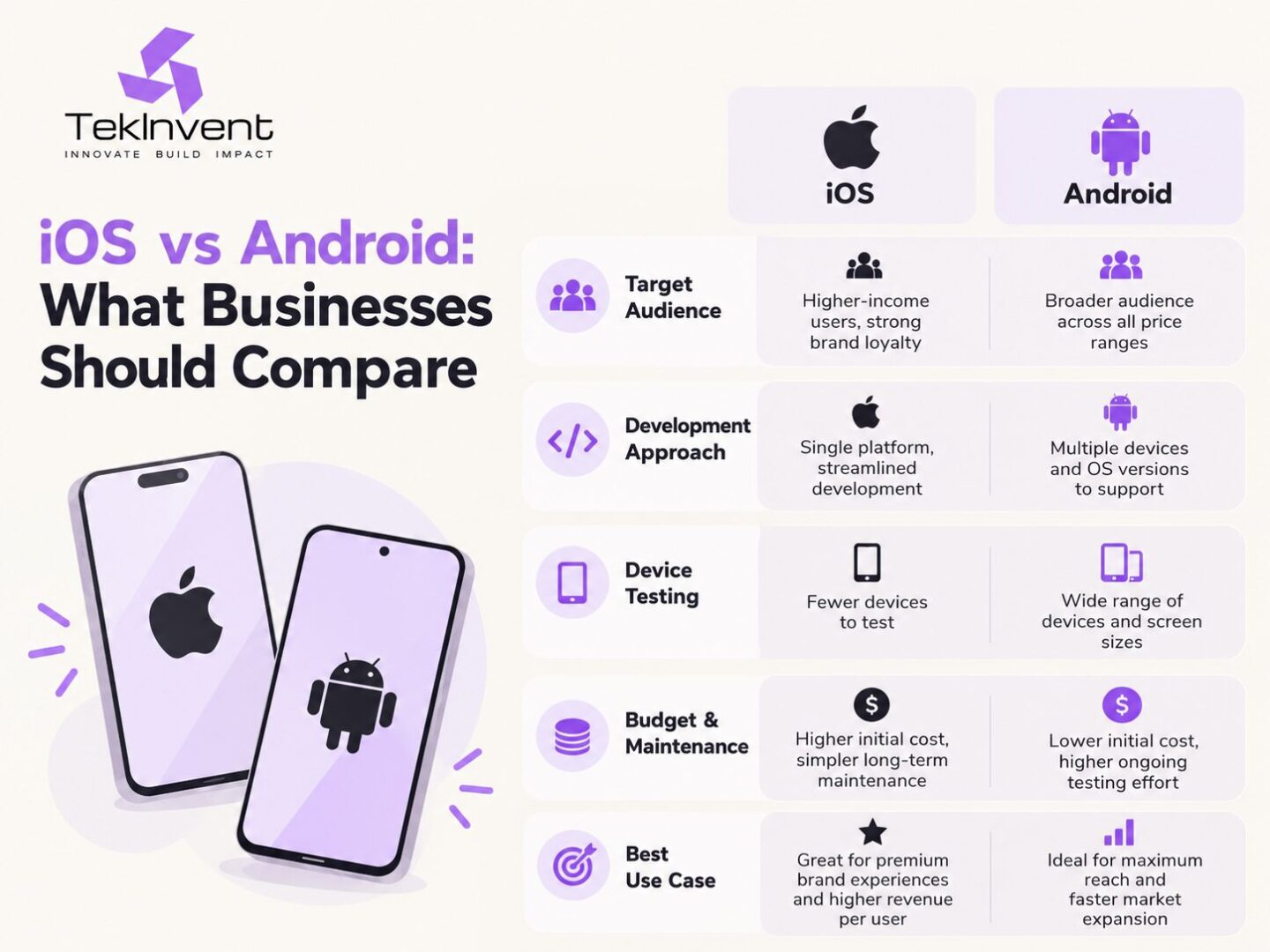
iOS vs Android App Development: What Is the Main Difference?
At a basic level, both platforms allow businesses to create powerful mobile applications.
The differences become more important when you look at development environment, device variety, testing, design expectations, app distribution, user behavior, and maintenance.
iOS operates within Apple’s controlled ecosystem.
Android operates across a broader and more varied device ecosystem.
That difference affects several parts of development.
An iOS team may test against a more limited set of common devices.
An Android team may need to test across more manufacturers, screen sizes, processors, and system versions.
That does not make Android worse.
It simply creates a different engineering and QA environment.
Which Platform Is Better for Houston Businesses?
There is no single answer for every Houston business.
The right choice depends on the product.
Imagine a Houston startup building a premium subscription service where most early users already use Apple devices.
An iOS first launch may allow the business to focus development on one ecosystem and validate the concept with a narrower audience.
Now imagine a logistics company building an application for drivers using company issued Android phones.
Android may be the obvious first choice.
A consumer marketplace may need both because limiting the product to one operating system could restrict growth.
The decision should follow actual user requirements.
iOS vs Android Development Cost
Cost is one of the most common questions businesses ask.
The truth is that platform alone does not determine the final budget.
App complexity matters much more.
A basic application with a few screens, simple authentication, and limited backend functionality may be relatively straightforward on either platform.
A large application with real time tracking, payment systems, video, complex APIs, role based access, advanced security, and large backend systems will cost considerably more regardless of whether it is built for iOS or Android.
However, platform differences can affect effort.
Android may require broader device testing because of the larger hardware variety.
iOS may involve more focused device coverage but still requires careful testing across supported Apple devices and operating system versions.
If the business needs two separate native applications, development and maintenance costs can also increase because features may need to be implemented in both codebases.
This is one reason some companies later compare native development with cross platform app development company, where much of the codebase can be shared between iOS and Android.
Which Platform Is Faster to Develop?
Development speed depends on the app.
For a simple project, either platform can move relatively quickly.
The timeline becomes longer when the application includes complex integrations, custom UI, backend systems, real time functionality, advanced animations, or strong security requirements.
Android development can require additional testing because of device fragmentation.
iOS development may involve fewer device variations, but application review and platform specific requirements still need to be considered.
The fastest platform is usually the one that best matches the team’s expertise and the product requirements.
Businesses should be cautious about choosing a platform only because someone claims it is always faster.
Design Differences Between iOS and Android
Good mobile design should feel natural on the platform where the app is running.
Users develop expectations based on the apps they use every day.
iOS users expect certain navigation patterns, controls, gestures, spacing, and interface behavior.
Android users also have established patterns and conventions.
A strong app should respect those expectations rather than forcing the exact same interface onto both systems without consideration.
This does not mean the brand needs to look completely different.
Colors, typography, visual identity, and core experience can remain consistent.
However, some interactions may need platform specific adjustment.
Good UX design balances brand consistency with platform familiarity.
Development Tools and Technologies
iOS and Android use different native technology ecosystems.
iOS development typically centers around Apple tools and technologies such as Xcode, Swift, and SwiftUI.
Android development commonly uses Android Studio, Kotlin, and Android specific SDKs.
The technologies matter because they influence development, debugging, testing, maintenance, and access to platform features.
However, businesses do not need to choose technologies themselves.
A capable development team should recommend a technical approach based on the app’s requirements.
The important thing is that the recommendation can be explained clearly.
If a team cannot explain why it recommends iOS, Android, or both, the platform strategy may not be based on enough product analysis.
Device Testing Is Different
Testing is one of the biggest practical differences in iOS vs Android app development.
Apple controls a more limited device family.
Android exists across devices from many manufacturers.
This means Android testing often needs broader coverage.
Screen sizes may vary.
Hardware performance can vary.
Different manufacturers may handle certain system behaviors differently.
The operating system version may also vary across users.
Developers therefore need a thoughtful device testing strategy.
For iOS, testing still matters across different iPhones, iPads where relevant, operating system versions, and screen sizes.
The device range may be smaller, but businesses should never assume that one test phone is enough.
Performance Differences
Both iOS and Android applications can deliver strong performance when they are built properly.
Performance depends on architecture, code quality, backend response times, image handling, network requests, animation, memory use, and many other factors.
A poorly built native app can perform badly.
A carefully engineered app can perform well.
Platform choice alone does not guarantee performance.
Businesses should ask how the development team measures performance.
That may include launch time, loading behavior, memory usage, battery impact, crash rates, API speed, and responsiveness.
Performance needs to be tested with real devices and realistic data.
Which Platform Is Better for Security?
Both platforms provide security capabilities.
The level of security your application needs depends more on what the app handles than on the platform name.
A basic consumer utility app has different requirements from a healthcare, fintech, or enterprise application.
Security planning may involve authentication, encrypted data transfer, secure storage, API protection, access control, session management, dependency management, and backend security.
Businesses should not assume that choosing iOS automatically makes an app secure.
They should also not assume Android is unsafe.
Security depends on how the entire product is designed and maintained.
App Store and Google Play Distribution
iOS applications are commonly distributed through Apple’s App Store.
Android applications are commonly distributed through Google Play, although Android offers additional distribution possibilities depending on the use case.
For businesses, store requirements matter because they can influence release planning.
Applications need store listings, screenshots, descriptions, privacy information, and platform compliance.
Approval processes should be considered before the planned launch date.
A business should not complete development on Friday and assume the application will automatically be live everywhere on Monday.
Store preparation should be part of the development schedule.
Which Platform Is Better for Startups?
Startups often have limited budget and need to validate their product quickly.
That does not automatically mean they should build for both platforms immediately.
If early customer research shows one platform clearly dominates the first target audience, launching there first can reduce initial development scope.
The startup can validate the product, gather feedback, improve onboarding, refine features, and learn how users behave.
Once the core product is validated, the second platform can be introduced.
However, if the product depends on network effects or needs a large general consumer audience, limiting access to one operating system may create unnecessary friction.
The right answer depends on the startup’s users and business model.
Which Platform Is Better for B2B Apps?
B2B applications often have clearer user groups than consumer applications.
A company may already know which devices employees or customers use.
For example, a field service business may issue Android phones to technicians.
In that situation, there may be no business reason to build an iOS version at launch.
Another organization may operate entirely within the Apple ecosystem.
An iOS focused application may make more sense.
The key advantage of B2B projects is that platform selection can often be based on known device requirements instead of general market assumptions.
iOS vs Android for Ecommerce Apps
Ecommerce businesses often want to reach as many customers as possible.
If both iOS and Android users contribute significantly to revenue, supporting both platforms can be important.
However, launching both does not always require two completely separate native applications.
The team can evaluate whether native development or a shared development approach is better based on performance, features, integrations, budget, and maintenance requirements.
What matters most is creating a smooth shopping experience.
Product discovery should be fast.
Search should work well.
Checkout should be simple.
Payments should be secure.
Push notifications should provide useful value.
The platform decision supports these goals rather than replacing them.
iOS vs Android for Healthcare Apps
Healthcare applications can have higher privacy, security, integration, and workflow requirements.
The platform decision should therefore consider the devices used by patients, doctors, staff, and partner organizations.
Some healthcare apps are consumer focused.
Others are internal clinical tools.
The target users may therefore have very different device patterns.
Before selecting a platform, define user roles and the environments where the application will be used.
A platform that works well for consumers may not match the hardware used internally by the organization.
The product strategy should come before platform preference.
iOS vs Android for Logistics and Field Service Apps
Houston has a large number of businesses that depend on transportation, logistics, field operations, energy, and service teams.
Applications in these environments may require location tracking, offline functionality, camera access, barcode scanning, notifications, job assignment, navigation, and real time status updates.
Device control can become very important.
If the business provides company owned Android devices to all workers, Android first may be practical.
If employees use their own phones, supporting both platforms may become more important.
The app should be designed around the real working environment rather than office assumptions.
Should You Launch on iOS First?
An iOS first strategy can make sense when your research shows that the majority of your early users rely on Apple devices.
It can also work when the product has a controlled user group and the business wants to limit initial development scope.
Launching on one platform first allows the team to focus testing, gather feedback, and refine the app before expanding.
However, do not choose iOS first simply because someone says Apple users are always more valuable.
The right decision depends on your own customer data.
Should You Launch on Android First?
Android first may make sense when your target users primarily use Android devices.
It can also be useful for internal business applications where the organization controls the hardware.
A Houston logistics company using Android devices across its workforce may gain little value from building an iOS app during the first release.
Again, the platform should follow users.
The biggest mistake is building for a platform that your intended audience does not actually use.
Should You Build Both iOS and Android Apps?
Many businesses eventually need both.
The important question is whether both are needed from day one.
Launching both at the same time can maximize reach, but it can also increase development, testing, deployment, and maintenance requirements.
If the audience is divided across both operating systems, simultaneous support may be justified.
If one platform clearly dominates early users, a phased approach may be more efficient.
Businesses should compare the cost of supporting two native codebases with the benefits of launching both immediately.
Native iOS and Android vs Cross Platform Development
This is where businesses often confuse two different decisions.
The first decision is:
Which operating systems do we need?
The second decision is:
How should we build for those operating systems?
You may need both iOS and Android but still choose between separate native applications and a cross platform architecture.
Native development gives teams deeper platform specific control.
Cross platform frameworks can allow much of the application logic to be shared across platforms.
Neither approach is automatically correct for every project.
If you need a deeper comparison of those architectures, the existing native vs cross platform app development guide covers that question separately.
This blog should remain focused on iOS vs Android app development, which is primarily about choosing the right platform for the business and its users.
Maintenance After Launch
The platform decision also affects maintenance.
Operating systems change.
New devices are released.
Third party SDKs are updated.
Security requirements evolve.
Bugs appear.
Features change.
With two separate native applications, some updates may need to be implemented and tested independently.
A shared cross platform codebase can reduce duplication for some features, although both operating systems still require testing.
Maintenance should therefore be considered during planning rather than after launch.
Your development budget should include the lifecycle of the application, not only the first store release.
How Houston Businesses Should Make the Decision
Houston businesses can make the platform decision easier by following a simple process.
Start with user data.
Identify which devices your target audience actually uses.
Then review the product requirements.
Does the app depend heavily on platform specific hardware or APIs?
Does the business need both operating systems immediately?
What is the available budget?
How quickly does the product need to launch?
Who will maintain the application?
Will users expect the same experience across both platforms?
Do employees use company issued devices?
These questions usually provide more useful answers than asking whether iOS or Android is generally better.
When a Houston Mobile App Partner Can Help
Some businesses already know which platform they need.
Others need technical guidance before deciding.
If your project involves uncertain platform requirements, complex integrations, or a mixed user base, working with a mobile app development process for Houston businesses can help you understand how platform selection fits into the wider planning, design, development, testing, and launch process.
The goal should be to choose the platform based on evidence.
A development partner should be able to explain why iOS, Android, or both fit the project rather than pushing whichever technology the team happens to prefer.
Common Mistakes When Choosing Between iOS and Android
One common mistake is choosing based only on personal preference.
A founder may use an iPhone and automatically assume the app should launch on iOS.
Another founder may prefer Android.
Neither preference tells you what customers use.
Another mistake is assuming that one platform is always cheaper.
Complexity, backend systems, integrations, design, security, and testing usually have a much larger impact on overall cost.
Businesses also sometimes assume that they must launch on both platforms immediately.
That can unnecessarily increase initial scope.
The opposite mistake is limiting the app to one platform even when the target audience clearly uses both.
The decision should be based on evidence, not habit.
Questions to Ask Before Choosing iOS or Android
Before finalizing the platform, the business should be able to answer a few important questions.
Who is the primary user?
What devices do those users already use?
Is the application customer facing or internal?
Does the business need both platforms at launch?
Are there platform specific device features the app depends on?
What is the development budget?
How important is launch speed?
How will the application be maintained?
Will the app expand to additional platforms later?
Clear answers make technical planning much easier.
Final Thoughts
The iOS vs Android app development decision should start with your users and business goals.
iOS can be a strong choice when the target audience is concentrated within Apple’s ecosystem or when the business wants to begin with a more controlled device environment.
Android can be a strong choice when the intended users rely heavily on Android devices or when broad device coverage is important.
Many businesses will eventually need both.
The important question is whether both platforms are necessary for the first version and how the application should be built to support long term growth.
For Houston businesses, the strongest approach is to review actual audience data, define product requirements, consider budget and maintenance, and then choose the platform that supports the business rather than following general assumptions.
A good app does not succeed because it was built for iOS or Android.
It succeeds because the platform, product, user experience, technology, and business strategy all work together.

Build Smart with The Right Team.
We bring expertise, technology, and trust you look for in your digital journey.