
Choosing how to build a mobile application involves more than selecting a programming language or framework. One of the most important decisions businesses need to make is whether to develop separate native applications for each operating system or use a shared development approach that works across multiple platforms.
This is where the native vs cross platform app development decision becomes important.
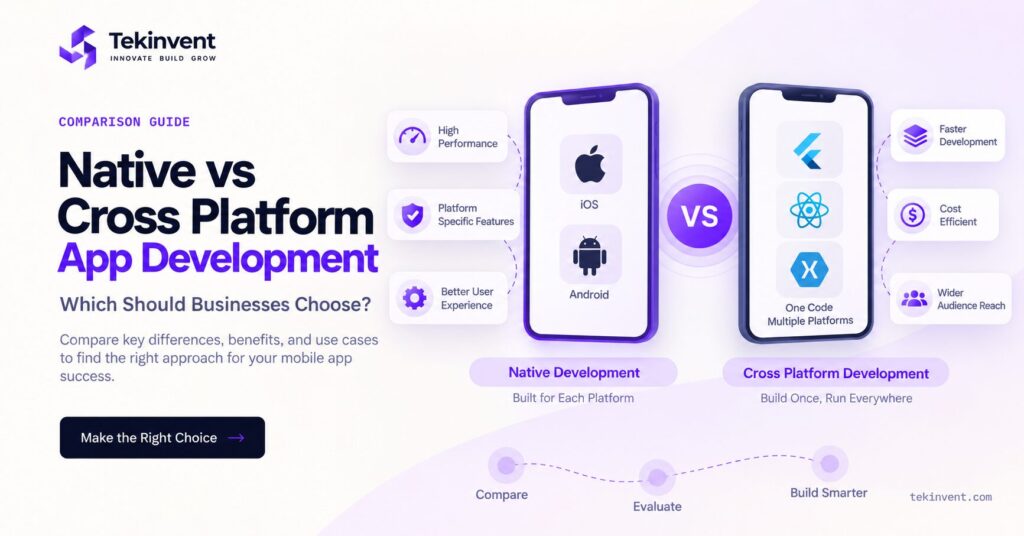
Native development allows businesses to create applications specifically for platforms such as iOS or Android. Cross platform development, on the other hand, allows developers to build applications for multiple operating systems using much of the same codebase.
Both approaches can produce successful mobile applications, but they differ in development cost, performance, time to market, access to device features, maintenance, and scalability.
Understanding these differences before development begins can help businesses choose an approach that fits both their immediate product requirements and their long term plans.
What Is Native Mobile App Development?
Native mobile app development means creating an application specifically for one operating system.
An iOS application is developed specifically for Apple devices, while an Android application is built specifically for devices running Android.
Because the application is designed for a particular operating system, developers can work directly with the platform’s native technologies, APIs, hardware capabilities, and design standards.
For example, businesses developing specifically for Android can use specialized Android app development when their product requires deeper integration with the Android ecosystem.
The same principle applies to iOS. When businesses need an application specifically designed around Apple’s ecosystem and user experience requirements, dedicated iOS app development can provide greater platform specific control.
Native development is particularly useful when performance, advanced device functionality, complex animations, security, or deep operating system integration is important to the application.
The tradeoff is that supporting both Android and iOS usually requires separate development work.
What Is Cross Platform Mobile App Development?
Cross platform mobile development allows developers to build applications that can run on multiple operating systems while sharing a significant portion of the underlying code.
Instead of creating an entirely separate application for Android and another for iOS, developers can use technologies such as Flutter or React Native to share code between platforms.
This can reduce duplicated development work and simplify certain aspects of ongoing maintenance.
Businesses that want to launch across both major mobile ecosystems can therefore consider cross platform app development when their product requirements do not demand completely separate native applications.
However, cross platform does not mean that every part of an application automatically works identically everywhere.
Developers still need to test different operating systems, devices, screen sizes, platform behaviors, and integrations. Some platform specific development may also be required when an application needs functionality that cannot be handled effectively through the shared framework.
Native vs Cross Platform App Development: The Main Differences
When comparing native vs cross platform mobile app development, businesses should look beyond the simple question of whether one codebase is better than two.
The decision affects the entire development lifecycle.
Native applications are designed around a particular operating system. This can provide developers with more direct access to platform specific APIs and hardware capabilities.
Cross platform applications prioritize code sharing. This can reduce duplicate engineering effort when a business wants to support Android and iOS simultaneously.
There are also differences in team structure.
Supporting two fully native applications may require separate iOS and Android expertise. A cross platform team can often work across both versions using a shared framework, although native expertise may still be necessary for certain integrations.
Neither approach should therefore be selected simply because it is popular. The technical architecture should match what the application actually needs to accomplish.
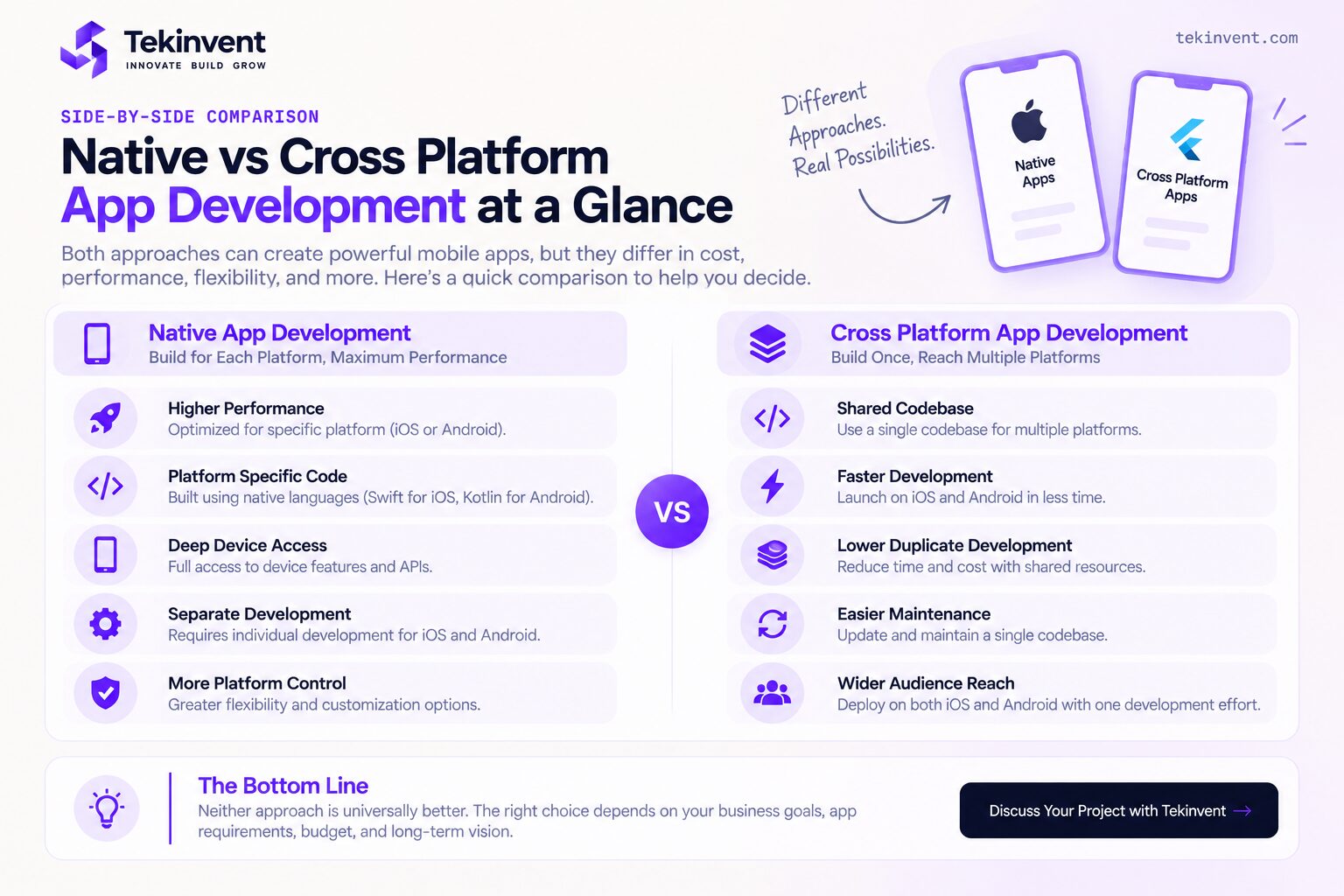
Native vs Cross Platform App Development at a Glance
For businesses evaluating cross platform mobile app development vs native, the major differences can be summarized across several areas.
Native development generally provides stronger platform specific control and direct access to operating system functionality. It can be particularly suitable for applications where performance and hardware integration are major priorities.
Cross platform development generally provides greater code reuse. This can make it attractive when businesses need to launch on Android and iOS without developing every feature twice.
Native applications may require more development resources when both platforms are supported independently.
Cross platform applications can reduce duplicated development work, but complicated platform specific functionality can still require native code.
The choice therefore depends heavily on the type of application being developed.
Native Development
Performance
Platform Specific Code
Deep Device Access
Separate iOS & Android Development
More Platform Control
Cross Platform Development
Shared Codebase
Faster Multi Platform Development
Lower Duplicate Development
Easier Shared Maintenance
Android & iOS Reach
Performance: Native vs Cross Platform
Performance is often one of the first concerns businesses have when comparing native app vs cross platform development.
Native applications communicate more directly with the operating system because they are built specifically for that environment.
This can be important for applications involving intensive graphics, complex animations, real time processing, augmented reality, gaming, advanced camera functionality, Bluetooth connectivity, or other demanding device interactions.
Modern cross platform frameworks have significantly improved performance for many common business applications.
For applications involving ecommerce, booking, content delivery, dashboards, marketplaces, customer portals, social functionality, or standard business workflows, cross platform performance may be entirely suitable when the application is properly designed and optimized.
Businesses should therefore avoid assuming that every application requires native development purely because native applications can offer deeper platform optimization.
The actual performance requirements of the product should drive the decision.
Development Cost
Cost is another major factor in the native vs cross platform development decision.
If a business needs separate native applications for Android and iOS, some development work must be performed independently.
Separate codebases can also increase testing and maintenance requirements.
Cross platform development can reduce duplicated engineering because much of the application logic can be shared.
However, this does not mean that a cross platform application automatically costs half as much.
Backend development, UI/UX design, project management, quality assurance, integrations, security, infrastructure, and product planning are still required regardless of the mobile development approach.
The biggest potential savings usually come from reducing duplicated mobile engineering work rather than eliminating half of the overall project.
Development Time and Time to Market
Businesses often want their applications available on both Android and iOS as quickly as possible.
Developing two separate native applications can require additional development and testing effort because each platform needs its own implementation.
With cross platform application development, developers can reuse a significant amount of code between platforms.
This can shorten the development cycle for certain applications and allow Android and iOS versions to progress together.
For startups launching an MVP, this can be particularly useful.
Instead of investing heavily in two independent applications before validating the product, a business may launch across both platforms with a shared approach and learn from real users.
However, development speed should not override technical requirements. If the application depends heavily on platform specific functionality, forcing everything into a shared architecture can create additional complexity later.
User Experience and Interface Design
Android and iOS users do not always interact with applications in exactly the same way.
Each operating system has its own interface conventions, navigation behaviors, gestures, components, and user expectations.
Native development allows designers and developers to follow each platform’s conventions very closely.
Cross platform frameworks can also create high quality interfaces, but developers need to ensure the application does not simply look identical everywhere without considering platform expectations.
A well designed cross platform application should maintain a consistent brand experience while still respecting important Android and iOS behaviors.
Therefore, the question is not simply whether native applications have better design.
Design quality depends heavily on the UI/UX strategy, development quality, testing, and attention given to each platform.
Access to Device Features
Some applications depend heavily on smartphone hardware and operating system features.
Examples include cameras, GPS, biometrics, Bluetooth, sensors, background processing, push notifications, NFC, and platform specific APIs.
Native development generally provides direct access to these capabilities.
Cross platform frameworks provide access to many common device features through libraries and plugins. For standard functionality, this may work extremely well.
The challenge appears when a product requires new, uncommon, or highly specialized platform capabilities.
In those situations, developers may need to write native modules even though the rest of the application uses a cross platform framework.
Businesses should therefore identify critical device integrations during technical discovery rather than discovering these limitations halfway through development.
Maintenance and Updates
Mobile application development does not end when an application reaches the app stores.
Both Android and iOS evolve continuously. Operating system updates, new devices, security requirements, third party integrations, and changing user expectations create ongoing maintenance requirements.
With separate native applications, updates may need to be implemented and tested independently.
Cross platform applications can simplify some maintenance because shared functionality can often be updated within the common codebase.
However, platform specific testing is still necessary.
A feature working correctly on Android does not automatically guarantee identical behavior on every supported iPhone.
The maintenance advantage of cross platform development therefore comes primarily from code sharing, not from eliminating platform testing.
Scalability and Long Term Development
Businesses should consider where the application may be several years after launch.
A relatively simple application today could eventually include real time functionality, advanced integrations, new user roles, offline functionality, AI capabilities, subscriptions, payments, or other complex features.
Native architecture can provide considerable flexibility when deep platform customization becomes necessary.
Cross platform architecture can also scale successfully, but framework selection and technical architecture become important.
Businesses should discuss their future product roadmap with their mobile app development company before deciding purely on short term development cost.
A development approach that saves time during the first release but creates limitations for critical future functionality may become expensive to change later.
When Should Businesses Choose Native Development?
Native development makes sense when the product depends heavily on platform specific capabilities.
Applications requiring extremely high performance, advanced graphics, complex animations, extensive hardware access, or deep operating system integrations may benefit from a native approach.
It may also be appropriate when a business plans to support only one operating system.
For example, if research shows that nearly all intended users rely on iOS, building an Android application simultaneously may provide little immediate value.
Native development can also be attractive for businesses with established Android and iOS engineering teams.
In this situation, the company already has the technical capabilities needed to maintain separate applications.
When Should Businesses Choose Cross Platform Development?
Cross platform development can be attractive when a business needs to reach Android and iOS users while reducing duplicated development effort.
Startups building an MVP may benefit because they can test their idea across a larger mobile audience without immediately maintaining two completely independent mobile projects.
Cross platform development may also fit internal business applications, ecommerce applications, booking platforms, customer portals, marketplace applications, and many other products where the core functionality is similar across operating systems.
The strongest use case appears when most application functionality can genuinely be shared.
If developers repeatedly need to create platform specific workarounds, the benefits of a shared codebase can gradually decrease.
What About Native vs Hybrid App Development?
The terms cross platform and hybrid are sometimes used interchangeably, but they are not always technically identical.
Traditional hybrid applications often use web technologies displayed inside a native application container.
Modern cross platform frameworks such as Flutter and React Native follow different architectures and can provide experiences much closer to native applications.
Therefore, businesses researching native vs hybrid app development should understand exactly which technology a development provider is proposing rather than treating every non native approach as the same.
Technology selection should be based on application requirements rather than terminology alone.
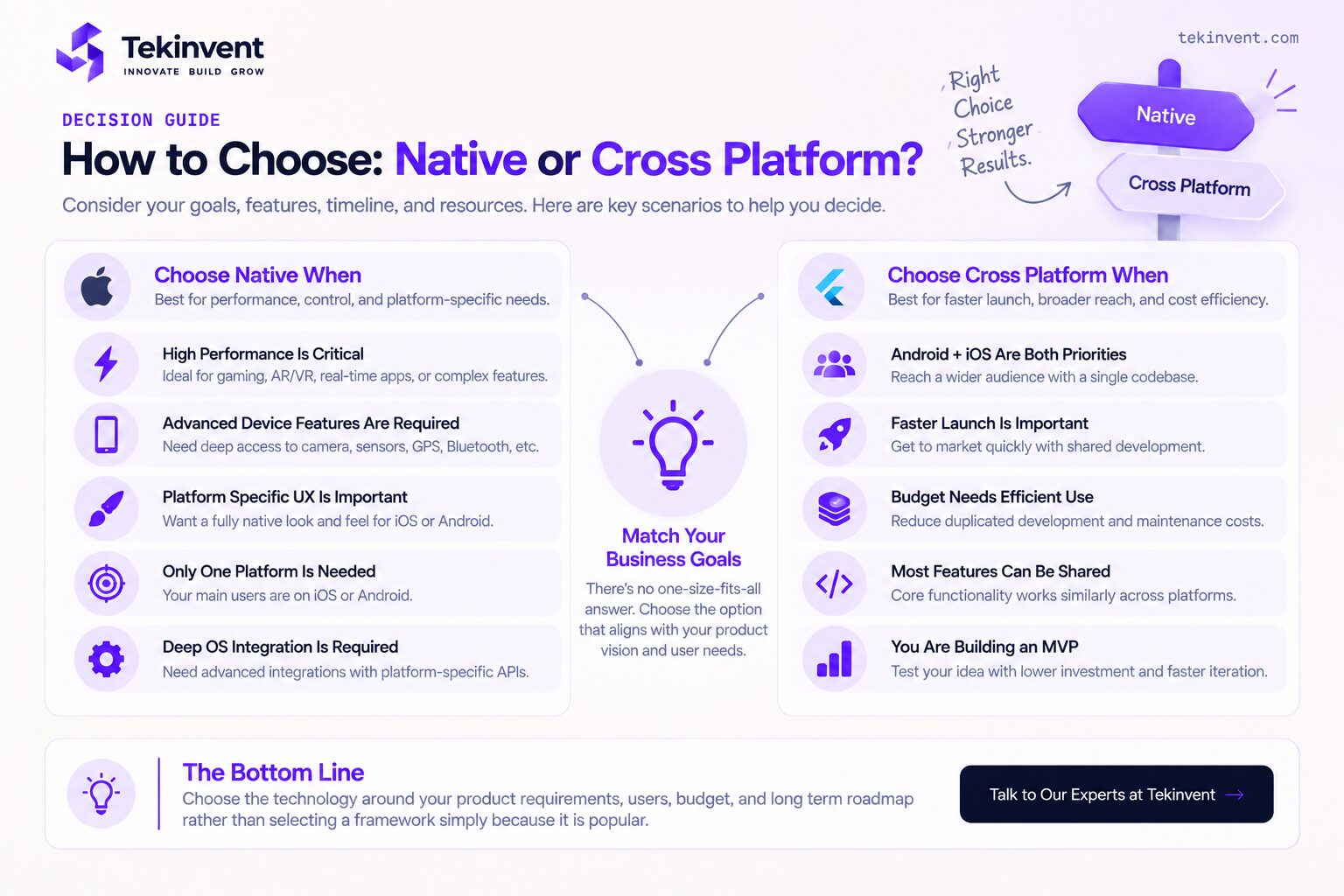
How to Choose Between Native and Cross Platform Development
Before selecting either approach, businesses should define what the application actually needs.
Start with the target audience.
Determine whether users are primarily on Android, iOS, or both.
Next, identify critical features. If the application requires extensive hardware interaction or specialized operating system functionality, discuss those requirements before choosing a framework.
Consider the expected launch timeline and available budget.
Businesses should also think beyond version one. Features planned for the next two or three years can influence today’s architecture decision.
Finally, consider the development team.
Technology should not be chosen solely because a particular framework is trending. The experience of the developers building and maintaining the application matters significantly.
Choose Native When:
High Performance Is Critical
Advanced Device Features Are Required
Platform Specific UX Is Important
Only One Platform Is Needed
Deep OS Integration Is Required
Choose Cross Platform When:
Android + iOS Are Both Priorities
Faster Launch Is Important
Budget Needs Efficient Use
Most Features Can Be Shared
You Are Building an MVP
At the bottom:
The Bottom Line:
Choose the technology around your product requirements, users, budget, and long term roadmap rather than selecting a framework simply because it is popular.
Final Thoughts
The native vs cross platform app development decision does not have one correct answer for every business.
Native development provides deeper platform control and can be the better technical fit for applications with demanding performance or device integration requirements.
Cross platform development can reduce duplicated development effort and help businesses reach Android and iOS users through a shared development approach.
The decision should therefore begin with the product rather than the technology.
Consider your users, required features, performance expectations, budget, launch timeline, maintenance requirements, and long term roadmap. Once these requirements are clear, it becomes much easier to determine whether native development or cross platform development provides the right foundation for your mobile application.

Build Smart with The Right Team.
We bring expertise, technology, and trust you look for in your digital journey.