

A website can look outdated long before it stops working.
That is where many businesses get stuck.
The website may still receive traffic. Forms may still work. Customers may still find important pages. But the design feels old, editing content is difficult, pages load slowly, mobile usability is poor, and every new feature requires another workaround.
At that point, businesses usually begin asking the same question.
Should we redesign the existing website, or should we rebuild it?
The website redesign vs rebuild decision is more important than it appears because the two approaches solve different problems.
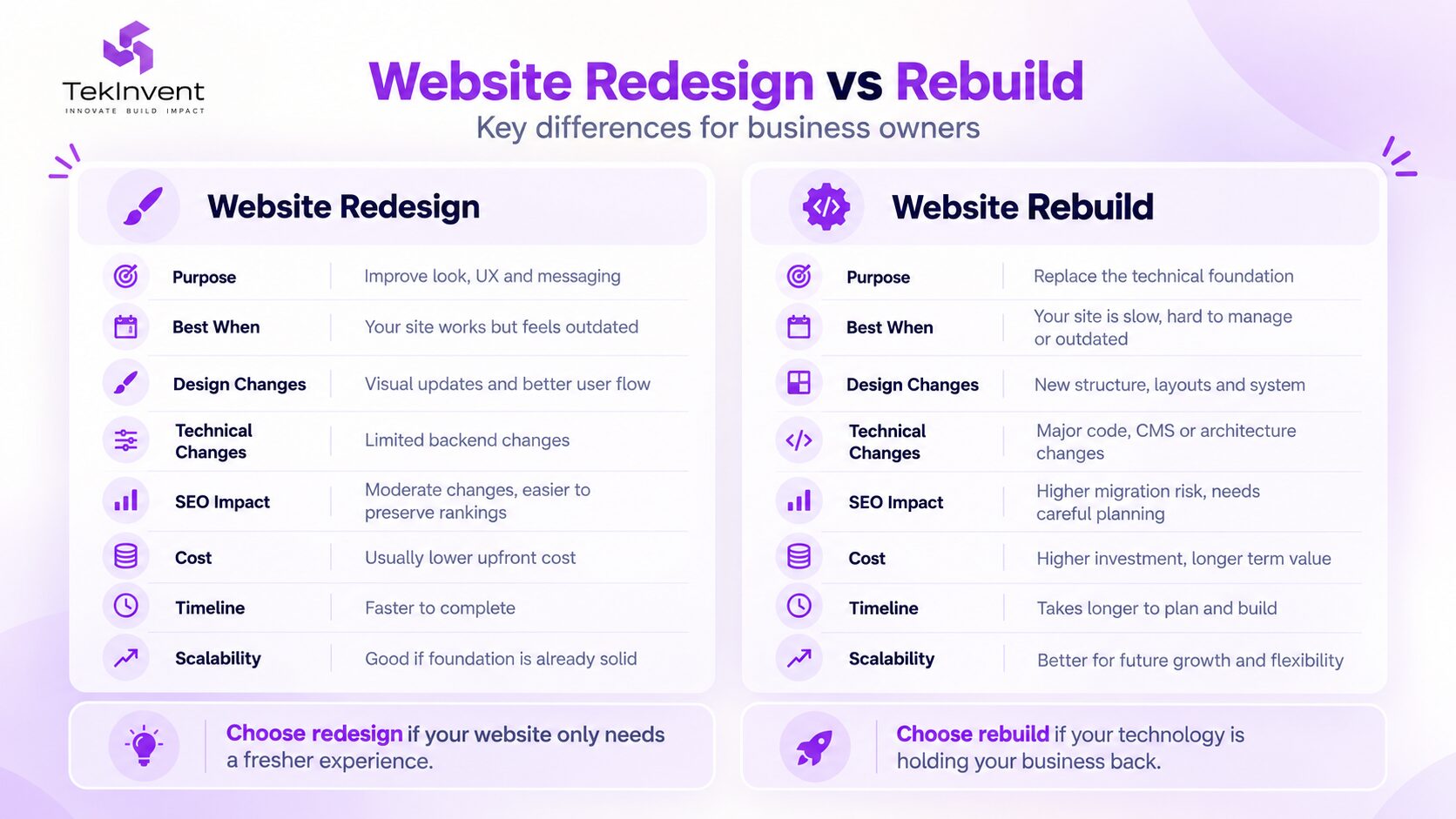
A redesign focuses mainly on improving the experience, presentation, structure, and usability of an existing website while keeping much of the underlying system intact.
A rebuild goes deeper. It may replace the technology, architecture, templates, codebase, content structure, or even the entire content management system.
One option is not automatically better than the other.
The right choice depends on what is actually wrong with your current website.
If the website has a strong technical foundation but looks dated and converts poorly, redesigning it may be enough.
If the site is slow, difficult to maintain, technically outdated, insecure, restricted by old technology, or unable to support future business requirements, rebuilding may be the more practical long term decision.
Understanding the difference before development begins can prevent unnecessary costs and help your business avoid repeating the same problems with a newer design.
What Is a Website Redesign?
A website redesign focuses on improving the existing website rather than replacing everything underneath it.
The exact scope can vary.
Some redesign projects are mostly visual. They update colors, typography, imagery, page layouts, navigation, and calls to action.
Others go further and improve content structure, mobile usability, conversion paths, internal linking, and page templates while keeping the current content management system and major technical components.
The important point is that a redesign works with an existing foundation.
Imagine a WordPress website that performs reasonably well, is secure, and is easy to manage, but the design was created six years ago.
The company may not need a completely new technology stack.
It may simply need a modern interface, stronger messaging, improved page hierarchy, better mobile layouts, and clearer conversion paths.
In that situation, a redesign can solve the business problem without unnecessarily rebuilding working technology.
What Does It Mean to Rebuild a Website?
A website rebuild involves replacing a significant part of the technical foundation.
The website may look completely different after the project, but visual appearance is only one part of the change.
A rebuild may include new code, a new CMS, different hosting architecture, improved database structures, new page templates, redesigned integrations, updated functionality, new URL structures, or a completely different front end.
Businesses usually consider a rebuild when the existing website has technical limitations that cannot be solved efficiently through design changes.
For example, the website may depend on outdated plugins that are no longer supported.
Developers may struggle to add new features because the codebase has become difficult to maintain.
The CMS may be frustrating for employees.
The website may also have serious performance problems caused by years of patches, extensions, and temporary fixes.
In these cases, redesigning the surface does not solve the real issue.
The website may look new while carrying the same technical problems underneath.
Website Redesign vs Rebuild: What Is the Real Difference?
The easiest way to understand website redesign vs rebuild is to think about a house.
A redesign is similar to renovating rooms inside a structurally sound building.
You may change the layout, flooring, lighting, furniture, colors, and overall experience while keeping the main structure.
A rebuild is closer to replacing the building because the existing structure can no longer support what you need.
The same principle applies to websites.
A redesign changes how users experience the website.
A rebuild changes the foundation that makes the website work.
In practice, the line between the two can sometimes become blurry.
A large redesign may involve some development changes.
A rebuild may still reuse valuable content, branding, or certain integrations.
The important thing is not the label.
The important thing is identifying which parts of the existing website should be preserved and which parts are creating problems.
When Does a Website Redesign Make Sense?
A redesign makes sense when the main problems are related to presentation, usability, messaging, or conversions rather than core technology.
Your website may still have a reliable CMS and stable development environment, but visitors struggle to understand what your business offers.
The navigation may be confusing.
Service pages may feel cluttered.
Calls to action may be difficult to find.
The visual identity may no longer reflect the company.
These problems can often be corrected without replacing the entire technical system.
A redesign may also be appropriate when the company has recently changed its positioning.
Perhaps the business started with one service and now provides several.
The website structure may no longer reflect how the company sells today.
A redesign can reorganize the site around the current business model while preserving valuable technical components that already work.
If the existing foundation is healthy, replacing it simply because the site looks old may create unnecessary cost and risk.
When Is a Complete Website Rebuild the Better Choice?
A rebuild becomes more practical when technical limitations are affecting business performance.
One of the clearest signs is when every new request becomes difficult.
Your marketing team wants to create a new landing page, but developers need several days to modify the template.
Your sales team wants CRM integration, but the current system cannot support it cleanly.
You want better site speed, but removing old code causes other features to stop working.
These are signs that the website may have accumulated too much technical debt.
Technical debt happens when short term solutions, outdated code, old plugins, or poorly planned changes make future improvements harder.
A rebuild gives the team an opportunity to clean up that foundation.
It can also be the better option if your current CMS is no longer suitable for the business.
A system that worked for a ten page website may become difficult to manage when the business expands to hundreds of pages, multiple services, several locations, or different content types.
When the technology itself is restricting growth, a redesign alone may only delay the problem.
How Does Performance Affect the Decision?
Website performance should be evaluated before deciding between redesign and rebuild.
Slow websites are not always caused by design.
Large images, excessive scripts, poor hosting, inefficient database queries, outdated themes, unnecessary plugins, third party tools, and weak code can all affect performance.
If these problems are isolated, developers may be able to improve them during a redesign.
However, if performance issues are deeply connected to the architecture, a rebuild may provide more value.
This is especially important for businesses that depend on organic search, paid advertising, lead generation, or ecommerce.
When customers are arriving through expensive marketing channels, a slow or unstable website can reduce the value of that traffic.
A better looking website will not solve that problem if the underlying performance remains poor.
Website Redesign vs Rebuild for SEO
SEO is one of the most important areas to protect during either project.
A redesign can affect rankings if headings, content, internal links, page structure, or navigation are changed carelessly.
A rebuild creates even greater risk because URLs, templates, site architecture, metadata, and technical settings may all change at the same time.
This does not mean businesses should avoid rebuilding an SEO performing website.
It means the migration needs to be planned properly.
Before major changes begin, important pages should be identified.
Existing rankings, backlinks, organic traffic, conversions, URLs, internal links, metadata, structured data, and indexed pages should be reviewed.
If URLs change, appropriate redirects should be prepared.
Content that currently attracts qualified traffic should not simply disappear because it does not fit the new design.
SEO should therefore be part of the website project before launch rather than something added afterward.
When working with experienced website development services, the technical build, UX, content structure, and SEO requirements should be considered together so the new website improves the experience without unnecessarily sacrificing existing search value.
What If Your Website Looks Fine but Is Difficult to Manage?
This situation often points more toward a rebuild than a redesign.
Website administrators experience the problems visitors cannot see.
Perhaps changing a simple banner requires a developer.
Maybe page layouts break when editors add content.
The CMS may have dozens of outdated plugins.
New pages may require copying old pages because no proper content structure exists.
These problems affect operational efficiency.
The website may still look professional from the outside, but internally it consumes too much time.
A modern rebuild can improve both sides of the website.
Visitors receive a better experience, while the internal team gets a cleaner system for publishing content, managing landing pages, updating products, editing service pages, or creating campaigns.
That can reduce dependence on developers for everyday changes.
How Important Is Mobile Experience?
Very important.
A website may have been designed during a period when desktop traffic dominated.
Over time, different fixes may have been added to make it responsive.
The result can be a website that technically works on phones but still feels uncomfortable to use.
Text may be too small.
Navigation may require too many taps.
Forms may be difficult to complete.
Buttons may appear too close together.
Important content may be pushed too far down the page.
If these issues are mainly layout related, a redesign can often solve them.
But if the website uses outdated front end technology or rigid templates that make responsive improvements difficult, rebuilding may be more efficient.
The decision should be based on what creates the cleanest long term solution rather than which option sounds smaller.
How Do Conversions Affect Website Redesign vs Rebuild?
Traffic alone does not make a website successful.
The website should help visitors move toward a business goal.
That could be requesting a quote, booking a consultation, starting a free trial, purchasing a product, scheduling a demo, or contacting the sales team.
If your website receives relevant traffic but few visitors convert, the issue may be related to user experience.
A redesign can improve page hierarchy, calls to action, trust signals, forms, navigation, content flow, and messaging.
These changes may significantly improve conversions without replacing the technical foundation.
However, sometimes the conversion problem is technical.
Perhaps the website cannot support personalized landing pages.
Forms do not integrate properly with the CRM.
Checkout functionality is outdated.
Important analytics events cannot be tracked accurately.
In those situations, rebuilding the platform may provide more flexibility for long term conversion optimization.
What About Security and Outdated Technology?
Security should never be treated as a cosmetic issue.
If a website depends on technology that is no longer supported, a rebuild may become necessary even if the site still appears to work.
Old frameworks, plugins, libraries, themes, and server environments can create security vulnerabilities.
They can also make maintenance increasingly difficult because newer tools may not remain compatible.
Businesses should not wait until something breaks before evaluating this risk.
A technical audit can determine whether the current website can be updated safely or whether replacing the underlying technology would create a more secure foundation.
If the existing platform still receives updates and is properly maintained, a redesign may be completely reasonable.
If the technology has reached the end of its useful life, rebuilding is usually the more sustainable approach.
How Does Scalability Influence the Decision?
Think about where the business is going, not only where it is today.
A website may currently support ten service pages and a few blog posts.
Next year, the business may need location pages, a customer portal, new product categories, ecommerce functionality, multilingual content, partner integrations, or additional conversion tools.
If the current architecture can support those changes, redesigning it may be enough.
If every future requirement would need another workaround, investing heavily in a redesign may not make financial sense.
A rebuild can provide a cleaner foundation for expansion.
This does not mean building every future feature now.
It means creating an architecture that allows those features to be introduced without rebuilding the website again.
Is Redesigning a Website Cheaper Than Rebuilding It?
Usually, but not always.
A straightforward redesign generally costs less because the team is reusing more of the existing system.
However, a redesign can become expensive if developers spend large amounts of time working around old technology.
This is where businesses can fall into a trap.
A redesign initially appears cheaper.
Then the team discovers that templates cannot support the new layouts.
Plugins conflict with one another.
The backend needs extensive modification.
Mobile responsiveness requires custom fixes.
Performance problems remain after the new design is implemented.
At that point, the business may spend almost as much as a rebuild while still keeping many of the original limitations.
The best comparison is therefore not simply redesign cost versus rebuild cost.
It is total cost over the next several years.
How Long Does a Website Redesign Take?
A website redesign can take several weeks to several months.
The timeline depends on how many pages are involved, how much content is changing, how customized the new design will be, and whether the existing technology can support the new requirements.
A relatively simple visual redesign may move quickly.
A large redesign involving UX research, content restructuring, new page templates, SEO migration, and conversion optimization takes longer.
The important thing is to define the scope clearly.
Without that, what begins as a redesign can slowly turn into a rebuild halfway through the project.
That creates budget and timeline problems.
How Long Does a Website Rebuild Take?
A rebuild normally takes longer because more technical work is involved.
The team may need to plan new architecture, rebuild templates, migrate content, recreate integrations, implement redirects, configure new hosting, perform extensive QA, and test the site across different environments.
A typical business website rebuild may take two to four months.
Larger platforms can take considerably longer.
The timeline should reflect the complexity rather than an arbitrary deadline.
Rushing a rebuild creates the risk of launching a new website with old problems.
Should You Redesign and Rebuild at the Same Time?
Sometimes that is the best approach.
If the website needs a new technical foundation, it usually makes sense to review the user experience and design at the same time.
There is little value in rebuilding outdated layouts exactly as they were.
Similarly, there is little value in creating an impressive new interface on top of technology that will need replacing soon afterward.
Combining the two projects allows the business to align design, technology, SEO, content, performance, and conversion requirements around one strategy.
The key is planning.
The project should clearly identify what is being changed and why.
Without that clarity, the scope can become unnecessarily large.
How Can You Decide What Your Business Actually Needs?
Start with the problems rather than the solution.
Ask why you are considering a website project.
If the answer is mainly that the website looks outdated, does not reflect the brand, has confusing navigation, or needs stronger conversion paths, a redesign may be enough.
If the answer includes poor performance, outdated technology, difficult maintenance, security concerns, unreliable integrations, limited scalability, or heavy technical debt, rebuilding deserves serious consideration.
The current website should ideally be reviewed from several perspectives.
Look at user experience.
Review technical performance.
Check organic search performance.
Evaluate how easily employees can manage content.
Review conversion data.
Talk to the developers responsible for maintaining the site.
When those perspectives are combined, the right direction usually becomes clearer.
Avoid Rebuilding Just Because You Want Something New
A complete rebuild can be exciting.
It can also create unnecessary risk if the existing website already performs well.
Businesses sometimes replace strong websites because internal teams are tired of looking at them.
Customers may not feel the same way.
If visitors can easily find information, pages perform well in search, conversions are healthy, and the system is easy to maintain, a full rebuild should have a clear business reason.
Changing technology simply for the sake of using newer technology rarely creates value by itself.
The project should solve measurable problems.
That keeps investment focused on business outcomes rather than novelty.
Do Not Redesign Around Internal Opinions Alone
Another common mistake is treating a redesign as an internal design competition.
Marketing prefers one layout.
Leadership wants another.
Sales wants more information above the fold.
The design team wants fewer elements.
Personal preferences begin driving the project.
The final website should certainly reflect the brand, but customer behavior needs to remain central.
Analytics, search queries, sales questions, user feedback, conversion data, and support requests can all reveal what visitors actually need.
A strong website redesign should make those customer journeys easier.
It should not simply make the internal team feel that the website looks newer.
Website Redesign vs Rebuild: Which One Is Right for You?
There is no universal answer.
Choose a redesign when the existing technical foundation is reliable and the biggest opportunities are related to design, content, navigation, usability, branding, or conversion paths.
Consider a rebuild when technology itself has become a limitation.
That includes outdated platforms, security risks, performance problems, difficult maintenance, poor scalability, major integration requirements, or technical debt that makes even simple improvements expensive.
Some businesses will need a combination.
They may rebuild the underlying website while redesigning the customer experience at the same time.
What matters is understanding why each change is necessary.
Final Thoughts
The website redesign vs rebuild decision should not begin with colors, layouts, or development frameworks.
It should begin with the problems your business is trying to solve.
A redesign can give a strong existing website a better user experience, clearer messaging, stronger branding, and improved conversion paths.
A rebuild can remove technical limitations and create a cleaner foundation for performance, integrations, security, content management, and future growth.
Both approaches can be successful when chosen for the right reasons.
Before investing in either one, review the current website carefully.
Identify what should be preserved.
Identify what is holding the business back.
Protect the pages and SEO value that already work.
Then build the project around the needs that actually affect customers and business growth.
If your website is reaching the point where design improvements alone are not enough, TekInvent can help assess the current structure, define the right development scope, and create a website that is easier to manage, faster to improve, and better prepared for future growth.

Build Smart with The Right Team.
We bring expertise, technology, and trust you look for in your digital journey.