
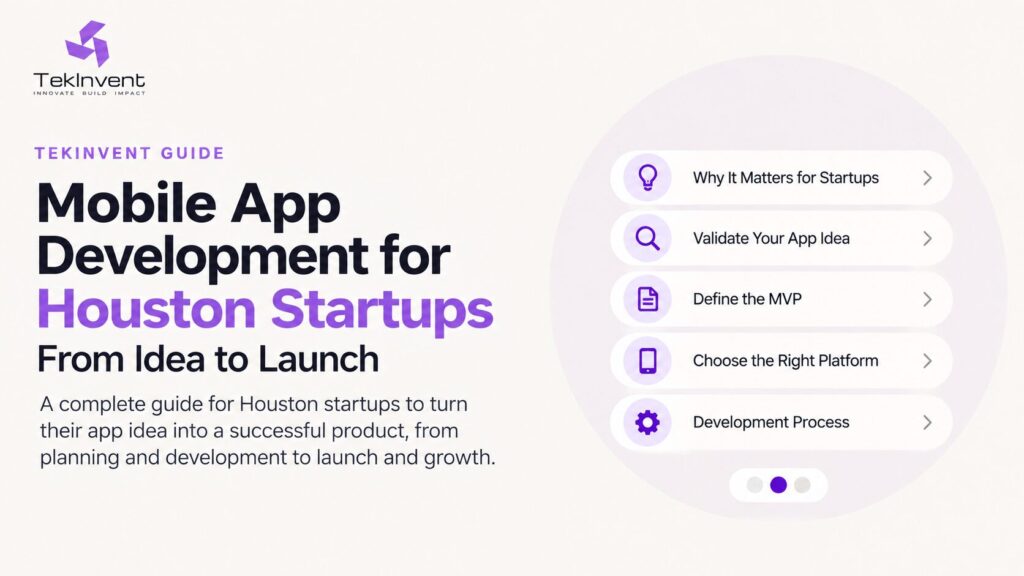
Starting a business with a mobile app idea can be exciting, but turning that idea into a product people actually want to use requires more than development. Startups need to validate the idea, understand their users, select the right features, control costs, and launch at the right time.
This is why mobile app development for startups should begin with a clear business goal rather than a long list of features. For Houston startups, the goal should be to build a useful first version, test it with real users, and improve the product based on actual feedback.
This guide explains the complete journey from the initial idea to launching an app and growing it after release.
Why Mobile App Development Matters for Startups
A startup usually operates with limited time, budget, and resources. Unlike an established company, it may not have the flexibility to spend months developing features that customers never use.
A well planned mobile application can help a startup create a direct connection with customers, automate business processes, improve customer experience, and test a new business model.
However, successful mobile app development for startups starts by answering a simple question: what problem will this application solve?
A startup should be able to explain the problem, target customer, and main benefit of the application before development begins.
Start With a Clear App Idea
An idea alone is not enough to justify building an application. Before investing in development, Houston startups should determine whether there is a genuine market need.
Start by identifying the target audience. Understand what problem those users currently face and how they solve it today.
Then look at competing applications. Their reviews can provide useful information about what customers like, what frustrates them, and what features they expect.
The purpose of this stage is not to copy competitors. It is to identify an opportunity to provide a better or different experience.
For example, a Houston healthcare startup may discover that patients struggle to schedule appointments quickly. A logistics startup may identify inefficient communication between drivers and customers. These problems can become the foundation of a useful mobile product.
Validate the Idea Before Full Development
One of the biggest mistakes a startup can make is investing heavily in an untested idea.
Validation can start before writing the full application code.
Startups can create wireframes, interactive prototypes, landing pages, or simple product demonstrations. These can be shown to potential users to understand whether the concept solves a real problem.
Feedback at this stage is much cheaper than rebuilding an application after launch.
If users understand the product, show interest, and identify value in it, the startup has stronger evidence to move toward development.
Define the MVP
After validating the idea, the next step in mobile app development for startups is defining a Minimum Viable Product.
An MVP is the first usable version of an application containing the features necessary to solve its main problem.
Suppose a startup wants to develop an on demand delivery application. Its first version may only require user registration, order placement, payment, order tracking, and notifications.
Features such as advanced analytics, loyalty programs, social sharing, or sophisticated personalization can be introduced later.
This approach allows startups to launch sooner and collect real user feedback before committing more resources.
Choose the Right Mobile Platform
Startups also need to decide whether the application should launch on iOS, Android, or both.
The decision should depend on the target audience rather than personal preference.
If research shows that most potential customers use iPhones, launching on iOS first may make sense. If the audience is spread across both platforms, cross platform development can be considered.
Technologies such as Flutter and React Native can allow businesses to develop applications for iOS and Android using a shared codebase.
Native development can still be useful when an application requires extensive platform specific functionality or very high performance.
A reliable mobile app development company in Houston can help evaluate the audience, product requirements, budget, and technical needs before selecting an approach.
Create the User Experience and App Design
Users usually do not care how complicated the technology behind an application is. They care whether they can use it easily.
The design process should therefore focus on simplicity.
Before visual design begins, developers and designers normally create user flows and wireframes. These show how users will move through the application.
For example:
Home Screen → Search → Product Details → Checkout → Payment → Confirmation
Once the user journey is clear, the visual interface can be created.
Houston startups should avoid adding unnecessary screens and complicated navigation simply to make an application look more advanced. A simple product that helps users complete their task quickly is often more effective.
Select the Right Technology Stack
The technology behind an application affects its performance, scalability, security, maintenance, and future development costs.
There is no single technology stack that works for every startup.
The right choice depends on factors such as the type of application, expected number of users, integrations, security requirements, platform choice, and future product roadmap.
A custom mobile app development for startups project may also require a backend system, APIs, database, cloud infrastructure, payment integration, analytics, or third party services.
Technology decisions should consider what the application may need in the future, not only what is required for the first release.
Develop the Application in Stages
Once the requirements, design, and technology are finalized, development can begin.
Breaking development into smaller stages makes the project easier to manage.
Instead of waiting until the entire application is completed, startups can review working features throughout development.
A typical workflow may include frontend development, backend development, API integration, database configuration, third party integrations, and testing.
Regular reviews also make it easier to identify misunderstandings early.
This is particularly important for startups because business requirements can evolve as founders learn more about their customers.
Test Before Launching
Testing should not be left until the final day of development.
Developers should test functionality throughout the project. Before launch, the complete application should also be tested across relevant devices and operating systems.
Testing should cover areas such as account creation, navigation, forms, payments, notifications, integrations, security, loading speed, and different screen sizes.
Real users should also test the application when possible.
A developer may understand exactly where every button is located, while a new user may struggle with the same interface. User testing can reveal these problems before the public launch.
Prepare for App Store Launch
Finishing development does not mean the application is automatically ready for customers.
For iOS applications, startups need to prepare the product for Apple’s App Store. Android applications generally need to be prepared for Google Play.
This includes the application name, description, screenshots, privacy information, icons, category selection, and other store requirements.
Startups should also have a launch strategy.
The first users may come from an existing customer base, social media audience, email subscribers, partnerships, paid campaigns, or local Houston business networks.
The objective of the initial launch should be to attract relevant users who can provide useful feedback.
Measure What Happens After Launch
Launching an application is the beginning of the next stage, not the end of development.
Startups should monitor how people actually use the product.
Important questions include:
Are users completing registration? Which features are used most often? Where do users leave the application? Are customers returning? Are technical errors preventing users from completing important actions?
Analytics and customer feedback can answer these questions.
Instead of guessing what feature should be developed next, startups can use this information to prioritize improvements.
Improve the App Based on Real Users
The biggest advantage of launching an MVP is that future decisions can be based on real behavior.
Suppose founders originally believed that customers wanted ten different features. After launch, analytics may show that three features generate most of the engagement.
Development resources can then be concentrated on improving those areas.
This creates a continuous process:
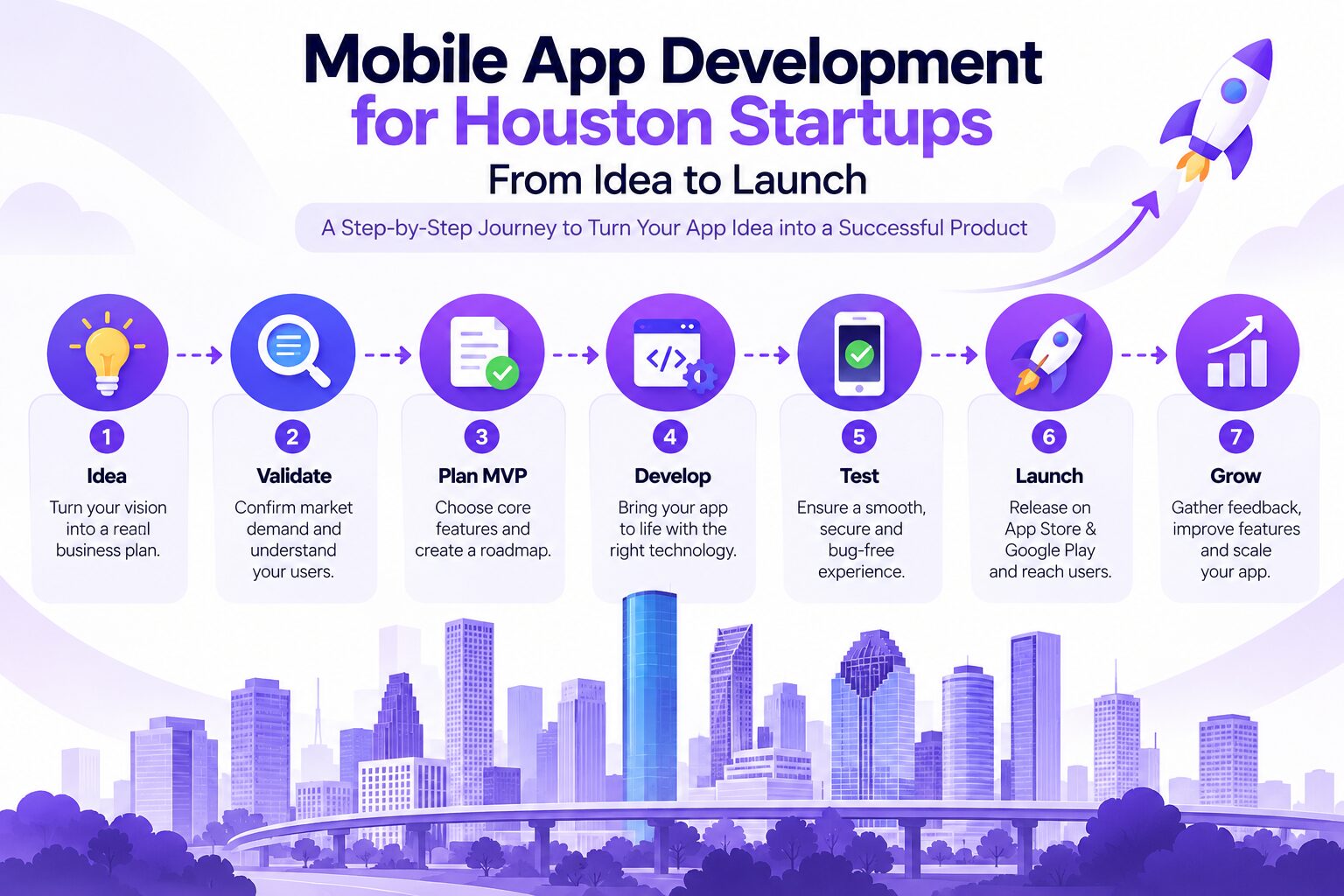
Idea → MVP → Launch → Measure → Learn → Improve
For startups, this is usually more sustainable than trying to build a perfect application before the first customer ever uses it.
How Much Does Mobile App Development for Startups Cost?
The cost varies significantly because applications can have very different requirements.
A relatively simple MVP will generally require fewer resources than a marketplace, healthcare platform, fintech application, or real time delivery system.
Cost is influenced by the number of features, UI and UX complexity, platform choice, backend requirements, third party integrations, security requirements, testing, and ongoing maintenance.
Instead of asking only, “How much does an app cost?”, startups should first define what the first version actually needs.
Removing unnecessary features can reduce both development cost and time without reducing the core value of the product.
Common Mistakes Startups Should Avoid
A common mistake is trying to build too much in the first version. Every additional feature increases development, testing, and maintenance requirements.
Another mistake is choosing technology before clearly defining the business problem.
Startups should also avoid ignoring user feedback, launching without proper testing, and treating maintenance as an optional expense.
The objective should not be to create the application with the most features. It should be to create a product that solves an important problem effectively.
Why Houston Startups Need the Right Development Partner
A development partner should do more than simply write code.
Startups often need help converting business requirements into technical features, selecting an appropriate technology stack, planning an MVP, designing the user experience, testing the application, and preparing for launch.
For founders without an internal development team, working with an experienced development company can also provide access to designers, developers, QA specialists, and project managers without building every capability internally.
TekInvent provides mobile app development for startups and businesses looking to move from an initial idea to a scalable digital product. The development process can be structured around the startup’s requirements, target users, budget, and long term product roadmap.
Final Thoughts
Successful mobile app development for startups is not about building the largest possible application. It is about identifying a genuine customer problem and creating the simplest product capable of solving it.
For Houston startups, the process should begin with validation, followed by MVP planning, design, development, testing, launch, and continuous improvement.
A focused first version can help a startup enter the market sooner, learn from actual users, and make better development decisions as the business grows.

Build Smart with The Right Team.
We bring expertise, technology, and trust you look for in your digital journey.