
Running a business becomes more complicated as operations grow. What initially worked through spreadsheets, emails, and basic software subscriptions may eventually become difficult to manage. Employees spend more time switching between applications, customer information gets scattered across different platforms, and routine activities require unnecessary manual work.
For businesses in Dallas, these challenges can become more noticeable when expanding operations, managing multiple locations, or introducing new services.
Custom software can help address these problems, but building a new application should never begin with choosing technologies or requesting a development quotation.
It should begin with understanding the business problem.
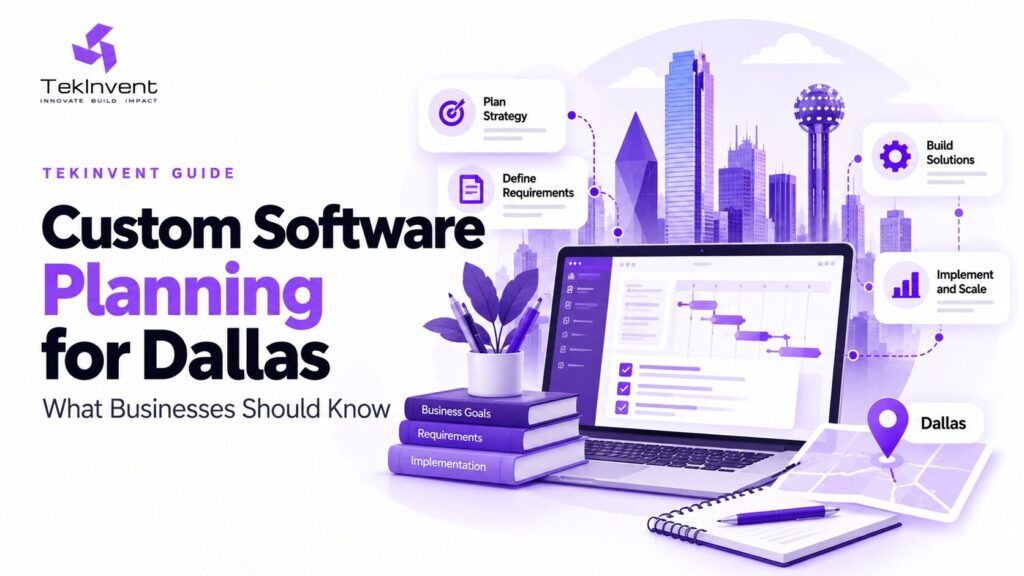
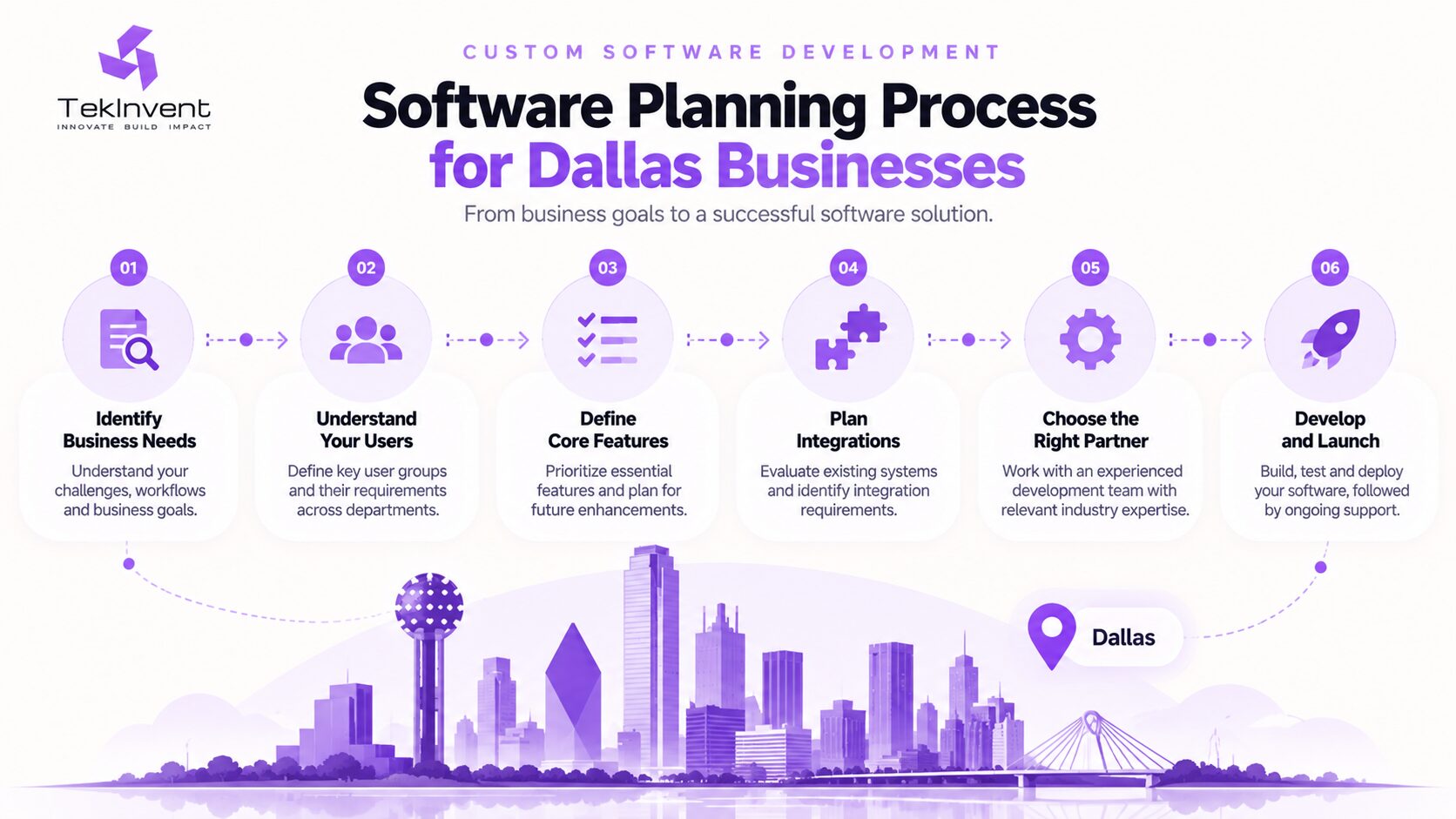
Effective custom software planning for Dallas businesses involves identifying operational challenges, evaluating existing systems, defining software requirements, and establishing clear expectations before development starts.
Whether a company operates in healthcare, logistics, retail, real estate, or professional services, proper planning helps ensure that its software investment addresses actual business needs.
This guide explains what Dallas businesses should understand before investing in custom software, how to prepare for development, which challenges to consider, and how to make informed decisions throughout the project.
Why Dallas Businesses Should Consider Custom Software
Every business uses technology differently.
A logistics company may need better visibility into delivery operations, while a healthcare provider may require a centralized system for appointments, patient communication, and administrative activities.
Similarly, a retail business managing several locations may struggle to maintain consistent inventory information across different stores.
Ready-made software can handle many standard business requirements. However, challenges arise when an organization needs specific workflows, integrations, or functionality that existing products cannot adequately support.
For example, imagine a Dallas distribution company using separate applications for customer orders, inventory management, delivery scheduling, and reporting.
Employees may need to enter the same information multiple times because these systems do not communicate effectively.
A custom application could connect the necessary processes and provide employees with a more consistent way to manage their responsibilities.
The decision to develop software should depend on the value of solving these operational problems rather than simply following technology trends.
How to Know When Your Business Needs Custom Software
Before investing in development, business owners should evaluate whether their existing tools can continue supporting their operations.
Several common situations may indicate that a business needs a more tailored solution.
Employees Spend Too Much Time on Manual Activities
Manual processes are not necessarily a problem when a business is small. However, repetitive administrative work can become difficult to manage as transaction volumes and employee responsibilities increase.
For example, employees might manually transfer customer information between a CRM, accounting platform, and internal reporting system.
This increases administrative effort and creates opportunities for data entry mistakes.
A custom application may help automate these activities or connect the systems responsible for them.
Existing Software Cannot Support Important Workflows
Many subscription-based applications provide useful standard features but offer limited flexibility for specialized business requirements.
A Dallas healthcare organization, for instance, may need specific appointment workflows, administrative permissions, and integrations that are not fully supported by its existing software.
Before replacing the current system, the business should determine whether customization or integration could resolve the problem.
Business Information Is Scattered Across Multiple Platforms
When employees cannot access reliable information from one place, operational decisions become more difficult.
Sales teams may have different customer records from the accounting department, while management reports may require information from several disconnected applications.
Custom software can help centralize relevant information or create integrations between existing systems.
The Business Is Preparing to Expand
Growth introduces new operational requirements.
A business opening additional locations may need better reporting, employee management, inventory visibility, or centralized administrative controls.
Planning these requirements early helps determine whether the current technology infrastructure can support future operations.
How Dallas Businesses Should Plan a Custom Software Project
A successful project begins before the first line of code is written.
The purpose of software planning is to translate business requirements into a clear development direction.
Rather than starting with a long list of desired features, companies should first identify the problems they want the application to solve.
Identify the Main Business Problem
Begin by documenting the operational challenges affecting employees, customers, or management.
For example, a Dallas property management business might experience delays because tenant requests, maintenance schedules, and contractor information are managed separately.
Instead of immediately requesting a complete property management platform, the company should identify which activities cause the greatest difficulties.
This helps establish a clear development objective.
Understand Who Will Use the Software
Different users often require different functionality.
An employee may need access to daily tasks, while a manager requires reporting and administrative controls.
Customers may need a simplified interface for submitting requests, tracking progress, or reviewing information.
Understanding these user groups helps determine the application’s structure, permissions, and interface requirements.
Define Essential Software Features
Once the business problem and user requirements are understood, the next step is identifying the functionality required to address them.
For an internal operations platform, essential features might include employee access, task management, automated notifications, reporting, and integration with existing applications.
Additional functionality can be considered after the essential requirements have been defined.
This approach helps businesses avoid expanding the project unnecessarily during early development.
Establish Measurable Business Objectives
Software development should support outcomes that can be evaluated.
A business might want to reduce manual order processing, improve reporting accuracy, shorten customer response times, or make information easier for employees to access.
These objectives should be documented before development begins.
For example, if employees currently spend several hours preparing weekly reports, the company can measure whether the new application reduces that effort after implementation.
Clear objectives provide a practical way to evaluate the software beyond its technical features.
What Should a Custom Software Requirements Document Include?
A software requirements document explains what the application should accomplish and how it is expected to operate.
It helps business owners, project managers, designers, and developers maintain a shared understanding of the project.
A useful requirements document should explain the business problem, intended users, essential features, existing systems, integration requirements, user permissions, security expectations, and operational constraints.
For example, a Dallas wholesale business developing an inventory application should document how products enter its system, how orders affect inventory levels, and which employees can modify important records.
The document should also identify whether the new application needs to communicate with accounting software, payment systems, or warehouse management tools.
These details allow the development team to evaluate technical requirements before implementation.
Businesses do not need to prepare every technical specification independently. However, they should be able to explain their workflows, operational challenges, and expected outcomes.
The development partner can then help translate those requirements into a structured technical plan.
Should Dallas Businesses Build New Software or Improve Existing Systems?
Not every operational challenge requires developing a completely new application.
In some situations, improving existing systems may provide a more practical solution.
For example, a company experiencing reporting difficulties might benefit from connecting its current applications through APIs rather than replacing every platform.
Similarly, a business struggling with employee adoption may need better interface design, workflow adjustments, or additional training.
Before committing to new development, businesses should evaluate their current software capabilities, integration options, licensing restrictions, and long-term requirements.
Custom development becomes worth considering when existing tools cannot adequately support essential workflows or when continued modifications create unnecessary operational complexity.
The decision should reflect the company’s requirements, not an assumption that custom software is automatically superior to ready-made products.
What Types of Custom Software Can Dallas Businesses Develop?
The type of application a business needs depends on its industry, internal processes, and intended users.
Different organizations may benefit from different software solutions.
Internal Business Management Applications
These applications help employees manage daily operations through centralized systems.
Common functionality includes task assignments, employee management, document storage, approval workflows, and administrative reporting.
They can be useful for businesses currently relying on disconnected spreadsheets and manual communication.
Customer Management Systems
A custom customer management platform can help businesses organize customer records, track interactions, manage service requests, and monitor sales activities.
For companies with specialized customer workflows, tailored functionality may provide greater flexibility than standard CRM configurations.
Inventory and Logistics Software
Distribution and logistics businesses may require applications that connect inventory information, supplier records, delivery scheduling, and operational reporting.
For example, a Dallas distribution company managing several warehouses may need employees to access consistent inventory information across locations.
Healthcare Management Applications
Healthcare organizations may need software supporting scheduling, administrative workflows, patient communication, and integration with existing healthcare systems.
Security, privacy, access controls, and applicable regulatory requirements should be considered during the planning stage.
Custom Web and Mobile Applications
Some businesses require software that customers or employees can access outside the office.
A web application may support browser-based access, while a mobile application can provide functionality designed around smartphones and tablets.
Companies considering customer-facing mobile products can also explore TekInvent’s mobile app development company in Dallas page to understand the available development services.
The appropriate platform depends on how users will interact with the application and which features they need.
Why Software Integration Matters Before Development
One of the most important considerations in custom software planning is how the new application will interact with existing business systems.
Many organizations already depend on accounting platforms, payment services, customer management tools, inventory applications, and internal databases.
Developing new software without considering these connections can create additional administrative work instead of reducing it.
For example, a Dallas retail business may want its new inventory application to exchange information with its ecommerce platform and accounting software.
The development team should evaluate whether the existing applications provide suitable APIs, how information will move between systems, and what happens when an integration fails.
Data accuracy, authentication, access permissions, and system reliability should also be discussed.
Addressing these requirements during planning helps businesses avoid unnecessary complications after development begins.
What Should Businesses Know About Software Development Cost and Timeline?
Budget and delivery expectations are important parts of software planning, but they should be based on clearly defined requirements.
Two businesses requesting an inventory management application may receive very different estimates.
One company might need basic product records and reporting, while another requires multiple warehouse integrations, employee permissions, automated purchasing, and extensive data migration.
Both projects fall under inventory management, but their technical requirements are different.
Businesses should therefore avoid making budget decisions based entirely on general industry estimates.
For a detailed explanation of project pricing, feature complexity, integrations, and ongoing expenses, read TekInvent’s guide on custom software development cost.
Delivery expectations require similar consideration.
A focused application with limited functionality will usually require less development effort than an enterprise platform connecting several departments and existing systems.
Businesses can explore the factors influencing delivery schedules in our article explaining the custom software development timeline.
The most useful approach is to establish the initial scope before requesting a detailed project estimate.
Why Starting With an MVP Can Be a Practical Decision
A minimum viable product, commonly called an MVP, includes the essential functionality needed to address the primary business problem.
Instead of developing every planned feature immediately, businesses can begin with a smaller version of the application and evaluate how it performs.
For example, a Dallas logistics company planning a complete operations platform might initially develop shipment tracking, employee access, and basic reporting.
Additional functionality, such as advanced analytics or automated supplier management, could be introduced after the initial system has been tested.
This approach allows the organization to gather feedback from actual users before expanding the product.
However, an MVP should still meet appropriate quality, reliability, and security requirements. It should not be treated as an unfinished application released without proper testing.
Common Mistakes Businesses Should Avoid During Software Planning
Custom software projects can become more difficult when important decisions are postponed until development has already started.
One common mistake is requesting too many features without identifying which ones are essential.
This can increase project complexity and make it harder to establish clear priorities.
Another issue is failing to involve the employees who will eventually use the application.
Management may understand the broader business objectives, but employees often have valuable knowledge about daily workflows and operational difficulties.
Businesses should also avoid overlooking existing system integrations, data migration, security requirements, and maintenance responsibilities.
For example, replacing an older application may require transferring historical records into the new system. If this requirement is not identified early, it can introduce additional work later.
Finally, businesses should establish a clear process for reviewing project progress and approving changes.
Regular communication between stakeholders and the development team helps keep implementation aligned with the agreed requirements.
How to Evaluate a Development Partner for Your Dallas Business
Choosing a development partner involves more than comparing prices or reviewing a company’s website.
Businesses should look for relevant technical experience, a structured discovery process, clear communication, and an understanding of their operational requirements.
During initial discussions, explain the business problem rather than presenting only a list of desired technologies.
Ask how the team evaluates existing systems, documents requirements, manages changes, and approaches quality assurance.
It is also important to understand who will manage the project, how progress will be communicated, and what happens after deployment.
Businesses should discuss source code ownership, documentation, maintenance responsibilities, and access to important technical resources before signing an agreement.
If you are evaluating development options for a Dallas-based project, TekInvent’s custom software development services in Dallas page provides further information about its development capabilities and engagement approach.
The right partnership should establish clear expectations before development begins and maintain communication throughout the project.
How to Prepare Employees for Custom Software Implementation
Developing an application is only one part of introducing new technology into a business.
Employees also need to understand how the software will affect their responsibilities and daily activities.
Businesses should identify which departments will use the application and involve relevant employees during requirements gathering and testing.
For example, a Dallas retail company introducing centralized inventory software should gather feedback from store managers, warehouse employees, and administrative staff.
Each group may interact with the system differently.
Training materials, user documentation, and a clear implementation schedule can help employees adjust to the new application.
Businesses should also consider whether the software will be introduced across the entire organization at once or through a smaller initial rollout.
A phased implementation can provide opportunities to identify usability issues before expanding access to additional departments.
After deployment, gathering employee feedback helps determine whether the application is achieving its intended objectives.
How to Measure the Success of Custom Software
A successful software project should deliver more than a functioning application.
It should help the organization achieve the business objectives established during planning.
The most useful performance indicators depend on the original problem.
A company developing workflow automation software might measure the time employees spend completing repetitive tasks.
A business introducing a customer management platform may monitor response times, record accuracy, or the efficiency of customer service activities.
For an inventory application, relevant measurements could include reporting accuracy, stock visibility, and the time required to complete inventory-related processes.
Businesses should establish baseline measurements before introducing the new application whenever possible.
This allows management to compare performance after implementation and determine whether additional improvements are necessary.
Regular evaluation also helps identify opportunities for future software updates.
Final Thoughts
Custom software development can help Dallas businesses address operational challenges that standard applications cannot adequately solve.
However, successful development begins with understanding business requirements rather than immediately selecting features or technologies.
Proper custom software planning for Dallas businesses involves evaluating existing workflows, identifying essential functionality, considering system integrations, preparing employees, and establishing measurable objectives.
Businesses should also evaluate whether a completely new application is necessary or whether improving their current systems could address the problem.
By approaching development with clear requirements and realistic expectations, organizations can make better decisions about their technology investments.
TekInvent works with businesses to explore software development solutions based on their operational needs, technical requirements, and long-term objectives.

Build Smart with The Right Team.
We bring expertise, technology, and trust you look for in your digital journey.