
The 3D game development cost can range from tens of thousands of dollars for a focused mobile or indie project to hundreds of thousands or even millions for sophisticated commercial games.
The reason for such a wide range is simple.
There is no standard 3D game.
A small low-poly mobile game with one environment and straightforward mechanics has completely different production requirements from an online multiplayer RPG containing realistic characters, large environments, advanced AI, cinematic animation, backend infrastructure, and continuous content.
Businesses therefore should not begin budgeting by asking only, “How much does a 3D game cost?”
The better question is:
What exactly needs to be designed, modeled, animated, programmed, tested, and maintained to create our game?
Once those requirements are clear, estimating the budget becomes considerably more realistic.
How Much Does 3D Game Development Cost in 2026?
For early planning, businesses can think about 3D game budgets in broad project categories rather than treating one figure as a universal market price.
A relatively focused 3D game with limited environments, straightforward mechanics, modest custom assets, and a single primary platform might require a budget starting in the tens of thousands of dollars.
A more polished commercial project involving multiple environments, custom characters, substantial animation, progression systems, monetization, advanced gameplay, or multiple platforms can move well into six figures.
Large multiplayer, open-world, console, or high-fidelity productions can cost substantially more.
These should be treated as planning bands rather than guaranteed quotes because visual quality alone does not determine cost.
The quantity of content, gameplay complexity, platforms, networking, backend systems, team composition, development time, and post-launch requirements can all dramatically change the final investment.
That distinction is especially important for businesses seeking development proposals. Two studios may quote completely different amounts because they are effectively estimating two different interpretations of the same idea.
Why Does 3D Game Development Usually Cost More?
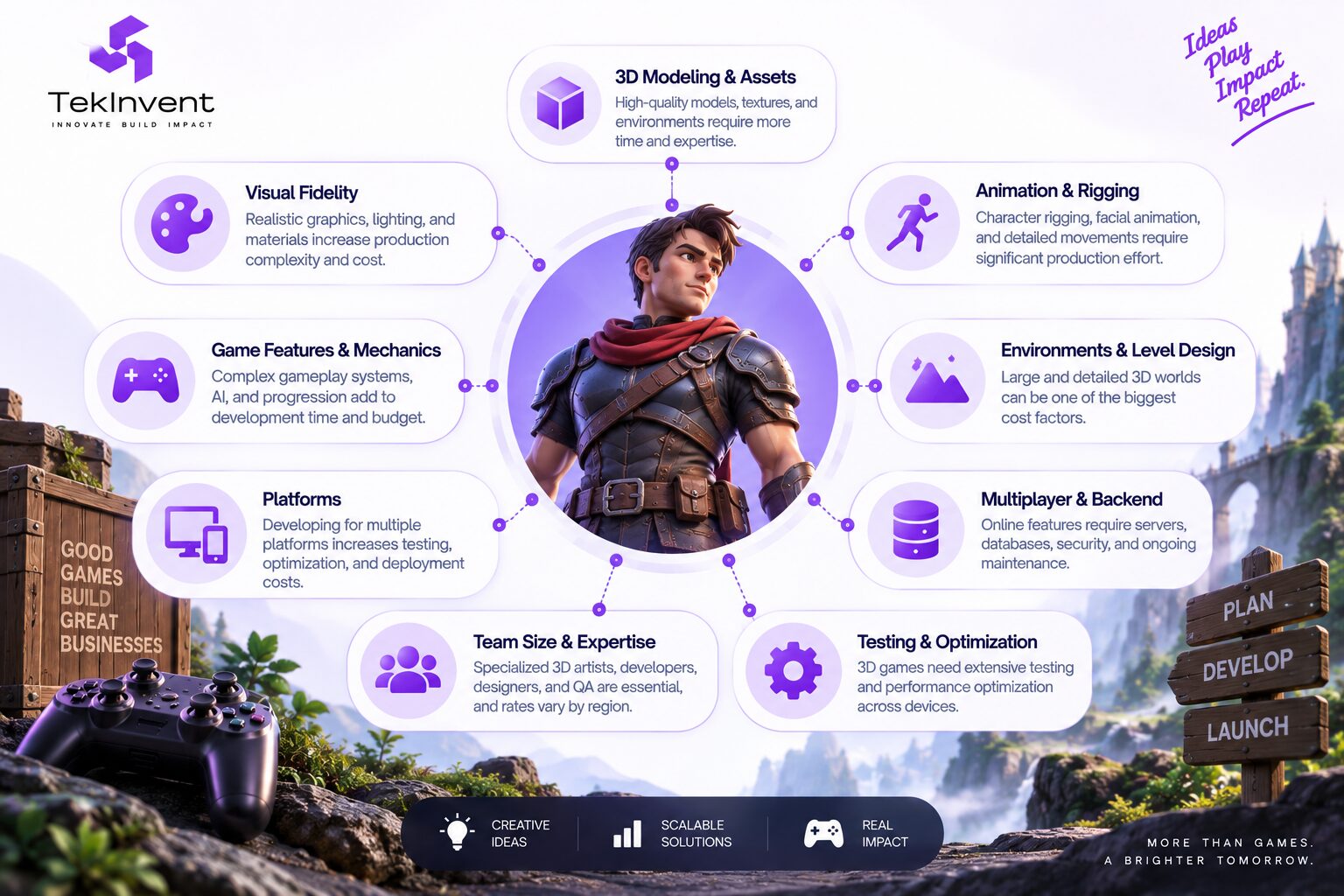
3D production introduces an extensive asset pipeline.
Consider a single playable character.
The team may first need concept artwork defining the character’s appearance.
A 3D artist then creates the model.
That model may require topology optimization, UV mapping, textures, materials, rigging, animation, collision setup, integration into the game engine, lighting adjustments, effects, and performance optimization.
And that is only one character.
The same process can apply to enemies, vehicles, weapons, buildings, environments, props, and interactive objects.
The game still needs programming, game design, UI, audio, QA, optimization, and potentially online infrastructure.
This is why the cost to develop a 3D game depends heavily on the quantity and quality of assets being produced.
Game Scope Is the Biggest Budget Decision
Before discussing graphics, engines, or team rates, define scope.
Imagine one 3D action game containing five short levels, one playable character, six enemies, and a few weapons.
Now imagine another containing twenty environments, ten playable characters, hundreds of items, vehicles, multiplayer, crafting, progression, achievements, cinematics, and continuous events.
Both are 3D games.
Their budgets have almost nothing in common.
Every additional system creates work across multiple disciplines.
A new character requires more than a model.
A new environment requires more than scenery.
A new gameplay mode requires more than programming.
Each addition can affect design, art, animation, audio, UI, QA, balancing, performance, and sometimes backend infrastructure.
Businesses should therefore define the smallest commercially viable version before estimating full production.
3D Modeling Has a Direct Impact on Cost
3D models form a major part of the production pipeline.
Characters, buildings, environments, weapons, furniture, vehicles, creatures, vegetation, and interactive objects may all require modeling.
But not every model requires the same amount of work.
A stylized low-poly tree might be produced relatively efficiently.
A realistic human character with detailed clothing, hair, skin, facial features, and accessories can require far more specialized work.
Quantity matters as much as quality.
A game containing five detailed characters may have a manageable character-production pipeline.
A game requiring 100 unique characters creates a completely different workload.
Before requesting an estimate, businesses should identify approximately how many major custom assets the game requires.
That one exercise can make early budget discussions significantly more accurate.
Visual Fidelity Can Change the Entire Production Pipeline
“3D graphics” does not describe one visual standard.
A game may use simple low-poly graphics, stylized environments, cartoon characters, semi-realistic visuals, or highly realistic assets.
Higher visual fidelity can increase requirements for textures, materials, lighting, effects, animation, facial systems, environments, and optimization.
This is one reason the industry is increasingly discussing the sustainability of continually escalating visual complexity. Recent commentary from veteran developers has highlighted how high-resolution textures, sophisticated shaders, content requirements, and QA contribute to rising production costs even as development tools improve.
Businesses should therefore choose visual quality strategically.
The goal should not automatically be to create the most realistic graphics possible.
The goal should be to create a visual style appropriate for the audience, gameplay, platform, and available budget.
Character Rigging and Animation Add Another Cost Layer
A completed character model cannot automatically walk, fight, jump, or interact with the world.
It usually needs a rig.
Animations are then created using that rig.
A simple character might require walking, running, jumping, idle, attack, damage, and death animations.
More sophisticated characters can require dozens or hundreds of animations.
Combat games can be particularly animation-heavy because weapons, attacks, dodges, abilities, reactions, executions, and interactions may all need unique movement.
Facial animation can increase complexity further.
If the project includes cinematic scenes, dialogue, motion capture, or realistic facial performances, the animation budget can become substantial.
Businesses should therefore estimate not only the number of characters but also the approximate animation requirements per character.
Environments Can Consume a Large Part of the Budget
Characters often receive the most attention, but environments can require enormous production effort.
A 3D environment may involve terrain, buildings, vegetation, props, textures, lighting, collision, effects, navigation, interactive objects, optimization, and level design.
A contained arena is relatively straightforward compared with a large explorable city.
An open world creates additional challenges because the game may need to stream assets efficiently while maintaining acceptable performance.
More environments also mean more testing.
Every location needs to be checked for collision problems, navigation issues, graphical errors, performance bottlenecks, inaccessible areas, and gameplay problems.
For businesses working with limited budgets, controlling environment size is one of the most effective ways to control production cost.
Gameplay Complexity Matters as Much as Graphics
A visually simple 3D game can still be technically complex.
Imagine a multiplayer strategy game with relatively modest graphics.
Behind those graphics may be sophisticated AI, inventories, progression, matchmaking, networking, databases, player accounts, economies, analytics, leaderboards, cloud saves, and anti-cheat systems.
Conversely, a visually attractive single-player exploration game may have relatively straightforward mechanics.
This is why estimating 3D game development pricing from screenshots or visual references alone can be misleading.
A proper estimate needs to understand what happens behind the graphics.
Does a 3D Game Cost More Than a 2D Game?
For comparable scope and quality expectations, 3D commonly introduces additional production stages through modeling, materials, rigging, lighting, cameras, and three-dimensional environments.
However, that does not mean every 3D game costs more than every 2D game.
A focused low-poly 3D game could be considerably cheaper than an enormous hand-animated 2D RPG.
Scope remains more important than dimension alone.
If you are deciding between the two approaches rather than specifically budgeting a 3D project, TekInvent’s 2D vs 3D game development guide explains their differences in production, performance, team requirements, and use cases.
For businesses that have already decided on 2D, the separate 2D game development cost guide keeps that pricing intent separate from this article.
Mobile 3D Game Development Cost
Mobile 3D development creates a unique balancing problem.
Developers want attractive graphics, but smartphones have limitations around processing power, GPU performance, memory, storage, battery usage, and thermal behavior.
The game may also need to support a wide range of devices.
That means 3D assets need to be created with optimization in mind.
Developers may need to manage polygon counts, textures, materials, lighting, effects, draw calls, memory consumption, and level loading carefully.
Mobile projects can also include advertising, in-app purchases, analytics, notifications, cloud saves, leaderboards, and other platform-specific systems.
If smartphones are your primary target, the mobile game development process explains how a mobile title moves from concept and prototyping through development, testing, store preparation, and launch.
Multiplayer Can Increase a 3D Game Budget Significantly
Multiplayer changes the technical architecture of a game.
Instead of managing gameplay only on one device, developers may need servers or peer-to-peer networking to keep multiple players synchronized.
The project can require authentication, matchmaking, lobbies, databases, player accounts, inventories, leaderboards, reconnection systems, security, moderation, and anti-cheat functionality.
Real-time gameplay introduces latency challenges.
The game needs to remain playable even when players have different network conditions.
Testing becomes more complicated as well.
Unity’s 2026 industry research illustrates this complexity. Among surveyed multiplayer developers, 31% identified keeping pace with content and balance updates as their biggest multiplayer challenge, while 23% selected technological complexity.
Multiplayer should therefore be treated as a foundational architecture decision, not as a small feature to add shortly before launch.
Open-World Games Create a Different Budget Category
An open-world game needs more than a large map.
The environment needs meaningful content.
That can include towns, landscapes, buildings, NPCs, quests, encounters, collectibles, vehicles, wildlife, dialogue, environmental effects, and interactive systems.
The technical requirements also increase.
Developers may need world streaming, level-of-detail systems, AI navigation, dynamic loading, memory management, and sophisticated optimization.
Testing becomes enormous because players can approach environments and objectives from directions developers may not have anticipated.
For a business with a limited initial budget, a smaller but denser world can often be more realistic than building an enormous environment that lacks meaningful content.
AI and NPC Complexity Affect Development Cost
NPC behavior can range from extremely simple to highly sophisticated.
An enemy might only move toward the player and attack.
Another game might require NPCs to patrol, search, communicate, use cover, respond to sound, navigate complex environments, cooperate with other characters, and adapt to changing gameplay conditions.
More sophisticated behavior requires more programming, design, balancing, animation, and testing.
The same principle applies to crowds.
Placing hundreds of characters inside a city affects both behavior systems and technical performance.
Businesses should therefore define what NPCs actually need to do instead of simply requesting “advanced AI.”
Physics and Destruction Can Increase Technical Complexity
3D games frequently use physics for vehicles, projectiles, objects, character movement, environmental interactions, or destruction.
Basic physics can be relatively straightforward.
Complex simulations are different.
A driving game may need convincing vehicle behavior.
A sports title may depend heavily on ball physics.
A destruction-focused game may require buildings and objects to break dynamically while maintaining performance.
These systems often require repeated tuning.
Something can be technically realistic while still feeling wrong to players.
Developers therefore need time not only to implement physics but also to make the results enjoyable.
Platform Choice Changes the Budget
Developing for PC alone creates one testing and deployment environment.
Supporting PC, PlayStation, Xbox, mobile, and other platforms creates many more.
Each platform can have different hardware, controls, interfaces, performance expectations, platform services, and certification requirements.
Cross-platform multiplayer adds another level of complexity because gameplay and online systems need to behave consistently across different environments.
Unity’s 2026 developer survey found that 72% of surveyed studios prioritize cross-play, while 38% identified maintaining a consistent experience across devices and environments as their main obstacle.
Businesses should therefore decide whether every intended platform needs to launch simultaneously.
A staged platform strategy can sometimes reduce initial risk and investment.
Unity vs Unreal Engine: Does the Engine Change the Cost?
Engine choice can influence development workflow, available tools, team expertise, performance, visual capabilities, and licensing.
But the engine alone rarely determines the complete project budget.
A highly experienced Unity team may deliver one type of project efficiently, while another team may have significantly more expertise with Unreal Engine.
The project’s technical and visual requirements should guide the choice.
For businesses comparing these technologies, TekInvent’s Unity vs Unreal Engine guide covers graphics, mobile development, programming, performance, 2D and 3D workflows, and project suitability.
Licensing should also be considered.
For games distributed under Unreal Engine’s standard royalty model, Epic currently states that a 5% royalty applies to worldwide gross revenue above the first $1 million in lifetime gross revenue per product. Its qualifying Launch Everywhere with Epic program can reduce the royalty rate to 3.5%.
That does not necessarily make one engine cheaper overall. Development efficiency and project requirements remain major considerations.
Team Size and Expertise Affect 3D Game Development Pricing
A commercial 3D project may require game designers, programmers, 3D modelers, texture artists, animators, technical artists, level designers, UI designers, QA engineers, sound professionals, producers, and other specialists.
Small teams may combine roles.
Larger productions may employ multiple specialists within each discipline.
Location also influences labor rates.
But businesses should avoid comparing development partners only by hourly cost.
A lower hourly rate can become expensive if the project requires considerably more hours, suffers from rework, or needs substantial redevelopment later.
Experience with the required type of game can improve estimation and reduce technical mistakes.
The more useful comparison is total project value rather than hourly rate alone.
How Long Does a 3D Game Take to Develop?
Time directly affects cost because game production depends heavily on skilled labor.
A focused project may require months.
Larger commercial projects can require years.
Instead of repeating the complete timeline discussion here, TekInvent’s game development timeline breaks down discovery, pre-production, prototyping, production, alpha, beta, QA, launch, and post-launch development.
Current industry behavior shows why early validation matters.
Unity’s 2026 report found that 67% of surveyed developers spend three months or less prototyping. It also found that 48% have become more selective about which prototypes they pursue and 26% increased their use of rapid low-fidelity prototypes.
The business lesson is straightforward.
Validate the expensive assumptions before funding full production.
Testing and Optimization Need a Serious Budget
3D games can place significant demands on hardware.
Performance can be affected by models, textures, lighting, shadows, effects, physics, AI, environments, animations, and the number of objects being rendered.
Testing therefore goes beyond finding gameplay bugs.
Developers may need to analyze frame rates, memory usage, loading, CPU performance, GPU performance, network behavior, crashes, and platform-specific problems.
Optimization can require adjusting models, textures, effects, lighting, code, asset loading, and level design.
The more platforms and hardware configurations the game supports, the larger the testing matrix becomes.
Cutting QA from the budget does not eliminate those costs.
It increases the chance that players encounter the problems after launch.
Audio and Voice Acting Should Be Included in the Budget
3D games can require substantial audio production.
Weapons, vehicles, footsteps, environments, creatures, interfaces, impacts, weather, and interactions may all need sound.
Music can be licensed or created specifically for the game.
Narrative projects may also require voice actors.
A few short character lines are very different from a fully voiced RPG containing thousands of lines of dialogue.
Localization multiplies those requirements if dialogue needs to be recorded in multiple languages.
Audio requirements should therefore be scoped alongside art and programming.
Cinematics Can Become Expensive Quickly
Businesses sometimes treat cinematics as a small addition to the game.
High-quality cinematics can require scripting, storyboarding, environments, character animation, facial animation, camera work, lighting, effects, voice acting, audio, and editing.
The quality target matters enormously.
An in-engine conversation using existing assets may be manageable.
A highly polished cinematic sequence can become a substantial production project by itself.
If cinematics are important to the experience, define their approximate number and duration before finalizing the development budget.
Post-Launch Costs Should Not Be Ignored
The initial development quote is not necessarily the total cost of owning a game.
After launch, developers may need to fix bugs, improve performance, respond to operating-system or platform changes, balance gameplay, update servers, introduce new content, and support players.
Live-service games have even larger ongoing requirements.
Unity’s 2026 research found that 26% of surveyed developers said their studios were increasing emphasis on post-launch content and LiveOps.
Businesses should therefore separate two numbers:
Cost to reach launch
and
Cost to operate and grow the game after launch
This creates a much more realistic financial plan.
How Can Businesses Reduce 3D Game Development Cost?
Reducing cost does not necessarily mean lowering quality.
It often means removing unnecessary scope.
Begin with one strong gameplay loop.
Prototype it.
Use a limited number of representative characters and environments.
Choose a visual style that the available team can produce consistently.
Avoid building a huge open world unless the gameplay genuinely requires one.
Determine whether multiplayer is necessary for version one.
Select launch platforms strategically.
Reuse modular environment assets where appropriate.
Separate essential launch features from future updates.
Most importantly, validate technical risk before mass-producing content.
Unity’s current industry data supports this direction. In its 2026 survey, 52% of developers said their teams were focusing on smaller, more manageable projects as a risk-reduction strategy.
Smaller scope does not automatically mean a worse game.
It can mean more resources are available to polish what actually matters.
Start With a Prototype or Vertical Slice
Before funding dozens of characters and environments, build a representative portion of the experience.
A prototype validates mechanics.
A vertical slice goes further.
It can demonstrate one small section of the game at something approaching intended production quality.
For example, instead of immediately creating 30 environments, the team might build one polished environment containing a representative character, enemies, animations, interface, lighting, effects, audio, and gameplay systems.
That allows the business to evaluate whether the intended quality is achievable within the proposed production pipeline.
It can also reveal how long individual assets actually take to produce.
Those lessons improve the full production estimate.
What Should a 3D Game Development Quote Include?
A useful quote should explain its assumptions.
Businesses should know approximately how many environments, characters, major assets, animations, levels, game modes, and platforms are included.
Gameplay systems should be defined.
Multiplayer and backend requirements should be clear.
The estimate should explain whether UI, audio, QA, deployment, store submission, infrastructure, and post-launch support are included.
Milestones should also be visible.
A quote for ten environments cannot reasonably remain unchanged if the project later expands to thirty.
Likewise, adding multiplayer or an open world after architecture has been established can substantially change both budget and timeline.
The more specific the scope, the more meaningful the price becomes.
When Should You Hire a 3D Game Development Company?
Businesses do not need every detail completed before approaching developers.
But they should understand the core concept.
Define the genre, target audience, intended platforms, core gameplay loop, approximate visual style, multiplayer requirements, and major features.
An experienced 3D game development company can then convert those requirements into asset pipelines, technical architecture, development milestones, team requirements, and a more realistic production budget.
A strong discovery phase should also challenge assumptions.
If a particular feature consumes a large percentage of the budget without significantly improving the player experience, that should be discussed before development begins.
Choosing a Game Development Company for a 3D Project
When evaluating a game development company, compare more than final quotes.
Look at what each estimate includes.
One proposal might include original 3D assets, animation, QA, backend development, deployment, and post-launch support.
Another may exclude several of those requirements.
The lower number may therefore not represent a cheaper version of the same product.
Businesses should also examine relevant technical experience, production processes, communication, milestones, testing methodology, and how scope changes are managed.
A useful development partner should be able to explain why the project costs what it costs.
How Much Should Your Business Actually Budget?
Start with scope rather than a predetermined dollar figure.
Write down the game’s genre and core loop.
Define the target platforms.
Estimate the number of characters.
Estimate the number and size of environments.
Describe the intended visual quality.
Identify important gameplay systems.
Determine whether multiplayer is required.
Define backend functionality.
Identify cinematics and voice acting.
Clarify monetization.
Decide what version one absolutely needs.
Then separate future ideas.
This gives developers enough information to begin decomposing the project into actual production work.
If the resulting estimate exceeds the available budget, do not immediately search for a dramatically cheaper team.
First determine whether the scope can be reduced without damaging the core experience.
That is often the safer way to bring the project and budget closer together.
Final Thoughts
There is no single 3D game development cost that applies to every project in 2026.
A focused mobile or indie game can require tens of thousands of dollars. More sophisticated commercial productions can move into six figures, while large multiplayer, open-world, console, and high-fidelity projects can require substantially larger investments.
The most important cost drivers are scope, asset volume, visual fidelity, animation, environments, gameplay complexity, multiplayer, backend infrastructure, platforms, team composition, QA, and post-launch support.
Current industry behavior reinforces the importance of controlling these variables. Unity reports that 52% of surveyed developers are prioritizing smaller projects, while 67% keep prototyping within three months.
For businesses, the most effective budgeting strategy is therefore not trying to find one universal price for a 3D game.
Define the smallest version that delivers the intended player experience.
Prototype the risky parts.
Measure the real production effort.
Then expand the project with a much clearer understanding of what the complete game will actually cost.

Build Smart with The Right Team.
We bring expertise, technology, and trust you look for in your digital journey.