
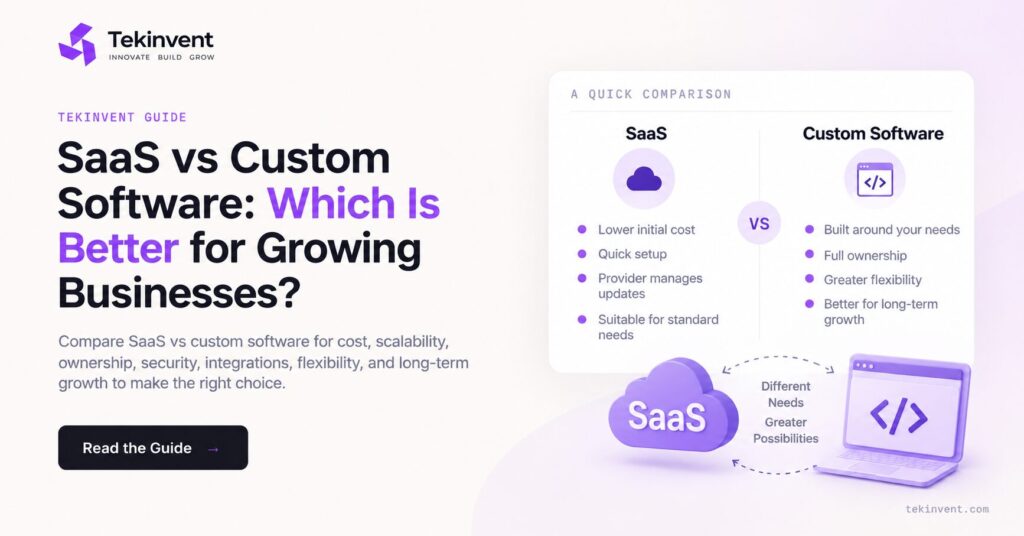
Growing businesses eventually reach a point where software becomes more than a tool. It starts influencing how efficiently employees work, how customers interact with the company, and how easily the organization can scale.
At this stage, many businesses face the same decision: should they continue using ready-made SaaS products or invest in software built specifically around their operations?
The SaaS vs custom software decision is not simply about choosing the cheaper option. SaaS can provide fast implementation, predictable subscription costs, and less technical responsibility. Custom software can provide greater flexibility, ownership, integration possibilities, and control over how the technology evolves.
For a small company with standard requirements, SaaS may provide everything necessary. For a growing organization dealing with unusual workflows, increasing subscription costs, disconnected systems, or complicated integrations, custom software may eventually become more practical.
Understanding where each model works best can help businesses make the decision based on long-term value rather than short-term price.
What Is SaaS?
Software as a Service, commonly known as SaaS, is software hosted and maintained by a third-party provider and accessed by customers through the internet.
Instead of building the application, a business subscribes to an existing product.
Popular categories include customer relationship management systems, accounting platforms, project management software, email marketing platforms, HR systems, and collaboration tools.
The provider normally manages hosting, updates, infrastructure, security patches, and general maintenance.
This makes SaaS attractive to businesses that want to start using software quickly without creating their own development team.
Businesses considering the SaaS model in greater depth can also review TekInvent’sSaaS development guide, which explains SaaS architecture, scalability, development, and other important considerations.
What Is Custom Software?
Custom software is developed around the specific requirements of a business or group of users.
Instead of changing business processes to fit an existing application, the application can be designed around the organization’s workflows.
A custom platform may automate internal operations, connect departments, manage customer processes, integrate several existing systems, or create functionality that is unavailable in commercial SaaS products.
Businesses usually begin considering custom development when generic software starts creating limitations.
For example, employees may be manually transferring information between several applications because none of them fully supports the company’s workflow.
Custom software can bring these processes into one environment.
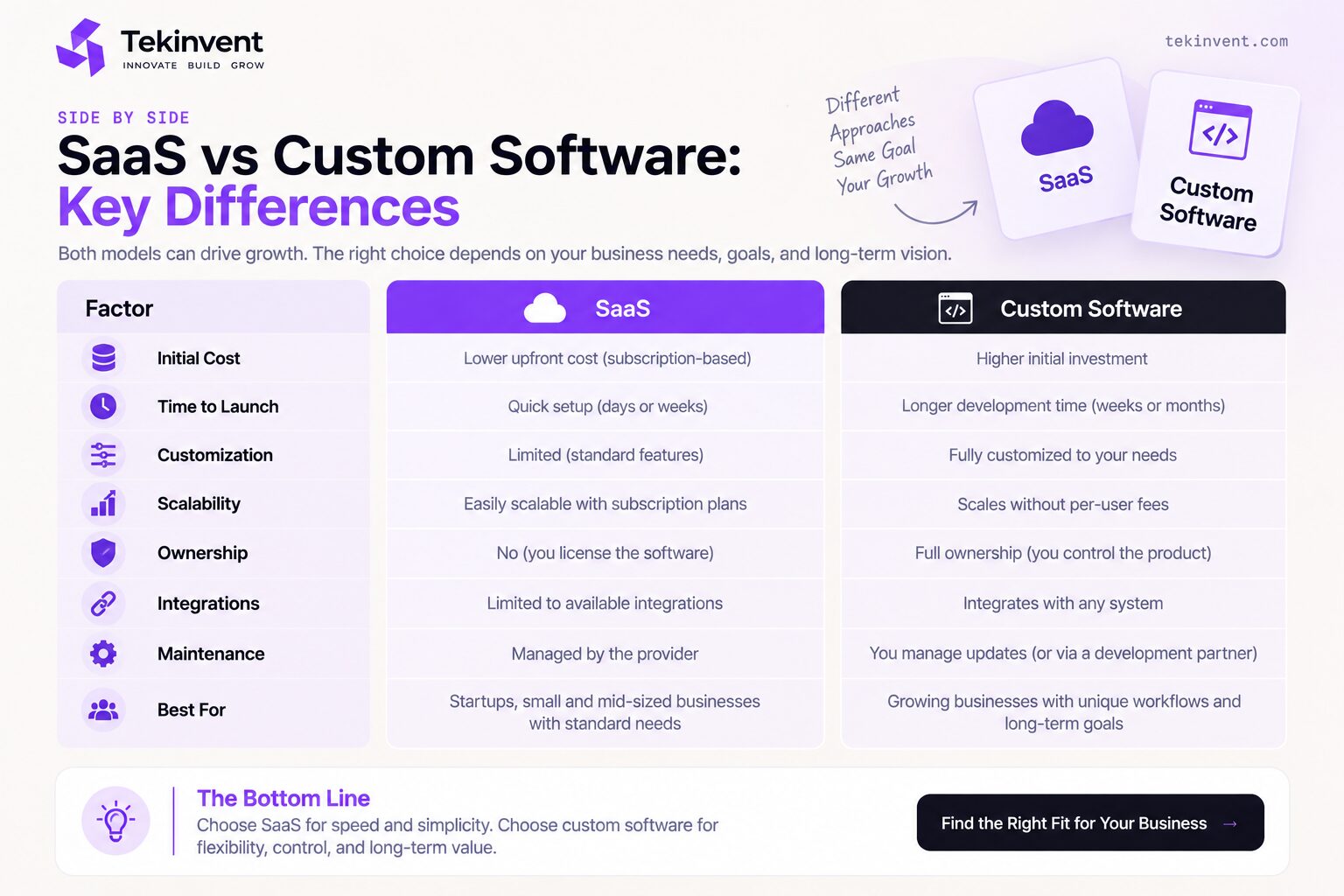
SaaS vs Custom Software: What Is the Main Difference?
The fundamental difference is standardization versus customization.
SaaS products are generally designed for a broad customer base. Providers create features that solve common problems across many businesses.
Custom software is built around the requirements of a particular organization.
With SaaS, the business usually adapts at least part of its process to the software.
With custom software, the software can be designed to adapt to the business.
Neither approach is automatically better.
The right choice depends on how unique the company’s processes are and how much control it needs over its technology.
SaaS Usually Has a Lower Initial Cost
Cost is often the first reason businesses choose SaaS.
Instead of funding design, development, testing, and deployment, the company pays a monthly or annual subscription.
This reduces the initial financial commitment.
A growing company can start with a few users and increase its subscription as the team expands.
For standard business functions, this can be highly cost effective.
If a $100 monthly SaaS product already performs everything a company requires, spending tens of thousands of dollars building a similar application would rarely make financial sense.
The calculation begins to change when the organization grows.
SaaS Costs Can Increase as the Business Scales
SaaS pricing often depends on users, usage, storage, features, or subscription tiers.
A small company with ten users may find the subscription inexpensive.
A mid-sized organization with hundreds of users can face a very different annual bill.
Additional features may also require higher pricing tiers.
A company might initially purchase a basic plan but later need automation, advanced reporting, API access, additional storage, security controls, or enterprise features.
Businesses should therefore calculate SaaS costs over several years rather than comparing one month of subscription fees with the upfront cost of custom development.
The long-term answer to custom software vs SaaS can look different from the short-term answer.
Custom Software Requires More Upfront Investment
Custom development normally requires a larger initial budget.
The business may need discovery, planning, UI and UX design, software architecture, development, integrations, testing, deployment, and project management.
The final investment depends heavily on scope.
A focused internal application will cost substantially less than a complex enterprise platform.
Businesses evaluating this route should therefore understand their expected custom software development cost before comparing it with several years of SaaS subscriptions.
The comparison should include both initial and ongoing expenses.
Custom Software Provides Greater Control
Control is one of the biggest differences between the two approaches.
A SaaS provider controls the core product.
Customers can request features, but the provider decides what enters the development roadmap.
The provider may also redesign the interface, discontinue functionality, change pricing, alter usage limits, or modify integrations.
Custom software gives the business greater influence over these decisions.
Features can be prioritized according to business requirements rather than the needs of thousands of other customers.
For organizations where software supports a strategic or competitive process, this control can become particularly valuable.
SaaS Can Be Much Faster to Implement
If the business needs software immediately, SaaS has a major advantage.
An account can often be created within minutes.
Depending on complexity, configuration and employee onboarding may take days or weeks, but the underlying application already exists.
Custom software needs to be designed and developed.
Even a relatively focused application can require months rather than days.
This means businesses should consider urgency.
If an existing SaaS product solves the immediate problem well, waiting several months for a custom application may provide little benefit.
Custom development makes more sense when existing products cannot adequately solve the problem.
Custom Software Can Match Existing Workflows
Growing businesses often develop processes that are specific to how they operate.
A standard SaaS product may cover most requirements but leave important gaps.
Employees then begin creating workarounds.
They may use spreadsheets between systems, manually copy information, maintain duplicate records, or rely on several applications to complete one process.
These workarounds create hidden costs.
Employees spend time moving data rather than performing higher-value work. Errors can increase, reporting becomes fragmented, and managers may lack a complete view of operations.
TekInvent’s guide on signs your business needs custom software covers this problem in more detail, including situations where manual processes and disconnected systems become barriers to growth.
Integrations Can Become a Deciding Factor
Most businesses use more than one software platform.
A company may have separate applications for CRM, accounting, customer support, inventory, analytics, marketing, payments, and internal operations.
SaaS products often provide standard integrations with popular platforms.
For many organizations, those integrations are enough.
Problems appear when the business uses specialized systems or needs data to move through several applications in a very specific way.
Teams may end up exporting CSV files, manually entering information, or using several automation tools to keep platforms connected.
Custom software can be developed around these integration requirements.
The business can create workflows based on how its systems actually need to exchange information.
SaaS Offers Easier Maintenance
Maintenance is one of the strongest advantages of SaaS.
The provider manages the underlying product.
Customers generally do not need to maintain servers, release security patches, fix application-wide bugs, or manage major software updates.
Those responsibilities are included in the subscription.
Custom software places more responsibility on the owner.
The application requires monitoring, maintenance, security updates, bug fixes, infrastructure management, and occasional upgrades.
A business choosing custom development should therefore consider post-launch costs from the beginning.
Ownership provides greater control, but that control comes with responsibility.
Which Option Provides Better Scalability?
Both SaaS and custom software can scale, but they scale differently.
A mature SaaS platform may already support thousands or millions of users. A growing company can often upgrade its subscription rather than redesigning infrastructure.
This makes SaaS extremely convenient.
However, the company scales within the provider’s limits.
Custom software can be architected around the organization’s expected growth.
The development team can plan infrastructure, database architecture, integrations, permissions, and workflows according to expected usage.
This can provide greater flexibility, but only if scalability is considered during development.
Poorly designed custom software can create scaling problems just as easily as any other application.
Custom Software vs SaaS for a Mid Sized Company
The decision becomes particularly interesting for mid-sized organizations.
Small businesses often benefit from SaaS because their processes are relatively standard and development budgets are limited.
Very large enterprises may have enough unique requirements and technical resources to justify custom platforms.
Mid-sized companies sit between these two situations.
A mid-sized company may already have hundreds of employees, several departments, large amounts of customer data, and complicated operational processes.
At the same time, it may still rely on multiple SaaS tools introduced during earlier stages of growth.
This is where custom software vs SaaS for a mid sized company becomes a strategic question.
If existing SaaS products continue to support the company efficiently, replacing them simply for the sake of ownership may be unnecessary.
If employees are spending substantial time working around software limitations, custom development becomes more attractive.
Custom Software vs SaaS for Mid Market Businesses
Mid-market organizations should pay particular attention to total cost and operational efficiency.
Software subscriptions that looked inexpensive when the business had 20 employees can become significant with 200 or 500 employees.
However, subscription cost alone is not enough to justify custom development.
The business should also identify operational limitations.
Are employees duplicating work?
Are integrations unreliable?
Are important processes still managed through spreadsheets?
Is reporting fragmented across several platforms?
Does the company need functionality that its SaaS providers do not offer?
If these problems are costing meaningful amounts of time or money, custom software vs SaaS for mid market businesses becomes a much stronger business case.
Enterprise Custom Software vs SaaS Solutions
Enterprise organizations usually evaluate additional factors.
Security, data ownership, compliance, system integrations, user permissions, reporting, infrastructure, and long-term control can become more important.
Enterprise SaaS products can still be excellent solutions.
They often provide advanced security, enterprise support, integrations, service agreements, and proven scalability.
However, some enterprises have processes that cannot easily fit into standardized software.
In the enterprise custom software vs SaaS solutions decision, organizations should identify which processes create genuine competitive or operational value.
Standard functions such as email or basic collaboration rarely need custom development.
Unique operational systems may be different.
If the software represents an important part of how the organization competes, operates, or serves customers, greater customization can provide strategic value.
What About HSE SaaS vs Custom Built Software?
Health, safety, and environment systems provide a good example of how the decision can become industry-specific.
An HSE SaaS product may already provide incident reporting, audits, compliance tracking, inspections, and standard dashboards.
For organizations with conventional requirements, this can be enough.
The HSE SaaS vs custom built software decision changes when a company has unusual reporting structures, specialized compliance workflows, custom equipment integrations, complex approval processes, or requirements that differ substantially across facilities.
In these cases, businesses should first determine whether the SaaS platform can be configured adequately.
Custom development should solve a real limitation rather than recreate functionality that already exists in a reliable commercial platform.
Which Option Offers Better Security?
Security depends more on implementation than on whether software is SaaS or custom built.
Established SaaS providers may invest heavily in infrastructure security, monitoring, backups, access controls, and compliance.
This can be difficult for a smaller company to reproduce internally.
Custom software provides greater control over architecture, hosting, permissions, data storage, and integrations.
However, greater control does not automatically create better security.
The application still needs to be designed, tested, maintained, and monitored correctly.
Businesses handling sensitive information should evaluate the actual security architecture rather than assuming one software model is always safer.
Consider Data Ownership and Portability
Data becomes increasingly valuable as a business grows.
Before selecting a SaaS provider, organizations should understand how data can be exported, which formats are available, and what happens when the subscription ends.
Vendor lock-in can become a problem when years of operational information are difficult to move elsewhere.
Custom software gives the business greater control over its database and application architecture.
However, the company should still maintain documentation, backups, and clear ownership arrangements with its development partner.
The goal should be avoiding unnecessary dependency regardless of the software model.
Custom Software Development vs SaaS: Which Has Better ROI?
Return on investment depends on how the software creates business value.
Suppose a SaaS platform costs $40,000 per year and handles the company’s requirements efficiently.
Replacing it with a $200,000 custom platform may not make financial sense.
Now consider a company paying $100,000 annually across several SaaS tools while employees spend thousands of hours manually moving information between them.
If custom software consolidates those workflows and reduces significant operational costs, the investment becomes easier to justify.
This is why custom software development vs SaaS should be evaluated through total cost of ownership and business impact rather than purchase price alone.
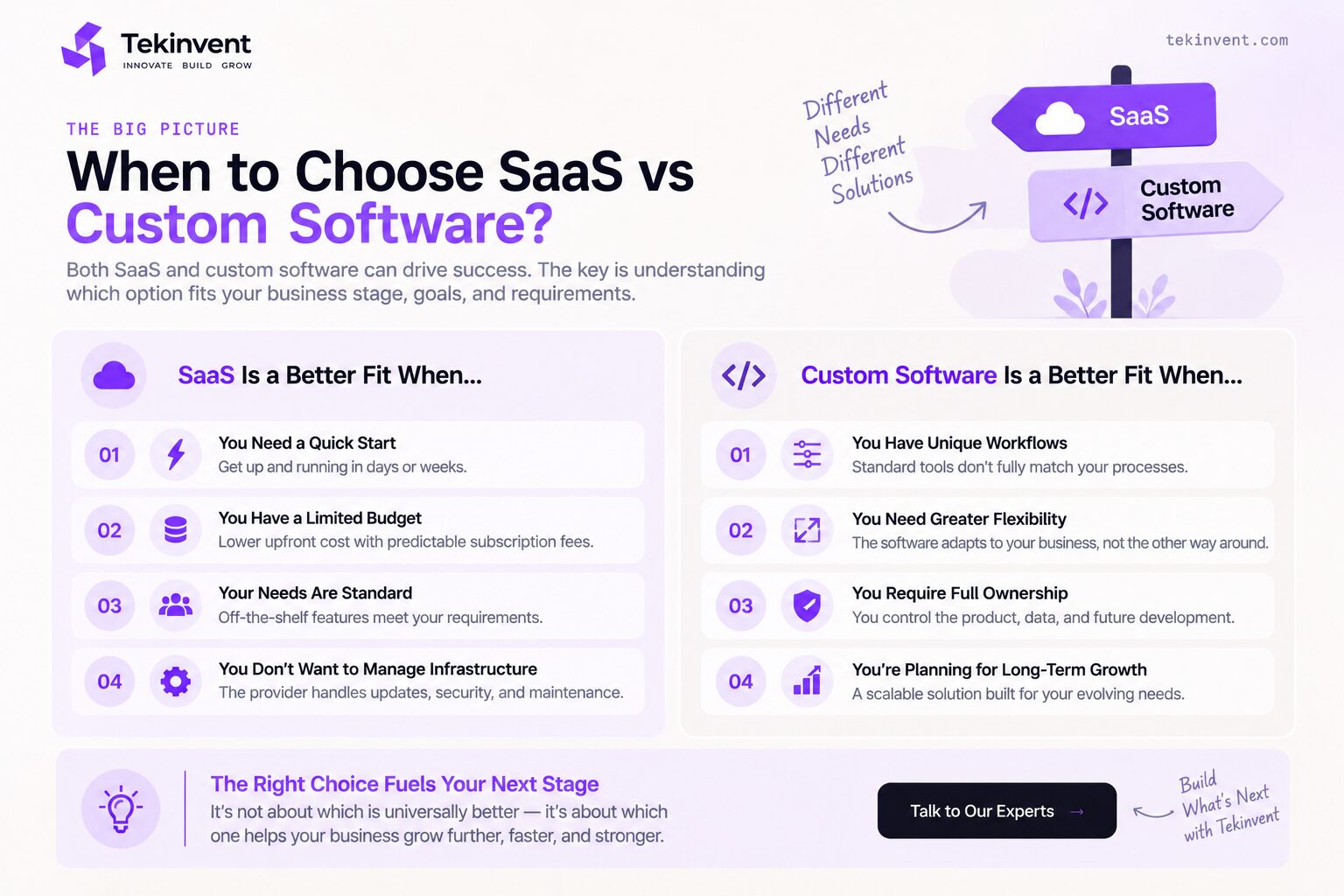
When Should a Growing Business Choose SaaS?
SaaS makes sense when the company’s requirements are standard, implementation speed matters, the subscription remains affordable, and the product already solves the business problem effectively.
It is also appropriate when the company does not want responsibility for software maintenance and infrastructure.
Growing businesses should not abandon a good SaaS product simply because custom software offers more control.
If the software continues to support growth without creating significant operational limitations, SaaS can remain the more efficient choice.
When Should a Growing Business Choose Custom Software?
Custom development becomes more attractive when the business has unique workflows that existing products cannot support efficiently.
It can also make sense when several disconnected applications create manual work, when integrations have become too complicated, when SaaS licensing costs increase significantly with scale, or when the software itself provides a competitive advantage.
At that stage, businesses may want to discuss their requirements with an experienced custom software development company to determine whether a tailored platform provides enough long-term value to justify development. TekInvent’s service offering includes custom and enterprise software, API development, testing, maintenance, and different engagement models.
The commercial decision should come after the requirements have been evaluated, not before.
Can Businesses Use SaaS and Custom Software Together?
Yes, and for many growing businesses this is the most practical strategy.
Choosing custom software does not mean rebuilding every tool the company uses.
A business may continue using established SaaS products for accounting, email, payments, communication, or CRM while developing custom software for the workflows that make the company unique.
The custom application can then integrate with those SaaS platforms.
This hybrid approach avoids rebuilding mature technology while still giving the company control over the processes where customization creates real value.
How to Decide Between SaaS and Custom Software
Start by looking at the problem rather than the technology.
Determine whether existing SaaS products can meet the requirement without creating significant compromises.
Then calculate the true cost of the current system, including subscriptions, add-ons, manual work, integrations, duplicate tools, training, and operational inefficiencies.
Consider how those costs could change over the next three to five years as the company grows.
Next, identify whether the process is standard or strategically unique.
If thousands of businesses perform the same task in essentially the same way, a mature SaaS product may already be the most efficient solution.
If the workflow is specific to your organization and provides operational or competitive value, custom software deserves closer consideration.
Finally, compare total ownership costs, implementation time, maintenance responsibilities, scalability, integrations, security, and expected ROI.
That creates a much more useful decision than simply asking which option has the lowest price today.
Final Thoughts
The SaaS vs custom software decision does not have one answer for every growing business.
SaaS offers speed, lower initial investment, easier maintenance, and access to mature functionality. If an existing product already solves the problem effectively, it can remain the smartest option even as the company grows.
Custom software offers greater control, deeper customization, ownership, and the ability to design technology around specific business processes. It becomes particularly valuable when standard platforms create expensive workarounds, integration problems, scaling limitations, or restrictions on strategically important workflows.
Growing businesses should therefore avoid choosing based only on upfront cost.
Evaluate what the company needs today, where existing software is creating friction, what subscriptions and manual processes will cost as the organization expands, and which capabilities genuinely differentiate the business.
In many cases, the final answer is not SaaS or custom software. It is using SaaS where standardized technology works well and investing in custom software where greater control and customization can create measurable long-term value.

Build Smart with The Right Team.
We bring expertise, technology, and trust you look for in your digital journey.