
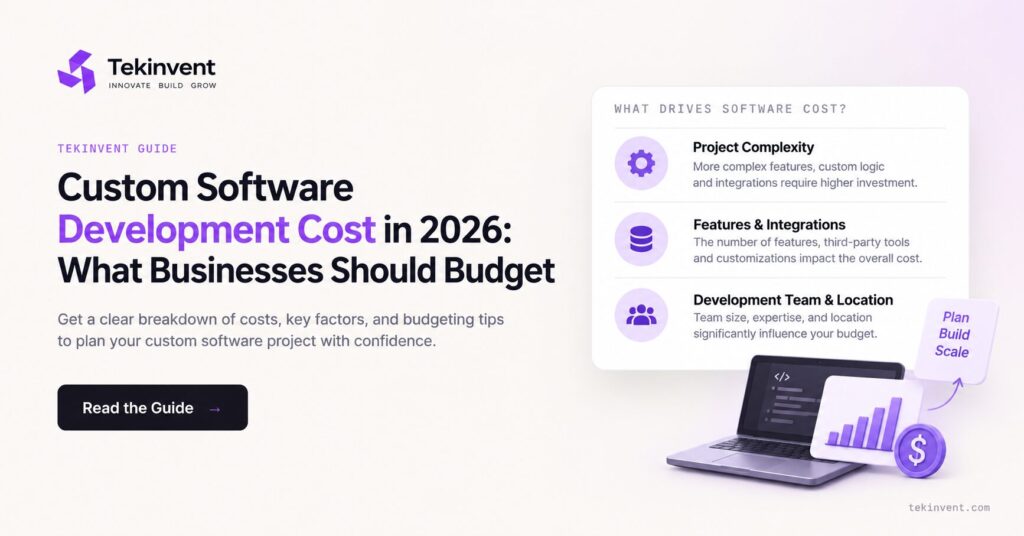
How much does custom software development cost in 2026? It is one of the first questions businesses ask when they decide that off-the-shelf software can no longer meet their requirements.
The short answer is that custom software development cost can range from around $20,000 for a focused solution to $200,000 or more for a complex enterprise platform. Highly sophisticated systems with extensive integrations, advanced security, multiple user roles, large data requirements, or AI functionality can move significantly beyond that range.
The wide difference exists because custom software is built around individual business requirements. A simple internal dashboard cannot be priced in the same way as an enterprise resource planning system connecting hundreds of employees, multiple departments, payment systems, customer databases, and third-party applications.
Instead of asking only, “How much will my software cost?”, businesses should understand what creates the cost and which features are actually necessary.
This guide explains the major custom software development cost factors, expected budgets, hourly development rates, enterprise costs, ongoing expenses, and practical ways to control your investment.
How Much Does Custom Software Development Cost in 2026?
For initial budgeting, a focused custom software MVP may start around $20,000 to $50,000. A more complete small to mid-sized business application can move into approximately the $50,000 to $150,000 range, while complex enterprise software can require $200,000 or considerably more.
These figures should be treated as planning ranges rather than fixed quotations.
TekInvent’s existing custom software guidance also shows how widely pricing can change by scope. Its published estimates range from smaller projects through enterprise systems costing hundreds of thousands of dollars.
The actual cost of custom software development depends on what needs to be designed, developed, integrated, secured, tested, deployed, and maintained.
A company requiring an internal inventory dashboard for 20 employees will have a very different budget from a business developing a SaaS platform for thousands of paying customers.
What Is the Average Cost of Custom Software Development?
There is no meaningful single average that applies to every software project.
A better way to understand the average cost of custom software development is to divide projects according to their complexity.
A relatively simple MVP with a focused workflow, standard interface, basic authentication, and limited integrations may require approximately $20,000 to $50,000.
A mid-level application involving multiple user roles, dashboards, payment functionality, APIs, notifications, reporting, and more advanced backend development may require roughly $50,000 to $150,000.
Complex business or enterprise software can begin around $150,000 to $200,000 and continue upward depending on its architecture.
Enterprise platforms involving extensive integrations, high security requirements, real-time processing, large numbers of users, legacy system migration, or advanced automation can require several hundred thousand dollars.
This is why a business should not choose its budget based only on the average number found online.
The estimate needs to match the actual scope.
What Factors Affect Custom Software Development Cost?
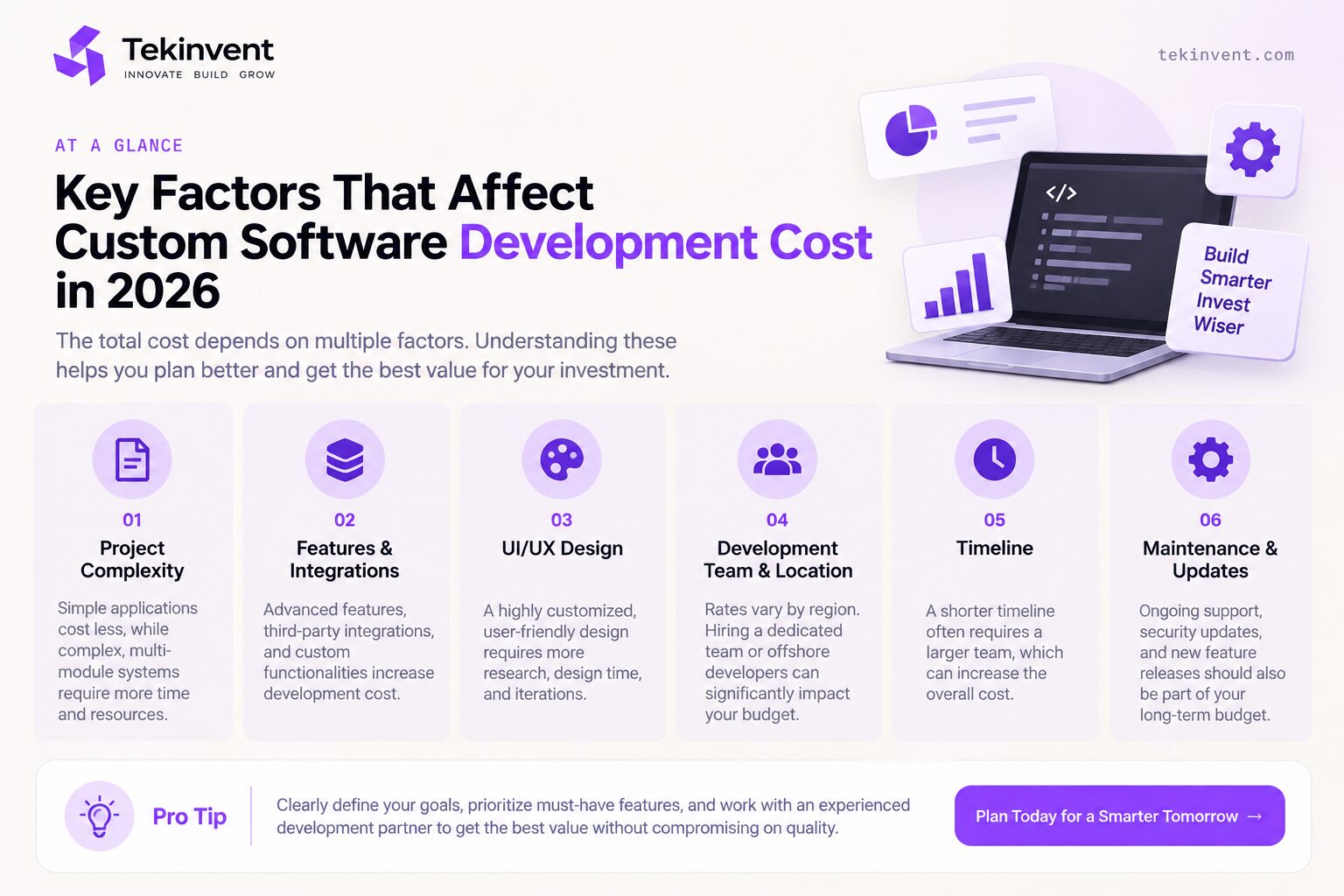
The first major factor is project complexity.
A software product with five straightforward features requires less development than a platform containing dozens of connected workflows.
Every additional feature creates more than development work. It can also require additional interface design, backend logic, database architecture, testing, security checks, and maintenance.
The number of platforms also matters.
A web application alone may require one development approach. Building web, iOS, and Android experiences can increase the scope.
User roles can further affect complexity. A simple application where every user sees similar functionality is easier to develop than software with customers, employees, managers, administrators, and partners who all have different permissions.
Before requesting estimates, businesses should therefore separate essential functionality from features that can be introduced after launch.
Software Features Have a Direct Impact on Budget
Features are one of the clearest custom software development cost factors.
Basic login functionality is relatively straightforward.
Adding multi-factor authentication, role-based permissions, social login, single sign-on, and enterprise identity management creates a larger requirement.
The same applies to payments.
A basic payment gateway is different from a system handling subscriptions, refunds, multiple currencies, invoices, commissions, and complex billing rules.
Real-time chat, geolocation, advanced search, video streaming, analytics, document processing, notifications, automation, and AI capabilities can all increase development requirements.
The objective should not be to remove useful functionality simply to reduce cost.
Instead, businesses should identify which features must exist at launch and which can wait until the product proves its value.
UI and UX Design Also Affect Development Cost
Custom software is not only backend code.
Users need an interface that allows them to complete tasks easily.
Design work can include user research, user flows, wireframes, prototypes, interface design, responsive layouts, accessibility considerations, and usability testing.
An internal administrative application may require a relatively straightforward interface.
A customer-facing SaaS product competing in a crowded market may require a much more polished experience.
Poor UX can also create hidden costs after launch because users struggle with the product, support requests increase, and important screens may need to be redesigned.
Investing in the right level of design before development can prevent expensive changes later.
Third-Party Integrations Can Increase the Cost
Modern software rarely operates completely independently.
A business may need its application to communicate with a CRM, payment gateway, accounting system, mapping service, analytics platform, email provider, cloud storage service, ERP, or another internal application.
Every integration introduces additional development and testing.
Well-documented modern APIs can make integration relatively straightforward.
Older systems can be more difficult.
If a company needs custom middleware or must connect with legacy software that was never designed for modern integrations, the development effort can increase considerably.
Businesses should identify required integrations before requesting final development estimates.
Development Team Location Influences Pricing
The custom software development cost per hour varies significantly depending on where developers are located, their experience, and the complexity of the work.
A senior engineer with experience designing enterprise systems will generally cost more per hour than a junior developer working on straightforward functionality.
Development rates also vary by region.
TekInvent’s published software-cost guidance, for example, lists North American senior development rates substantially above rates commonly found in several offshore regions.
However, choosing developers based only on the lowest hourly rate can create problems.
A $30-per-hour team that requires twice as many hours, produces unstable code, or needs extensive rework may ultimately cost more than a higher-priced team that understands the requirements and executes efficiently.
Businesses should compare expertise, communication, delivery process, quality assurance, and relevant project experience alongside hourly rates.
Fixed Price vs Hourly Development Cost
The engagement model can also affect the final budget.
A fixed-price project works best when requirements are clearly documented and unlikely to change significantly.
The development company estimates the scope and provides a defined price for delivering it.
Hourly or time-and-material arrangements can work better when the product is expected to evolve during development.
In this model, the business pays according to the development resources and time used.
Neither approach is automatically cheaper.
A fixed-price model offers greater budget predictability, while an hourly model can provide more flexibility.
The right choice depends on how clearly the project can be defined before development begins.
What Is the Cost of Custom Enterprise Software Development?
The cost of custom enterprise software development is usually higher because enterprise applications have requirements that smaller applications may not.
A large organization may need hundreds or thousands of users, several permission levels, complex reporting, multiple departments, legacy system integrations, security controls, audit logs, high availability, data migration, and scalable infrastructure.
Enterprise applications may also need to meet regulatory or industry-specific requirements.
A serious enterprise platform can therefore move beyond $200,000, with large and technically complex implementations potentially reaching $500,000 or more.
TekInvent’s existing guidance similarly places large enterprise solutions into substantially higher investment ranges than small and medium software projects.
The important question is not whether enterprise software is expensive.
It is whether the new system can reduce operating costs, improve productivity, replace inefficient tools, or create enough new revenue to justify the investment.
Does Adding AI Increase Software Development Cost?
It can.
Businesses increasingly want software that can summarize documents, answer questions, automate workflows, generate content, classify information, analyze data, or assist employees.
Adding AI introduces additional considerations such as model selection, API usage, data preparation, evaluation, security, monitoring, and ongoing model costs.
However, AI does not always make a project dramatically more expensive.
A focused application using an existing AI API may be relatively manageable. A sophisticated platform using private data, retrieval systems, multiple models, complex automation, or custom AI architecture will require a larger budget.
TekInvent’s guide to AI app development cost explains how AI-specific functionality changes the budget as applications move from focused MVPs to production and enterprise systems.
Businesses should therefore add AI because it improves a workflow, not simply because AI is popular.
Security Requirements Can Increase the Budget
Security should be planned from the beginning.
An internal scheduling tool and a financial application processing sensitive customer information have very different security requirements.
Advanced applications may require encryption, role-based access control, multi-factor authentication, secure API architecture, audit logs, compliance measures, penetration testing, and additional monitoring.
These requirements add development and testing effort.
However, reducing security simply to lower the initial budget can create much larger financial and reputational risks later.
The more sensitive the data and the greater the authority of the software, the more important security becomes.
Testing and Quality Assurance Are Part of the Real Cost
Software development is not complete when developers finish writing code.
The application needs to be tested.
Quality assurance can include functional testing, integration testing, usability testing, performance testing, compatibility testing, security testing, and regression testing.
A simple internal application may require a relatively limited testing process.
A customer-facing platform processing payments or important business data needs considerably more attention.
Businesses comparing development quotes should check whether testing is included.
A surprisingly cheap proposal may sometimes exclude important QA work that another provider has included.
Do Not Forget Data Migration
Businesses replacing existing software often need historical data moved into the new system.
That can become a project of its own.
Existing data may contain duplicates, inconsistent formats, missing information, outdated records, or fields that do not map cleanly into the new application.
The team may need to clean, transform, validate, and migrate this information.
If the new software depends heavily on existing business data, migration should be included in the initial project scope rather than discovered shortly before launch.
Maintenance Is an Ongoing Cost
The initial development budget is not the complete lifetime cost.
After launch, software needs maintenance.
Operating systems change. Third-party APIs change. Security vulnerabilities appear. Users discover new requirements. Browsers and devices evolve.
The software may also need infrastructure monitoring, database management, backups, bug fixes, security updates, and performance improvements.
A business should therefore create an annual maintenance budget rather than assuming the application will operate indefinitely without further investment.
Post-launch support is also one of the services TekInvent identifies as part of its software development offering.
Cloud Infrastructure and Software Licenses Add Recurring Costs
Hosting is another cost that businesses sometimes overlook.
The software may require cloud servers, databases, file storage, content delivery, backups, email services, analytics tools, monitoring platforms, payment services, or third-party APIs.
A small application with limited traffic may have relatively low infrastructure costs.
A platform serving thousands of active users and processing large amounts of data can require substantially more resources.
These costs should be estimated separately from the initial development budget.
The same applies to commercial software licenses used inside the application.
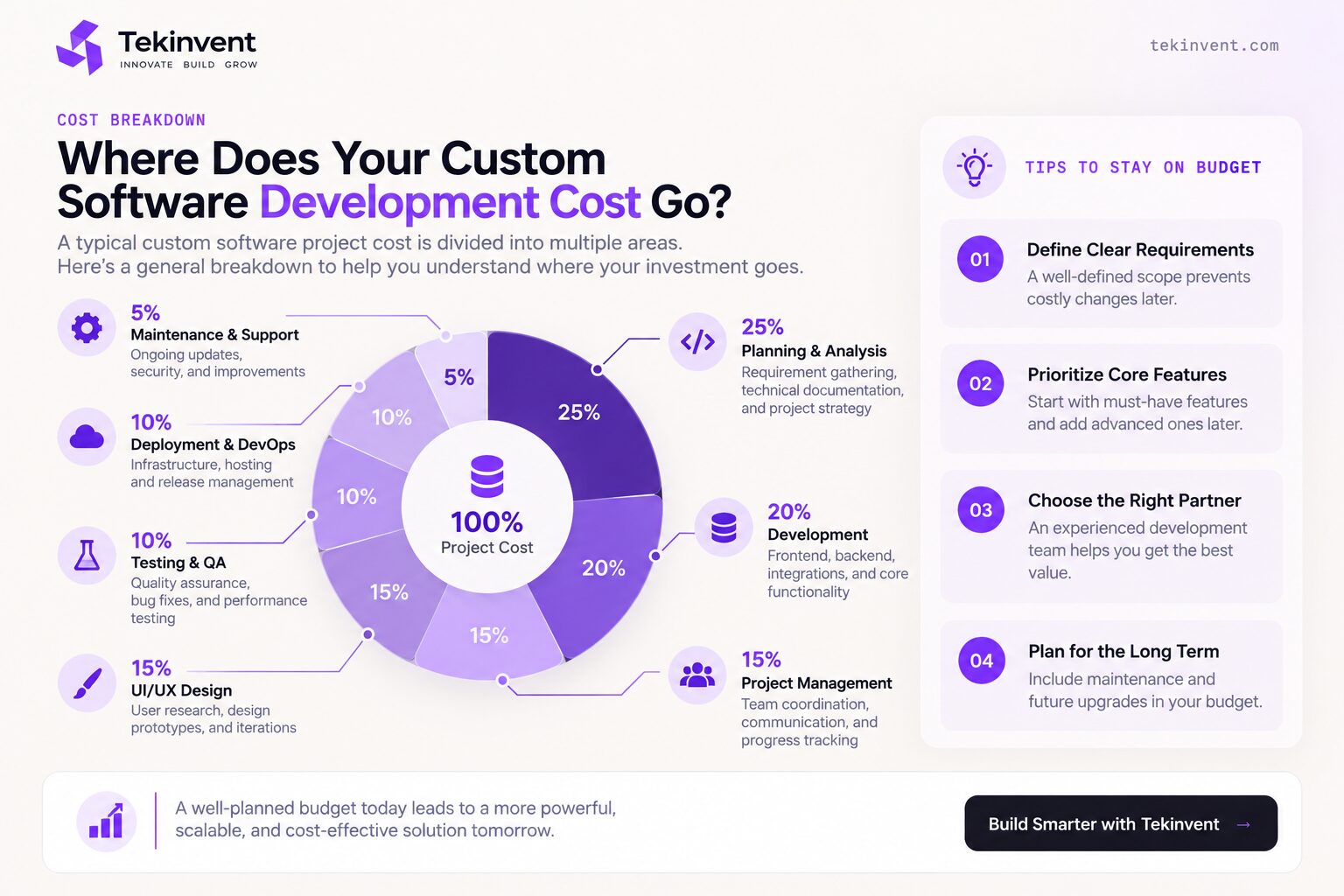
How Can You Estimate Your Own Custom Software Development Budget?
Start with the business problem rather than the feature list.
Define exactly what the software needs to improve.
Perhaps employees are spending hundreds of hours manually moving information between systems.
Maybe existing software cannot support an important business workflow.
Perhaps customers need a digital self-service platform.
Once the problem is clear, define the smallest set of features capable of solving it.
Then identify required users, platforms, integrations, data, security requirements, and expected traffic.
This gives development companies enough information to create a much more useful estimate.
A request that simply says “I need custom software” cannot produce an accurate quote.
How Can Businesses Reduce Custom Software Development Cost?
The most effective method is usually controlling scope.
Businesses often make the mistake of trying to build every possible feature in version one.
That increases the initial investment and creates more assumptions that have not yet been tested with real users.
A focused MVP can solve the primary problem first.
Once users begin interacting with the software, the company gains real information about which features matter.
Existing technologies should also be reused when appropriate.
Not every component needs to be developed from scratch. Reliable payment systems, authentication platforms, cloud infrastructure, APIs, and software frameworks can reduce development time.
Good planning also saves money.
Changing an idea during a wireframe is inexpensive compared with rebuilding the same feature after backend development and testing are complete.
Custom Software vs Off-the-Shelf Software
Custom development is not always the correct decision.
If an existing SaaS product already solves 90 percent of the business requirement at a reasonable subscription price, developing a completely new platform may not provide enough return.
Custom software becomes more attractive when existing products force the business to change important workflows, require too much manual work, cannot integrate with essential systems, create scaling problems, or lack functionality that provides a competitive advantage.
The decision should therefore consider total business value rather than simply comparing a development quote with a monthly subscription.
How Do You Choose the Right Development Partner?
Price matters, but it should not be the only selection factor.
A development partner should understand the business problem before recommending technologies.
The team should be able to explain the architecture, project stages, timeline, testing process, communication structure, ownership, deployment, and post-launch support.
When your business reaches this stage, working with an experienced custom software development company can help turn business requirements into a realistic technical scope before significant development spending begins.
Businesses should also ask what is included in the quotation.
A lower proposal may exclude design, testing, deployment, documentation, project management, or maintenance.
Comparing deliverables is more useful than comparing the final numbers alone.
Is Custom Software Worth the Cost?
The answer depends on the return the software can create.
Suppose a $100,000 internal system saves a company $80,000 every year in manual work and operational errors. The investment may be relatively easy to justify.
If the same system saves only a few thousand dollars per year and creates no meaningful strategic advantage, custom development may not be the right decision.
Businesses should estimate potential time savings, operating cost reductions, new revenue, customer retention, productivity improvements, and risk reduction.
The development budget then becomes part of a business case rather than an isolated technology expense.
Final Thoughts
The custom software development cost in 2026 cannot be reduced to one number.
A focused product may require tens of thousands of dollars, while a complex enterprise platform can require an investment of several hundred thousand dollars.
Features, integrations, design, security, development rates, data migration, testing, infrastructure, and maintenance all influence the final budget.
For businesses, the best approach is to begin with the problem that needs to be solved. Define essential functionality, separate launch requirements from future features, estimate ongoing expenses, and compare development proposals based on what they actually include.
Most importantly, evaluate the expected return.
The right question is not simply, “What is the cost of custom software development?”
It is, “What should we invest to build software that solves this problem reliably and produces enough business value to justify the cost?”
When that question is answered first, budgeting becomes clearer, unnecessary features become easier to remove, and the business can make a much more informed development decision.

Build Smart with The Right Team.
We bring expertise, technology, and trust you look for in your digital journey.