
Launching a mobile app is an important milestone, but it is not the end of the investment. Once an application reaches users, businesses still need to keep it secure, compatible, fast, reliable, and relevant.
This is why mobile app maintenance cost should be included in the budget before development even begins.
Operating systems change, new smartphones are released, APIs are updated, security vulnerabilities appear, and users report issues that were difficult to predict before launch. Businesses may also want to improve existing features or introduce new functionality as the product grows.
The amount a business spends after launch depends on the complexity of the application, its infrastructure, number of users, integrations, security requirements, and frequency of updates.
This guide explains what businesses should expect from mobile app maintenance, where the money goes, what affects the annual budget, and how to control ongoing costs without compromising application quality.
What Is Mobile App Maintenance?
Mobile app maintenance includes the ongoing technical work required to keep an application functioning properly after it has been released.
It can include fixing bugs, updating dependencies, improving performance, maintaining servers, monitoring crashes, addressing security vulnerabilities, updating third party integrations, and ensuring compatibility with new versions of Android and iOS.
Maintenance can also include smaller usability improvements based on actual user behavior.
This makes maintenance different from simply fixing an application when something breaks.
A proper maintenance strategy is proactive. Developers monitor the product and address potential issues before they become serious enough to affect a large number of users.
Why Do Mobile Apps Need Maintenance After Launch?
The environment surrounding a mobile application is constantly changing.
Apple and Google regularly update their operating systems and app store requirements. Smartphone manufacturers release new devices with different screen sizes and hardware capabilities. External services can change their APIs, while libraries and frameworks used during development receive updates.
User expectations change as well.
An application that performs well when it has 1,000 users may require infrastructure improvements when it reaches 50,000 users.
Security is another ongoing responsibility. Vulnerabilities can appear in dependencies, APIs, authentication systems, and other parts of an application’s technology stack.
Without regular mobile application maintenance, a technically successful launch can gradually become a slow, unstable, insecure, or outdated product.
How Much Does It Cost to Maintain an App?
There is no universal answer to how much does it cost to maintain an app because maintenance requirements vary considerably between products.
A relatively simple application with limited functionality, stable integrations, and a small user base may require only occasional updates and monitoring.
A larger marketplace, healthcare platform, fintech application, social application, or real time platform may require continuous technical support, infrastructure monitoring, security work, and regular releases.
Instead of looking for one fixed maintenance price, businesses should evaluate the areas that create recurring costs.
These commonly include developer support, hosting, monitoring tools, third party APIs, security, bug fixes, operating system compatibility, application store requirements, and ongoing improvements.
This provides a much more realistic estimate than assuming every mobile application requires the same maintenance budget.
What Percentage of Development Cost Goes to Maintenance?
Businesses sometimes estimate the mobile app maintenance cost percentage as a portion of the original development investment.
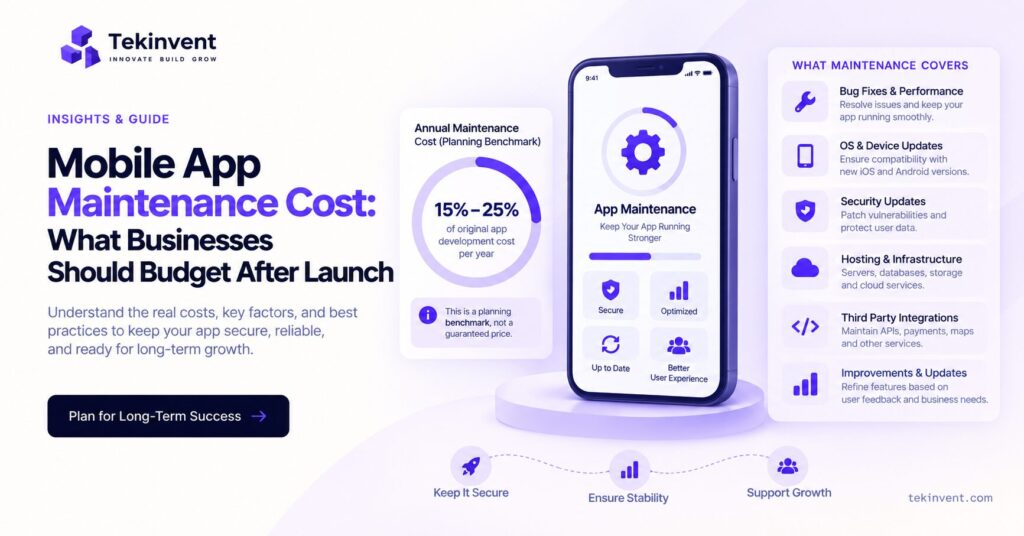
A commonly used planning benchmark is approximately 15% to 25% of the original development cost per year, but this should be treated as a budgeting starting point rather than a guaranteed rate.
For example, if an application costs $100,000 to develop, a preliminary maintenance budget based on this benchmark could be around $15,000 to $25,000 annually.
However, an application experiencing rapid user growth or frequent feature changes could require more. A stable application with limited functionality may require less.
The first year after launch can also be different from later years because real users may reveal usability problems, edge cases, performance issues, and improvement opportunities that were not visible during testing.
Businesses should therefore calculate their mobile app maintenance cost per year around actual product requirements rather than relying exclusively on a percentage.
What Is Included in Mobile App Maintenance Costs?
An app maintenance cost is usually made up of several smaller ongoing expenses rather than one single fee.
Bug fixing is one component. Even thoroughly tested applications can encounter issues when exposed to thousands of users, different devices, network conditions, and usage patterns.
Compatibility updates are another. Applications may need adjustments when new Android and iOS versions are released.
Infrastructure costs can include servers, databases, cloud storage, backups, content delivery networks, and other backend services.
Security maintenance includes dependency updates, vulnerability fixes, authentication improvements, access control reviews, and other measures required to protect users and business data.
Monitoring tools can also create recurring expenses because development teams need visibility into crashes, performance, infrastructure, and application behavior.
Finally, businesses should budget for continuous improvements. User feedback and analytics often reveal small changes that can make the application easier or more effective to use.
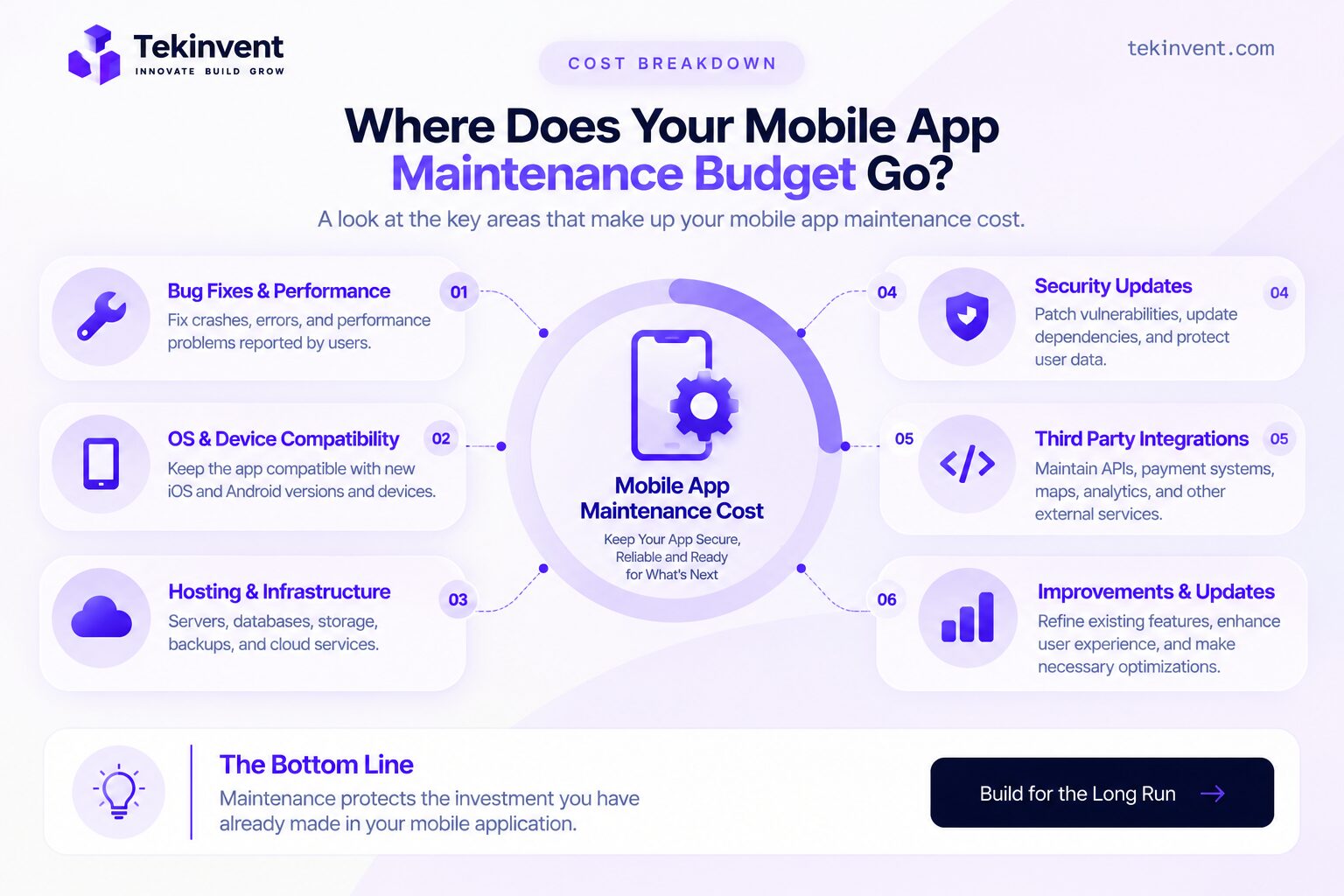
Where Does Your Mobile App Maintenance Budget Go?
Understanding where money is being spent makes the cost of app maintenance easier to control.
A typical maintenance budget may cover several categories.
Bug fixes and performance optimization help keep the application stable.
Operating system and device compatibility work ensures the application continues functioning when mobile platforms change.
Infrastructure keeps the backend, databases, storage, and related services operational.
Security maintenance protects the application as new vulnerabilities and threats emerge.
Third party services require monitoring because payment providers, mapping services, communication platforms, analytics systems, and other external tools can change their APIs or pricing.
Finally, ongoing UI, UX, and feature improvements help keep the application aligned with user expectations.
The exact distribution will differ significantly from one product to another, so businesses should not treat a generic percentage breakdown as a fixed rule.
Suggested categories:
Bug Fixes & Performance
Fix crashes, errors, and performance problems.
OS & Device Compatibility
Keep the app compatible with Android, iOS, and new devices.
Hosting & Infrastructure
Servers, databases, storage, backups, and cloud services.
Security Updates
Patch vulnerabilities and protect application data.
Third Party Integrations
Maintain APIs, payment systems, maps, analytics, and other services.
Improvements & Updates
Refine existing functionality based on users and business needs.
Bottom line:
Maintenance protects the investment you have already made in your mobile application.
What Factors Affect Mobile App Maintenance Cost?
Application complexity is one of the biggest cost factors.
A basic informational application generally requires less ongoing work than an application containing real time messaging, payments, location tracking, complex user permissions, subscriptions, or multiple external integrations.
The number of supported platforms matters as well.
Maintaining separate native Android and iOS applications can require platform specific updates. A cross platform app development approach may allow some maintenance work to be shared, although both platforms still require proper testing.
Infrastructure usage can significantly affect the cost of running an app.
As the number of users, uploaded files, database queries, API requests, or transactions increases, cloud and infrastructure expenses may increase as well.
Security and compliance requirements can add further work, particularly for applications handling sensitive business, financial, or healthcare information.
Code quality also matters. A poorly structured application can make even small changes difficult, while clean architecture and documentation can reduce the effort required for future maintenance.
Native vs Cross Platform Maintenance Costs
The technology used to build an application can influence long term maintenance.
With separate native applications, Android and iOS may have independent codebases. A feature or bug fix may therefore require implementation and testing on both platforms.
Cross platform applications can share much of their code, potentially reducing duplicated work for common functionality.
However, cross platform applications still require Android and iOS testing. Framework upgrades can also occasionally require changes to plugins, dependencies, or platform specific modules.
Businesses should therefore consider maintenance during technology selection instead of focusing entirely on the initial development budget.
The cheapest development option is not necessarily the option with the lowest total cost over several years.
How User Growth Changes the Cost of Running an App
The cost of running an app can change considerably as the product grows.
An early stage application may operate comfortably on relatively modest infrastructure. As users increase, the application may need additional computing resources, database capacity, storage, bandwidth, monitoring, and technical support.
Higher traffic can also expose performance problems that were not visible with a smaller audience.
Businesses may need database optimization, caching, infrastructure scaling, load balancing, or architectural improvements.
Third party service costs can rise as well. Some APIs charge according to requests, active users, messages, transactions, storage, or other usage metrics.
For this reason, businesses should model maintenance at several growth levels instead of assuming today’s operating cost will remain unchanged.
How Third Party Services Affect App Maintenance Costs
Modern applications rarely operate completely independently.
They may use payment gateways, maps, SMS providers, email services, analytics platforms, authentication systems, cloud storage, AI APIs, customer support systems, or other external technologies.
Each integration introduces both potential financial and technical maintenance requirements.
Providers may change API versions, authentication methods, pricing structures, limits, or supported functionality.
An integration that works perfectly today may therefore require development work in the future.
Before launch, businesses should document important external dependencies and understand their pricing models.
This makes future application maintenance cost easier to forecast.
Does App Maintenance Include New Features?
This depends on the maintenance agreement.
Basic maintenance usually focuses on keeping existing functionality stable and operational.
A completely new feature may be considered additional development rather than routine maintenance.
For example, fixing an existing payment integration would normally fall under maintenance. Adding an entirely new subscription system could represent product development.
Businesses should clarify this distinction before signing an ongoing support agreement.
A transparent app development and maintenance plan should explain what is covered by the maintenance fee, how additional work is estimated, and how priorities are handled.
How to Maintain an App Effectively
A good maintenance process starts with monitoring rather than waiting for users to complain.
Development teams should track crashes, errors, application performance, server health, and important infrastructure metrics.
User reviews and support requests should also be monitored because repeated complaints can reveal problems that technical monitoring does not detect.
Dependencies should be reviewed and updated regularly. Security patches should not be postponed unnecessarily.
Teams should also test important application functionality when Android, iOS, frameworks, or major third party services release significant updates.
Businesses working with a mobile app development company should establish clear responsibilities for monitoring, bug resolution, security updates, releases, and technical support before the application goes live.
Maintenance becomes easier when it is treated as part of the product lifecycle rather than an emergency service used only when something breaks.
How Can Businesses Reduce Mobile App Maintenance Costs?
The most effective way to control mobile app maintenance costs is to make good technical decisions before launch.
Clear architecture reduces the difficulty of future changes.
Well documented code helps developers understand the application faster.
Automated testing can reduce the risk that updates break existing functionality.
Monitoring tools help identify problems before they become widespread.
Businesses should also avoid unnecessary features and integrations. Every external service and complicated feature adds another component that may eventually require maintenance.
Regular maintenance can itself reduce long term expenses.
Ignoring small problems often allows them to accumulate into larger technical issues that are more expensive to resolve later.
 How to Plan an Annual Mobile App Maintenance Budget
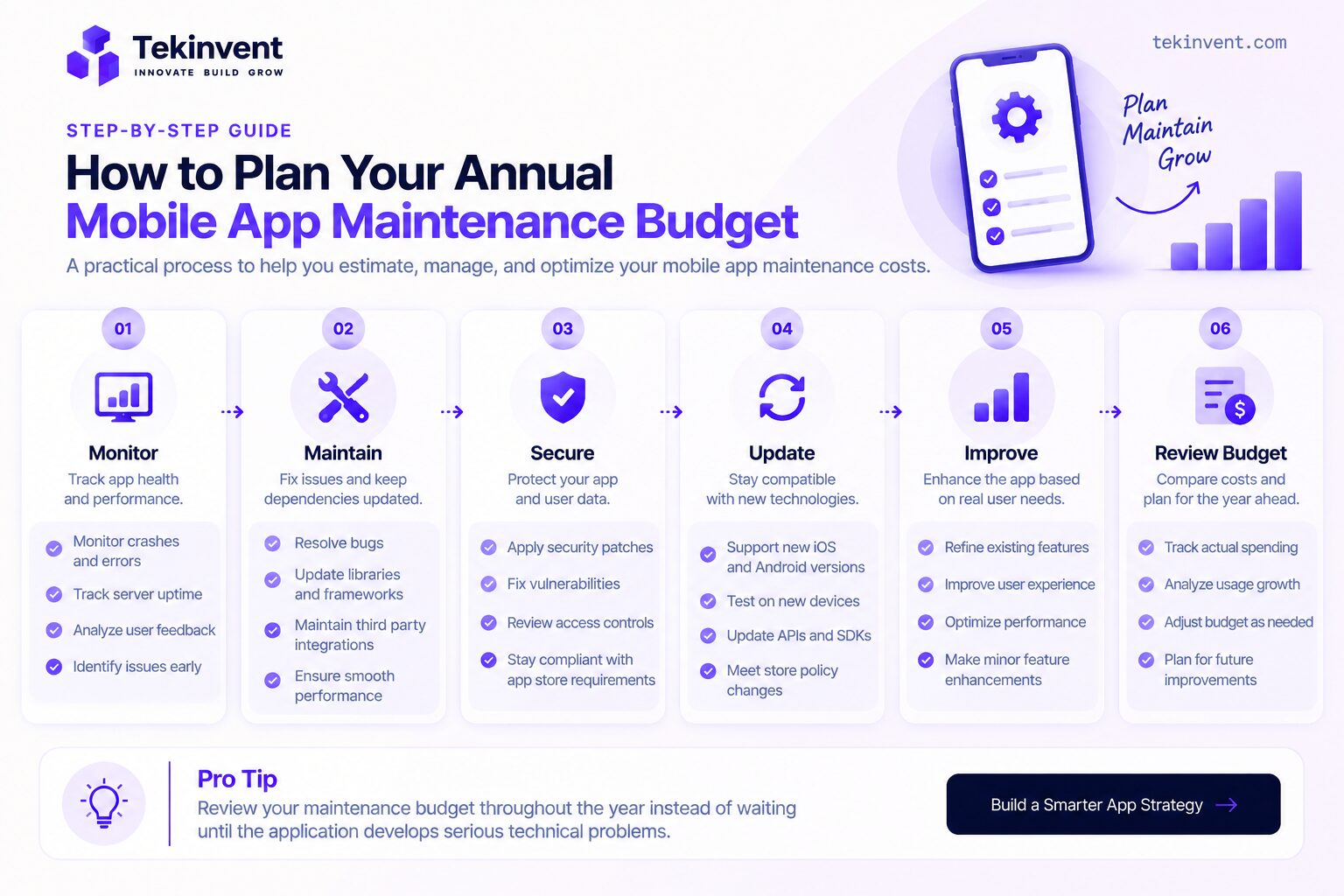 How to Plan an Annual Mobile App Maintenance Budget
Businesses should establish an annual maintenance plan rather than treating every technical issue as an unexpected expense.
Start by identifying all recurring infrastructure and third party costs.
Next, estimate the development resources required for operating system updates, dependency updates, security work, bug fixes, monitoring, and routine releases.
Then create a separate allowance for unexpected technical issues.
Product improvements should also have their own budget if the business expects to release new features regularly.
Finally, review actual maintenance spending periodically.
An application that grows rapidly may require a larger budget. A stable product may eventually require fewer development hours but continue to generate infrastructure and service costs.
01 Monitor
Track crashes, performance, servers, and user feedback.
02 Maintain
Fix bugs and keep dependencies updated.
03 Secure
Apply security patches and review vulnerabilities.
04 Update
Prepare for Android, iOS, device, and API changes.
05 Improve
Refine existing features and user experience.
06 Review Budget
Compare actual costs with usage and product growth.
Pro Tip:
Review your maintenance budget throughout the year instead of waiting until the application develops serious technical problems.
Is Mobile App Maintenance Worth the Cost?
For an application that continues serving customers or supporting business operations, maintenance is not simply an optional expense.
The original development investment can lose value if the application becomes unstable, incompatible, insecure, or frustrating to use.
Regular maintenance helps extend the useful life of the product.
It also gives businesses an opportunity to improve the application gradually rather than waiting until technical problems require major redevelopment.
The objective is not to spend as much as possible on maintenance. It is to spend enough to keep the product reliable, secure, and aligned with the needs of its users.
Final Thoughts
Mobile app maintenance cost should be considered part of the total cost of owning a mobile application rather than an unexpected expense that appears after launch.
Businesses need to account for bug fixes, infrastructure, operating system compatibility, security updates, third party integrations, monitoring, and ongoing improvements.
A percentage of the original development cost can provide an initial planning benchmark, but actual spending should be based on the application’s complexity, technology, users, infrastructure, integrations, and growth.
The best time to think about maintenance is before development begins.
A maintainable architecture, clear documentation, appropriate technology choices, reliable monitoring, and a defined post launch support plan can make future maintenance more predictable and help businesses protect their mobile app investment over the long term.

Build Smart with The Right Team.
We bring expertise, technology, and trust you look for in your digital journey.