
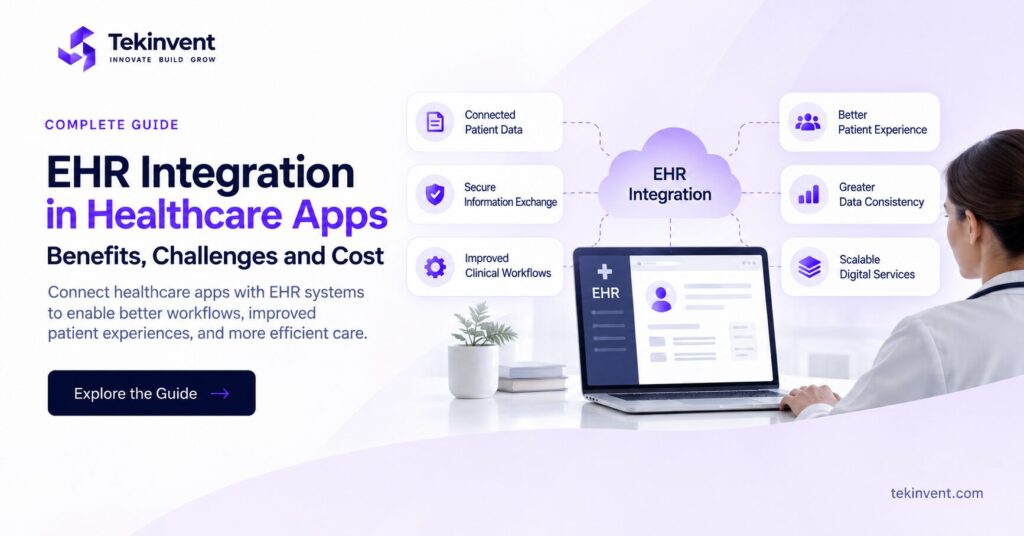
Healthcare applications become far more useful when they can exchange information with the systems healthcare organizations already use. A patient may book an appointment through a mobile app, but the provider still needs that appointment inside its clinical system. A doctor may update a medical record, while the patient expects relevant information to appear in the app without calling the clinic.
This is where EHR integration becomes important.
EHR integration connects healthcare applications with electronic health record systems so authorized information can move between platforms. Depending on the product, this may include patient demographics, appointments, medications, laboratory results, clinical records, billing information, or other healthcare data.
However, connecting an app to an EHR is not simply a matter of creating an API connection. Healthcare businesses need to consider interoperability standards, security, patient matching, permissions, data formats, vendor capabilities, testing, compliance, and ongoing maintenance.
This guide explains how EHR integration in healthcare apps works, its business and clinical benefits, common challenges, implementation approaches, and the factors that determine development cost.
What Is EHR Integration?
EHR integration is the process of connecting an application, platform, or healthcare system with an Electronic Health Record system so information can be exchanged between them.
Without integration, staff may need to move information manually between systems.
For example, imagine a patient schedules an appointment through a healthcare app. Without proper integration, clinic staff might need to copy the appointment details into another system.
With integration, relevant information can potentially flow directly into the connected healthcare workflow.
The same concept can apply to patient profiles, prescriptions, laboratory information, clinical records, billing workflows, and other authorized healthcare information.
The Office of the National Coordinator for Health Information Technology describes interoperability as the ability of systems to exchange electronic health information and use that information without special effort by the user.
Effective EHR integration solutions therefore focus not only on connecting two systems but on making exchanged information usable within real healthcare workflows.
How EHR Integration Works in a Healthcare App
A healthcare mobile application usually does not communicate directly with an EHR database.
Instead, information is typically exchanged through controlled interfaces.
A simplified architecture might look like:
Healthcare App → Secure Backend → Integration/API Layer → EHR System
When a patient requests information, the application sends an authorized request to its backend.
The backend validates the request and communicates with the appropriate healthcare system through supported interfaces.
The EHR responds with authorized information, which is then processed and presented inside the application.
The opposite can happen when information needs to move toward the EHR.
For example, appointment information entered through an application might be validated and transferred to the provider’s system.
Authentication, authorization, validation, logging, error handling, data mapping, and security controls need to operate throughout this process.
What Healthcare Data Can Be Integrated?
The exact information available through an EHR system integration depends on the EHR vendor, healthcare organization, supported standards, APIs, permissions, and intended use case.
Common examples can include patient demographics, appointments, medications, allergies, diagnoses, laboratory results, immunization records, clinical documents, observations, and other authorized information.
Healthcare businesses should avoid starting with the idea that every available record needs to be synchronized.
Instead, determine what information the application actually requires.
A patient appointment application may only need patient identification, scheduling, and provider information.
A more sophisticated care management platform may require considerably broader clinical integration.
Limiting unnecessary data exchange can simplify development while reducing security and privacy exposure.
EHR Integration vs API Integration
API integration is a broader technical concept.
An API allows different software systems to communicate according to defined rules.
EHR integration may use APIs, but the overall integration usually involves much more than making API requests.
Healthcare information must be mapped correctly. Authentication and permissions need to be managed. Different systems may represent information differently. Failed transactions need appropriate handling, and healthcare workflows need to remain reliable.
This means a technically successful API call does not automatically mean the entire healthcare integration works correctly.
The receiving application must also understand and use the information appropriately.
EHR Integration and FHIR
FHIR, which stands for Fast Healthcare Interoperability Resources, is an important standard for exchanging healthcare information electronically.
HL7 describes FHIR as a standard for healthcare data exchange that uses modular resources and modern web technologies.
Instead of every healthcare application inventing its own completely different format for common healthcare concepts, FHIR provides standardized resources for representing information.
Examples can include patients, observations, medications, appointments, practitioners, and other healthcare concepts.
FHIR can make modern EHR data integration more structured, but developers still need to understand the implementation supported by the particular EHR.
Not every vendor exposes identical functionality, versions, workflows, or authorization requirements.
Therefore, saying an EHR “supports FHIR” should be the beginning of technical discovery rather than the end of it.
EHR Integration and HL7
HL7 is another term businesses frequently encounter when researching healthcare interoperability.
HL7 refers to standards developed for exchanging healthcare information.
Many existing healthcare organizations still depend on integrations involving older HL7 messaging approaches, while newer systems increasingly support FHIR based APIs.
A healthcare product may therefore encounter different integration methods depending on the systems used by its customers.
This is particularly important for businesses developing products intended to work across multiple hospitals or healthcare organizations.
The integration architecture should be flexible enough to accommodate differences instead of assuming every healthcare provider has the same technology environment.
Major Benefits of EHR Integration
The value of EHR integration extends beyond eliminating manual data entry.
A well designed integration can improve how patients, clinicians, and administrative teams interact with healthcare information.
Better Access to Patient Information
Healthcare professionals often work across multiple systems.
Integration can make relevant information available within the workflow where it is needed, reducing unnecessary switching between platforms.
The objective is not necessarily to copy an entire medical record into every application.
It is to provide appropriate information to authorized users at the right point in their workflow.
Less Manual Data Entry
Repeatedly entering the same information into different systems wastes staff time and can introduce errors.
Integration can allow appropriate information to move electronically between connected systems.
This can be particularly valuable for appointments, demographics, clinical information, and other repetitive workflows.
Better Patient Experiences
Patients increasingly expect digital healthcare services to work together.
If someone updates information in a patient application but clinic staff cannot see it, the digital experience becomes fragmented.
Integration can support more connected experiences involving appointments, medical information, test results, care communication, and other patient services.
Improved Healthcare Workflows
A healthcare application should fit into existing clinical operations rather than create another isolated system that staff need to maintain manually.
Appropriate integration can reduce duplicate work and make digital tools more useful to healthcare teams.
More Consistent Information
When separate systems maintain independent copies of the same information, inconsistencies can develop.
A well designed integration strategy can reduce unnecessary duplication and help connected systems work with more consistent information.

Where EHR Integration Creates Business Value
Healthcare businesses should connect EHR integration to a specific operational or patient problem.
Consider appointment scheduling.
If a mobile application allows patients to request appointments but staff still need to manually enter every booking into the provider’s system, much of the operational benefit disappears.
Now consider laboratory results.
If authorized results can securely move from the clinical system into a patient facing experience, patients may receive information through a more convenient workflow.
Similar benefits can appear in medication management, care coordination, telehealth, patient onboarding, remote monitoring, and other healthcare products.
The business value comes from improving the workflow, not simply from being able to say that the application has an EHR connection.
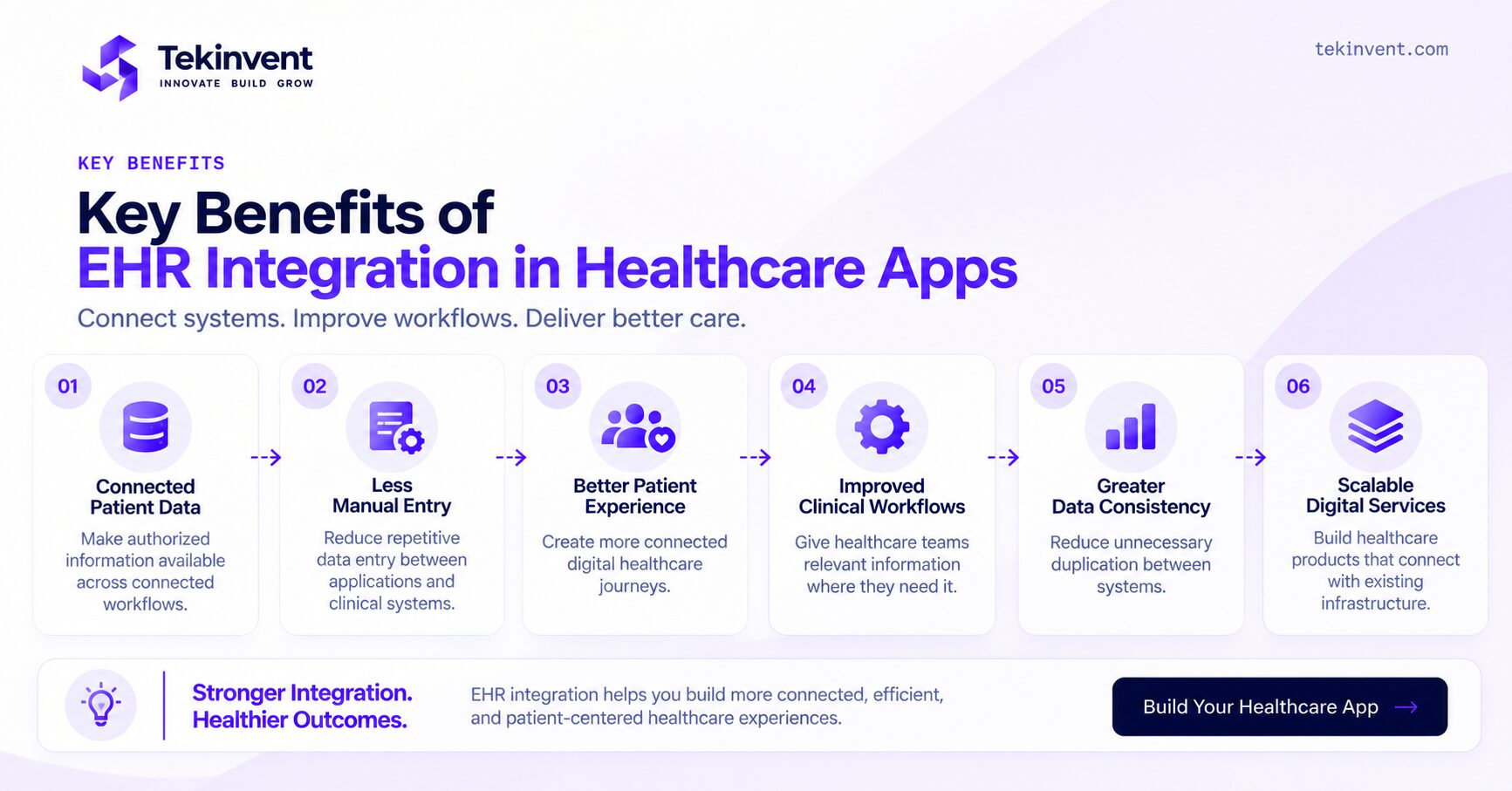
Connected Patient Data
Make authorized information available across connected workflows.
Less Manual Entry
Reduce repetitive data entry between applications and clinical systems.
Better Patient Experience
Create more connected digital healthcare journeys.
Improved Clinical Workflows
Give healthcare teams relevant information where they need it.
Greater Data Consistency
Reduce unnecessary duplication between systems.
Scalable Digital Services
Build healthcare products that connect with existing infrastructure.
Common Challenges of EHR Integration
Despite its advantages, integration with EHR systems can be technically demanding.
The difficulty often comes from differences between healthcare organizations, EHR vendors, data structures, security requirements, and workflows.
Different EHR Vendors and Implementations
Healthcare organizations do not all use the same EHR.
Even organizations using the same vendor may have different configurations, enabled modules, workflows, API capabilities, or versions.
A healthcare application intended for one provider can therefore have a much simpler integration requirement than a SaaS product intended to connect with many healthcare organizations.
Multi EHR products need an architecture that anticipates variation.
Healthcare Data Standardization
Two systems may describe similar healthcare information differently.
Developers need to understand how fields and resources correspond between systems.
Poor data mapping can cause information to appear incorrectly or lose meaning during exchange.
This makes healthcare integration more than a networking problem.
The data needs to remain clinically and operationally meaningful after it reaches the destination.
Patient Matching
Connecting information to the correct patient is critical.
Names alone are not reliable identifiers.
People can share names, change contact information, enter details differently, or have records across several healthcare organizations.
Integration architecture needs appropriate patient identification and matching processes based on the systems involved.
Incorrect matching can create serious privacy and clinical risks.
Authentication and Authorization
An application should not receive information simply because it knows an API endpoint.
The integration needs to establish who is requesting information and what that person or system is authorized to access.
Permissions can differ between patients, clinicians, administrative users, and connected applications.
Authorization therefore needs to be designed around the actual workflow.
Security and Privacy
Healthcare integrations may transmit sensitive patient information across several technical systems.
That increases the importance of secure transmission, appropriate access controls, logging, infrastructure security, and careful vendor management.
For applications subject to HIPAA, businesses should incorporate these considerations throughout development rather than attempting to add them later. Our HIPAA compliant app development guide explains the security safeguards, ePHI considerations, BAAs, and development practices involved.
Integration Reliability
External systems are not always available.
APIs can experience downtime, requests can time out, authentication tokens can expire, and data can fail validation.
Healthcare applications need appropriate error handling.
Developers should determine what happens when information cannot be synchronized immediately.
Simply showing an error message may not be enough for important healthcare workflows.
EHR Integration With Telehealth Apps
Telehealth EHR integration can connect virtual care with existing patient records and clinical workflows.
For example, a telehealth application might retrieve authorized patient information before an appointment and send appropriate documentation back into the connected healthcare environment afterward.
Scheduling may also be synchronized.
The objective is to prevent telehealth from becoming an isolated source of patient information.
However, telehealth integrations can introduce additional complexity because the application may also involve video communication, messaging, prescriptions, payments, or other external services.
Businesses should map these systems before deciding how information will move between them.
EHR Integration With Healthcare Mobile Apps
Mobile applications can provide patients with convenient access to healthcare services, but their usefulness depends heavily on the systems behind them.
An app may provide appointment booking, health information, secure communication, prescription functionality, or care management.
If these features need information from a clinical record, an integration strategy becomes part of the core product architecture.
Working with a healthcare app development company can help businesses plan mobile functionality around healthcare workflows, interoperability requirements, security, and the systems already used by providers.
The integration should be designed during architecture planning rather than treated as a plugin that can always be added at the end.
EHR Integration With Other Systems
EHRs are rarely the only technology used inside healthcare organizations.
Applications may also need to connect with laboratories, pharmacies, billing systems, insurance systems, telehealth platforms, CRM tools, patient communication platforms, or remote monitoring technologies.
This creates a broader interoperability environment.
Businesses should therefore map the complete ecosystem before building individual connections.
A direct point to point integration may work when only two systems are involved.
As the number of systems grows, a more structured integration layer can become easier to maintain.
What Is an EHR Integration Strategy?
An EHR integration strategy defines how a product will communicate with healthcare systems both now and as the business grows.
It should begin with the use case.
Determine which healthcare organizations will use the application, which EHR systems they use, what information needs to move, and whether communication needs to work in one direction or both directions.
Next, determine available integration methods.
Evaluate supported APIs, FHIR capabilities, HL7 interfaces, authentication requirements, vendor documentation, sandbox environments, and technical limitations.
Then define how information will be mapped, validated, monitored, and handled when an integration fails.
For products intended to serve many healthcare organizations, scalability should be considered early.
Building every integration as a completely independent custom project can become difficult to maintain as the number of customers grows.
A Practical EHR Integration Process
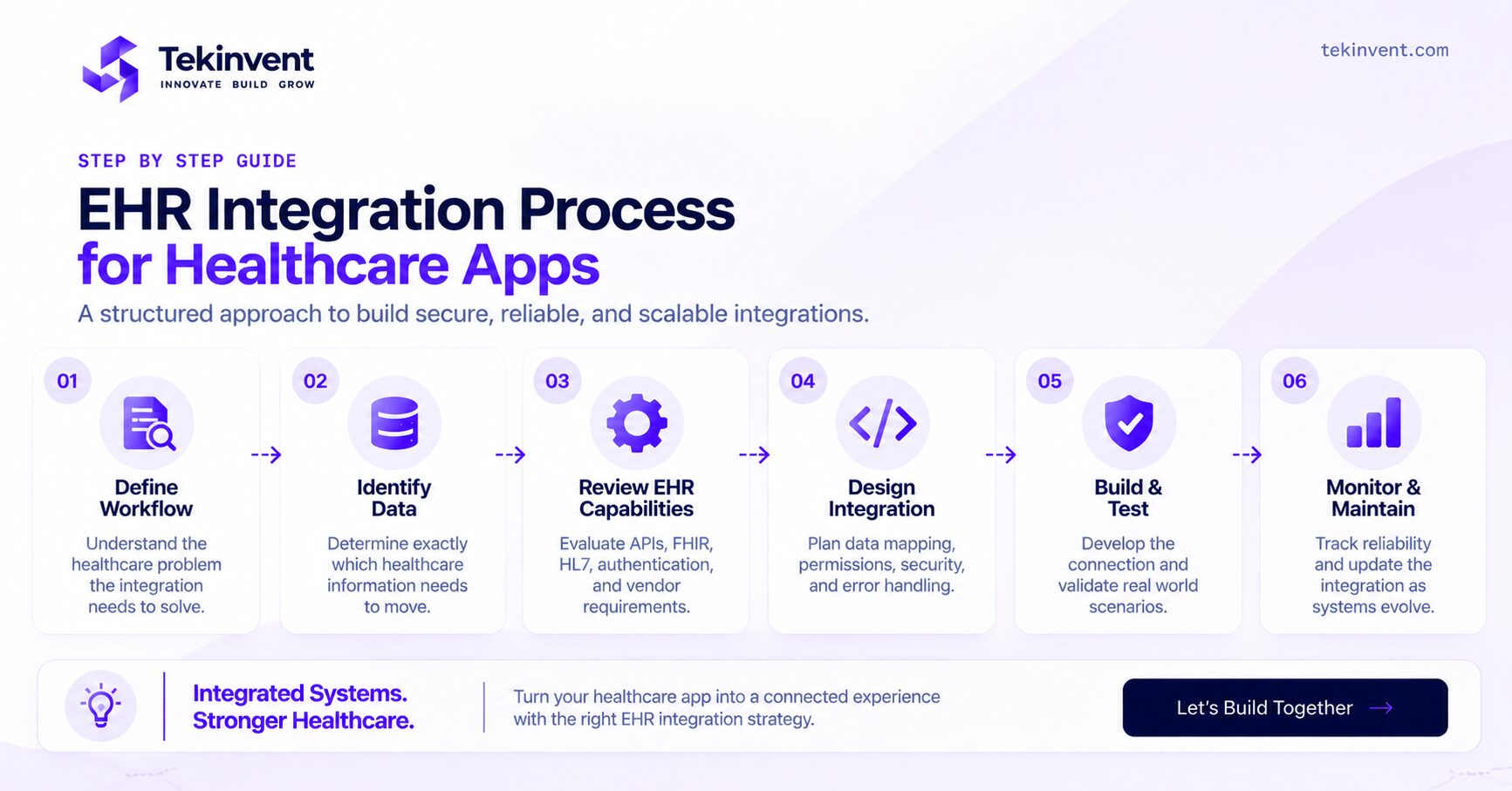
A structured process helps reduce integration problems.
1. Define the Healthcare Workflow
Start with what the patient, clinician, or staff member needs to accomplish.
Do not begin with an API simply because it is available.
2. Identify Required Data
Determine exactly what information needs to be read, created, or updated.
Avoid integrating unnecessary data.
3. Review the EHR
Identify the EHR vendor, available APIs, FHIR support, documentation, authentication requirements, and limitations.
4. Design Data Mapping and Security
Define how information will move between systems and how identities, permissions, validation, logging, and security will be handled.
5. Build and Test the Integration
Test successful requests as well as failures, invalid information, unavailable services, expired credentials, and unusual user scenarios.
6. Deploy and Monitor
Monitor integration health after launch and maintain the connection as vendors, APIs, and healthcare workflows change.
01 Define Workflow
Understand the healthcare problem the integration needs to solve.
02 Identify Data
Determine exactly which healthcare information needs to move.
03 Review EHR Capabilities
Evaluate APIs, FHIR, HL7, authentication, and vendor requirements.
04 Design Integration
Plan data mapping, permissions, security, and error handling.
05 Build & Test
Develop the connection and validate real world scenarios.
06 Monitor & Maintain
Track reliability and update the integration as systems evolve.
How Much Does EHR Integration Cost?
There is no universal EHR integration cost because projects vary significantly.
A focused integration with one well documented API can require substantially less work than a platform that needs to communicate with several EHR vendors and healthcare organizations.
The number of data types matters.
Reading appointment information is different from supporting complex bidirectional clinical workflows involving patients, medications, observations, and documents.
Vendor access also matters.
Some EHR vendors provide well documented modern APIs and development environments. Other integrations may involve additional onboarding, certification, interfaces, or implementation requirements.
Security requirements, testing, data mapping, infrastructure, monitoring, and maintenance also affect development effort.
For these reasons, businesses should estimate EHR integration after technical discovery rather than relying on a generic fixed price.
What Factors Increase EHR Integration Cost?
The first major factor is the number of EHR systems.
Supporting one known system is usually more predictable than creating a product that must work across several vendors.
The second factor is integration depth.
A read only integration with a limited data set can be simpler than a bidirectional system that creates and updates multiple types of healthcare information.
Custom workflows can also increase complexity.
If information needs transformation or complicated validation before reaching another system, additional development and testing are required.
Security, compliance, monitoring, and reliability requirements also contribute to the overall project.
Finally, ongoing vendor changes need to be considered.
An integration is not necessarily finished forever after the first successful launch.
EHR Integration Testing
Testing should simulate real healthcare workflows rather than checking only whether an API returns a successful response.
Teams should test correct information, missing information, invalid information, duplicate records, permission restrictions, failed authentication, network interruptions, API downtime, and other realistic scenarios.
Data mapping should also be validated carefully.
A technically valid response is not useful if the application interprets the healthcare information incorrectly.
Testing becomes particularly important when the integration can write information back to an EHR.
Businesses should establish clear validation procedures before enabling production write operations.
Maintaining EHR Integrations After Launch
EHR vendors update APIs, authentication systems, standards, documentation, and product functionality over time.
Applications also change.
New features may require additional information or new workflows.
Integration monitoring should therefore continue after deployment.
Teams should monitor failures, latency, authentication problems, synchronization issues, and unexpected changes in external services.
The ongoing expense should also be included in the broader application maintenance plan. Businesses budgeting for long term support can use our mobile app maintenance cost guide to understand the other expenses that continue after a healthcare app launches.
Choosing the Right EHR Integration Approach
The appropriate architecture depends on how many systems the application needs to support and how complex the required workflows are.
A product built for a single healthcare organization may be able to integrate directly with its existing EHR.
A platform designed for healthcare organizations across the United States may need a more scalable integration architecture.
The team should evaluate current requirements alongside the future product roadmap.
A quick integration that works for the first customer but cannot scale to additional EHR systems can eventually create significant technical debt.
The goal should be to build enough flexibility for realistic future requirements without unnecessarily overengineering the first version.
Final Thoughts
EHR integration can transform a standalone healthcare application into a connected part of a healthcare organization’s digital ecosystem.
It can reduce manual work, improve access to authorized information, support better patient experiences, and connect mobile or telehealth products with existing clinical workflows.
However, successful integration requires more than connecting an API.
Businesses need to understand EHR vendors, FHIR and HL7, data mapping, patient matching, permissions, security, testing, reliability, and long term maintenance.
The strongest approach begins with the healthcare workflow.
Determine what information genuinely needs to move and why. Then choose the technical integration approach that supports that workflow securely and reliably.
When EHR integration is planned as part of the product architecture from the beginning, healthcare businesses are better positioned to build applications that work alongside existing healthcare systems instead of becoming another disconnected tool.

Build Smart with The Right Team.
We bring expertise, technology, and trust you look for in your digital journey.