

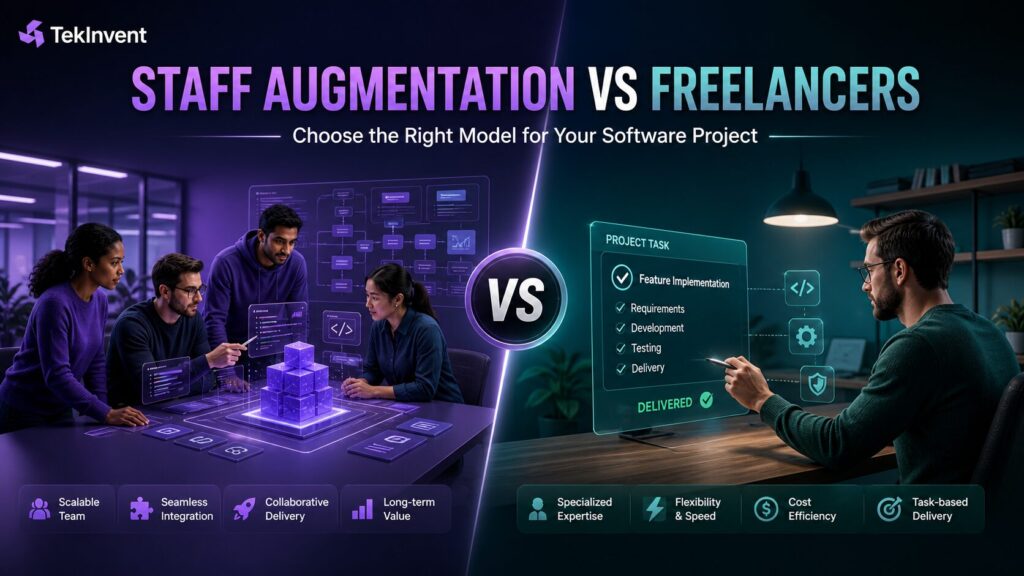
When a software project needs additional expertise, companies often face a practical choice: hire an independent freelancer or add a professional through staff augmentation.
Both models can provide faster access to talent than permanent recruitment. However, they solve different types of hiring and delivery problems.
A freelancer is often suitable for a clearly defined assignment that one person can complete independently. Staff augmentation is generally more appropriate when an external professional must become part of an existing engineering team, contribute to an evolving product roadmap or provide continuity over a longer engagement.
The right choice should not be based on hourly rates alone. Screening effort, availability, team integration, replacement support, intellectual-property protection and delivery risk can have a much greater effect on the final cost of a software project.
This staff augmentation vs freelancers comparison explains how the two models work and helps US companies select the structure that best matches their project.
The Main Difference Between Staff Augmentation and Freelancers
The main difference is the support structure surrounding the professional.
A freelancer is an independent professional engaged directly by the client or through a marketplace. The client usually handles candidate selection, technical evaluation, contracting, onboarding, payment and replacement.
In staff augmentation, a provider sources and screens professionals before presenting them to the client. The selected professional then works within the client’s existing team, tools and development process. The client continues to control priorities, architecture and delivery.
Staff augmentation does not mean outsourcing the entire project. The augmented professional contributes inside the client’s delivery organization rather than completing the project under a separate vendor-managed structure.
This distinction becomes important when the work involves changing priorities, multiple stakeholders or access to important production systems.
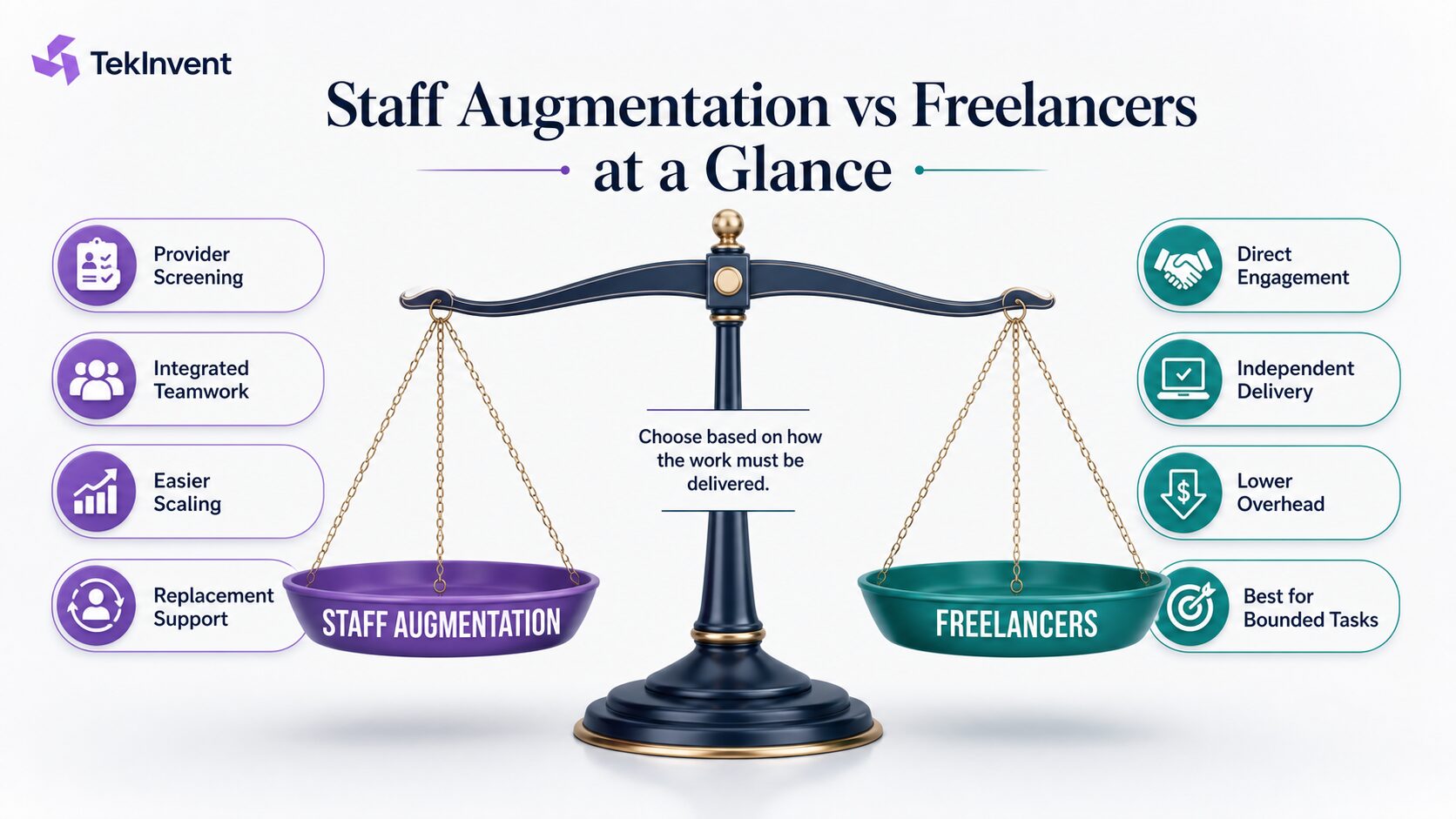
Staff Augmentation vs Freelancers at a Glance
| Decision factor | Staff augmentation | Freelancer |
| Talent sourcing | Provider presents screened candidates | Client or marketplace searches for candidates |
| Technical screening | Provider screening plus client interview | Mainly handled by the client |
| Team integration | Designed for ongoing collaboration | Commonly suited to independent delivery |
| Scalability | Additional roles can be added through one provider | Each new role may require another search |
| Replacement | Often included in provider terms | Client usually finds a replacement |
| Availability | Usually agreed for a defined schedule | May depend on other client commitments |
| Administration | Provider manages much of the engagement administration | Client manages the direct relationship |
| Best use | Integrated, evolving or multi-role work | Bounded work for one specialist |
The exact arrangement will depend on the provider, freelancer, marketplace and contract. Companies should confirm what is included instead of relying only on the name of the model.
When a Freelancer Is Usually the Better Choice
A freelancer is often a practical choice when the assignment has clear boundaries and can be completed by one professional with limited daily supervision.
For example, a company may need a developer to review an existing codebase, create a small integration, improve a landing page or conduct a focused technical assessment. If the inputs, expected output and acceptance criteria are stable, an independent professional can complete the assignment efficiently.
The freelancer model can also work well when the company already knows and trusts the individual. A developer who has successfully completed previous projects may require less screening and onboarding.
Freelancers can offer direct communication and flexible commercial arrangements. For a small task, this simplicity may be more valuable than the additional structure provided by an augmentation company.
However, the client should verify availability before work begins. Freelancers commonly serve multiple clients, which can affect meeting coverage, delivery dates and response times.
The contract should specify the expected working schedule, milestones, revision process, ownership and communication method. Without this clarity, even a small assignment can become difficult to manage.
When Staff Augmentation Is Usually the Better Choice
Staff augmentation is often a stronger fit when the external professional must work closely with an internal product or engineering team.
An augmented developer may participate in sprint planning, daily coordination, code reviews, architecture discussions and releases. The professional works within the company’s existing delivery system while internal managers maintain control of priorities.
This model is especially useful when requirements are expected to change. Product development rarely follows a completely fixed specification, and an integrated professional can respond to new information more easily than someone hired only to complete a predetermined deliverable.
Staff augmentation is also useful when the requirement may grow from one role into a broader team. A company that initially needs a backend developer may later require QA automation, DevOps or data-engineering support. Adding those capabilities through the same provider can reduce repeated sourcing and contracting work.
Businesses using their first provider should carefully choose an IT staff augmentation company based on technical screening, candidate relevance, replacement support and transparent contract terms.
Which Model Provides Better Technical Screening?
With freelancers, screening is normally the client’s responsibility. A marketplace profile may show ratings, project history and reviews, but these signals do not confirm whether someone can work successfully within the company’s production environment.
The client needs to confirm identity, communication, technical experience and availability. The interview should reflect the actual project rather than relying exclusively on generic coding questions.
If a freelancer will work on a multi-tenant SaaS platform, the evaluation might examine tenant isolation, permissions, migration safety and monitoring. A candidate working on a data pipeline should be evaluated on reliability, data quality and recovery from failures.
A staff augmentation provider generally completes an initial screening process before presenting candidates. The provider may verify technical experience, communication, work history and role suitability.
The client should still interview the proposed professional. Provider screening should reduce the number of unsuitable candidates, but it should not replace the client’s evaluation of technical fit and team compatibility.
Ask the provider who conducts technical screening, what the assessment covers and how experience is verified. A long candidate list is not necessarily evidence of a strong recruitment process.
Is a Freelancer Always Less Expensive?
A freelancer may have a lower hourly rate because the client contracts with the professional directly. This can make freelancing financially attractive for small or short assignments.
However, the hourly rate does not represent the complete cost of the engagement.
The client may spend substantial time searching profiles, interviewing candidates, preparing agreements, coordinating work and finding a replacement if the freelancer becomes unavailable. Delayed delivery and management time also have financial value.
Staff augmentation rates normally include provider services such as sourcing, screening, engagement administration and replacement support. The hourly rate may therefore be higher, but the client may spend less internal time assembling and maintaining the team.
The type of expertise also affects pricing. A senior cloud architect, cybersecurity engineer or machine-learning specialist will generally cost more than a developer completing a well-defined interface.
Companies should evaluate the factors behind IT staff augmentation costs before comparing proposals. Location, seniority, technology, schedule and engagement duration can all influence the final rate.
The better question is not “Which option has the lowest hourly price?” It is “Which option provides the required outcome with an acceptable level of cost and delivery risk?”
How the Models Differ in Team Integration
Freelance assignments commonly emphasize independent delivery. The client provides requirements, the freelancer completes the work and the client reviews the result.
This structure can be efficient when dependencies are limited. It becomes more challenging when the professional needs frequent input from product managers, designers, developers, security teams and customers.
Staff augmentation is designed for closer integration. Augmented professionals normally use the company’s backlog, repository, communication tools and code-review process. Their work remains visible to internal team members.
Integration does not mean an augmented developer should be left without direction. The client must assign an internal owner who can explain priorities, answer questions and accept completed work.
Companies can use a structured process to onboard and manage augmented developers so external professionals receive the right product context, system access, feedback and knowledge-transfer expectations.
The onboarding process should explain how technical decisions are made, where documentation is stored and who approves production changes.
Continuity and Replacement Support
Continuity is one of the biggest differences between the two models.
When a freelancer becomes unavailable, the client may need to restart the search, screening and onboarding process. This can interrupt delivery, particularly when the freelancer holds important undocumented knowledge.
A staff augmentation provider may offer replacement support as part of the agreement. If an augmented professional leaves or does not meet expectations, the provider can source another candidate.
Replacement is not free of disruption. A new engineer still needs time to understand the product and codebase. However, having an established provider and replacement process can reduce the time required to restore capacity.
Contract terms should explain when replacement is available, how quickly candidates will be presented and whether additional costs apply.
Regardless of the model, companies should require documentation, code review and shared ownership. No critical system should depend entirely on one external professional.
Scaling From One Professional to Several Roles
A freelancer can be an effective solution when the company needs one specific capability. The administrative burden grows when the requirement expands.
Building a five-person freelance group can involve separate searches, contracts, rates, schedules and onboarding processes. Availability across several independent professionals may also be difficult to coordinate.
Staff augmentation provides a clearer scaling path because one provider can source several related roles. A software company might begin with one backend developer and later add a QA automation engineer and DevOps specialist.
This does not mean the company should add people before defining the work. More professionals will not solve unclear priorities or missing technical leadership.
Each added role should correspond to a measurable delivery constraint. The internal product owner should understand why the role is necessary and how its contribution will be evaluated.
Companies that need a stable cross-functional unit with its own delivery rhythm may also compare staff augmentation vs a dedicated team before selecting their final structure.
Security and Access Must Be Controlled in Both Models
Both freelancers and augmented professionals may require access to source code, customer information, cloud platforms and internal documentation.
The engagement type does not determine whether this access is safe. Security depends on the controls established by the client and the working practices followed by the professional.
Use named accounts instead of shared credentials. Require multifactor authentication and apply least-privilege permissions. Separate development, testing and production environments whenever possible.
Production access should be limited to people who genuinely need it. Changes should pass through the company’s normal review and deployment process.
The agreement should address confidentiality, approved tools, data storage, subcontracting, security incidents and the return or deletion of company information.
Access should be reviewed when responsibilities change and removed promptly at the end of the engagement.
Intellectual-Property Ownership Requires a Written Agreement
Payment does not automatically resolve every intellectual-property question.
The US Copyright Office explains that work-made-for-hire treatment applies in specific circumstances, including qualifying employee work and certain commissioned works covered by a signed agreement. Copyright can also be transferred through written contracts. US Copyright Office
A software agreement should clearly define ownership of source code, designs, documentation, configurations, infrastructure files, datasets and other deliverables.
It should also identify pre-existing components. A freelancer or augmented professional may use libraries, frameworks or tools that cannot be transferred to the client because they are governed by separate licenses.
Important deliverables should be committed to company-controlled repositories rather than stored only on a personal device or account.
The IT staff augmentation contract checklist provides a practical starting point for reviewing ownership, confidentiality, access, termination and knowledge-transfer terms. Companies should adapt the agreement to the selected model and obtain legal advice where required.
Independent-Contractor Classification in the United States
US companies must also consider worker classification when directly engaging freelancers.
The IRS states that classification depends on the facts of the relationship, including behavioral control, financial control and the type of relationship between the parties. Simply describing someone as an independent contractor in an agreement does not determine their legal status. IRS independent-contractor guidance
Federal and state requirements can differ, and classification guidance may change. The US Department of Labor maintains information about employee and independent-contractor classification under the Fair Labor Standards Act. US Department of Labor
Staff augmentation does not automatically eliminate all employment, tax or co-employment considerations. The agreement and actual working practices should reflect the intended relationship.
Businesses should obtain qualified legal and tax advice when classification is uncertain, particularly for long-term or highly controlled engagements.
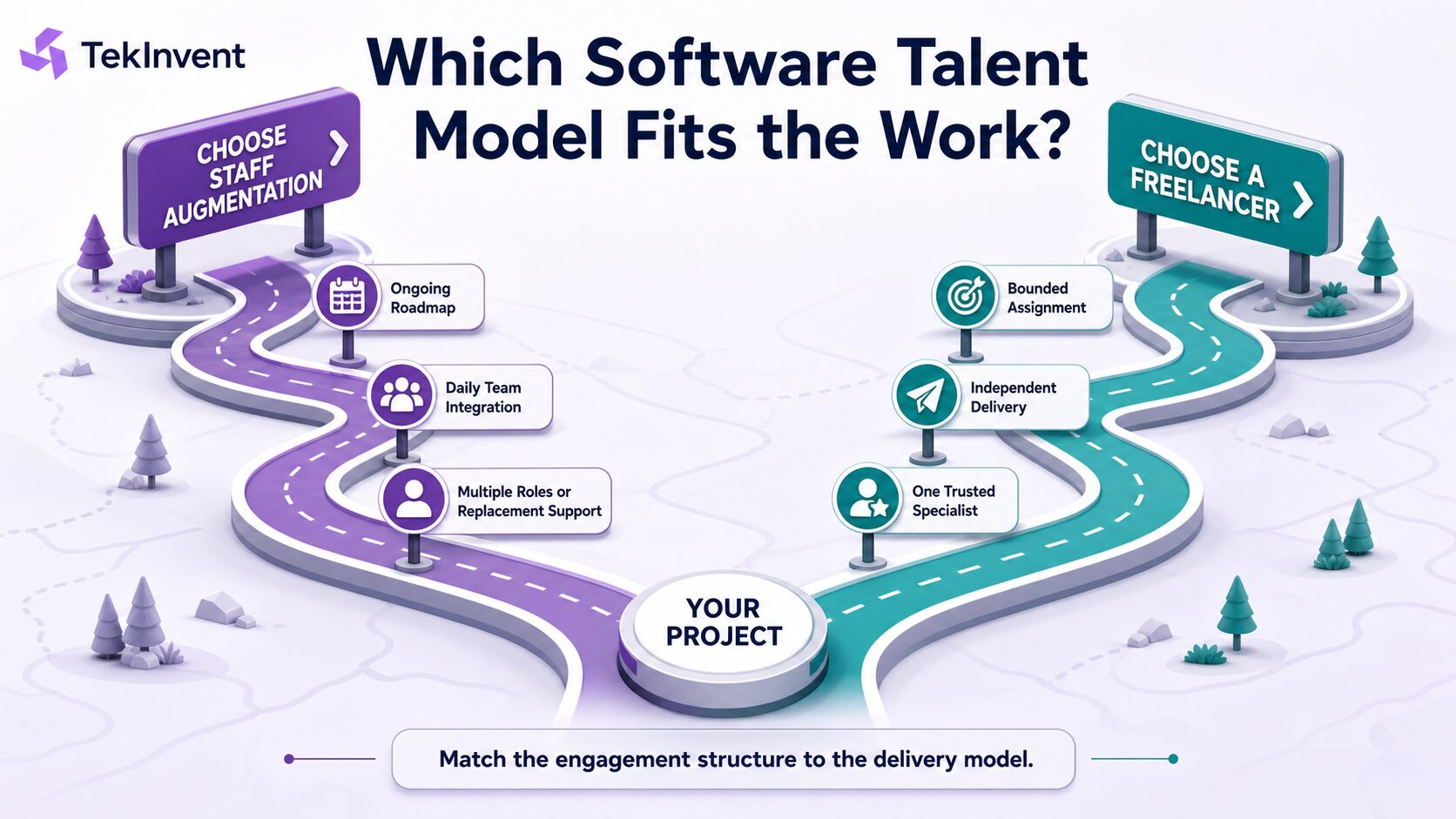
A Practical Decision Framework
Begin by determining how the work must be performed.
A freelancer is likely to be the better choice when the scope is stable, one specialist can complete the assignment, independent delivery is practical and the client is comfortable handling screening and contracting.
Staff augmentation is likely to be the better choice when the professional must join daily engineering workflows, requirements will evolve, continuity is important or the need may expand into several roles.
The following table can help decision-makers apply these conditions to their project.
| Project condition | More suitable model |
| One bounded assignment | Freelancer |
| Stable requirements and clear acceptance criteria | Freelancer |
| Trusted specialist already identified | Freelancer |
| Daily collaboration with an internal team | Staff augmentation |
| Evolving product roadmap | Staff augmentation |
| Multiple engineering roles may be needed | Staff augmentation |
| Provider-backed replacement is important | Staff augmentation |
| Client wants sourcing and screening support | Staff augmentation |
A company should decide on the required engagement structure before comparing individual candidates. Otherwise, an impressive profile may lead the business toward a model that does not fit the work.
How Staff Augmentation Compares With Other Hiring Options
Freelancers and augmented professionals are not the only available choices.
Permanent employees can provide long-term organizational knowledge and ownership, but recruitment may take longer and creates an ongoing employment commitment. The right decision depends on whether the responsibility is temporary or central to the long-term organization. TekInvent’s staff augmentation vs in-house hiring comparison covers these cost, control and continuity considerations in greater detail.
Project outsourcing is another option. With outsourcing, a vendor generally assumes more responsibility for project management and delivery. Staff augmentation keeps management and priorities with the client. Companies unsure about the ownership structure should review the differences between staff augmentation and outsourcing.
Consulting is more appropriate when a business needs analysis, strategic recommendations or transformation leadership. Staff augmentation is usually selected when the company already knows what it wants to deliver but requires additional execution capacity.
These models can also be combined. A consultant might help define the strategy, augmented professionals may implement it and permanent employees can own the resulting system.
Risks to Address Before Choosing Either Model
The first risk is hiring before defining the outcome. A strong developer cannot compensate for unclear priorities or missing product ownership.
The second risk is selecting solely by price. The lowest rate may introduce additional screening, supervision, rework or replacement costs.
The third risk is uncontrolled access. External professionals should receive only the systems and information necessary for their assignments.
The fourth risk is failing to document decisions. Code without documentation or shared ownership can create long-term dependency.
The fifth risk is unclear availability. Confirm working hours, communication coverage and notice requirements before delivery begins.
Companies using an augmentation provider should also understand the broader IT staff augmentation risks, including weak screening, hidden pricing, security exposure and insufficient knowledge transfer.
Starting with a bounded milestone can reduce these risks. The first milestone should use the real development workflow and provide enough evidence to evaluate technical quality, communication and reliability.
Choose the Model That Matches Your Delivery Environment
The decision between staff augmentation vs freelancers is not about declaring one model universally better.
Freelancers can be an efficient option for focused assignments that one trusted professional can complete independently. They provide direct access to specialized talent without the structure or cost of a staffing provider.
Staff augmentation is generally better suited to evolving software products, ongoing collaboration, multi-role scaling and situations where sourcing and replacement support have significant value.
Before choosing, define the outcome, duration, required level of integration and acceptable delivery risk. Then compare the complete engagement value rather than hourly rates alone.
TekInvent’s IT staff augmentation services help US companies add screened technical professionals to existing engineering teams while maintaining control of their roadmap, systems and delivery decisions.
Share your required role, project timeline and preferred working model with TekInvent to receive a tailored talent recommendation.

Build Smart with The Right Team.
We bring expertise, technology, and trust you look for in your digital journey.