
Software teams cannot deliver quickly when environments take weeks to provision, deployments depend on manual steps and production incidents repeatedly interrupt roadmap work. These problems are rarely solved by adding another application developer. They usually require focused expertise in automation, cloud infrastructure, reliability and secure delivery.
DevOps staff augmentation allows a company to add that expertise to its existing engineering organization without waiting through a long permanent hiring cycle. Augmented professionals work within the client’s tools and priorities while the client retains control of architecture, access and delivery.
The model is useful for cloud migrations, CI/CD modernization, Kubernetes adoption, platform engineering and reliability programs. It works best when the company defines a specific operational outcome rather than asking one “DevOps engineer” to fix every infrastructure problem.
Why DevOps and Platform Skills Remain Strategically Important
Cloud-native infrastructure has become a production foundation rather than an experiment. The Cloud Native Computing Foundation reported that 82% of surveyed container users were running Kubernetes in production in 2025. CNCF Annual Cloud Native Survey
AI workloads are adding new infrastructure demands, but conventional software delivery still needs dependable automation, observability and security. The US Bureau of Labor Statistics projects software developer employment to grow 15.8% from 2024 to 2034, adding approximately 267,700 jobs. More software and more frequent changes increase the need for reliable delivery platforms. US Bureau of Labor Statistics
At the same time, cloud complexity can create fragmented tooling and escalating costs. A company may operate several CI systems, inconsistent infrastructure modules and alerts no one trusts. Adding tools without operating discipline makes the environment harder to manage.
The most valuable DevOps professionals therefore do more than configure technology. They simplify delivery, define ownership and create a platform that other engineers can use safely.
What Is DevOps Staff Augmentation?
DevOps staff augmentation is a flexible engagement in which external cloud, platform, automation or reliability professionals join an existing technology team. The client normally manages priorities and approves changes while the augmented specialist contributes hands-on expertise.
One engineer may join to automate infrastructure provisioning. A platform engineer may build reusable deployment paths for several product teams. An SRE may improve incident response and service-level objectives. A larger initiative may combine several roles.
This differs from a managed cloud service in which a provider delivers an ongoing operational function under its own process and service levels. Augmentation preserves closer client control and is often better suited to internal platform change, temporary capacity or specialized delivery work.
When Should a Company Use DevOps Augmentation?
The strongest use case is a valuable delivery or reliability goal blocked by missing expertise. Examples include a cloud migration without an experienced architect, a Kubernetes platform that cannot be operated confidently or a deployment process dependent on one employee.
Other signals include long lead times, frequent failed releases, manual environment creation, unstable infrastructure, excessive cloud spending and repeated incidents with no corrective engineering work.
Augmentation can also bridge a vacancy or accelerate a time-bounded modernization program. It should not be used to avoid internal ownership. Someone inside the organization must remain accountable for production risk, architecture and business priorities.
DevOps Roles That Can Be Augmented
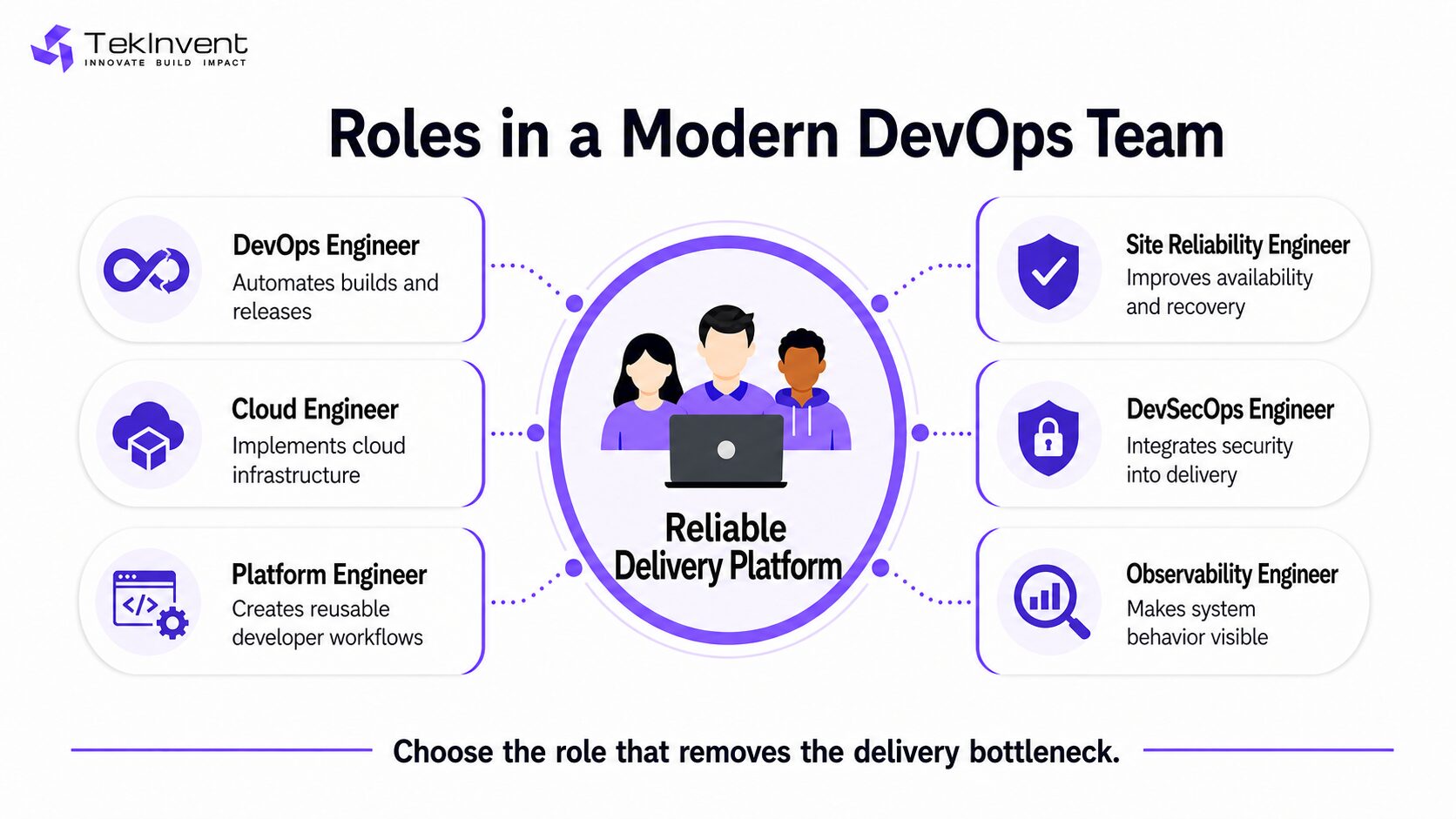
The term DevOps covers several distinct responsibilities. Selecting a precise role improves candidate quality and prevents unrealistic expectations.
| Role | Main responsibility | Best used for |
|---|---|---|
| DevOps engineer | Automates builds, releases and infrastructure workflows | Improving CI/CD and reducing manual delivery work |
| Cloud engineer | Implements cloud infrastructure and services | Migration, expansion and environment modernization |
| Platform engineer | Creates reusable internal platforms and developer workflows | Supporting multiple product teams consistently |
| Site reliability engineer | Improves reliability through engineering, measurement and automation | Availability, incident response and operational resilience |
| Kubernetes engineer | Designs and operates container orchestration environments | Container migration and production cluster maturity |
| DevSecOps engineer | Integrates security controls into software delivery | Secure pipelines, artifacts and vulnerability management |
| Observability engineer | Improves metrics, logs, traces and actionable alerts | Faster diagnosis and reduced monitoring noise |
| FinOps-focused cloud engineer | Connects technical usage with cloud-cost accountability | Cost visibility, waste reduction and capacity planning |
Some companies need a combination. A Kubernetes program may require a cloud architect for foundational design, a platform engineer for developer experience and an SRE for production reliability.
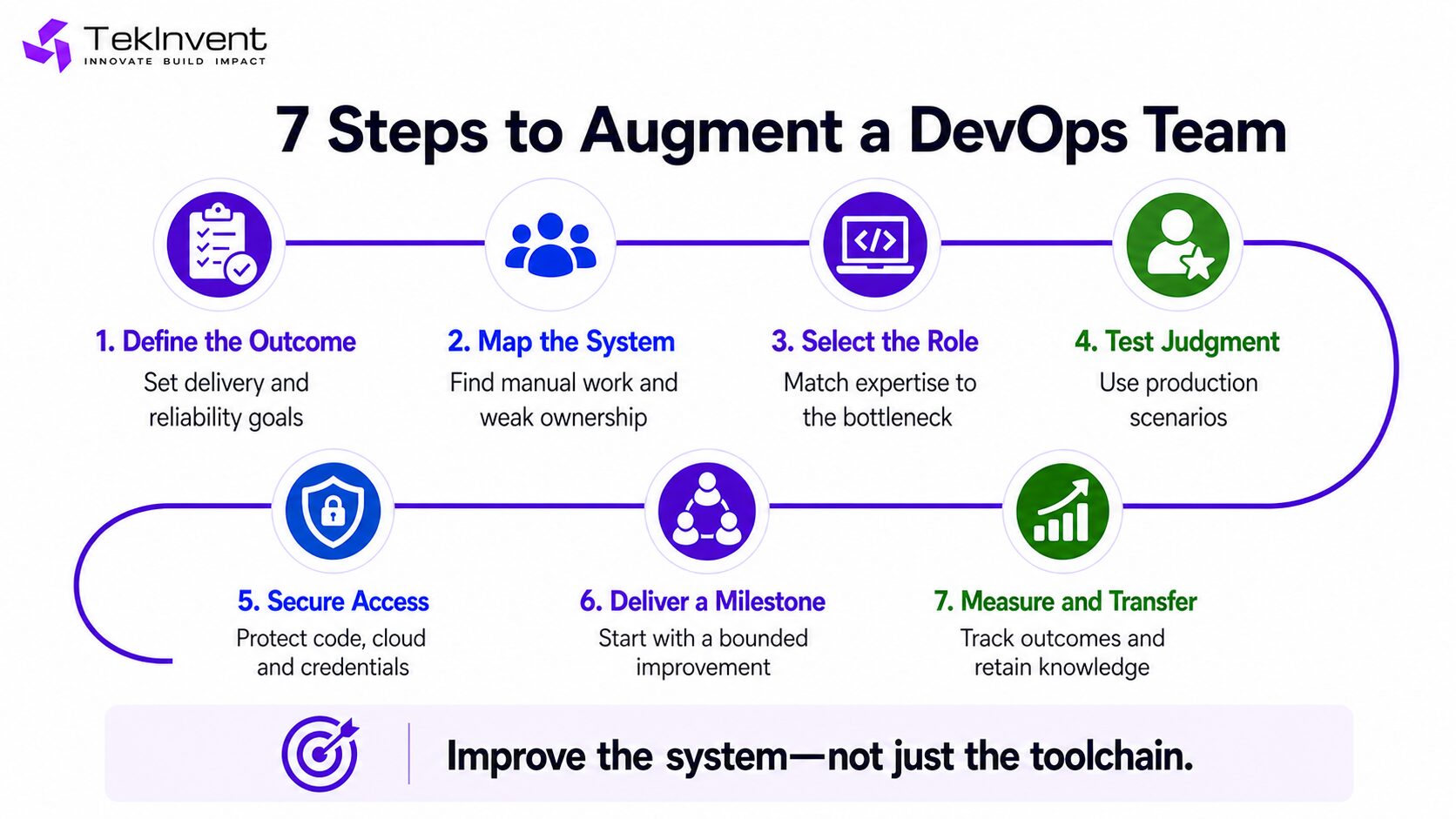
A Seven-Step DevOps Augmentation Process
1. Define the Delivery or Reliability Outcome
Start with a measurable problem. “Improve DevOps” is not an outcome. “Reduce production deployment lead time from three days to two hours while preserving approval controls” is specific enough to guide hiring and implementation.
Record current performance, expected improvement, deadlines and constraints. Include availability, security, recovery and cloud-cost requirements where relevant.
A clearly defined outcome also improves candidate evaluation. Instead of searching broadly for someone familiar with cloud tools, the company can look for a specialist who has solved a comparable delivery or reliability problem.
2. Map the Current Delivery System
Document source control, builds, testing, artifacts, infrastructure, deployment, monitoring and incident response. Identify manual handoffs, duplicated tools and unclear ownership.
This map helps reveal whether the gap is primarily automation, architecture, platform design, reliability or security. It also prevents hiring a candidate based only on a tool name.
The assessment should include the people involved in delivery. A technical bottleneck may originate from an approval process or unclear responsibility rather than a missing automation tool.
3. Select the Correct Role and Location Model
Define the work the specialist should complete in the first 30, 60 and 90 days. Specify required production environments, on-call expectations, collaboration hours and access constraints.
Location affects coverage and collaboration. US companies evaluating aligned working hours and regional talent can review nearshore staff augmentation. For a broader comparison, use the guide to onshore vs nearshore vs offshore staff augmentation.
The engagement brief should distinguish essential requirements from preferences. For example, production experience with AWS and Terraform may be essential, while experience with a specific monitoring tool may be transferable.
4. Test Production Judgment
Use scenarios drawn from the real environment. Ask a candidate how they would make a deployment reversible, respond to a failing infrastructure change or introduce Kubernetes without transferring every operational burden to product developers.
Strong candidates explain tradeoffs and failure modes. They should discuss rollback, state, secrets, permissions, observability and recovery rather than presenting automation as a collection of scripts.
Review examples of documentation and cross-team work. Platform changes affect many people, so communication and adoption are central to the role.
A capable engineer should also recognize when a simpler solution is appropriate. Introducing a complex orchestration platform for a small workload may increase operational risk instead of reducing it.
5. Establish Secure Access and Change Controls
DevOps professionals may receive access to source code, cloud accounts, deployment credentials and production systems. Use named accounts, multifactor authentication, least privilege, auditable elevation and protected secrets.
NIST’s Secure Software Development Framework organizes practices around preparing the organization, protecting software, producing well-secured software and responding to vulnerabilities. NIST’s DevSecOps work demonstrates how security can be integrated into cloud delivery through automation, continuous feedback and security as code. NIST DevSecOps Practices
The specialist should follow the same review and change process as authorized internal personnel. Emergency access should be time-limited and logged.
Access rights should also be reviewed when responsibilities change. An engineer who needed production access during migration may not require the same permissions once the platform enters normal operation.
6. Deliver a Bounded Improvement First
Select an initial milestone that produces value and tests collaboration. It could be automating one environment, moving one service to a standardized pipeline or introducing service-level indicators for a critical application.
Avoid beginning with a company-wide rewrite. A bounded milestone exposes real constraints and provides evidence before the engagement expands.
The first result should be large enough to demonstrate production judgment but small enough to reverse or adjust if the approach requires refinement.
7. Measure Adoption and Transfer Knowledge
Track whether the platform improves delivery and reliability for its users. Relevant measures include lead time, deployment frequency, change failure rate, recovery time, provisioning time, availability and cloud cost.
Documentation should cover architecture, infrastructure modules, deployment procedures, alerts, recovery and ownership. Pair augmented specialists with internal engineers so knowledge transfer occurs throughout delivery.
A platform improvement has limited value if developers cannot use it confidently. Adoption, support requests and developer feedback should therefore be measured alongside technical performance.
What Should a DevOps Engineer Improve First?
Priorities depend on the organization’s bottleneck. A team with fragile deployments may begin with repeatable builds, versioned artifacts and rollback. A company with inconsistent cloud environments may prioritize infrastructure as code and reusable modules.
When incidents dominate engineering time, observability and service ownership may create more value than a new deployment platform. If cloud spending is rising without clear accountability, tagging, cost allocation and capacity review may be the first milestone.
The goal is not to adopt every modern tool. It is to remove the constraint that most limits safe delivery.
Teams can identify that constraint by reviewing recent deployments, incidents and delays. If releases are slow because environments are unavailable, provisioning may be the priority. If releases are fast but frequently fail, testing and rollback may deserve attention first.
DevSecOps Must Be Part of the Design
Security checks added only before release create delays and conflict. DevSecOps integrates security into planning, development, build, testing, release and operations.
NIST emphasizes practices including automated testing, continuous monitoring, vulnerability management, security as code and least-privilege access. These practices should be adapted to the organization’s risks rather than treated as a tool checklist.
An augmented specialist should help teams create controls developers can understand and use. A pipeline that produces too many false positives or requires constant exceptions will eventually be bypassed.
Security requirements should be documented before tooling decisions are made. Organizations handling healthcare, financial or other regulated information may require additional controls, approvals and evidence.
How Much Does DevOps Staff Augmentation Cost?
Rates vary with seniority, location, cloud platform, on-call requirements and production complexity. A senior platform architect or SRE handling critical systems will generally cost more than an engineer implementing a well-defined pipeline.
Compare total value rather than hourly rate. Consider sourcing speed, onboarding, management effort, rework, downtime risk and the cost of delaying product delivery.
The guide to IT staff augmentation costs explains the broader factors affecting engagement pricing. A financial evaluation should also connect delivery improvement with staff augmentation ROI.
Before comparing proposals, define which expenses are included. Cloud accounts, software licenses, after-hours coverage, travel and additional specialist support can affect the total engagement cost.
A lower hourly rate may not create savings if the engineer requires extensive supervision or introduces infrastructure the internal team cannot maintain. Experience relevant to the company’s actual environment often matters more than rate alone.
Is cloud or platform work blocking your product roadmap? TekInvent can help define the required DevOps role and assemble specialists aligned with your environment and delivery schedule.
How to Manage Augmented DevOps Professionals
Assign an internal owner with authority to resolve priorities and approve risk. Include the professional in architecture reviews, sprint planning and relevant incident analysis.
Define communication coverage, escalation paths and on-call responsibilities before production work begins. Do not assume time-zone overlap or emergency coverage from a standard development schedule.
The guide to manage augmented teams provides a practical framework for access, ownership, feedback and knowledge transfer during onboarding.
Augmented specialists should work through the same backlog and documentation systems used by internal engineers. Creating a separate workflow for external team members can hide dependencies and make handover more difficult.
Regular technical reviews allow the company to verify that infrastructure decisions remain aligned with business requirements, security expectations and the skills of the permanent team.
Common Mistakes to Avoid
The first mistake is expecting one engineer to cover cloud architecture, security, databases, Kubernetes, networking, developer experience and 24-hour operations. Separate essential responsibilities and build complementary roles when needed.
The second is measuring success through tooling. Installing a CI platform or observability product is not an outcome. Measure whether teams deploy more safely, recover faster and spend less time on manual work.
The third is automating a broken process without simplifying it. Automation can make poor decisions happen faster. Remove unnecessary approvals, duplicated pipelines and unclear ownership before encoding them.
Another mistake is treating DevOps as a support function disconnected from product delivery. Platform professionals need to understand developer workflows and business priorities to create solutions teams will adopt.
Companies should also avoid starting a large migration without rollback criteria. A migration plan should explain how workloads will be validated, how failures will be contained and when the organization will pause or reverse a change.
Finally, avoid external dependency. Infrastructure, runbooks, credentials and architectural decisions must remain accessible to the client.
DevOps Augmentation vs Permanent Hiring
Permanent hiring is often appropriate when platform engineering is a long-term core capability with continuous work. Augmentation works well for urgent gaps, specialist migrations and defined modernization phases.
| Factor | DevOps augmentation | Permanent hiring |
|---|---|---|
| Start time | Often faster | Requires a complete recruitment cycle |
| Flexibility | Can match a project phase | Creates a long-term commitment |
| Specialization | Targets exact platform experience | Supports lasting internal ownership |
| Control | Client directs delivery | Employer directs delivery |
| Knowledge retention | Requires deliberate transfer | More likely to remain internally |
| Scaling | Capacity can change with project requirements | Additional recruitment is needed |
A hybrid approach can combine internal platform ownership with augmented specialists who accelerate implementation and mentor the permanent team.
For example, an internal platform leader may define standards while augmented cloud and Kubernetes engineers implement the migration. As the engagement progresses, permanent employees can take over operations using the documentation and training created during delivery.

Build Smart with The Right Team.
We bring expertise, technology, and trust you look for in your digital journey.