
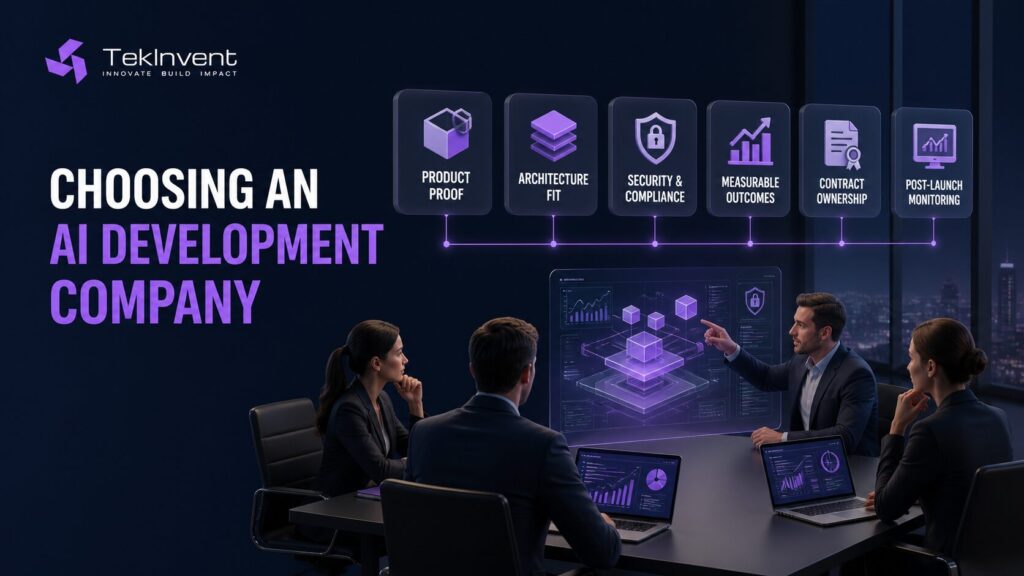
Choosing an AI development company is no longer a decision based on who can connect an application to the latest model.
Modern AI products must operate with real users, private information, business integrations, unpredictable inputs, evolving models, and measurable performance requirements. A polished demonstration may prove that a model can generate an answer, but it does not prove that the vendor can deliver a secure and dependable product.
The right partner should understand the business problem before recommending technology. It should be able to demonstrate production engineering, data governance, evaluation discipline, security, transparent ownership, and post-launch operations.
This guide explains how to choose an AI development company that can move a product beyond experimentation and into controlled business use.
Define the Outcome Before Comparing Companies
Vendor selection becomes difficult when the project itself is unclear.
Before requesting proposals, define who will use the product, which workflow it should improve, what information it needs, and what measurable result should change.
“Build an AI assistant” is too broad for a useful estimate. A clearer objective might be reducing the time employees spend locating approved compliance information while maintaining document-level permissions.
The project brief should explain the current process, intended users, essential integrations, required platforms, data sensitivity, risk tolerance, expected usage, and success metrics.
A strong development partner will challenge vague assumptions during discovery. A weak vendor may accept every requested feature without determining whether it contributes to the intended outcome.
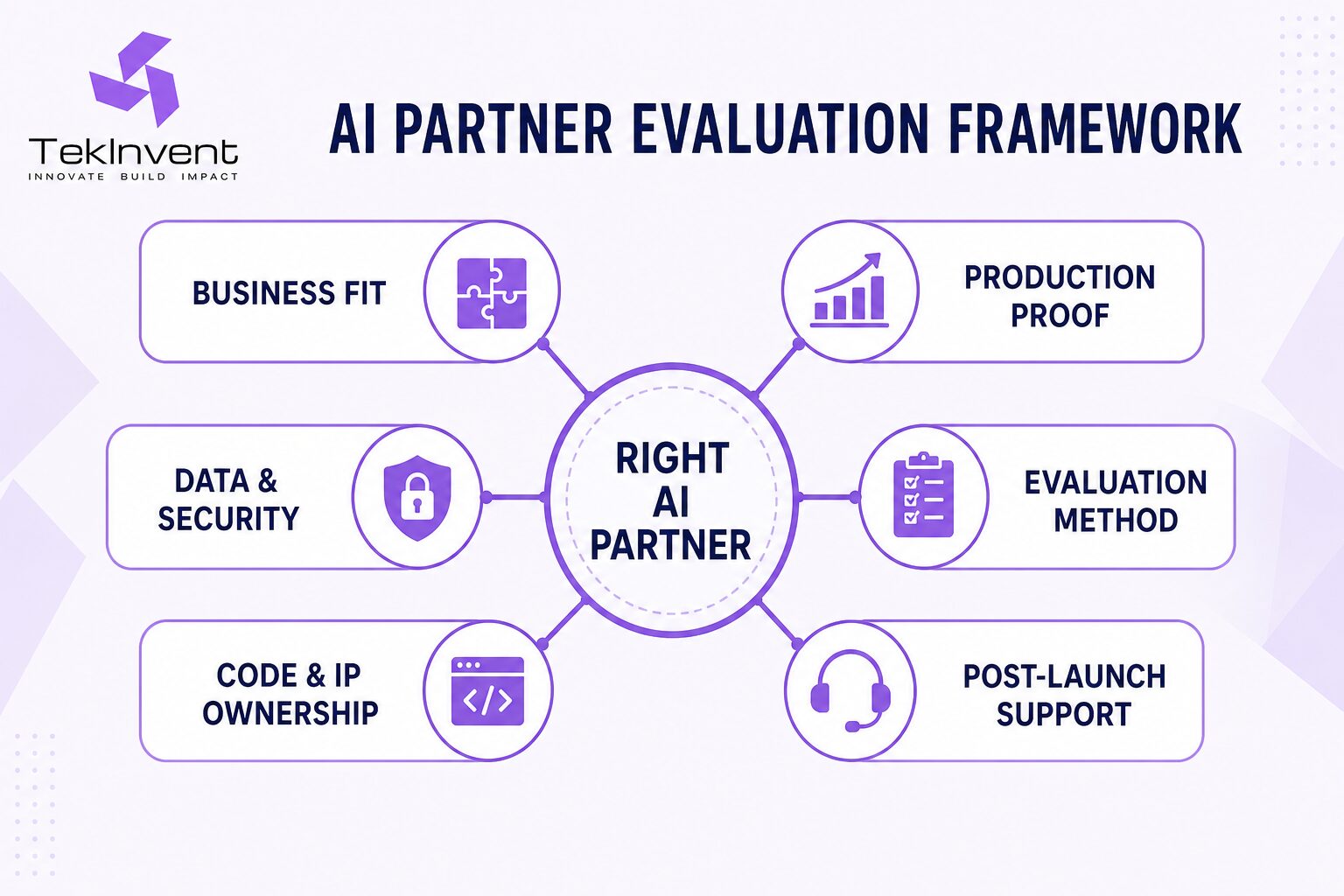
Look for Production Proof, Not Demo Volume
A company can create dozens of model demonstrations without having experience operating AI in production.
Ask for examples that reached real users. The company should explain the original problem, architecture, data sources, evaluation method, security requirements, and measurable outcome.
A credible case study should also discuss limitations and lessons learned. AI systems are not perfect, and experienced teams understand how to identify, manage, and communicate failure modes.
The case studies presented by a development company should provide evidence of complete product delivery rather than only attractive interface designs.
When client confidentiality prevents detailed disclosure, the vendor should still be able to describe its process, responsibilities, technical decisions, and results without exposing protected information.
Evaluate Business and Product Thinking
The strongest AI partner thinks like a product team, not an order-taking development resource.
It should ask why the workflow requires AI, whether a simpler solution would be more dependable, and which assumptions need to be tested first.
The company should help separate prototype requirements from production requirements. It should recommend a focused MVP that validates one valuable journey rather than expanding the first release into an unmanageable platform.
Ask how the proposed feature will change the user’s existing workflow. Determine how employees will review uncertain results, correct errors, and escalate important decisions.
A vendor focused entirely on model selection may overlook the interface, adoption, operational change, and measurement required to create business value.
Examine the Technical Architecture
An AI product includes considerably more than prompts and model calls.
The company should demonstrate capability across backend development, databases, APIs, cloud infrastructure, authentication, permissions, observability, and user-interface engineering.
Ask how the architecture will respond if a model provider becomes unavailable, changes its pricing, or no longer meets the product’s quality requirements. A flexible model layer can reduce unnecessary dependency on one vendor.
The team should explain when it would use generative AI, traditional machine learning, retrieval, rules-based software, or a combination of approaches.
TekInvent’s software development company capabilities reflect the broader engineering foundation required to connect intelligent features with scalable applications and business systems.
Review the Data Strategy
Data is often the most valuable and sensitive component of an AI product.
The vendor should explain what information the system requires, where it will be processed, how it will be protected, and whether it will be retained by third-party model providers.
Ask how documents or records will be cleaned, versioned, updated, and removed. Determine how permissions from the source system will be carried into the AI application.
The company should not request unrestricted access to every data source before defining a legitimate need. Data minimization reduces security exposure and simplifies governance.
If the project uses customer, employee, healthcare, or financial information, the proposal should clearly address encryption, access controls, audit logs, retention, deletion, and incident response.
Require a Real Evaluation Method
An AI company should be able to explain how it will know whether the system works.
Testing a few manually selected prompts is not sufficient. The project needs a representative evaluation dataset containing common requests, difficult cases, ambiguous language, missing information, unsafe instructions, and expected refusals.
The evaluation metrics should match the workflow. A knowledge assistant may need factual accuracy and citation support. A predictive model may need precision, recall, and segmented performance. An agent may need tool-selection accuracy, valid arguments, completion rate, and approval compliance.
Ask whether failed production cases will become regression tests. Determine how the team will evaluate a model, prompt, retrieval, or data change before releasing it.
A vendor without an evaluation plan is effectively asking the business to discover failures through customer complaints.
Investigate Security and AI-Specific Risks
Conventional application security remains essential, but AI introduces additional risks.
Prompt injection may attempt to manipulate the system through user input or retrieved documents. A model may expose sensitive information, generate unsafe content, or request an unauthorized action.
The vendor should enforce permissions in application code rather than trusting the model to follow a written instruction. Model-generated tool inputs should be validated before reaching a business system.
Actions involving payments, records, customer communication, or important decisions should include clear approval requirements and audit trails.
Ask how the team performs threat modeling, access-control testing, security reviews, logging, and incident management. Security should be part of the architecture from the beginning, not an optional feature added before launch.
Understand the Proposed Team
Ask who will actually work on the project.
A credible team may include a product lead, AI or machine-learning engineer, data engineer, software engineers, UX designer, quality-assurance specialist, and security support.
The exact combination depends on scope, but the proposal should identify responsibilities and senior oversight.
Be cautious when a company presents an experienced leadership team during sales but plans to assign an entirely different delivery team after the contract is signed.
Ask how often specialists will be available, who owns technical decisions, and who will communicate progress and risks.
Compare Pricing Through Scope and Deliverables
The lowest quote is not always the lowest-cost path to production.
Compare what each proposal includes. One estimate may cover a visual prototype, while another includes authentication, data pipelines, integrations, evaluation, cloud deployment, documentation, and post-launch support.
Each project phase should have identifiable deliverables, assumptions, dependencies, and acceptance criteria.
Fixed-price work is suitable when scope is clear. Time-and-materials pricing may be more appropriate when discovery or experimentation must resolve significant uncertainty. Either approach can work when reporting and decision rights are transparent.
The vendor should also estimate post-launch costs, including model usage, cloud infrastructure, monitoring, maintenance, and support.
Clarify Code, Data and Intellectual-Property Ownership
Ownership should be agreed before development begins.
The contract must identify who owns the application code, prompts, evaluation datasets, model configurations, data pipelines, designs, documentation, and infrastructure setup.
Determine whether the business will receive access to source-code repositories, cloud accounts, deployment instructions, and operational documentation.
Ask whether the solution depends on proprietary vendor components that cannot be transferred. A dependency may be acceptable, but it should be visible and priced clearly.
The business should also understand how its data may be used. Project information should not be reused for another client or model-training purpose without explicit authorization.
Plan for Post-Launch Operations
AI products require continuous attention after release.
The company should explain how it will monitor quality, unsupported answers, model usage, latency, costs, security events, and integration failures.
Ask who responds when performance declines or a provider changes its model. Determine how updates will be evaluated and released.
Post-launch support should include response expectations, escalation contacts, maintenance responsibilities, and knowledge transfer to the internal team.
A partner that treats deployment as the end of the project may leave the business without the processes needed to operate the product safely.
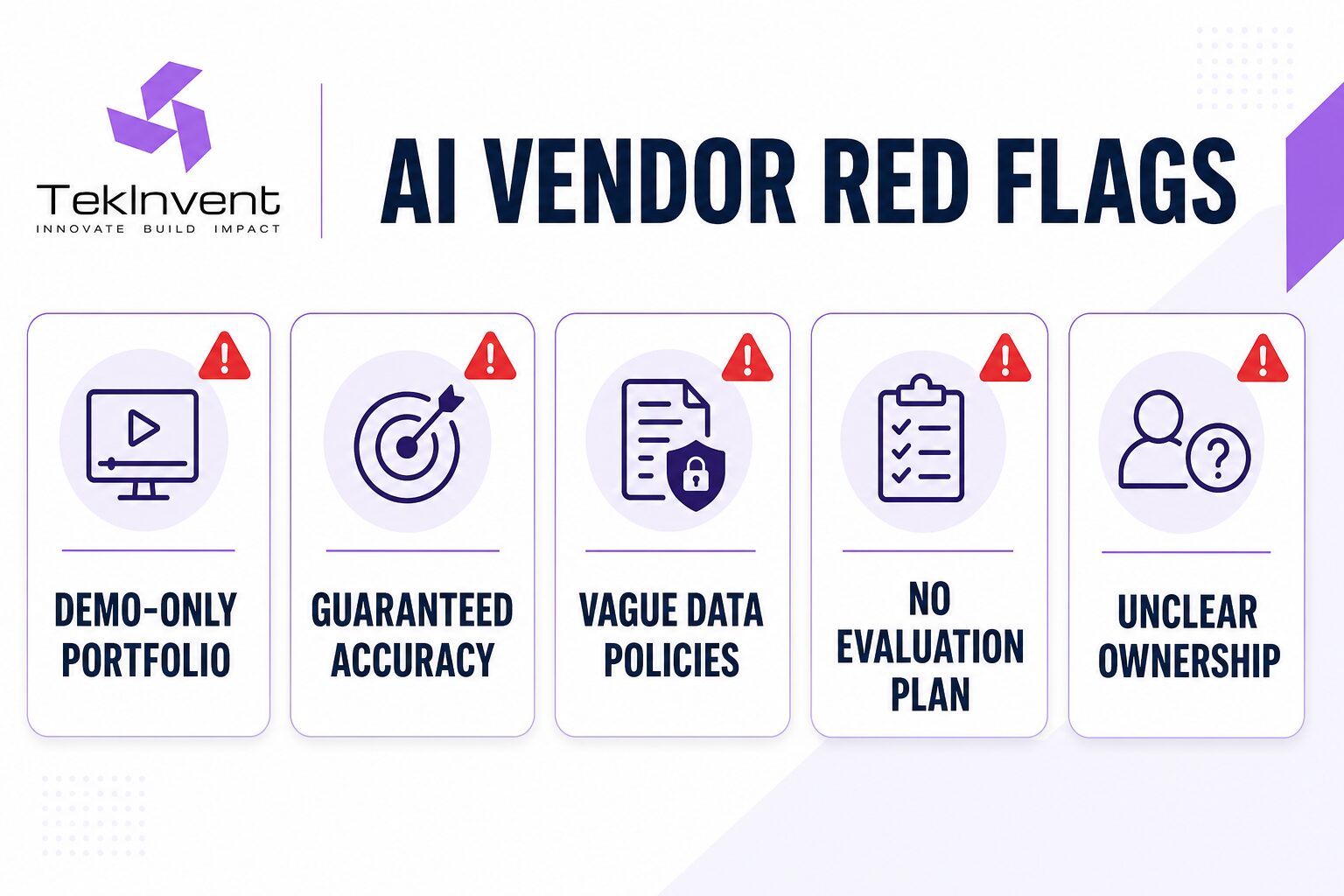
Watch for AI Vendor Red Flags
A demo-only portfolio is one of the clearest warning signs. Other concerns include guaranteed accuracy before discovery, vague answers about data retention, no evaluation methodology, and unclear ownership terms.
Be cautious when a vendor recommends a particular model for every project or cannot explain when AI is unnecessary.
A proposal should not hide operating costs behind a low development estimate. Similarly, a company should not promise an aggressive timeline without examining the data, integrations, and approval process.
Responsible teams describe uncertainty honestly. They show how it will be tested rather than hiding it behind confident marketing language.
Run a Focused Discovery Engagement
When the project is complex, begin with a limited discovery engagement before committing to full development.
This phase should clarify the problem, users, data, technical feasibility, risks, architecture, MVP scope, timeline, and budget.
At the end of discovery, the business should receive useful artifacts even if it decides not to continue with the same partner.
A focused engagement also reveals how the company communicates, responds to uncertainty, documents decisions, and collaborates with stakeholders.
Choosing a Partner for the Intelligence Layer Ahead
The right development partner does more than produce AI features. It creates the engineering, evaluation, and operational foundation that allows those features to earn trust.
A strong partner will connect model capability with a valuable workflow, protect the organization’s data, make quality measurable, and leave ownership transparent. It will design for model change rather than locking the product to whichever tool is currently popular.
This standard helps the business complete its selection journey with evidence instead of sales promises. The chosen team should be capable of taking responsibility from discovery through production monitoring while giving the organization lasting control over its product, data, and future direction.

Build Smart with The Right Team.
We bring expertise, technology, and trust you look for in your digital journey.