

Artificial intelligence, machine learning, and generative AI are frequently discussed as though they are interchangeable. They are closely connected, but they do not describe the same technology.
Artificial intelligence is the broad field of creating systems capable of performing tasks associated with human intelligence. Machine learning is a method within AI that enables systems to learn patterns from data. Generative AI is a specialized area that can produce new content, including text, images, audio, video, and software code.
Understanding these differences is essential before investing in an intelligent product. A business trying to forecast customer demand may need machine learning, while an organization that wants to summarize documents may benefit from generative AI. Another workflow may only require rules-based automation rather than either approach.
This guide compares AI vs machine learning vs generative AI, explains how they are connected, and helps businesses determine which technology best fits their requirements.
What Is Artificial Intelligence?
Artificial intelligence is the broadest concept of the three. It refers to computer systems designed to perform tasks that generally require human intelligence.
These tasks may include understanding language, recognizing objects, solving problems, making recommendations, planning actions, or interpreting complex information. An AI system does not necessarily need to learn from data. It may use predefined rules, search methods, optimization techniques, knowledge representations, or machine-learning models.
For example, a route-planning system can evaluate possible paths and select an efficient option. A rule-based fraud system may flag a transaction when specific conditions are met. A game character may use programmed logic to respond to a player’s actions.
These are examples of artificial intelligence, even if they do not use modern generative models.
AI is therefore an umbrella term. Machine learning and generative AI operate within this broader field.
What Is Machine Learning?
Machine learning is a branch of artificial intelligence that allows systems to identify patterns from data and use those patterns to make predictions or classifications.
Instead of writing a separate rule for every possible situation, developers provide data and create a process through which the model can learn relevant relationships.
Consider an e-commerce business trying to predict which customers may stop purchasing. A machine-learning model can analyze historical behavior, order frequency, customer-service activity, and other permitted data. It can then estimate the likelihood that an active customer will leave.
The model does not understand customer loyalty as a person does. It identifies statistical patterns connected with previous outcomes.
Machine learning is commonly used for demand forecasting, fraud detection, recommendation systems, predictive maintenance, customer segmentation, risk scoring, and quality inspection.
Its success depends heavily on data quality. If historical information is incomplete, inaccurate, outdated, or unrepresentative, the resulting predictions may also be unreliable.
What Is Generative AI?
Generative AI is designed to create new content based on patterns learned from existing data. It can produce text, images, audio, video, computer code, designs, and other forms of content.
A generative AI system may summarize a report, draft a customer response, create a product description, produce an image, translate text, or help a developer understand code.
Large language models are one form of generative AI. They process language and generate responses by predicting likely sequences based on their training, system instructions, and any additional context supplied by an application.
The word “generate” is important. Traditional machine learning often predicts a category, probability, or numerical value. Generative AI creates a new output.
That output may sound confident without being accurate. Businesses must therefore connect generative models with trusted information, evaluation systems, security controls, and human oversight.
How Are AI, Machine Learning and Generative AI Connected?
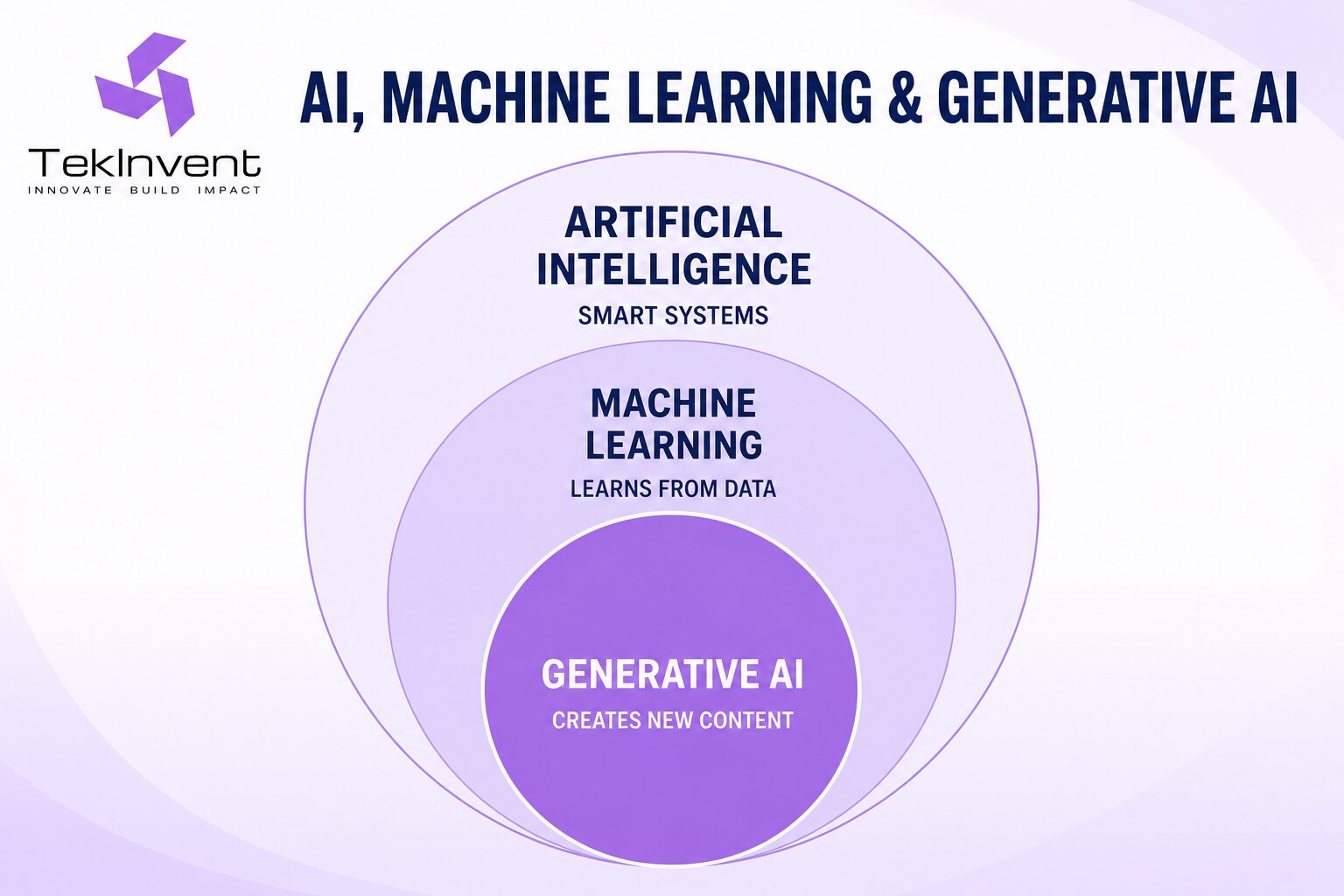
The simplest way to understand the relationship is to imagine nested categories.
Artificial intelligence is the largest category. It includes any computer system designed to perform an intelligent task.
Machine learning exists within artificial intelligence. It describes approaches that learn patterns from data rather than relying entirely on rules programmed by developers.
Generative AI is a more specialized area that commonly uses machine-learning models to create new content.
This means that generative AI is a form of artificial intelligence, but not every AI system is generative. Machine learning is also part of AI, but not every AI application must use machine learning.
The technologies may also operate together within one product. A customer-service platform could use conventional AI rules to route requests, machine learning to predict escalation risk, and generative AI to prepare a response for employee approval.
AI vs Machine Learning: What Is the Difference?
The main difference between artificial intelligence and machine learning is scope.
AI describes the overall goal of building systems that perform intelligent tasks. Machine learning describes one method used to achieve that goal.
A rules-based expert system can be considered AI because it uses encoded knowledge to make decisions. However, it is not machine learning because it does not discover patterns by learning from data.
Machine learning is particularly valuable when developers cannot realistically define every rule themselves. Fraud detection is a good example. Suspicious behavior can involve complex relationships across transaction amounts, locations, devices, timing, and account history.
A machine-learning model can analyze these relationships and estimate risk. It still requires careful training, evaluation, monitoring, and human review, especially when its decisions affect customers.
Machine Learning vs Generative AI
Machine learning and generative AI differ mainly in the kind of output they are designed to produce.
Traditional machine-learning systems are frequently used to predict or classify. They might estimate next month’s sales, identify whether an image contains a defect, or calculate the probability that a transaction is fraudulent.
Generative AI creates new material. It can prepare a written summary, generate an illustration, restructure a document, or produce software code.
The distinction is not absolute because generative AI is built using machine-learning methods. However, it remains useful from a business perspective.
If the desired result is a forecast, category, score, or recommendation based on historical data, traditional machine learning may be the better choice. If the desired result is newly generated language, imagery, audio, or code, generative AI is more relevant.
The technologies can complement each other. A machine-learning model may detect that a customer is at risk of leaving, while a generative model prepares a personalized retention message for employee review.
How the Development Process Differs
AI, machine learning, and generative AI projects share a need for clear objectives, quality data, secure engineering, and realistic evaluation. Their development requirements still differ.
A rules-based AI system requires developers and subject-matter experts to define the knowledge, conditions, and decisions governing its behavior. Its outputs can often be tested against exact expected results.
A machine-learning project requires historical data connected to a measurable outcome. Developers must prepare that data, select useful features, train the model, validate its performance, and monitor whether predictions lose accuracy over time.
A generative AI project may begin with an existing foundation model instead of training one from the beginning. Much of the work involves instructions, context management, retrieval, integrations, safety controls, and evaluation.
The technology selected for any of these approaches should follow the business requirements. Model popularity alone is not a sufficient reason to choose an architecture.
Choosing AI for Business Automation
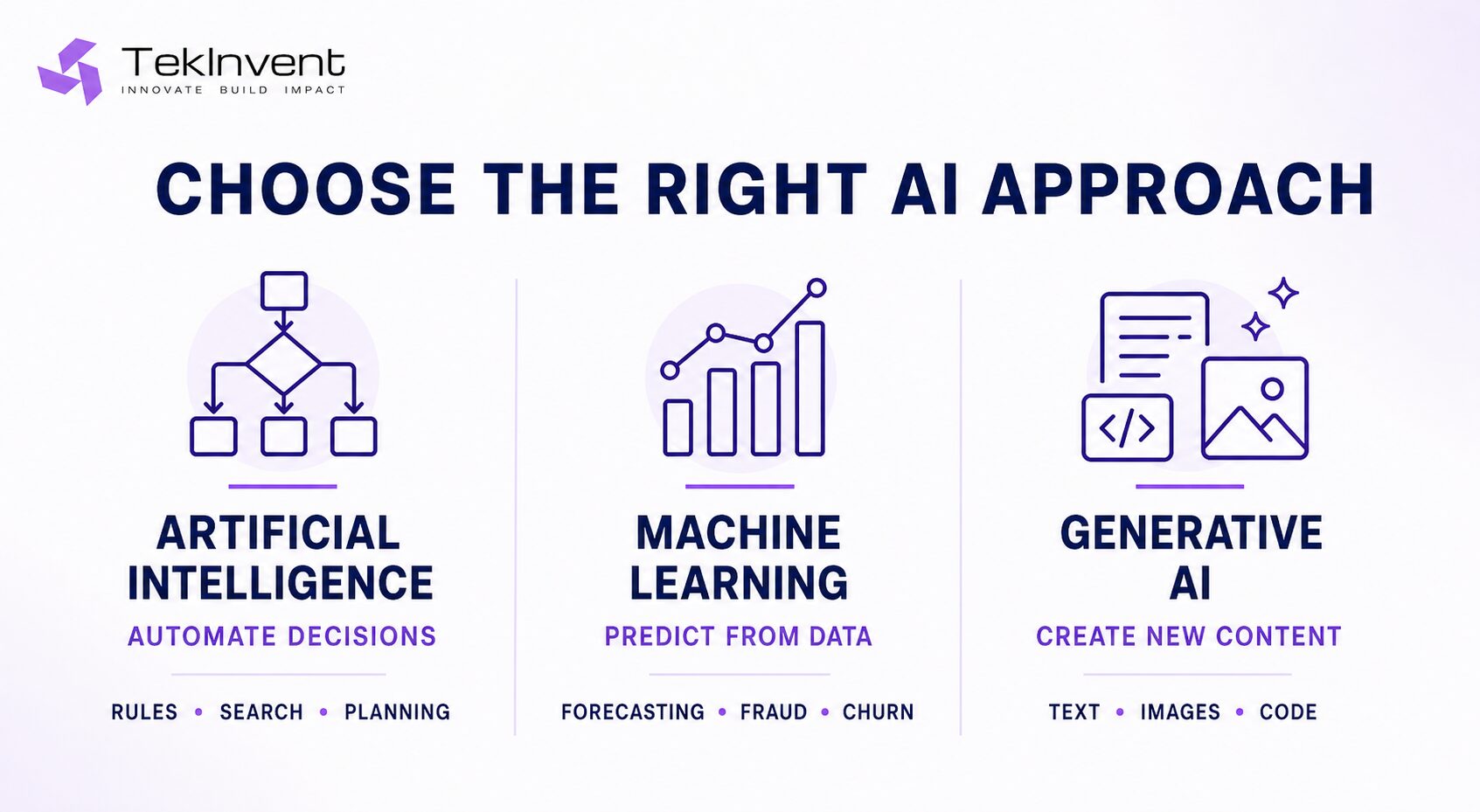
Broad AI techniques can be useful when a business needs software to make controlled decisions, search through possibilities, plan actions, or follow encoded knowledge.
A logistics platform might calculate an efficient delivery route using optimization techniques. A game may use programmed intelligence to control characters. An internal system could apply business rules to route approvals.
These projects do not necessarily require large amounts of training data or a generative model.
When a workflow is stable and every acceptable action can be defined, conventional software may still be the safest and most economical solution. Responsible technology selection includes recognizing when AI adds unnecessary complexity.
Choosing Machine Learning for Prediction
Machine learning is suitable when a business has relevant historical data and needs to predict an outcome, identify a pattern, or classify new information.
Potential projects include forecasting inventory demand, identifying customer churn, detecting suspicious transactions, predicting equipment maintenance requirements, and recommending products.
The desired result must be measurable. The organization should know what a correct prediction means and how the model will be evaluated.
Data also needs to represent the environment in which the system will operate. A model trained on one customer group, region, or period may perform poorly when circumstances change.
For a fintech product, machine learning may support fraud detection or risk analysis. However, important financial decisions require strong governance, explainability, security, and qualified human oversight.
Choosing Generative AI for Content and Knowledge
Generative AI is valuable when a workflow involves producing, transforming, or summarizing content.
A business might create a knowledge assistant that answers questions from approved documents, a tool that prepares report drafts, or a support feature that summarizes customer conversations.
Generative AI can also make software interfaces more flexible because users can communicate through natural language instead of navigating a fixed sequence of options.
This flexibility introduces risk. A generative model may misunderstand a request, produce unsupported information, or reveal data if permissions are poorly implemented.
The application should therefore limit the system to a clearly defined purpose. It should retrieve information from trusted sources, communicate uncertainty, protect sensitive data, and involve people when an incorrect answer could have a serious consequence.
Can One Product Use All Three?
A well-designed product can combine several intelligent approaches.
Imagine a customer-support platform. Rules-based AI can route a request according to product type and urgency. A machine-learning model can predict the risk of escalation. Generative AI can locate relevant company information and draft a response.
The final system is not simply a chatbot. It is a complete application containing multiple technologies, permissions, business rules, integrations, and monitoring systems.
This approach allows each technology to perform the task for which it is best suited. Predictive work remains with a predictive model, content generation remains with a generative model, and sensitive business constraints remain enforced through dependable software.
Important Questions Before Selecting an Approach
Technology selection should begin with the desired outcome.
A business must determine whether it needs to automate a decision, predict an outcome, or create new content. It should examine what data is available, how frequently that data changes, what accuracy is required, and what happens if the system produces an incorrect result.
The organization must also consider privacy, security, response time, operating costs, and human approval requirements.
An experienced AI development company can help translate these business requirements into an appropriate combination of models, software architecture, integrations, evaluation methods, and operational safeguards.
Creating the Right Intelligence for the Next Digital Era
The debate between AI vs machine learning vs generative AI should not focus on which technology sounds most advanced. The best approach is the one that solves the business problem with suitable accuracy, control, and cost.
Artificial intelligence provides the broad foundation for intelligent systems. Machine learning turns historical data into predictions and classifications. Generative AI transforms instructions and context into new content.
Businesses entering the next digital era may use one of these approaches or combine all three within a larger product. The strongest results will come from matching each technology to a clearly defined responsibility and surrounding it with trusted data, secure engineering, human judgment, and measurable performance goals.
When these elements work together, AI becomes more than a popular feature. It becomes a practical intelligence layer that can evolve with the organization and support meaningful innovation.

Build Smart with The Right Team.
We bring expertise, technology, and trust you look for in your digital journey.