
An AI project should not begin with selecting a model. It should begin with a clearly defined business problem.
Many organizations start with broad ambitions such as adding artificial intelligence to customer service, sales, healthcare, or internal operations. This approach often produces an impressive demonstration but not a dependable business product.
A successful AI development process connects business strategy, data preparation, software engineering, user experience, security, testing, and continuous monitoring. Each stage reduces uncertainty and helps the organization determine whether the solution can create measurable value.
Understanding this process allows businesses to make better technology decisions, avoid unnecessary costs, and move from an interesting AI concept to a reliable product.
Why Does an AI Project Need a Defined Process?
Traditional software follows instructions written directly by developers. AI systems learn patterns or generate responses based on data, context, models, and system instructions. Their output can vary, even when similar information is provided.
This variability introduces challenges that conventional software teams may not encounter. An AI solution must be tested for accuracy, relevance, safety, consistency, latency, and cost. The team must also determine how the system should respond when information is missing or confidence is low.
A defined process makes these decisions visible before the product reaches users. It also creates checkpoints where the business can stop, adjust, or expand the project based on evidence.
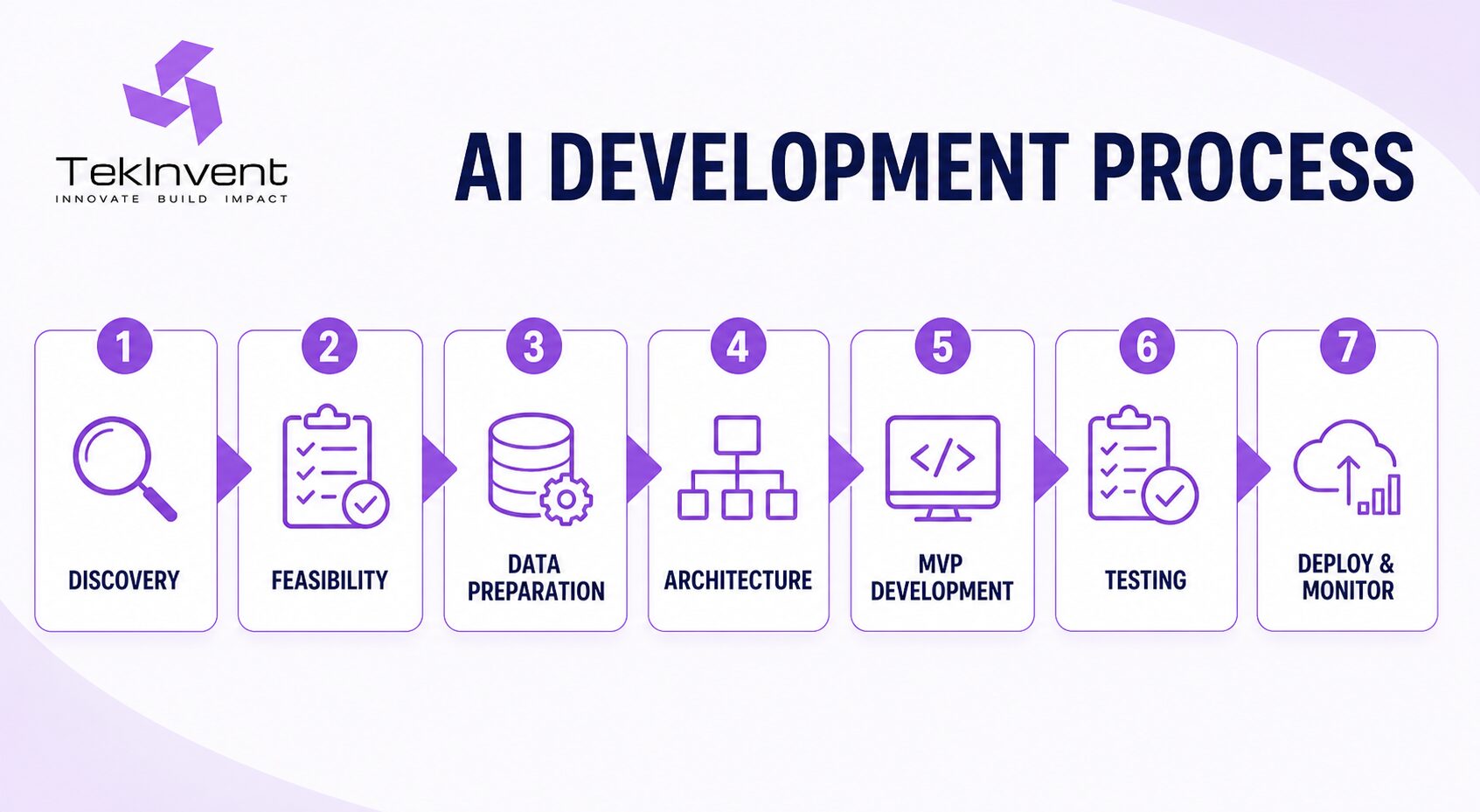
Stage 1: Discover a Valuable Business Problem
The first stage is understanding the existing workflow. The team should speak with the employees and customers who experience the problem, observe how the task is currently completed, and identify where time, revenue, quality, or customer satisfaction is being lost.
“Build an AI chatbot” is not a complete problem statement. A stronger statement would explain that support employees spend too much time searching scattered policy documents, causing delayed responses and inconsistent information.
The business must then define a measurable target. Depending on the project, this could involve reducing document-processing time, increasing successful support resolutions, improving forecast accuracy, or lowering the number of manual tasks.
The team should also examine whether AI is genuinely required. A conventional application or rules-based workflow may be more dependable when the process follows predictable steps. AI becomes particularly useful when the task involves language, images, complex patterns, predictions, or variable requests.
Stage 2: Assess Technical Feasibility
Once the business problem is clear, developers test whether the proposed solution is technically realistic.
A feasibility assessment examines the available data, required integrations, expected response time, accuracy requirements, privacy considerations, operating costs, and possible consequences of an incorrect result.
The team can use representative examples to compare different approaches. These may include an existing AI model, a traditional machine-learning system, a custom model, or non-AI automation.
This stage should answer a critical question: can the system deliver enough value to justify its complexity and risk?
A small technical experiment may be useful, but it should not be mistaken for a complete product. A prototype proves that an idea may work under controlled conditions. Production software must work with real users, permissions, data, traffic, and unexpected inputs.
Stage 3: Prepare and Govern the Data
AI performance depends heavily on the information available to the system. Poorly managed data can make even an advanced model unreliable.
The development team should identify all relevant data sources and determine who owns them. Records may need to be cleaned, reorganized, labeled, or removed when they are outdated or duplicated.
For a knowledge assistant, document preparation may include extracting text, preserving headings, adding metadata, dividing content into meaningful sections, and establishing an update process. For predictive machine learning, preparation may involve selecting features, correcting labels, balancing datasets, and separating training data from evaluation data.
Privacy and permission requirements must be addressed before development. Sensitive information should not enter an AI workflow simply because it is technically accessible. Encryption, data minimization, role-based access, retention limits, and audit logging should form part of the architecture.
Stage 4: Design the Product Architecture
AI is only one component of the finished product. The surrounding software determines how users interact with it, how information moves through the system, and how failures are controlled.
The architecture may include the user interface, backend services, AI model, databases, cloud infrastructure, authentication, integrations, analytics, and security controls.
Model selection should follow the product requirements. Developers should compare response quality, speed, privacy terms, availability, context capacity, and operating cost. The largest model is not automatically the most suitable option.
A team experienced in software development company projects can help ensure that intelligent features are supported by scalable architecture, secure integrations, and dependable application workflows.
The user experience also requires careful planning. The interface should show when content is AI-generated, communicate uncertainty, provide supporting evidence where appropriate, and offer a clear path to human support.
Stage 5: Develop a Focused AI MVP
An AI minimum viable product should test one valuable workflow for one clearly defined user group. It should not attempt to automate an entire department during the first release.
The MVP must include enough surrounding functionality to operate realistically. Authentication, permissions, error handling, feedback controls, analytics, and essential integrations should not be postponed until after testing.
Developers should maintain versions of prompts, model settings, datasets, retrieval configurations, and evaluation criteria. This makes results reproducible and helps the team identify what caused a change in performance.
This is also an appropriate stage to involve an AI development company when the internal team needs additional expertise in product strategy, data engineering, security, model integration, or deployment.
Stage 6: Test the Complete AI Solution
AI testing should use realistic examples collected from the intended workflow. The evaluation set should contain common requests, unusual wording, incomplete information, edge cases, unsafe instructions, and situations where the correct response is to admit uncertainty.
The team should measure qualities relevant to the task. These may include factual accuracy, citation quality, task completion, response time, cost, escalation behavior, and human correction rate.
Average performance alone can hide serious weaknesses. Results should be examined across different topics, languages, user groups, and risk levels.
NIST’s AI Risk Management Framework encourages organizations to manage AI risks throughout the system lifecycle. Testing should therefore consider privacy, security, reliability, transparency, accountability, and potential misuse alongside technical accuracy.
The surrounding application also needs conventional testing for permissions, integrations, accessibility, mobile usability, heavy traffic, and recovery from system failures.
Stage 7: Deploy With Controlled Exposure
AI products should usually launch through a limited pilot rather than an immediate public rollout.
A pilot allows selected users to test the product while the team closely monitors quality, failures, feedback, and costs. In sensitive workflows, the AI system may initially prepare recommendations while an employee remains responsible for approving every action.
The organization should define release standards before the pilot begins. The system should only expand when it meets acceptable thresholds for quality, security, response time, and business performance.
A rollback plan, emergency disable control, incident owner, and escalation procedure should be prepared before deployment.
Monitoring and Improvement After Launch
Deployment is not the final stage of an AI product. Models, source information, user behavior, operating costs, and security threats change over time.
The organization should monitor technical performance alongside business outcomes. Useful signals may include errors, unsupported answers, response times, retrieval failures, human overrides, user satisfaction, and cost per completed task.
Confirmed failures should become part of the evaluation dataset. The team can then improve the data, prompts, retrieval process, model configuration, integrations, or interface and verify whether those changes solve the problem.
Every significant change to the model, prompt, knowledge base, or workflow should trigger a new evaluation cycle.
Turning an AI Concept Into a Scalable Capability
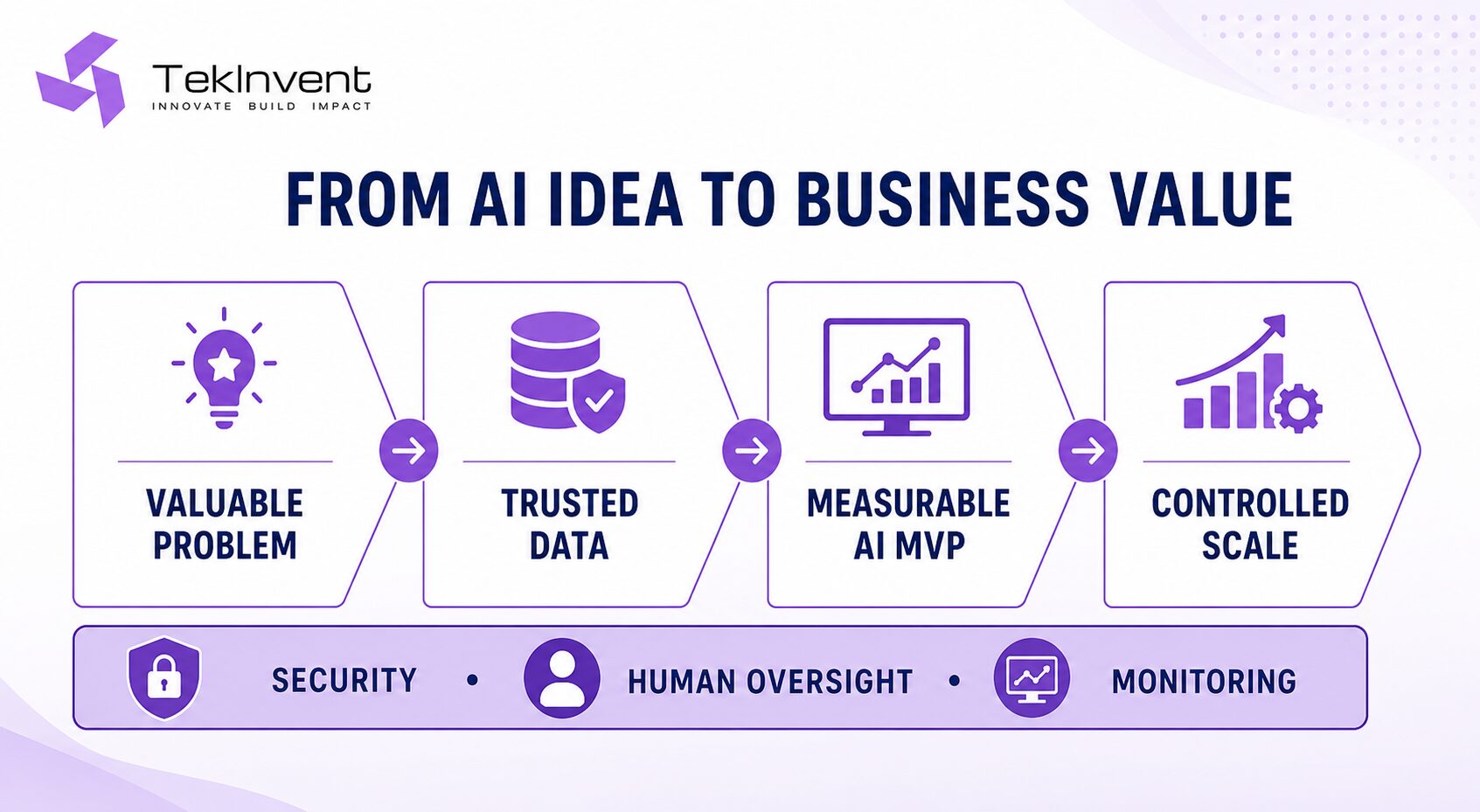
The strongest AI products are not necessarily those that reach the market first. They are the ones that move through discovery, evidence, testing, and controlled expansion with a clear business purpose.
A valuable problem provides direction. Trusted data gives the system dependable context. A focused MVP creates measurable evidence, while security, human oversight, and monitoring make responsible growth possible.
Businesses that follow this approach can move beyond isolated AI experiments. They can build an intelligent capability that evolves with their operations, supports their people, and creates lasting value in an increasingly AI-driven market.

Build Smart with The Right Team.
We bring expertise, technology, and trust you look for in your digital journey.