
The cost of developing an AI app in 2026 can range from approximately $20,000 for a focused minimum viable product to more than $500,000 for a complex enterprise platform.
That range is wide because the phrase “AI app” can describe very different products. A basic application that connects to an existing language-model API is not comparable to a secure healthcare platform that analyzes private records, integrates with multiple systems, and serves thousands of users.
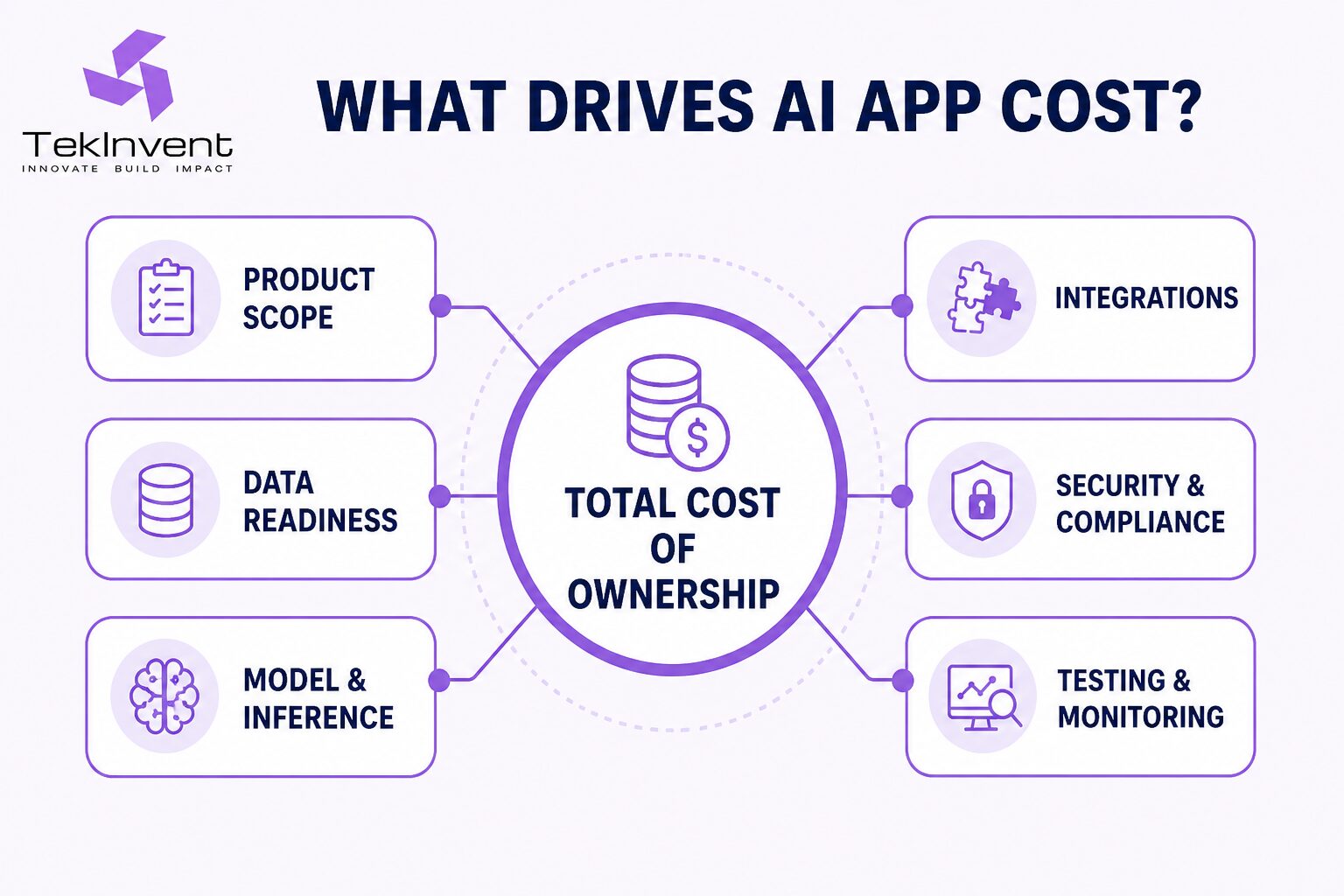
The model itself is rarely the only major expense. Businesses must also budget for product design, data preparation, backend development, integrations, permissions, testing, security, cloud infrastructure, monitoring, and ongoing model usage.
A useful estimate therefore begins with the business workflow rather than a list of features. The central question is not simply how much an AI app costs. It is how much it will cost to create a dependable product that delivers the intended outcome under real operating conditions.
AI App Development Cost by Complexity
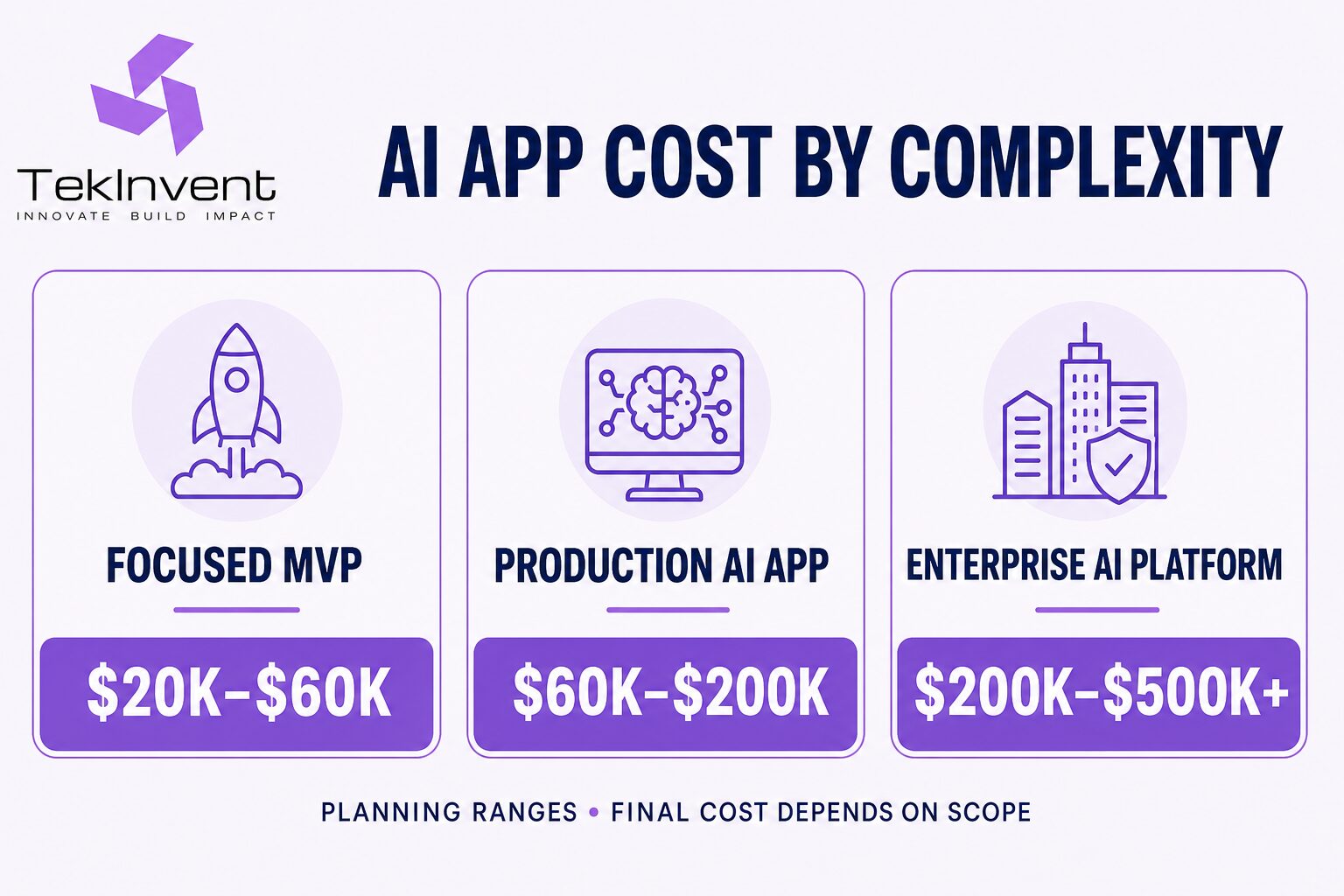
The following figures are planning ranges based on current 2026 market research. They should not be treated as fixed quotations because the final budget depends on the product scope, industry, data, technology, and delivery team.
A focused AI MVP typically falls between $20,000 and $60,000. This type of product usually validates one core workflow for one user group. It may include an existing AI model, a straightforward interface, limited integrations, basic authentication, and an initial evaluation process.
A production AI application commonly costs between $60,000 and $200,000. It may support more users, multiple workflows, company data, role-based permissions, mobile or web interfaces, analytics, stronger security, and dependable monitoring.
An enterprise AI platform can range from $200,000 to $500,000 or more. These systems may involve regulated data, extensive integrations, advanced governance, high traffic, multiple business units, private cloud infrastructure, human approval workflows, and detailed audit trails.
Training a sophisticated model from the beginning can push the investment far beyond these ranges. Most companies do not need to build a foundation model. They can often create greater value by adapting an existing model and investing in their proprietary data, workflows, integrations, and user experience.
What Does a Focused AI MVP Include?
An AI MVP is not supposed to contain every planned feature. Its purpose is to test whether one important workflow produces enough value to justify further investment.
A customer-support MVP might retrieve information from a limited collection of approved documents and prepare answers for employee review. A sales MVP could summarize call notes and create structured CRM updates. A healthcare prototype might organize non-diagnostic administrative information without making clinical decisions.
A credible MVP still needs more than a model connection. It should include a usable interface, secure authentication, basic permissions, error handling, analytics, feedback collection, and a representative evaluation dataset.
Removing these foundations can reduce the initial quote, but it also makes the result difficult to test with real users. A cheap demonstration may answer a few prepared questions while failing as soon as it encounters ambiguous language, missing information, unauthorized requests, or an unavailable integration.
Why Production AI Costs More Than a Prototype
A prototype is built to answer one question: can the core idea work?
A production application must answer a much harder set of questions. Can it work consistently? Can it protect user information? Can it manage traffic? Can employees understand its limitations? Can the business monitor its decisions? Can it recover when a model or external service fails?
Production development introduces work involving user accounts, permissions, databases, interfaces, integrations, cloud deployment, quality assurance, logging, support tools, and operational safeguards.
A complete product may also need mobile applications, administrative dashboards, subscription management, notifications, analytics, and customer-support workflows. TekInvent’s software development company services can support this surrounding architecture so the AI capability operates as part of a reliable business application.
The difference between prototype and production cost is not unnecessary engineering. It is the difference between demonstrating intelligence and delivering a product people can safely use.
Product Scope Is the First Cost Driver
Scope determines how many users, workflows, platforms, and business rules the team must support.
An application that summarizes uploaded documents is less complex than a platform that reads private company information, uses multiple business tools, remembers user preferences, and initiates actions.
Every additional role can introduce new permissions and interfaces. Every supported language requires additional testing. Every new workflow creates more edge cases, integrations, and evaluation requirements.
Businesses can control scope by selecting one valuable user journey for the initial release. The first version should solve a complete problem rather than offer a disconnected collection of AI features.
Data Readiness Can Change the Entire Budget
AI systems need reliable information. If the organization’s data is inaccurate, duplicated, outdated, poorly structured, or stored across disconnected platforms, the development team must resolve those issues before the application can perform dependably.
A knowledge-based AI app may require document extraction, cleaning, chunking, metadata, access controls, and an automated update pipeline. A predictive machine-learning system may require labeling, feature preparation, bias analysis, and historical data validation.
Data ownership also matters. The business must know whether it has permission to process the information, where the data can be stored, and how long it may be retained.
A project with clean, accessible data can move quickly. A project requiring months of data engineering may cost considerably more, even if both applications appear similar from the user’s perspective.
Model Choice and Inference Costs
Most modern AI applications use an existing model through a commercial API, managed cloud platform, or privately deployed open model.
Commercial models can reduce initial development time, but they introduce ongoing usage charges. Providers may charge according to input and output volume, model type, image processing, audio duration, storage, or reserved computing capacity.
A more capable model may produce stronger results but cost more per request and respond more slowly. The best architecture may route simple requests to a smaller model and reserve an advanced model for complex work.
Open models can provide additional control, but they are not automatically free. Hosting, graphics-processing resources, scaling, security, updates, and specialist engineering contribute to the operating cost.
Businesses should estimate cost per completed task rather than only cost per model request. If an agent needs several model calls and tool actions to finish one job, its real expense is the complete workflow.
Integrations and Backend Development
An AI application becomes more valuable when it can work with existing business systems. It may need to retrieve customer records, search inventory, update a CRM, analyze transactions, create support tickets, or send notifications.
Every integration introduces development and testing work. Older systems may have incomplete documentation, inconsistent data, slow APIs, or complicated permission models.
AI-generated inputs must never be trusted automatically. The backend should validate account identifiers, dates, financial values, and other parameters before an action is executed.
Integrations involving payments, medical information, financial records, or customer communications require especially careful safeguards. TekInvent’s fintech development expertise is relevant when intelligent features must operate within secure financial workflows.
Security, Privacy and Compliance
Security requirements can materially increase the AI application development cost, but excluding them creates a much greater long-term risk.
The system may require encryption, role-based access, audit logs, consent management, regional data storage, retention controls, incident response, and independent security testing.
AI introduces additional threats such as prompt injection, sensitive-data exposure, unsafe tool use, manipulated source documents, and unsupported generated answers.
Regulated industries may need legal and compliance review alongside technical implementation. Healthcare, finance, education, employment, and insurance products generally require more governance than a public content-generation tool.
Human approval should be included wherever an incorrect action could materially affect a person or business.
Testing and Evaluation
AI testing is different from checking whether a conventional feature returns an exact value.
The development team needs a representative collection of real user requests, expected outcomes, difficult cases, unsafe instructions, and situations in which the system should refuse or request human help.
Evaluation may measure factual accuracy, relevance, citation quality, prediction performance, tool selection, response time, user satisfaction, and cost per successful task.
Testing must continue after launch. Model providers release updates, company documents change, users discover new ways to interact with the product, and security threats evolve.
A system without ongoing evaluation can become less reliable while still appearing functional.
Design and Platform Requirements
A simple internal web tool generally costs less than a polished customer-facing product for web, iOS, and Android.
Mobile development introduces device testing, platform guidelines, notifications, offline behavior, accessibility requirements, and app-store preparation. Cross-platform development can reduce duplicated effort while still requiring careful performance and usability testing. TekInvent’s cross-platform app development services can support businesses that need an AI experience across multiple devices.
AI also creates unique interface requirements. Users need to understand when information is generated, where it came from, what the system can do, and how to correct a mistake.
A good interface does not merely make AI look modern. It helps people use the system responsibly.
Post-Launch and Total Cost of Ownership
The development quote is only one part of the investment.
After launch, the business may continue paying for model inference, cloud hosting, databases, monitoring platforms, technical support, security updates, document processing, and product improvements.
Usage can grow unpredictably. A successful application may serve more users, process longer conversations, or trigger more model calls than expected. Cost alerts, usage limits, caching, efficient prompts, and model routing should be designed before scale becomes expensive.
The organization should create low, expected, and high-usage projections. These scenarios make the budget more realistic than relying on one monthly estimate.
How to Reduce AI App Development Cost
The most effective cost-saving strategy is narrowing the first release to one measurable business problem.
Using an established model is usually more practical than training a custom model without a strong strategic reason. Clean data, clear requirements, and early integration testing also prevent expensive rework.
The team should evaluate quality with realistic examples before building every planned feature. If the core system cannot achieve the required result, expanding the interface will not rescue the product.
Architecture should remain flexible enough to compare models as pricing and capabilities change. Monitoring model usage from the first pilot also helps the business understand cost per task before a wider rollout.
Cost reduction should remove unnecessary complexity, not security, evaluation, or essential product engineering.
How to Evaluate an AI Development Quote
Two vendors may provide dramatically different prices for what appears to be the same application. The difference often lies in what each quotation includes.
A dependable proposal should explain the intended users, workflows, platforms, integrations, data responsibilities, security controls, evaluation approach, deployment model, post-launch support, and assumptions behind ongoing costs.
It should also define what is outside the scope. This reduces disputes and makes competing proposals easier to compare.
Ask whether the estimate covers only a demonstration or a deployable product. Confirm who owns the code, data pipelines, prompts, documentation, and infrastructure configuration.
An experienced AI development company should help a business understand trade-offs instead of presenting one unexplained total.
Designing an AI Investment That Can Scale
The best AI budget is not necessarily the smallest one. It is the budget that validates value before the organization commits to unnecessary complexity.
Begin with one important workflow, trusted data, a realistic evaluation set, and clear success criteria. Build enough of the surrounding product to test the experience under genuine operating conditions. Monitor quality and cost together, then expand only when the evidence supports the next investment.
This approach transforms AI app development cost from an uncertain technology expense into a controlled product decision. Businesses can see what they are paying for, what outcome the application must deliver, and what must be true before the system moves from MVP to meaningful scale.

Build Smart with The Right Team.
We bring expertise, technology, and trust you look for in your digital journey.