
A game idea can sound exciting in a meeting and still fail when someone actually tries to play it.
The controls may feel awkward. The core mechanic may become repetitive after five minutes. A planned multiplayer feature may introduce unexpected networking problems. The visual direction may perform poorly on the target hardware. A feature that sounded simple may require months of engineering.
Discovering these problems after full production begins can be expensive.
That is why game prototype development is one of the most valuable stages between an initial concept and a complete game.
A prototype creates a small, testable version of the most important parts of the game. It allows developers, founders, publishers, and investors to evaluate the concept before committing substantial resources to final artwork, environments, characters, animations, backend systems, and content.
The objective is not to build a beautiful miniature version of the finished game.
The objective is to answer the questions that could determine whether the full game is worth building.
What Is Game Prototype Development?
Game prototype development is the process of creating an early playable version of a game to test its core assumptions.
The prototype may contain placeholder graphics, unfinished interfaces, basic environments, temporary sounds, simple animations, and incomplete systems.
That is perfectly acceptable.
At this stage, polish is usually less important than learning.
Imagine a studio planning a new platformer.
Instead of designing 40 levels and producing final character artwork, developers could build one basic environment containing movement, jumping, obstacles, enemies, and one core gameplay mechanic.
Players can then test it.
Does movement feel responsive?
Is jumping satisfying?
Are controls understandable?
Is the main mechanic actually fun?
Does the player understand the objective?
Those answers provide more useful information than months of planning documents alone.
A prototype turns assumptions into something people can experience.
Why Should You Prototype a Game Before Full Production?
Full game production can require programmers, artists, animators, designers, QA engineers, sound designers, technical artists, backend developers, and producers.
Once those people begin creating production assets and systems, changing fundamental decisions becomes increasingly expensive.
Consider a 3D action game.
The team produces ten environments, dozens of animations, several characters, weapons, enemies, UI screens, and effects.
Six months later, playtesting reveals that the core combat mechanic is not enjoyable.
Changing combat could now affect animation, AI, level design, weapons, camera systems, controls, effects, sound, balancing, and testing.
The same discovery during a simple prototype could have been addressed before most of those dependencies existed.
game development timeline places prototyping before full production for exactly this reason: early validation reduces the risk of discovering fundamental gameplay problems after expensive production work has already begun.
Prototype development is therefore not an unnecessary preliminary expense.
It is a way of controlling larger expenses later.
Start With the Question You Need the Prototype to Answer
One of the biggest mistakes in game prototyping is trying to prototype the entire game.
A useful prototype should have a purpose.
Before development begins, identify the biggest uncertainty in the concept.
For one project, the question might be:
Is the combat system enjoyable?
For another:
Can 50 players interact reliably in the same session?
Another project may need to determine whether a particular visual style can run at the required frame rate on mobile devices.
A racing game may need to validate vehicle handling.
A puzzle game may need to determine whether players understand its central mechanic without lengthy instructions.
A VR game may need to test whether a movement system feels comfortable.
The prototype should be built around answering those questions.
Anything that does not help answer them may not belong in the first prototype.
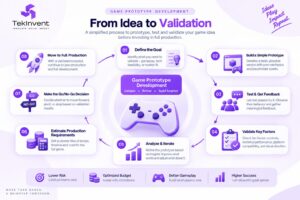
Step 1: Define the Core Gameplay Loop
Before creating the prototype, define what players repeatedly do.
This is the core gameplay loop.
In a racing game, the loop might be race, earn rewards, upgrade the vehicle, unlock content, and race again.
In a survival game, players might explore, gather resources, craft equipment, survive threats, and expand their capabilities.
In a puzzle game, the loop may simply be understand the challenge, solve it, receive feedback, and move to a harder challenge.
The prototype does not need every future progression system surrounding that loop.
It needs enough functionality to determine whether the repeated activity itself has potential.
If the central activity is not enjoyable, adding achievements, cosmetics, leaderboards, elaborate graphics, or monetization is unlikely to solve the fundamental problem.
Step 2: Identify the Riskiest Assumptions
Every game contains assumptions.
Some are inexpensive to change.
Others can determine the entire production architecture.
Suppose you are planning an online combat game.
You may be assuming that the combat remains responsive under real network conditions.
That is a high-risk assumption.
If the experience only feels good during local testing, the entire product concept could be affected.
A mobile game might assume that its intended visual quality will run smoothly across mid-range devices.
A large 3D game may assume that the proposed art pipeline can produce enough environments within the available budget.
A physics-based game may depend on one particular interaction feeling natural.
List these assumptions and rank them according to how damaging it would be if they were wrong.
The prototype should address the most dangerous assumptions first.
Step 3: Build Only What You Need to Learn
Prototype development benefits from restraint.
If the goal is testing character movement, developers may not need final characters.
A capsule or simple placeholder model can work.
If the goal is validating level flow, basic blocks can represent buildings, platforms, walls, and obstacles.
If the goal is testing combat, temporary effects and animations may be enough.
Developers often call this type of early environment a graybox or blockout.
The lack of visual polish can actually be useful because testers focus more on gameplay rather than being distracted by beautiful graphics.
Production assets should be created only when visual quality itself is something the prototype needs to validate.
Step 4: Test Whether the Core Mechanic Is Actually Fun
Technical functionality and enjoyable gameplay are not the same thing.
A mechanic can work exactly as designed and still feel boring.
This is why game prototypes need playtesting.
Observe how people interact with the build.
Do they understand what to do?
Do they discover the core mechanic naturally?
Are they engaged?
Where do they become confused?
Which actions do they repeat?
Where do they stop playing?
What do they expect to happen that does not happen?
Avoid explaining everything before the test.
If testers only understand the game because the developer is standing beside them explaining every mechanic, the prototype may reveal a usability problem.
Observation is often more valuable than asking whether someone “liked” the game.
Step 5: Validate Controls and Player Feedback
Controls directly affect how a game feels.
Movement should respond in a way that supports the intended experience.
A fast platformer may need immediate movement.
A realistic vehicle simulation may deliberately feel heavier.
A tactical game may prioritize precision over speed.
The prototype should test input response, camera behavior, aiming, movement, jumping, interaction, and other central controls.
Feedback matters too.
When the player attacks, does the game clearly communicate that the attack connected?
When something is collected, is the reward understandable?
When the player takes damage, is that immediately obvious?
Visual effects, sound, animation, camera movement, interface changes, and controller feedback can all communicate game state.
The prototype does not need final effects, but it needs enough feedback to evaluate whether actions feel understandable and satisfying.
Step 6: Validate 2D or 3D Direction Before Building Assets
Some concepts begin without a final decision about visual dimension.
That decision should not be based only on which screenshots look more impressive.
Build enough of the concept to understand how dimensionality affects gameplay.
A 2D version may provide clearer controls, simpler navigation, and more focused gameplay.
A 3D version may add exploration, camera freedom, spatial mechanics, or environmental depth that is essential to the experience.
2D vs 3D game development guide recommends prototyping the core gameplay before committing to the complete visual production pipeline.
A small prototype can therefore prevent a team from producing hundreds of assets for a visual direction that does not actually improve the game.
Step 7: Test Technical Feasibility
Some prototypes exist primarily to test gameplay.
Others need to prove that the technology works.
Suppose a game needs hundreds of enemies visible simultaneously.
Can the engine maintain the required frame rate?
A destructible environment may look impressive in a technical demo, but can the system work reliably during actual gameplay?
A mobile game may run smoothly on a powerful development phone but struggle on the minimum device the business intends to support.
A multiplayer concept may perform correctly with two players but behave very differently with twenty.
Technical prototypes should intentionally test difficult conditions.
The goal is not to demonstrate that the game works under perfect circumstances.
It is to identify where it stops working.
Step 8: Prototype Multiplayer Early
Multiplayer is one area where late validation can become particularly expensive.
Networking can affect movement, combat, physics, inventories, matchmaking, player accounts, backend systems, security, and game-state management.
A local gameplay system may need significant changes when server authority and network latency are introduced.
If multiplayer is fundamental to the concept, do not build the complete single-player version first and assume networking can simply be added later.
Create a networked prototype of the core experience.
Test multiple players joining.
Test movement.
Test the main interaction.
Simulate latency.
Disconnect a player.
Reconnect.
Test what happens when two users perform conflicting actions simultaneously.
The objective is to discover architectural problems before the rest of the game becomes dependent on the wrong architecture.
Step 9: Test the Prototype on the Target Platform
A PC prototype is not enough if the final game is intended primarily for smartphones.
Controls, performance, interface, screen size, memory, battery usage, and hardware capabilities can all change the experience.
The same principle applies to console, VR, handheld devices, and web-based games.
Prototype on representative hardware as early as practical.
For mobile concepts, mobile game development process also places playable prototyping before full production and real-device testing as a core part of validating the experience.
Testing on the actual target environment can expose assumptions that desktop development hides.
Step 10: Collect Useful Playtesting Feedback
A prototype should generate evidence.
But feedback needs to be collected carefully.
Do not simply ask:
“Did you like it?”
Someone may say yes because they want to be polite.
Instead, observe behavior and ask specific questions.
What did you think your objective was?
Which mechanic was hardest to understand?
Where did you feel frustrated?
What did you expect to happen here?
Would you play another round?
Which part would you remove?
What would you want to do next?
For commercial concepts, the test audience should resemble the intended player as closely as possible.
Feedback from experienced PC strategy players may not accurately represent the audience for a casual mobile puzzle game.
The prototype is more valuable when the right people test it.
Game Prototype vs Proof of Concept
A proof of concept and a game prototype can overlap, but they do not always answer the same question.
A proof of concept primarily asks:
Can this work?
A prototype more commonly asks:
How will this work or feel?
For example, a technical proof of concept may test whether hundreds of AI-controlled units can run simultaneously.
A playable prototype may then use that technology to test whether controlling those units creates enjoyable gameplay.
Both can happen before full production.
The terminology matters less than defining what uncertainty the build is supposed to resolve.
Game Prototype vs Vertical Slice
These terms are often confused.
A prototype is usually built for learning.
A vertical slice is generally built to demonstrate a small but representative portion of the final production quality.
Imagine a game planned to contain twenty environments.
The prototype may contain gray boxes, placeholder characters, temporary animations, and basic combat.
Once those systems have been validated, a vertical slice might build one representative environment using near-final artwork, lighting, animation, interface, sound, and gameplay quality.
The prototype asks whether the concept works.
The vertical slice helps demonstrate whether the team can produce the intended final experience.
This distinction matters for businesses because a vertical slice normally requires considerably more production effort than a low-fidelity prototype.
Game Prototype vs MVP
An MVP is closer to a usable product.
A prototype may never be released publicly.
It can be discarded after answering its questions.
An MVP generally contains the minimum complete experience needed to put the product in front of real users and begin collecting market-level feedback.
For a game, the boundaries can be less rigid than in traditional software.
An early-access game, limited regional release, closed beta, or small commercial release may sometimes serve an MVP-like purpose.
The important distinction is intent.
A prototype reduces uncertainty before production.
An MVP attempts to validate the product with actual users under more realistic market conditions.
Should Prototype Code Be Used in the Final Game?
Sometimes.
But businesses should not automatically assume prototype code will become production code.
Prototype development often prioritizes learning speed.
Developers may intentionally use shortcuts because the goal is to answer a question quickly.
Production code has different expectations.
It needs to be maintainable, scalable, testable, secure, performant, and understandable to the wider development team.
If the prototype architecture is solid enough, parts may be reused.
If it was deliberately built as a temporary experiment, rewriting systems for production can be the correct decision.
The prototype’s success should be measured by what the team learns, not by how much temporary code survives.
How Long Does Game Prototype Development Take?
There is no universal prototype timeline because prototypes answer different questions.
A simple mechanic may be testable in days.
A more substantial gameplay prototype can require several weeks.
A technically challenging multiplayer or simulation prototype may take longer.
The useful constraint is not an arbitrary number of days.
It is defining the minimum build required to answer the important questions.
If the prototype keeps expanding because the team wants polished menus, dozens of levels, final characters, cinematics, and monetization, it is beginning to become production rather than validation.
For the broader schedule beyond prototyping, the separate game development timeline explains how discovery, pre-production, prototyping, production, testing, launch, and post-launch work fit together.
Important for your WordPress version: maine upar timeline page ko pehle already link kiya hai. Final publish version mein second occurrence ko plain text rakhein, same URL ko dobara link na karein. Neeche final internal-link plan bhi diya hai.
How Much Does a Game Prototype Cost?
Game prototype cost depends on what needs to be validated.
A basic gameplay mechanic using placeholder assets can require relatively little production compared with a polished vertical slice.
Cost increases when the prototype needs custom 3D models, complex animation, advanced physics, multiplayer networking, backend systems, artificial intelligence, specialized hardware, or multiple target platforms.
A useful prototype budget should therefore be based on questions rather than visual ambition.
If you only need to determine whether a movement mechanic is enjoyable, spending heavily on finished artwork provides little validation value.
If visual fidelity is the uncertainty, however, representative artwork may be essential.
The budget should follow the risk being tested.
Prototyping Can Help Control 3D Production Cost
3D production can become expensive once large numbers of assets enter the pipeline.
Characters may need modeling, texturing, rigging, animation, effects, and optimization.
Environments require models, materials, lighting, level design, collision, and testing.
Before scaling that pipeline, create representative assets and put them into an actual playable scene.
Measure how long they take to create.
Test performance.
Evaluate whether the visual quality is achievable.
Determine whether the gameplay genuinely benefits from the proposed level of detail.3D game development cost guide explains why validating expensive assumptions before mass-producing content can make budgeting much more predictable.
When Is a Game Prototype Successful?
A successful prototype does not necessarily prove that the original idea was correct.
Sometimes the most valuable result is discovering that it was wrong.
Imagine spending four weeks building a prototype and learning that the central mechanic becomes repetitive quickly.
That may feel disappointing.
But compare it with spending eighteen months building the complete game and learning the same thing after launch.
The prototype succeeded because it exposed risk cheaply.
A useful prototype should produce one of three outcomes.
The concept works well enough to continue.
The concept has potential but requires changes.
Or the concept should not move into full production in its current form.
All three outcomes create useful information.
What Should You Validate Before Full Production?
Before moving into full production, the team should have reasonable confidence in the game’s core gameplay loop.
Controls should feel appropriate.
The central mechanic should be understandable.
Major technical risks should have been investigated.
The target platform should be capable of running the intended experience.
The chosen visual direction should be achievable.
The team should understand the approximate content-production pipeline.
If multiplayer is essential, its basic architecture should be proven.
The project should also have clear boundaries around what version one includes.
This does not mean every question needs to be solved.
Game development always involves uncertainty.
The objective is to remove the uncertainties capable of destroying the project after major investment has already occurred.
When Should Businesses Stop Prototyping?
Prototyping should not continue indefinitely.
Once the prototype has answered its intended questions, decide what happens next.
If the mechanic works, technical feasibility is established, the player response is promising, and the production requirements are understood, the project can move toward pre-production or full production.
If important questions remain unanswered, another focused iteration may be justified.
But continually adding features to a prototype without defining success criteria can turn validation into uncontrolled development.
Set exit criteria before beginning.
For example:
The core mechanic must be understandable without developer explanation.
The target device must maintain the required performance.
A multiplayer session must remain stable under defined network conditions.
Representative users must be able to complete the intended gameplay loop.
These criteria create a clearer decision point.
How to Move From Prototype to Full Production
Once the prototype validates the concept, do not immediately turn every idea into a production feature.
Document what was learned.
Identify which prototype systems can be retained and which need production-quality rebuilding.
Finalize the game’s scope.
Create the art pipeline.
Establish technical architecture.
Define milestones.
Estimate content volume.
Plan QA.
Determine launch platforms.
Separate essential features from post-launch possibilities.
The transition from prototype to production should convert experimentation into a repeatable development process.
That is where the value of prototyping becomes visible.
Instead of entering production with assumptions, the team enters with evidence.
Choosing a Development Partner for Game Prototyping
You do not need a complete Game Design Document before speaking with developers.
You do need to communicate the problem you want to solve.
Explain the concept, target audience, platform, gameplay idea, visual direction, important technical requirements, and biggest uncertainties.
A capable game development company should then help identify which assumptions need validation before full production.
The team should not automatically recommend building the complete game.
For an early concept, the more responsible recommendation may be a focused prototype containing only enough functionality to validate gameplay and technical feasibility.
That approach can save considerable time and budget if the initial assumptions need to change.
Common Game Prototyping Mistakes
The first mistake is polishing too early.
Final graphics can make an unfinished idea look impressive without making it more enjoyable.
The second is testing too many things simultaneously.
If the prototype contains twenty unfinished systems, it becomes difficult to understand why testers are responding positively or negatively.
The third is using only the development team as testers.
Developers already know how the game works.
New players do not.
The fourth is refusing to change the original idea.
The purpose of prototyping is learning. If evidence suggests that a mechanic should change, defending it simply because it was part of the original concept defeats the purpose.
The fifth is continuing prototype development without defining what success looks like.
A prototype needs a decision at the end.
Final Thoughts
Game prototype development gives businesses and development teams a relatively controlled way to answer difficult questions before those questions become expensive problems.
A prototype can validate the core gameplay loop, controls, player feedback, technical feasibility, networking, performance, visual direction, production pipeline, and target-platform assumptions.
It can also reveal that an idea needs substantial changes or should not move forward at all.
That is useful information.
The goal is not to prove that every original idea was correct.
The goal is to discover what is correct before committing to full production.
Start with the riskiest assumption.
Build only enough to test it.
Put the prototype in front of representative players.
Observe what happens.
Measure technical performance.
Change what does not work.
Then make the decision to continue, revise, or stop based on evidence rather than enthusiasm alone.
That is what makes game prototyping valuable: you spend a smaller amount learning what to build before spending a much larger amount building it.

Build Smart with The Right Team.
We bring expertise, technology, and trust you look for in your digital journey.