
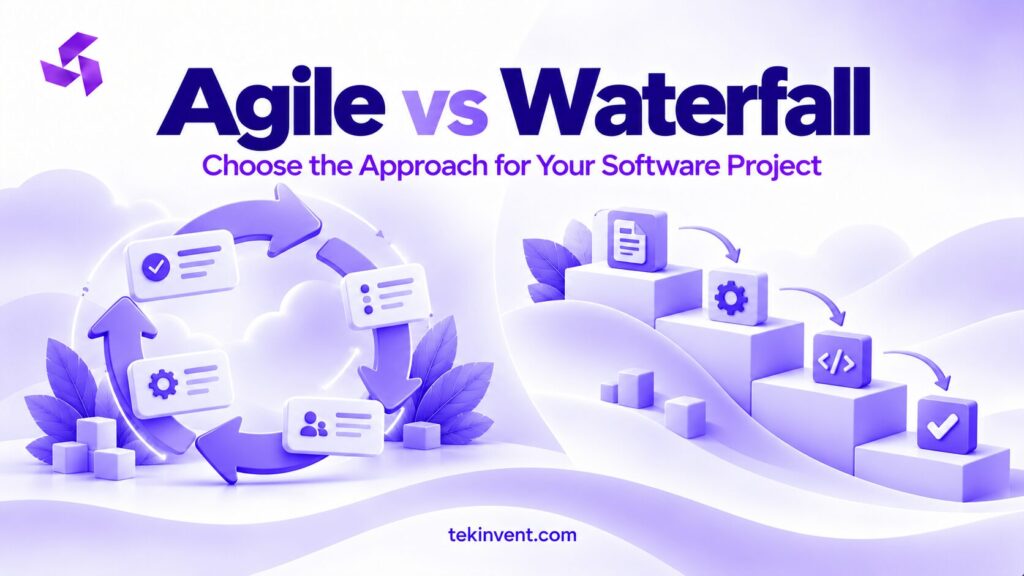
Agile vs Waterfall is a decision about how your project will handle learning and coordinate delivery. An iterative approach suits work that benefits from testing ideas with users. A sequential approach can suit a well-understood scope with clear handoffs. Either needs defined responsibilities, useful verification, and realistic planning.
Start with the work rather than the label. A new customer product may contain unanswered usability questions. A replacement for an established export process may have documented rules and a fixed receiving system. Those projects need different ways to reduce uncertainty.
The choice also depends on your team’s availability. Frequent reviews are useful only when someone can assess results and make decisions. Detailed upfront planning is useful only when the assumptions behind it have been investigated.
Understand the distinction without oversimplifying it
Agile describes values and principles that favor collaboration, working software, and adaptation. Teams use different frameworks and practices to apply them. It does not mean abandoning plans or writing code without requirements.
Waterfall generally organizes work through sequential phases, such as requirements, design, implementation, verification, and release. The handoff between phases is a significant part of the plan.
In practice, projects may include feedback loops regardless of their label. A sequential project can demonstrate designs before development. An iterative project can maintain detailed documentation and require approval before release.
The useful comparison is therefore how your actual plan treats change, evidence, and dependencies. A vendor’s claim to be Agile or Waterfall tells you less than its proposed milestone and review process.
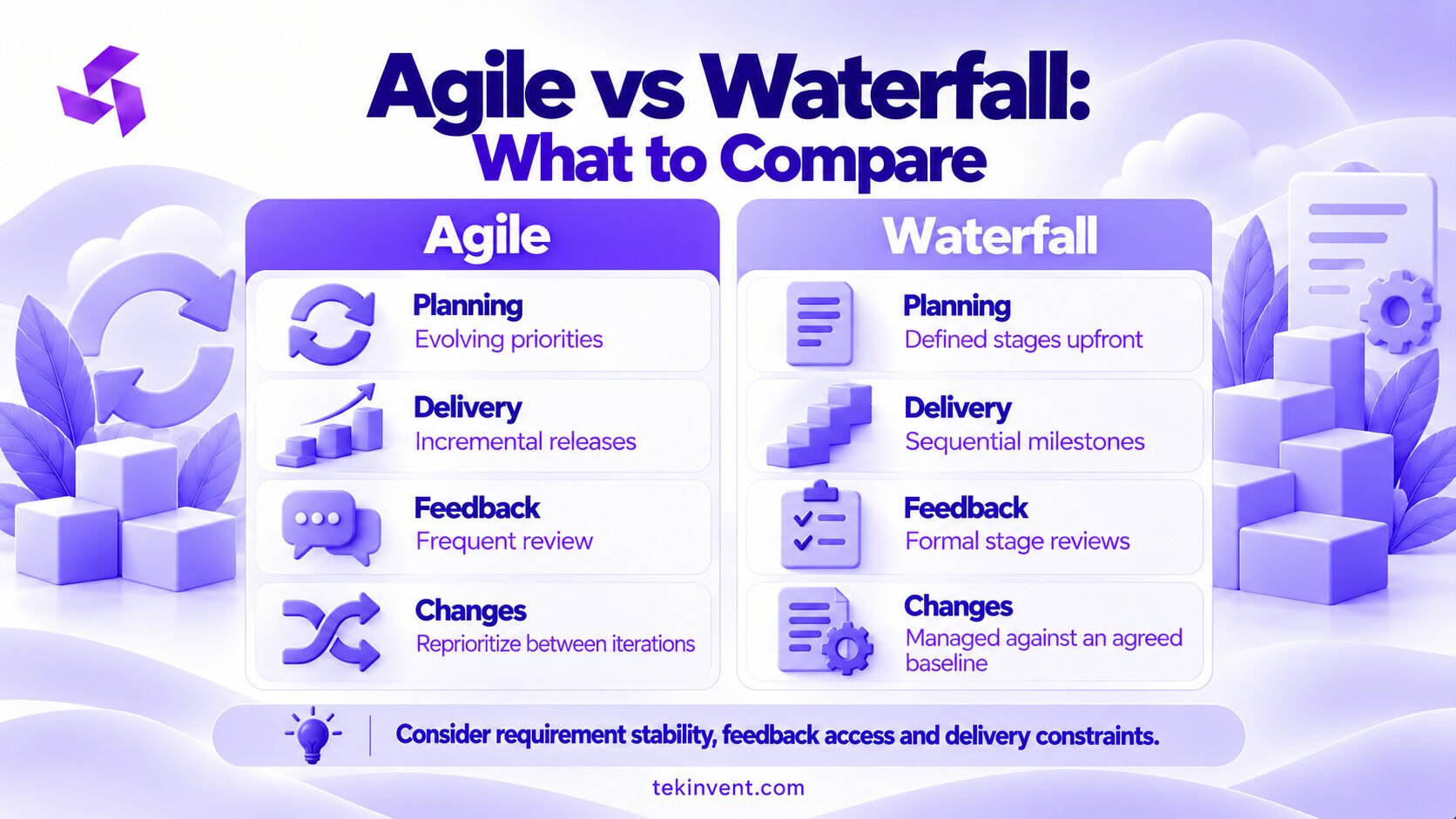
| Decision area | Iterative delivery | Sequential delivery |
|---|---|---|
| Uncertain user needs | Tests a small increment and adjusts direction | Seeks more clarity before committing to later phases |
| Planning | Updates priorities as evidence emerges | Establishes phase expectations and handoffs earlier |
| Business review | Repeated reviews of usable work | Reviews at defined approval points |
| Change | Reprioritizes upcoming work within agreed controls | Assesses changes against an approved baseline |
| Progress evidence | Demonstrated behavior in increments | Completed phase deliverables and verification evidence |
Neither column guarantees a lower cost or an earlier launch. Those results depend on scope, skills, dependencies, and the quality of decisions.
Examine where uncertainty actually exists
Some uncertainty concerns what to build. Other uncertainty concerns whether a proposed connection or migration is feasible. Treating both as a vague need for flexibility can hide the next useful action.
Product uncertainty
A hypothetical wholesaler wants customers to reorder supplies online. The team does not yet know whether customers prefer saved lists, previous invoices, or category browsing.
Small prototypes and a limited working release can test that question. Committing to a complete interface before observing customer behavior risks building the wrong purchasing flow.
Here, iteration has a clear purpose: each review informs the next product decision. The team should name the question an increment will answer instead of producing a collection of unrelated features.
Technical uncertainty
The same wholesaler might need an undocumented connection to its accounting system. User feedback cannot resolve whether that system exposes the required data.
A focused technical investigation is needed before the team commits to the integration schedule. That investigation can happen within either delivery approach.
The result should establish available access, supported operations, limitations, and a fallback. An Agile label does not make an unknown dependency safe to ignore.
Organizational uncertainty
Sometimes the business itself has not agreed on approval rules or ownership. Sales wants customers to submit orders immediately, while finance requires credit review.
That conflict needs an authorized decision. Building both versions in alternating iterations may spend money without resolving the disagreement.
Separate business policy decisions from questions that working software can answer. The project owner should know which kind of uncertainty is blocking progress.
Consider sequential delivery when the scope is demonstrably stable
A phase-based plan can be practical for a bounded project with established rules, accessible interfaces, and clear acceptance conditions. For example, a company may need to replace a nightly file export while preserving its existing format and timing.
The output can be compared against representative input records before replacing the old process. The receiving system and business users already know what a correct result looks like.
Even this project needs discovery. Hidden data exceptions, undocumented dependencies, or unreliable sample files can make an apparently stable requirement less predictable.
A sequential plan should include evidence at each handoff. Approved requirements need more than a signature; reviewers should have checked the data rules and exceptions. A design handoff should explain how those rules will be implemented and verified.
Do not assume that a fixed plan makes the date certain. External access, staff availability, and failed tests still affect delivery.
Use iteration when feedback can change the next decision
Iteration is useful when the business can review a small amount of working software and act on what it learns. It can reveal an awkward workflow before the team builds the surrounding features.
A hypothetical service company might first test request submission with a small group of customers. The business could discover that photo uploads are more valuable than the proposed appointment calendar.
That evidence can change priority while the release remains bounded. It does not mean every new request should enter the current work immediately.
The team needs a clear goal for each increment, acceptance conditions, and a decision-maker. Reviews should distinguish defects, useful feedback, and new ideas that belong in a later release.
Iteration also requires integration discipline. Several completed screens are not necessarily a usable increment if they cannot exchange data with the backend.
Match Your Delivery Plan to Your Project’s Uncertainty
Discuss your software scope, feedback needs, and dependencies with TekInvent.
Align the budget rules with the chosen plan
Delivery approach and pricing model are related decisions, but they are not identical. Iterative development can occur within a defined budget, and a sequential project can use hourly billing.
What matters is the agreement about scope and change. A fixed budget with flexible scope needs a clear way to decide what fits. A fixed scope needs clear treatment of additions and corrected work.
Consider an illustrative plan with 400 remaining hours. The business requests a new capability estimated at 60 hours. If capacity and the deadline stay unchanged, the team must remove equivalent work, reduce the request, or demonstrate that the original forecast had spare capacity.
These hours are hypothetical planning inputs. The example shows why reprioritizing work does not create free capacity.
The custom software development cost guide can help identify the workstreams behind the budget. Use your project’s actual requirements to evaluate the trade-off.
Establish change authorization
A change record should identify affected behavior, connected systems, expected effort, and consequences for accepted work. The authorized business owner decides whether to proceed.
For an iterative plan, update the backlog and release forecast after approval. For a sequential plan, update the affected baseline and downstream deliverables.
Both need a distinction between correcting a failure against approved requirements and adding a new requirement. That distinction prevents routine reviews from turning into repeated commercial disputes.
Account for dependencies that do not follow your review rhythm
An external integration, vendor approval, or hardware shipment may have a schedule your team cannot control. Frequent internal iterations do not automatically shorten those waits.
Map the dependency separately. Record who owns access, the expected availability, what can proceed without it, and the decision if it arrives late.
Your plan may need test substitutes, but they have limits. A simulated integration can help the team develop the app while access is pending; it does not prove the live connection will work.
The custom software development timeline guide provides useful context for these scheduling dependencies. In your own plan, distinguish verified durations from unresolved assumptions.
Define a hybrid plan through responsibilities
A hybrid approach is useful when different parts of the project require different coordination. It needs a clear boundary rather than a general promise to combine the advantages of everything.
For example, a company might complete a defined data-migration assessment and approve data rules before implementing user workflows iteratively. The final transition could still require a formal release review.
State which artifacts remain fixed, which priorities can change, and who approves each type of decision. Otherwise, one stakeholder may expect flexibility while another expects a locked feature list.
The boundary should also explain how changes cross it. If user testing reveals that additional historical data is needed, the migration plan must be reviewed rather than treated as unaffected.
A hybrid plan introduces coordination work. Use it because the dependencies require it, not because the label sounds balanced.
Check whether your business can support the review process
A workable plan includes review time from the people who understand the workflow. A sponsor may authorize spending, while operations staff verify exceptions and support needs.
Give reviewers a specific task. “Try the portal” is less useful than checking whether a customer can revise an order before staff approval and what happens afterward.
Decisions should have deadlines and backup owners. If the main approver is unavailable, the team should know which work can continue and which must wait.
A custom software development company discussion should cover this business participation along with the engineering schedule. Your own availability is a delivery dependency.
If regular reviews are difficult, reduce their scope and improve preparation. Switching labels will not eliminate the need for decisions.
Choose the approach with a short decision exercise
Before committing, answer these questions with the proposed delivery team:
- Which important requirements are already verified?
- Which questions need user feedback, and which need technical investigation?
- Can a small increment produce a meaningful learning result?
- Which external dependencies require planned handoffs?
- Who can approve changes and review working software?
- What may change if the deadline and budget remain fixed?
- What evidence is required before release?
Use the answers to select the review rhythm and milestone structure. An iterative plan is a stronger fit when repeated feedback will shape the next useful increment. A sequential plan may fit when the scope and handoffs are understood and phase approvals serve a practical purpose.
Revisit the decision if conditions change. Newly discovered integration limits or unavailable reviewers may require a revised plan. Agile vs Waterfall becomes a useful comparison when it leads to clear operating decisions about the actual project, rather than a claim that one approach always wins.

Build Smart with The Right Team.
We bring expertise, technology, and trust you look for in your digital journey.