
For founders planning MVP development in Austin, the first decision is what the product must prove. A minimum viable product should let a real user complete the core task and give the team evidence about a business assumption. A useful plan defines that assumption, keeps the initial scope narrow, and sets a clear point for deciding what comes next.
An MVP is a working first version, not a list of everything the company hopes to build. A founder may need a demo for a partner, a pilot for a small group of users, or a public launch. Those goals require different levels of polish, access, support, and technical readiness. Choose the outcome before asking a team to estimate the work.
Start with the founder’s decision
Product work often begins with a broad idea: make scheduling easier, connect local businesses with customers, or help teams manage information. Before choosing features, state what decision the first release should inform. Are users willing to switch from a spreadsheet? Will a buyer pay for the workflow? Can staff complete a process without manual corrections? A product test needs a question with an observable answer.
Describe the user and the moment the problem occurs. “Small businesses need better operations” is not specific enough. “A manager spends time every Friday reconciling job completion notes from field staff” points toward a user, a recurring situation, and a workflow to investigate.
Interview for evidence, not approval
Talk with people who match the intended audience. Ask about the last time they encountered the problem, what they did, who else was involved, and what happened when the workaround failed. Avoid asking whether they would use an app you have already described; people may be supportive without changing their behavior.
Look for patterns across conversations, but keep contrary evidence visible. If potential users describe different problems, you may be targeting several audiences. Narrow the first release to one group and one use case, or test which problem has the clearest urgency before development begins.
Choose a first-release goal
Founders commonly need one of three outcomes:
- A demo: Show the concept and gather informed reactions. A controlled prototype or limited implementation may be enough if users do not need to operate it independently.
- A pilot: Let a defined group complete the core task under real conditions. Support and manual operations may be acceptable if they are planned.
- A public release: Put the product in users’ hands more broadly, with onboarding, support, monitoring, and a repeatable operating process.
Choose this milestone’s outcome and define “ready.” A demo refines a pitch or workflow; a pilot tests a process. A public release requires operational readiness.
An Austin founder preparing for a partner conversation may need a reliable demo of one workflow. If the goal is repeat use, a guided demo cannot answer the question; a pilot should let users return to the task on their own.
Scope around the core workflow
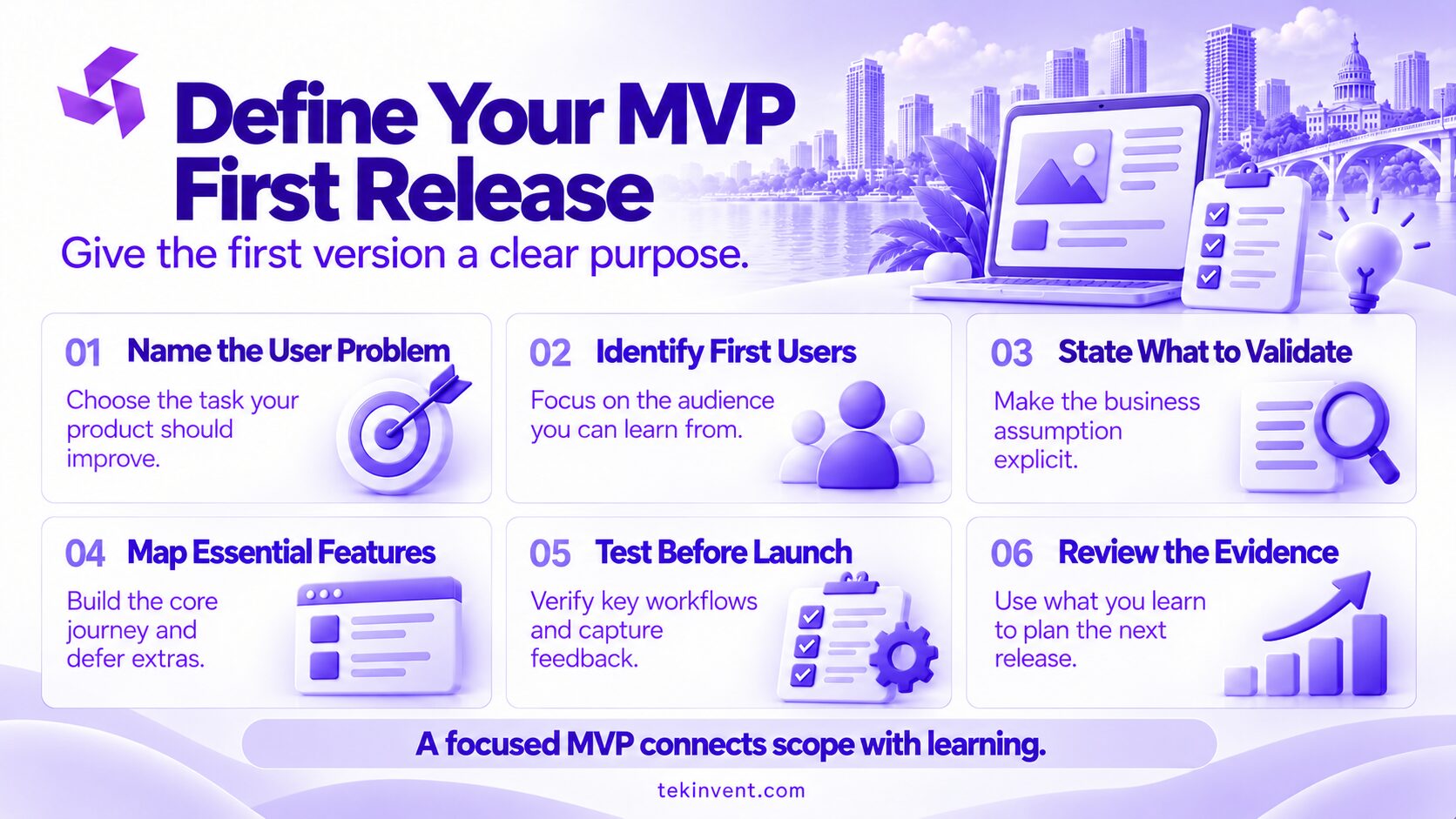
Map the user journey from the first action to a meaningful result. Include the data needed at each step, the roles involved, and the exceptions that can interrupt the flow. A service-request app, for example, may require a customer to describe an issue, select a time, and receive confirmation. If an employee must review requests, that internal action is part of the workflow too.
Use a simple priority test for each feature:
- Is it needed to complete the main task?
- Is it needed to meet a confirmed safety, privacy, or business requirement?
- Does it directly test the assumption behind the release?
- Can the team learn the same thing with a manual step or prototype?
- What breaks if the feature is deferred?
Features that do not support the first outcome go to a later list. Keep the rationale with them. This gives stakeholders a reason to revisit a decision when user evidence changes, without allowing every suggestion to expand the initial scope.
Be deliberate about roles
User roles affect permissions, screens, notifications, and testing. A founder may imagine an app for customers and staff, while an administrator needs another way to correct a record or resolve a problem. Include roles that are necessary for a safe, complete pilot. For low volume, a trained employee may handle some administration manually while the team validates demand.
Manual operations should have defined limits. Decide who performs the work, where it is recorded, and how the team will know the process needs automation. Otherwise, a temporary workaround can become a hidden dependency that leaves users waiting.
Set an explicit boundary
Write a one-page scope summary with the launch goal, user group, core workflow, supported platforms, included integrations, known constraints, and excluded features. The summary should also list open questions and name who will decide them. A short brief is often more useful than a long requirements document full of unprioritized ideas.
Select the right delivery approach
Choose the product form from user behavior and technical requirements. A responsive web product can work when people use the service occasionally from a browser. A native or cross-platform app can be justified when a workflow depends on device features, frequent use, push alerts, offline access, or app-store distribution.
Ask the team to explain its recommendation in plain language, connecting any framework choice to required capabilities and maintenance.
Consider what must exist behind the interface: accounts, data storage, administrative functions, analytics, and connections to existing systems. Confirm who owns each system, whether access and documentation are available, and which information needs to move between them. An integration that is central to the user outcome should be investigated early.
Do not design for an imagined future scale without a reason. At the same time, preserve basic data integrity, security, access control, and recoverability. If the product handles sensitive data, consult qualified legal and security professionals to identify applicable obligations before the architecture is fixed.
Plan product development in stages
A practical delivery process moves from uncertainty to increasingly concrete decisions:
1. Discovery and feasibility
Confirm the problem, release goal, workflow, constraints, and dependencies. Resolve questions that could change the approach, such as whether a needed API exists. The result should be a scope a team can estimate and stakeholders can review.
2. Prototype and user review
Prototype the main path and observe where intended users hesitate. Revise the flow before building supporting features. Positive reactions help assess usability, but do not prove retention or revenue.
3. Build and review working software
Implement the core workflow in increments. Demonstrations should include missing information, interrupted connections, access errors, and unresponsive integrations. Early review prevents polishing a misunderstanding.
4. Test the release conditions
Test on users’ devices and environments. Check permissions, data handling, onboarding, errors, and support procedures. Match the test plan to the product’s risk and release goal.
5. Launch, observe, and decide
Assign someone to watch for issues, answer users, and review evidence. Compare what happened with the question set at the beginning. Record what the team learned and why the next feature or workflow should be funded.
If your plan calls for app design, engineering, and launch support, TekInvent’s mobile app development company in Austin page is a relevant starting point for a requirements conversation.
Give Your Austin MVP a Clear First Milestone
TekInvent can help turn your startup’s product goal into a focused release plan.
Set a budget that supports learning
The development cost follows the scope and delivery needs. A budget should account for product discovery, interface design, engineering, testing, deployment, and post-launch work. It may also include service subscriptions, outside security review, or legal guidance depending on the product. Obtain current estimates from the providers involved instead of relying on generic citywide averages.
Ask a provider to list assumptions, exclusions, and dependencies. Clarify who supplies product decisions, content, test data, access to existing systems, and approvals. Compare proposals against the same scope so differences in testing, support, or staffing are visible.
Plan for changes. Discovery may show that a workflow should be different, or an integration may prove more involved than expected. Agree on how the team will describe the impact, approve a change, and decide what work moves out. This protects the product goal while giving the team room to respond to evidence.
Budget for after the first release
Launching creates ongoing work: monitoring, defect fixes, user support, dependency updates, and decisions about new features. Identify who will own those responsibilities and how users will report problems. If the development partner will provide support, define what is covered and how urgent issues are handled.
Keep access to project assets organized. Confirm ownership and storage of source code, design files, credentials, app-store accounts, and technical documentation. A founder should be able to explain how the product could be maintained if the original team changes.
Measure progress with useful signals
Pick measures connected to the release goal. A pilot might track whether users complete the main workflow, where they need help, and whether they return when the need recurs. An internal tool might measure how often staff correct records or switch back to the old process. These signals are more actionable than a general download count.
Pair quantitative measures with direct conversations. A user may complete a task but find it confusing; another may abandon it because of a missing integration. Keep a record of the context behind the data so the team does not mistake correlation for an explanation.
Set a review date and decision rule before launch. The result may support the current workflow, a revision, a different audience, or pausing the build.
Common founder mistakes
Building too much for a pitch
Investor conversations can create pressure to show a finished product. Clarify whether the audience needs a credible demonstration of the core idea or a production-ready system. Extra features can distract from the user problem and consume time that could be spent getting feedback.
Treating every request as a requirement
Record requests from advisors, users, and internal teams, then compare the underlying problem with the release goal. A feature belongs when it supports the core outcome or a confirmed obligation.
Waiting for certainty
Research cannot remove every unknown. The purpose of an MVP is to learn through a controlled product test. Define the highest-risk assumption and design a test that is safe, ethical, and informative. Do not delay indefinitely to collect opinions that cannot answer a behavior question.
Launching without an owner
Assign someone to monitor the system, respond to feedback, and make product decisions. Define how support issues reach the development team and who approves urgent fixes.
A founder’s final readiness checklist
Before approving the first release, make sure you can explain:
- Which user and problem the MVP serves.
- What decision the release is meant to inform.
- The main workflow and the roles required to complete it.
- Which platforms, integrations, and data are necessary.
- What is intentionally outside the first scope.
- How the team will test the product and respond to failures.
- Who owns support, evidence review, and roadmap decisions.
Resolve missing answers or record them as assumptions with an owner.
For Austin founders, a practical MVP plan is a learning plan: it connects a user problem to a working test, sets limits on scope, and makes the next investment depend on evidence. That gives a startup a clearer path from an early idea to a product people can actually use.

Build Smart with The Right Team.
We bring expertise, technology, and trust you look for in your digital journey.