
MVP app development in Houston should begin with a specific user problem and a small, testable first release. The goal is to learn whether people can complete a meaningful task with the product, then use that evidence to decide what to build next. A checklist helps founders make scope, validation, and launch decisions before development turns assumptions into expensive requirements.
An MVP is a working product that tests a central business or user assumption. It is different from a pitch deck or clickable prototype: people can use it to complete the core task. It is also smaller than a mature product, with nonessential workflows held for later. The right boundary depends on what the business needs to learn and what users need in order to complete that first task safely.
Start with a problem worth testing
Write down the user, the situation they face, the workaround they use now, and the outcome they want. “We need an app for contractors” is too broad to guide a build. “A site supervisor needs to report a delivery issue with a photo and notify the purchasing team” describes a specific event that can be investigated.
Houston has companies and users across many industries, but a city name does not validate demand. A founder building for energy operations, health services, logistics, or local retail still needs to find people who experience the problem and understand their constraints. Avoid assuming that access to a large employer, medical center, or business network means prospective users will adopt the product. Interviews and workflow observation should test that directly.
Talk to people who resemble the intended users, not only colleagues who already support the idea. Ask them to describe their last real experience. A question such as “What happened the last time this process failed?” often produces more useful detail than asking whether they like a proposed feature.
Validate before committing to a full build
Validation is a sequence of tests, not a single approval meeting. Begin with the least expensive method that can answer the current question. If you do not yet know how users describe the problem, conduct interviews. If the question is whether a workflow is understandable, test a sketch or clickable prototype. If the question is whether people will complete the service, run a small concierge pilot with a human handling the parts that are not automated.
Each method tests a different assumption. A positive reaction to a prototype shows that people understand the concept; it does not establish production use or willingness to pay. A pilot can reveal operational friction, though a small group of friendly testers may not represent the wider audience. Record the test’s limits.
Create a validation plan
- State the riskiest assumption. For example, users will share a particular type of data, or staff can respond within the service window.
- Choose an observable behavior. Look for a completed task, a repeat action, a submitted request, or another signal tied to the product goal.
- Set a decision rule before the test. Decide what result would support continuing, changing the workflow, or stopping.
- Recruit people who match the intended audience. Explain the test clearly and avoid leading them toward favorable feedback.
- Record behavior and questions. Note where people hesitate, abandon the task, or ask for help.
- Make the next decision. Keep, revise, or remove the assumption based on the result.
For a Houston field-service concept, observe how dispatchers receive and assign work. A paper prototype can test whether job details are clear. A limited pilot might use a basic request form while staff assign jobs manually. Automate a handoff when repeated demand supports it.
Define the smallest useful MVP scope
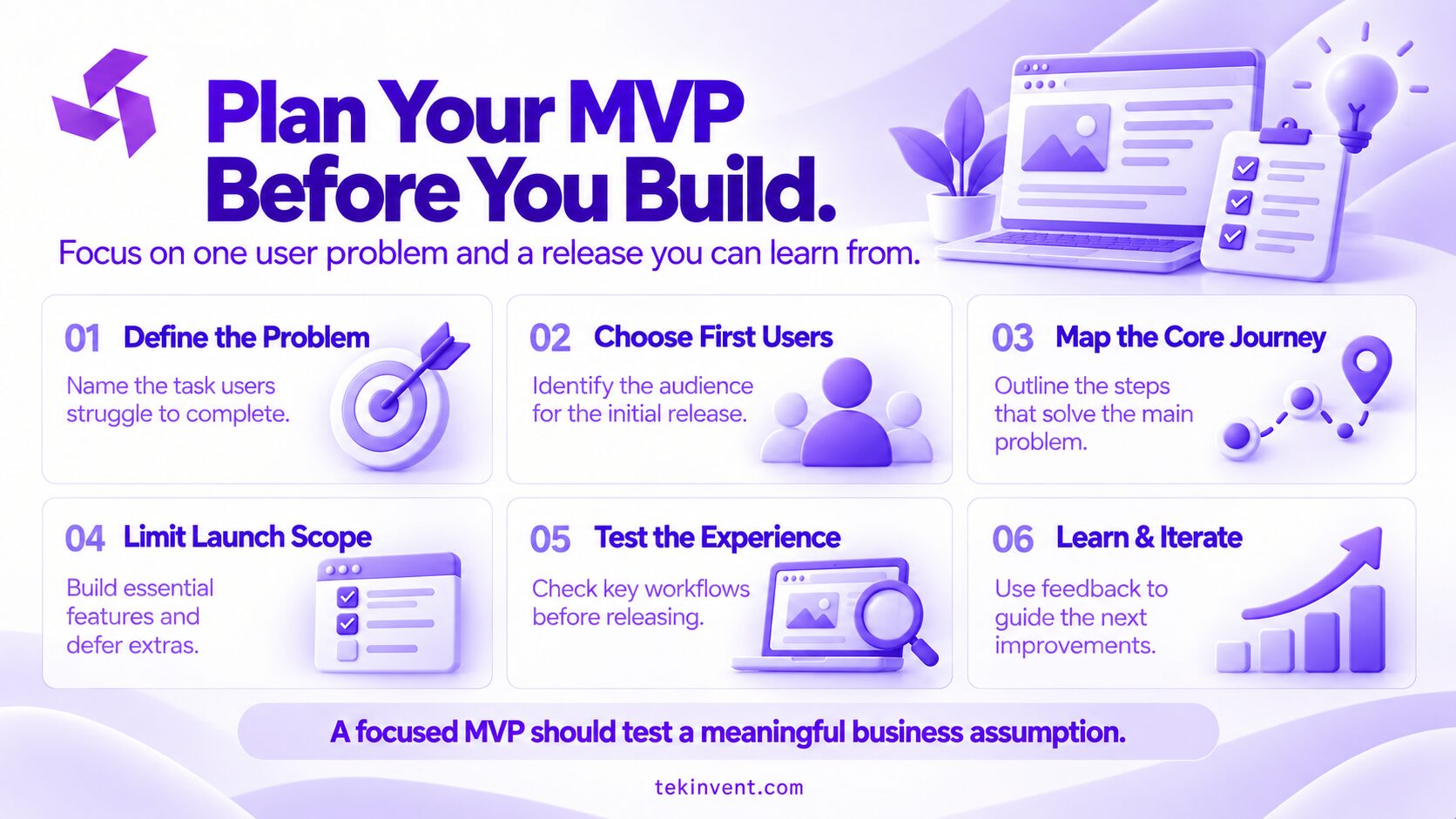
The MVP scope is the set of capabilities required to complete the core user outcome and learn from it. It should include the main path, the necessary supporting roles, and the failure cases that would make the product unsafe or unusable. It does not need every feature that may eventually help retention or efficiency.
Map the core workflow from the user’s first action to a clear result. Include what happens when required information is missing, a connection fails, or another person must review the request. These details often determine whether an MVP works in a real environment.
Use a feature decision test
For each proposed feature, ask:
- Does the core task fail without it?
- Is it necessary to protect user data or meet a confirmed obligation?
- Will it help answer the MVP’s main question?
- Can a person perform this step manually during a small pilot?
- Can the team add it later without reworking a core data model?
Features that are useful but not necessary belong in a later-release list. Keep the reason for deferring each one. That record prevents teams from revisiting the same debate every week and makes it easier to promote a feature when evidence supports it.
Decide which roles belong in version one
An app may involve customers, staff, managers, vendors, or administrators. Each role can create separate permissions, screens, and workflows. Include a role when the MVP needs that person to complete the main task or operate the service responsibly. Consider whether a simple internal process can substitute for a sophisticated dashboard during a limited pilot.
Manual steps are not automatically a weakness. They are useful when they are visible, safe, and manageable for the people performing them. Document who owns them, how requests are tracked, and what volume or delay would trigger automation.
Choose the right product form and technical approach
An MVP does not always need a native mobile application. A responsive web app may be enough if users complete the task occasionally and do not need device-specific behavior. A native or cross-platform app can be a better fit when the workflow relies on camera access, push notifications, offline operation, background activity, or regular use on a phone.
Make the decision from user needs. Test where people expect to access the service and which device functions are essential. Ask the delivery team to explain the maintenance implications of its recommendation, including how updates will be tested across supported platforms.
Build infrastructure for the pilot and a credible next step. Avoid designing for hypothetical scale, while preserving access control, data integrity, backups, and secure handling of sensitive information.
Plan for data, integrations, and safety
List the information the MVP collects, where it comes from, who can view or change it, and how long it needs to be retained. Collect only what supports the workflow. More fields create more user friction and more data to protect.
For each integration, confirm that the system owner can provide access, documentation, and a test environment. Identify what happens when the connection is unavailable or returns incomplete information. A payment, scheduling, identity, or inventory integration may be central to the product, but it should be included because the user outcome requires it—not because a competitor has one.
Products that handle health, financial, employee, or other sensitive information may have legal, contractual, or industry requirements. Those requirements depend on the product and organization. Consult qualified legal and security professionals early, and reflect confirmed obligations in the design and test plan. Do not treat a general checklist as a compliance determination.
A development and launch checklist
Before development starts, confirm the following:
- The target user and problem are specific.
- The main workflow has been mapped, including important exceptions.
- The MVP’s learning goal and decision rule are written down.
- Required platforms and device capabilities are known.
- User roles and access boundaries are documented.
- Data sources, integrations, and their owners are identified.
- Privacy, security, and accessibility needs have been reviewed.
- Features for later releases are separated from launch requirements.
- A product decision maker is available throughout the work.
Before launch, check that:
- Users can complete the main task without coaching.
- Error states explain what happened and what to do next.
- The team has tested supported devices and realistic network conditions.
- Access permissions prevent users from seeing or changing the wrong records.
- Backups, monitoring, and a way to report problems are in place.
- Support staff know how to handle the manual parts of the workflow.
- Users receive clear onboarding and privacy information.
- The team knows what evidence it will review after release.
Assign an owner to every checklist item so unresolved questions do not disappear between product, design, and engineering.
For a project that needs a local delivery partner, TekInvent’s mobile app development company in Houston page can help you start a scope discussion around your intended workflows.
Turn Your Houston App Idea Into a Testable MVP
TekInvent can help define a focused first release around your users and workflows.
Measure what happens after release
Choose a small set of measures that connect to the product’s main purpose. For a scheduling tool, that might include whether a request is completed, how often staff need to correct it, and whether users return for another task. For a customer portal, it might be whether people can find the information they came for without contacting support.
Do not track activity simply because analytics software makes it easy. Define each measure, the event that produces it, and who will review it. Combine usage data with interviews and support feedback. A high number of visits may not mean users are getting value, while a small number of successful transactions may reveal that the core workflow is sound but distribution needs work.
Set a review cadence before launch. Record what each review suggests and which product decision follows.
Common MVP mistakes to avoid
Building for several audiences at once
Founders often try to serve buyers, suppliers, managers, and partners in the first release. That creates a larger product before the team knows which side has the urgent problem. Start with the role and workflow needed to test the main assumption. Add other roles when the first path reveals a real dependency.
Treating a prototype as proof of demand
A prototype can test comprehension and navigation. It cannot confirm that users will adopt the service under real conditions. If adoption is the risk, the team needs a behavior-based test, such as completing a pilot task or returning to use the product again.
Leaving launch ownership unclear
Someone needs to watch for issues, respond to users, and decide which feedback affects the roadmap. If the founders, operations staff, and vendor all assume someone else owns support, the first release can become difficult to learn from. Name the owner and agree on escalation steps.
Expanding scope during development
New ideas will surface after users and stakeholders see the product take shape. Capture them, explain their impact, and decide whether they displace existing work. Keep the original test intact unless evidence gives the team a reason to change it.
Decide what to build next
An MVP is useful when evidence changes a decision. It may support investing in the next workflow, point to a different solution, or show that the problem is not important enough to pursue.
After launch, compare observed behavior with the decision rule. Look at where users complete or abandon tasks, what staff handle manually, and which issues recur. Prioritize the next release around an observed need and the cost of leaving it unresolved. That approach gives a Houston founder a disciplined path from idea to product without treating every assumption as a requirement.

Build Smart with The Right Team.
We bring expertise, technology, and trust you look for in your digital journey.