
Chicago businesses rely on technology to manage daily operations, improve customer experiences, and support long-term growth. From healthcare providers and logistics companies to retail stores and financial institutions, businesses need reliable software that works according to their operational requirements.
However, ready-made software does not always provide the flexibility businesses need. Some companies struggle with limited customization, expensive subscriptions, disconnected systems, or features that do not match their workflows.
This is where custom software development becomes a practical option.
One of the first questions business owners ask is how much they should expect to spend.
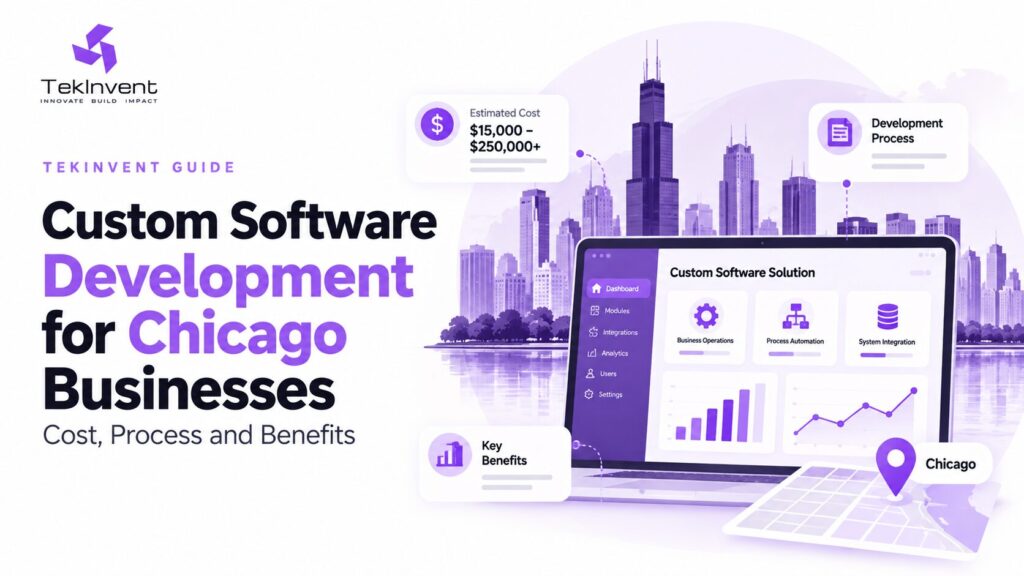
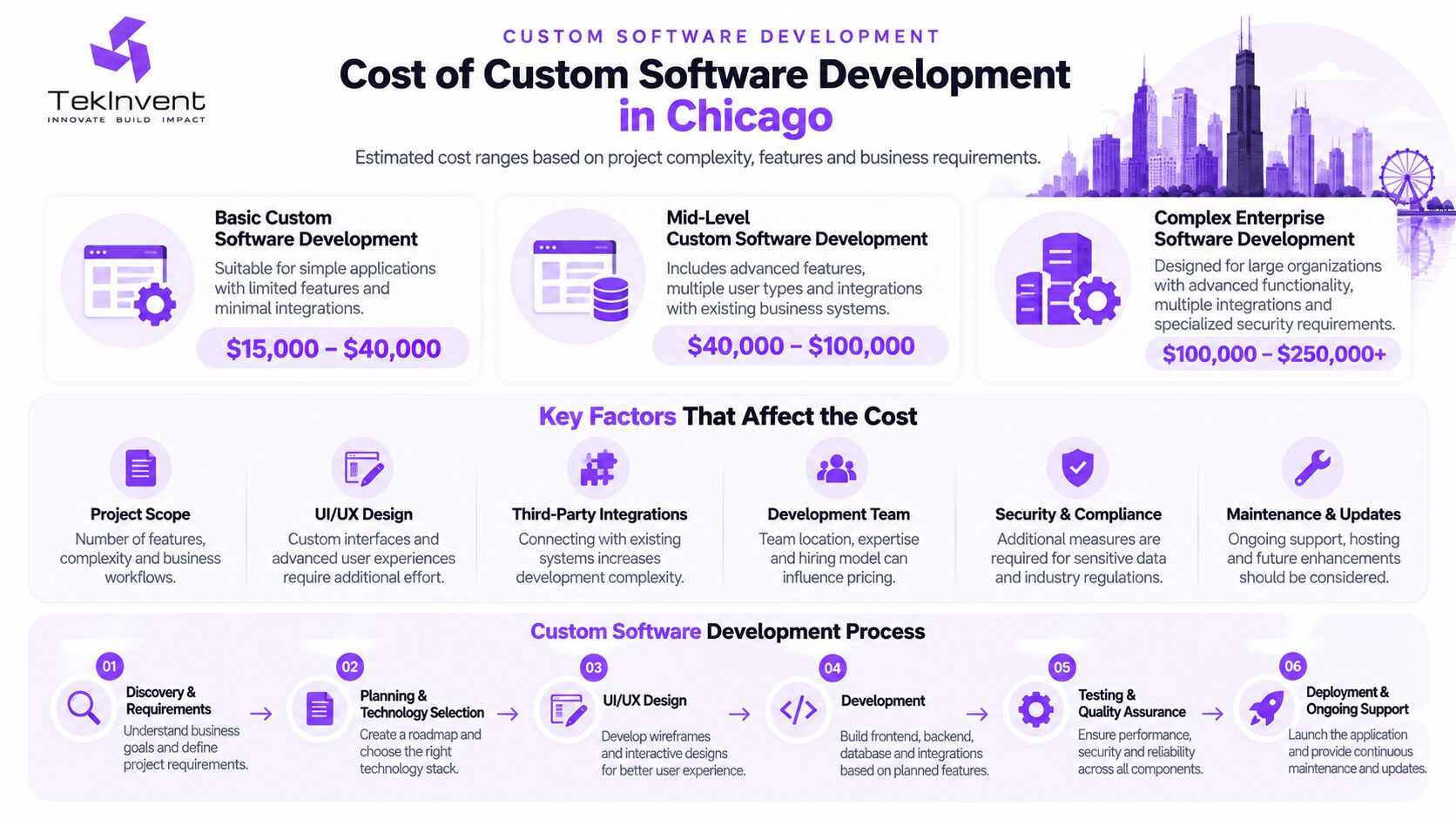
The custom software development cost in Chicago can range from approximately $15,000 for a relatively simple application to $250,000 or more for complex enterprise software. The final investment depends on project complexity, integrations, security requirements, development resources, and ongoing maintenance.
These figures are illustrative planning estimates rather than verified Chicago market averages or fixed development quotations.
This guide explains the estimated development costs, pricing factors, development process, and benefits to help Chicago businesses make informed decisions before investing in custom software.
What Is Custom Software Development and Why Do Chicago Businesses Need It?
Custom software development involves creating an application designed specifically around a company’s requirements, business processes, and long-term objectives.
Unlike ready-made solutions, custom software addresses particular operational challenges instead of providing the same standard features to every organization.
For example, a Chicago logistics company might need software that connects fleet management, delivery tracking, customer notifications, and internal reporting within a single platform.
A healthcare provider may require a patient management system that integrates with existing scheduling, billing, and electronic health record systems.
Similarly, a retail business operating multiple locations across Chicago might need centralized software to manage inventory, customer information, and sales reporting.
These requirements can become difficult to manage through multiple disconnected applications.
Working with an experienced custom software development in chicago allows businesses to evaluate their existing processes and develop solutions that align with their operational needs.
The objective is not simply to replace existing tools. It is to create software that helps employees work more efficiently, reduces repetitive activities, and supports future business growth.
How Much Does Custom Software Development Cost in Chicago?
Understanding the custom software development cost in Chicago is important before selecting a development partner or finalizing a project budget.
There is no universal price for custom software because every business has different requirements.
A basic internal application with limited functionality will generally cost less than a platform requiring multiple user roles, advanced integrations, real-time reporting, and extensive security features.
For initial budgeting, businesses can consider the following estimated project ranges.
Basic Custom Software Development
Estimated Cost: $15,000 to $40,000
Basic software typically focuses on solving a specific business problem with limited functionality.
Examples include employee management tools, internal dashboards, appointment scheduling systems, and simple inventory applications.
These projects usually involve a straightforward interface, limited user roles, and minimal third-party integrations.
For a small Chicago business looking to replace manual spreadsheets or automate repetitive administrative tasks, basic custom software can provide a practical starting point.
Mid-Level Custom Software Development
Estimated Cost: $40,000 to $100,000
Mid-level projects involve more advanced features, multiple user types, and integrations with existing business systems.
Examples include customer relationship management platforms, order management applications, business automation tools, and custom ecommerce management systems.
A Chicago distribution company, for example, may require software that connects inventory records, supplier information, customer orders, and delivery schedules.
Developing these interconnected features requires additional planning, backend development, and testing.
Complex Enterprise Software Development
Estimated Cost: $100,000 to $250,000+
Enterprise software typically supports larger organizations with complex operational requirements.
These applications may include advanced reporting, multiple system integrations, extensive access controls, automation, and specialized security requirements.
Examples include enterprise resource planning systems, healthcare management platforms, financial applications, and large-scale logistics solutions.
Projects involving artificial intelligence, extensive data migration, or specialized infrastructure can exceed these estimates.
Businesses should request a detailed project assessment rather than relying entirely on general pricing ranges.
What Factors Affect Custom Software Development Pricing?
Several factors influence the overall custom software development cost in Chicago. Understanding them can help businesses plan realistic budgets and avoid unexpected expenses.
Project Scope and Software Complexity
The number of features and the complexity of business workflows directly influence development effort.
A simple application that manages employee attendance requires fewer resources than a platform connecting human resources, payroll, reporting, and customer management.
Before requesting a development estimate, businesses should clearly define which features are essential and which can be introduced later.
UI and UX Design Requirements
Software should be easy for employees and customers to understand.
Applications requiring custom dashboards, multiple user journeys, interactive interfaces, or specialized accessibility features generally need additional design and testing.
Investing in usability early can reduce employee training difficulties and prevent expensive interface changes after launch.
Third-Party Integrations
Many businesses already use accounting software, CRM platforms, payment gateways, inventory tools, or other digital systems.
Connecting new software with these platforms can increase development complexity.
For example, a Chicago retail company might need its custom application to exchange information with Shopify, an accounting platform, and its existing warehouse management system.
Integration expenses depend on API availability, data structures, authentication requirements, and the complexity of information exchange.
Development Team and Hiring Model
The development team also influences project pricing.
Businesses may work with local developers, offshore teams, nearshore specialists, or a combination of different resources.
Local development teams may offer convenient communication and in-person collaboration, while distributed teams can provide access to additional technical expertise and different pricing structures.
However, selecting a development partner should involve more than comparing hourly rates.
Relevant experience, project management, communication, technical capabilities, and post-launch support are equally important.
Security and Compliance Requirements
Applications that manage sensitive business information, financial records, or healthcare data require additional security considerations.
Depending on the project, development teams may need to implement encryption, access controls, secure authentication, audit logging, and specialized compliance measures.
These requirements should be discussed during initial planning rather than introduced immediately before launch.
Maintenance and Future Updates
The initial development cost is only one part of the total investment.
Businesses should also budget for software updates, hosting, performance monitoring, security patches, bug fixes, and future improvements.
Maintenance requirements depend on the application architecture, hosting environment, number of integrations, and frequency of updates.
A clear maintenance agreement helps businesses understand what support is included after the application launches.
Custom Software Development Process for Chicago Businesses
Understanding the software development process helps business owners evaluate timelines, communicate expectations, and maintain control over project expenses.
Although the exact workflow varies between projects, most custom applications follow several important development stages.
Step 1: Business Requirements and Discovery
The development process begins with understanding the business problem.
During this stage, the development team discusses existing workflows, operational challenges, target users, and expected outcomes.
For example, a Chicago logistics business might explain that its employees currently use separate tools for delivery scheduling, customer communication, and fleet reporting.
The development team can then identify opportunities to connect these activities within a single application.
A detailed discovery process reduces misunderstandings and provides a clearer foundation for project estimates.
Step 2: Project Planning and Technology Selection
Once the requirements are understood, developers create a project roadmap.
This includes defining application features, technical architecture, development milestones, resource requirements, and estimated delivery timelines.
Technology selection depends on the type of software being developed.
A web-based business application may require a different technology stack from a mobile application or enterprise platform.
The selected technologies should support current requirements while allowing reasonable flexibility for future improvements.
Step 3: UI and UX Design
Designers develop wireframes and interactive prototypes to demonstrate how the software will function.
These designs help stakeholders understand navigation, screen layouts, and important user interactions before development begins.
For internal business applications, usability is particularly important because employees may interact with the software throughout their working day.
Reviewing prototypes early also allows businesses to identify potential usability problems before investing in full development.
Step 4: Software Development
During development, engineers build the application frontend, backend, database, integrations, and other required components.
Depending on the project, development may be divided into smaller milestones.
An iterative approach allows businesses to review progress, provide feedback, and make informed decisions throughout the project.
Regular communication helps ensure that the application continues to align with the original business objectives.
Step 5: Testing and Quality Assurance
Before launch, the software should undergo functional, performance, compatibility, and security testing appropriate to its requirements.
Quality assurance teams evaluate whether features work correctly and identify problems that could affect the user experience.
For example, an inventory management application should be tested to confirm that information updates correctly across connected systems.
Testing is particularly important when an application handles payments, sensitive customer information, or business-critical operations.
Step 6: Deployment and Ongoing Support
After testing and approval, the application is deployed to its intended environment.
This may involve cloud hosting, internal business infrastructure, or another deployment arrangement.
However, launching the software does not mark the end of the development relationship.
Businesses should monitor application performance, gather user feedback, address technical issues, and introduce improvements when necessary.
Regular maintenance helps the software remain reliable as business requirements and supporting technologies change.
How Long Does Custom Software Development Take?
Development timelines depend on application complexity, feature requirements, integrations, and the availability of project resources.
For general planning, a basic application may require approximately two to four months, while a mid-level business application may take four to eight months.
Complex enterprise software can require eight to twelve months or longer.
These are broad illustrative estimates. Actual timelines should be established after the project requirements have been reviewed.
A business can also consider launching a minimum viable product before developing every planned feature.
An MVP includes the essential functionality required to solve the primary business problem and gather feedback from initial users.
This approach allows companies to validate important assumptions before committing to a larger development investment.
Key Benefits of Custom Software Development for Chicago Businesses
Although custom software requires an initial investment, it can offer meaningful long-term benefits when developed around clear business requirements.
Improved Operational Efficiency
Custom software can automate repetitive activities and connect information that would otherwise remain scattered across different systems.
For example, a Chicago distribution business could use a centralized platform to manage orders, inventory, and delivery information.
This may reduce manual data entry and make operational information easier for employees to access.
Greater Flexibility and Scalability
Businesses change over time.
They may introduce new services, expand into additional locations, hire more employees, or adopt different operational processes.
Custom software can be designed to accommodate anticipated changes without forcing the organization to replace its entire system.
However, scalability should be considered during initial planning because poorly designed architecture can create limitations later.
Better Integration With Existing Systems
Custom applications can be developed to work with the software a business already uses.
Instead of replacing every existing platform, companies may be able to connect their most important systems and create a more consistent flow of information.
This can be particularly useful for organizations with established operational processes.
More Control Over Features and Development Priorities
Ready-made software often includes features that a business does not need while limiting functionality it considers important.
Custom development allows companies to prioritize features based on actual requirements.
Businesses can also plan future improvements according to customer feedback, operational changes, and available resources.
Long-Term Cost Management
Custom software is not automatically cheaper than subscription-based alternatives.
However, it can provide financial benefits when it replaces multiple disconnected tools, reduces repetitive work, or addresses requirements that would otherwise need expensive workarounds.
Businesses should compare the total cost of ownership rather than focusing only on initial development expenses.
This includes implementation, hosting, maintenance, training, upgrades, and any licensing obligations.
Custom Software vs Off-the-Shelf Software: Which Should Chicago Businesses Consider?
Choosing between custom software and ready-made applications depends on business requirements, available resources, and long-term objectives.
Off-the-shelf software can be suitable for businesses that need standard functionality and want to begin using a solution quickly.
For example, a small company requiring basic accounting or appointment scheduling may find that an established subscription platform already meets its needs.
Custom software becomes worth evaluating when existing tools cannot support important workflows, integrations, or operational requirements.
A growing Chicago logistics company may eventually need specialized functionality that standard software cannot provide without extensive modifications.
Before making a decision, businesses should compare implementation costs, customization options, ongoing expenses, integration capabilities, and future scalability.
The goal is to select a solution that addresses the actual business problem rather than choosing custom development simply because it offers more flexibility.
How to Choose a Software Development Company in Chicago
Choosing the right software development company in Chicago is an important decision for businesses planning to invest in custom applications.
The right development partner should understand your business requirements, have experience with similar projects, and provide clear communication throughout the development process.
Whether you need an internal management system, enterprise software, or a customer-facing application, evaluating technical expertise, previous work, and long-term support can help you make an informed decision.
Businesses should begin by reviewing the company’s experience with similar applications and industries.
A development team familiar with enterprise integrations may be suitable for complex business systems, while another team may specialize in customer-facing applications.
Ask potential development partners to explain their discovery process, project milestones, communication methods, and quality assurance practices.
Pricing transparency is equally important.
A proposal should clearly describe the expected deliverables, estimated timeline, payment structure, and how additional requirements will be handled.
Businesses should also discuss intellectual property ownership, access to source code, documentation, deployment responsibilities, and maintenance arrangements before signing an agreement.
A reliable development relationship should provide clarity throughout the project, not just during the initial sales discussion.
How Can Chicago Businesses Reduce Custom Software Development Costs?
Reducing development expenses does not necessarily mean selecting the lowest-priced development team.
A more practical approach is to control project scope and prioritize functionality that delivers measurable business value.
Start by documenting the operational problem and identifying the features required to solve it.
Avoid introducing unnecessary functionality during the initial development stage.
Businesses can also consider an MVP approach, use established frameworks where appropriate, and review existing systems before building replacements.
Clear communication and timely feedback can reduce misunderstandings that otherwise lead to additional development work.
Most importantly, establish a realistic budget that includes both initial development and ongoing maintenance.
Planning these expenses early can help prevent financial surprises after the application launches.
Final Thoughts
Understanding the custom software development cost in Chicago helps businesses make informed decisions about their technology investments.
While basic applications may begin around $15,000, more advanced business platforms can require significantly larger budgets depending on their features, integrations, and technical requirements.
The most important consideration is not simply how much the software costs to build. It is whether the final application solves a genuine business problem and provides sufficient value over time.
For Chicago businesses considering custom software, a clear project scope, realistic budget, experienced development team, and long-term maintenance strategy can provide a stronger foundation for success.
TekInvent helps businesses explore custom software solutions based on their operational requirements and growth objectives.
Planning a custom software project? Contact TekInvent to discuss your requirements, explore suitable development options, and request a project estimate.

Build Smart with The Right Team.
We bring expertise, technology, and trust you look for in your digital journey.