
Multiplayer games create something single-player experiences cannot fully replicate: interaction between real people.
Players can compete, cooperate, communicate, form teams, build communities, and return because every match can unfold differently. But creating that experience requires much more than simply allowing two players to enter the same game.
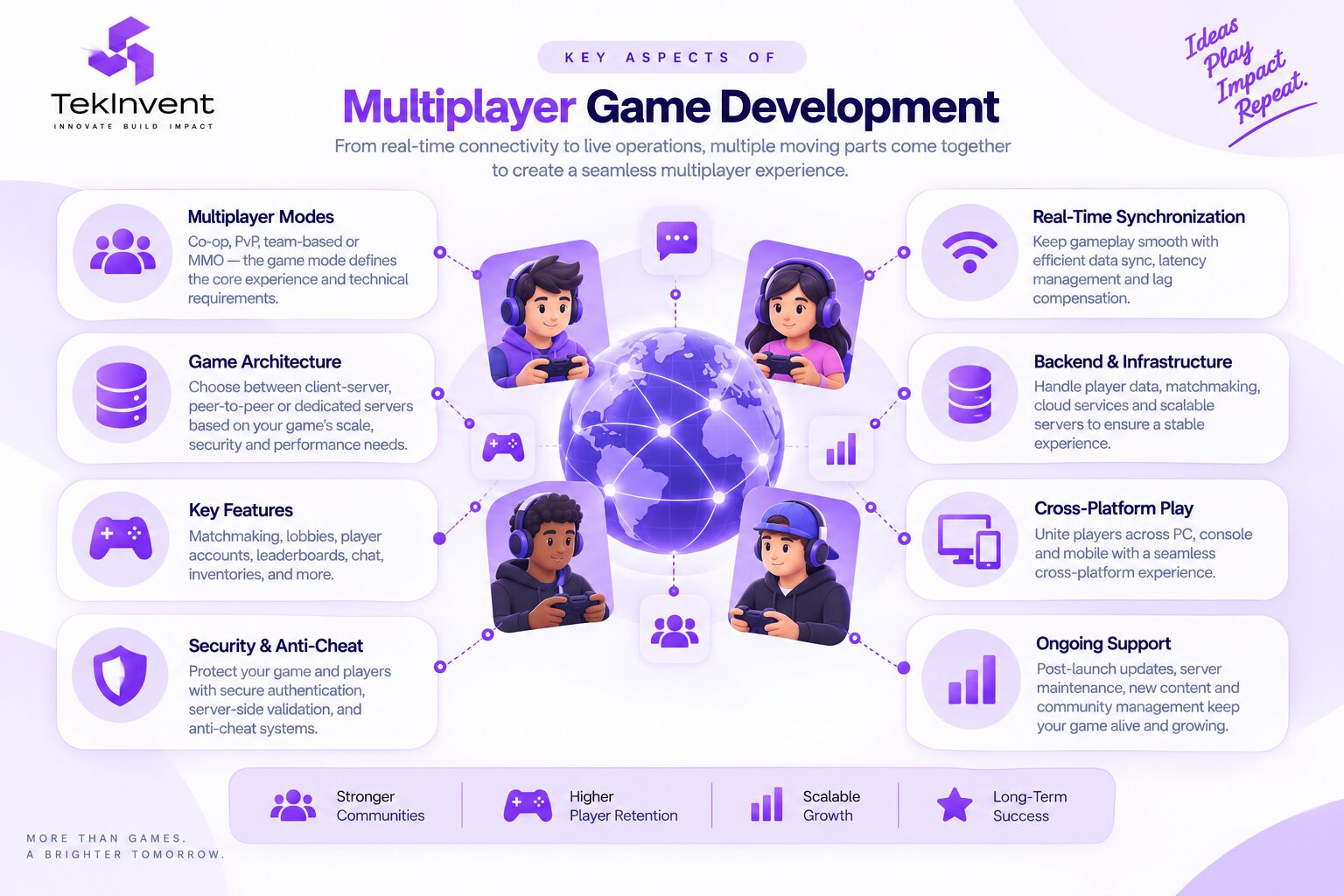
Multiplayer game development requires gameplay systems, networking architecture, synchronization, matchmaking, player accounts, backend infrastructure, security, testing, scalability, and ongoing server management to work together.
A multiplayer shooter may need near real-time synchronization between players. A turn-based strategy game can tolerate more network delay. A cooperative game may prioritize easy matchmaking and stable sessions, while a competitive game may require authoritative servers, ranking systems, anti-cheat measures, and significantly tighter latency management.
For businesses, this means the right question is not simply, “How much does a multiplayer game cost?”
The better starting point is understanding what type of multiplayer experience you want to create, how many players need to interact, how quickly information must move between them, and what infrastructure will be required to support the game after launch.
What Is Multiplayer Game Development?
Multiplayer game development is the process of designing and building a game where multiple players can participate in the same gameplay experience locally or through a network.
Online multiplayer games usually require information to move continuously between players and a server.
Consider a racing game.
One player accelerates, another turns, a third crashes, and another crosses the finish line. Those actions happen on separate devices, but every connected player needs to see a sufficiently consistent version of what happened.
That is where networking becomes critical.
In a client-server architecture, players run game clients while a server maintains or validates the shared game state. Unreal Engine, for example, uses a client-server model in which the server holds the authoritative game state and communicates relevant changes to connected clients. Epic Games Developers
Multiplayer development therefore combines traditional game production with networking and backend engineering.
The graphics, mechanics, animations, levels, UI, and audio still need to be created, but developers must also decide how the game communicates across multiple machines.
Why Multiplayer Games Are More Complex Than Single-Player Games
In a single-player game, the device running the game generally has direct access to the local game state.
Multiplayer changes that relationship.
Players may be thousands of miles apart.
One player might have a 20 ms connection to the server while another experiences 150 ms latency. Connections may temporarily drop. Packets can arrive late. Players can disconnect unexpectedly.
Meanwhile, the game still needs to feel responsive.
The architecture must also consider cheating because developers cannot always trust information coming from a player’s device.
Epic’s current networking documentation describes networked multiplayer as inherently more complex than local or single-player gameplay because game-state information must be communicated across potentially unstable network connections. Epic Games Developers
This is also why multiplayer should be considered early.
Trying to convert a finished single-player game into an online multiplayer product can require substantial architectural changes. Epic specifically recommends planning for multiplayer from the beginning when it may become a requirement later. Epic Games Developers
Step 1: Define the Multiplayer Experience
The multiplayer game development process should begin with the player experience rather than the server technology.
Define what players actually do together.
Is the game cooperative?
Competitive?
Player versus player?
Team based?
Turn based?
Real time?
Massively multiplayer?
Does a match contain two players, eight players, 100 players, or thousands of persistent users?
These decisions affect almost everything that follows.
A two-player chess game does not have the same networking requirements as a 100-player battle royale.
Likewise, a casual cooperative game does not necessarily need the infrastructure of an esports-focused competitive title.
Before development starts, define the expected session size, match duration, geographical audience, persistence requirements, competitiveness, and acceptable latency.
Those requirements become the foundation for the technical architecture.
Step 2: Choose the Right Multiplayer Architecture
One of the most important decisions is how players communicate and who controls the authoritative game state.
A casual game may use a listen-server model where one player’s machine acts as both host and client.
For competitive or larger-scale games, dedicated servers are often more appropriate.
Unreal’s documentation explains that a listen server includes a local player acting as host, while a dedicated server runs without a local player. Because nobody plays directly on the dedicated server, it can focus resources on gameplay and networking and avoid giving the hosting player the same advantage found in a listen-server setup. Epic Games Developers
Dedicated infrastructure, however, creates additional development and operating requirements.
Servers need to be deployed, monitored, scaled, secured, and paid for.
The architecture should therefore reflect the game rather than automatically selecting the most complicated option.
Step 3: Select the Game Engine and Networking Technology
Technology selection affects development workflow, performance, available networking tools, team requirements, and scalability.
Unity currently provides Netcode for GameObjects and Netcode for Entities for real-time synchronized multiplayer experiences. Unity describes Netcode for GameObjects as suited to projects with smaller player counts and less complex game logic, while Netcode for Entities is designed for higher-performance scenarios involving larger numbers of players or more complex logic. Unity Documentation
Unreal Engine provides replication and client-server networking systems designed specifically for multiplayer development. Epic Games Developers
Neither engine is automatically correct for every project.
The decision should account for genre, platforms, graphical requirements, expected player count, networking model, developer expertise, backend requirements, and long-term maintenance.
If you are deciding between the two engines, TekInvent’s Unity vs Unreal Engine comparison explains the differences in graphics, programming, performance, mobile development, and project suitability.
Step 4: Build the Multiplayer Prototype
Building the entire game before validating networking is risky.
Instead, create a prototype around the most important multiplayer interaction.
For a shooter, that could mean two or more players joining a session, moving, shooting, taking damage, and seeing synchronized results.
For a racing game, it might involve multiple vehicles joining the same race and maintaining reasonably consistent positions across clients.
The prototype does not need final graphics.
Its purpose is to answer technical questions early.
Can players connect reliably?
Does movement feel responsive?
How does the game behave under latency?
Which information needs to be synchronized?
How much network traffic is generated?
What happens when a player disconnects?
Answering these questions before full production reduces the chance of discovering fundamental networking problems after expensive assets and gameplay systems have already been built.
Step 5: Develop Player Accounts and Authentication
Many online games need to recognize individual players.
That usually requires some form of authentication and player identity.
An account system can support profiles, progression, inventories, friends, rankings, purchases, achievements, bans, statistics, and cross-device continuity.
Authentication requirements depend on the project.
A lightweight casual game may need relatively little persistent account functionality.
A competitive cross-platform title may need considerably more.
Security also matters because authentication systems can become targets for account theft and abuse.
Account architecture should therefore be planned alongside backend infrastructure rather than treated as a simple UI screen.
Step 6: Build Matchmaking and Lobby Systems
Getting players into a game is a major part of the experience.
Poor matchmaking can make an otherwise excellent game frustrating.
A basic matchmaking system might connect any available players.
A more sophisticated system could consider skill level, geographic region, latency, party size, game mode, ranking, platform, or waiting time.
Competitive games often require additional balancing logic so that matches feel reasonably fair.
Lobby systems can also allow players to invite friends, form parties, select modes, choose characters, configure settings, and prepare before a match begins.
Unreal’s current multiplayer tools explicitly include session management for creating, finding, joining, and managing network multiplayer sessions. Epic Games Developers
For businesses, matchmaking should therefore be treated as a core product system rather than an invisible technical feature.
Step 7: Synchronize the Game State
Synchronization is at the heart of real-time multiplayer development.
Players need to see sufficiently consistent information about positions, actions, health, projectiles, objects, scores, and other gameplay events.
But sending every piece of information constantly would consume unnecessary bandwidth.
Developers need to determine what must be synchronized, how often it should be sent, and which system has authority over it.
Unreal calls the synchronization of data and procedure calls between clients and servers replication. Epic Games Developers
Different game genres require different synchronization strategies.
A card game may tolerate noticeable network delay because actions occur relatively slowly.
A competitive shooter needs much tighter handling because fractions of a second can influence whether a shot hits.
Networking architecture must therefore be designed around gameplay.
Step 8: Handle Latency Without Making the Game Feel Slow
Network latency cannot be completely eliminated.
Even excellent infrastructure cannot make physical distance disappear.
Instead, multiplayer developers use techniques that help the game remain responsive despite network delay.
Depending on the game, these can include client prediction, interpolation, reconciliation, lag compensation, buffering, and server-side validation.
The appropriate technique depends on the gameplay.
A shooter and a turn-based strategy game should not necessarily solve latency in the same way.
The important business consideration is that responsive multiplayer gameplay requires engineering and testing beyond simply renting a server.
Networking quality becomes part of the user experience.
Essential Features of a Multiplayer Game
There is no universal feature list because multiplayer products serve different audiences.
However, commercial online games commonly need several interconnected systems.
Matchmaking connects players.
Lobbies organize sessions.
Player profiles establish persistent identities.
Friends and party systems allow people to play together.
Leaderboards and rankings support competition.
Chat or communication systems enable interaction.
Progression gives players long-term objectives.
Achievements provide additional milestones.
Cloud saves preserve progress.
Analytics help teams understand player behavior.
Moderation and reporting tools help manage abusive behavior.
Reconnect functionality can prevent a temporary connection failure from immediately ruining a match.
Each feature adds development work.
It may also affect backend architecture, databases, UI, testing, security, and operating cost.
Businesses should therefore distinguish launch-critical features from features that can be introduced later.
Multiplayer Backend Development
Players mostly see the game client.
A large portion of multiplayer complexity exists behind it.
The backend may handle authentication, profiles, inventories, matchmaking, rankings, player statistics, progression, cloud saves, purchases, social features, server allocation, analytics, and administrative tools.
Persistent games may require databases that continue storing player information when nobody is actively playing.
Competitive titles may require server-side validation to reduce manipulation.
Live games can also require remote configuration so teams can adjust certain values without forcing every player to download a completely new game build.
The backend is therefore not simply supporting technology.
For many multiplayer products, it is part of the core game.
Dedicated Servers vs Listen Servers
A listen server can work well for some cooperative or casual games.
One player’s machine hosts the session while also participating in it.
This can reduce infrastructure requirements, but it creates limitations.
The host can have a connection advantage.
The session may end if the host leaves unless host migration exists.
Performance depends partly on the host’s machine and network.
Dedicated servers separate hosting from the players.
Every player connects remotely, and the server focuses on authoritative game logic.
Epic notes that dedicated servers are particularly suitable for larger-scale or competitive games where fairness, security, reliability, or higher networking loads matter. Epic Games Developers
The tradeoff is cost and complexity.
Dedicated infrastructure must continue operating after development is complete.
That means multiplayer budgeting should include both development and ongoing hosting.
Multiplayer Game Security and Anti-Cheat
Competitive multiplayer games attract attempts to gain unfair advantages.
That makes security a product requirement.
Developers need to decide which actions can be trusted from clients and which must be validated by the server.
Sensitive gameplay calculations may need server authority.
Rate limits can reduce certain types of abuse.
Suspicious activity may need monitoring.
Account systems require secure authentication.
Competitive games may also require dedicated anti-cheat solutions.
No anti-cheat strategy eliminates every possible exploit.
The goal is to make cheating harder, detect suspicious behavior, limit its impact, and provide mechanisms for responding when it occurs.
Security requirements should be defined during architecture planning because adding them after launch can be substantially harder.
Cross-Platform Multiplayer Development
Cross-platform multiplayer allows players using different devices or ecosystems to play together.
This can increase the potential player pool but also increases development complexity.
Different platforms may use different input methods, hardware capabilities, account systems, store ecosystems, and platform services.
The game may need to normalize gameplay across these environments.
A PC player using a mouse and keyboard may have different control characteristics from a mobile player using a touchscreen.
Competitive matchmaking may therefore need platform or input considerations.
Cross-progression creates additional backend requirements because player progress must remain consistent across devices.
For businesses, cross-platform support should be an intentional product decision rather than something added automatically.
2D Multiplayer Game Development
Multiplayer networking is not limited to 3D games.
A 2D platformer, card game, fighting game, strategy game, racing title, or cooperative puzzle game can contain sophisticated online functionality.
The visual pipeline may be different, but systems such as matchmaking, authentication, synchronization, leaderboards, databases, chat, security, and server infrastructure can still be required.
Businesses considering this direction can work with a 2D game development company to determine how the art pipeline and multiplayer architecture fit together.
If the visual direction is still undecided, 2D vs 3D game development guide explains how both approaches differ in graphics, production, performance, and project requirements.
3D Multiplayer Game Development
3D multiplayer projects can add another layer of production complexity.
Characters may require modeling, texturing, rigging, and animation.
Environments need to be created and optimized.
Lighting, effects, physics, and cameras can increase hardware requirements.
Now those systems also need to function while players exchange information over a network.
For example, a multiplayer action game may need synchronized character movement, attacks, projectiles, physics interactions, animations, health, and environment events.
A 3D game development company therefore needs to consider both the visual production pipeline and networking requirements from the beginning.
For businesses evaluating the financial side of these assets and systems, 3D game development cost guide provides a dedicated breakdown of the major budget drivers.
Multiplayer Testing Is Different From Normal Game Testing
Multiplayer QA is not simply single-player testing with two people.
Developers need to test what happens under different network conditions.
Connections can be slow.
Latency can fluctuate.
Packets can be delayed.
Players can disconnect and reconnect.
Servers can fail.
Multiple players can attempt the same interaction simultaneously.
The game needs to respond predictably.
Testing should therefore cover normal gameplay and unstable conditions.
Unity provides multiplayer tooling that includes network simulation and profiling, while Unreal’s current testing tools allow developers to launch multiple player instances and dedicated-server configurations for network testing. Epic Games Developers
Real-world testing remains important because production environments can behave differently from local development environments.
How Long Does Multiplayer Game Development Take?
A small multiplayer prototype may be developed relatively quickly, but a commercial product can require many months or longer depending on its scope.
The number of players matters.
The game genre matters.
Backend requirements matter.
The amount of content matters.
Cross-platform support matters.
Competitive systems matter.
The team also needs time for networking tests and optimization.
Rather than repeating the complete production timeline here, game development timeline explains concept development, pre-production, prototyping, production, testing, launch, and post-launch work in more detail.
The important multiplayer-specific point is that networking should be tested early rather than left until the end of production.
How Much Does Multiplayer Game Development Cost?
The multiplayer game development cost varies too widely for one number to be meaningful.
A simple two-player casual title and a competitive online game supporting thousands of concurrent users are completely different products.
Budget is influenced by gameplay complexity, number of players per session, networking architecture, server requirements, backend features, platforms, art production, matchmaking, security, social functionality, testing, and post-launch support.
A multiplayer project can also create recurring expenses that a purely offline game may not have.
Servers need hosting.
Databases need infrastructure.
Monitoring services may be required.
Bandwidth is consumed.
Live operations require people.
Customer support and moderation may also become necessary as the player base grows.
This means businesses should evaluate total cost of operation, not only initial development cost.
What Makes Multiplayer Development More Expensive?
Networking affects many systems simultaneously.
A new gameplay mechanic might require additional replication logic.
A new inventory system may require backend storage.
A ranking feature can require databases and matchmaking integration.
Voice chat introduces additional infrastructure and moderation considerations.
Cross-platform support expands testing.
Large player counts increase scalability requirements.
Security introduces additional engineering.
Live operations continue after launch.
That is why simply comparing a multiplayer game’s graphics with a single-player game’s graphics does not provide a useful cost comparison.
Much of the additional work is invisible in screenshots.
Server Infrastructure and Ongoing Cost
Multiplayer games can continue generating technical costs even when the development team is not releasing new features.
Dedicated servers consume compute resources.
Databases store player information.
Network traffic uses bandwidth.
Monitoring systems track availability and performance.
Backups protect persistent data.
Server capacity may need to increase as the player base grows.
Businesses should therefore model server costs at different usage levels.
What happens with 1,000 active players?
What happens with 10,000?
What happens if the game suddenly attracts 100,000?
A scalable architecture does not necessarily mean paying for maximum capacity from day one.
It means designing infrastructure that can grow without requiring the entire backend to be rebuilt.
How to Reduce Multiplayer Game Development Cost
The safest approach is usually to control scope rather than cutting critical networking work.
Start with the smallest meaningful multiplayer experience.
If the complete vision includes ten game modes, launch with the strongest one or two.
If the game eventually needs 100-player matches, determine whether the first version genuinely requires that scale.
Avoid developing complex social features before the core gameplay has been validated.
Prototype networking early.
Use established networking technologies where they fit the project.
Design backend systems around realistic launch traffic rather than hypothetical massive scale.
Separate launch requirements from future updates.
A focused multiplayer product that works reliably is more valuable than an ambitious feature list built on unstable networking.
Mobile Multiplayer Game Development
Mobile introduces additional constraints because players may move between Wi-Fi and cellular connections, use different device generations, and experience varying network quality.
Developers also need to consider battery consumption, thermal limitations, memory, touchscreen controls, background behavior, and platform requirements.
A multiplayer mobile game therefore needs to balance networking with device performance.
If mobile is your primary platform, mobile game development process covers the broader path from concept and prototyping to production, testing, store submission, launch, and updates.
Multiplayer functionality should be integrated into that process early rather than attached shortly before release.
Launching a Multiplayer Game
Launching is not the end of multiplayer development.
In many cases, it is when the most valuable real-world information begins arriving.
The team needs to monitor server health, latency, matchmaking performance, crashes, disconnects, player behavior, queue times, cheating reports, and infrastructure usage.
Unexpected player growth can stress systems.
Unexpectedly low activity can create matchmaking problems because fewer players are available at the same time.
Balance issues can appear when thousands of people discover strategies the development team never anticipated.
A successful multiplayer launch therefore needs both technical monitoring and a product plan for responding to player behavior.
Post-Launch Development and Live Operations
Multiplayer communities expect games to remain active.
Depending on the business model, post-launch work can include new maps, characters, weapons, modes, events, cosmetics, balance changes, bug fixes, server improvements, seasonal content, and security updates.
Not every game needs an aggressive LiveOps strategy.
But every online game needs some level of maintenance.
Server dependencies change.
Platforms evolve.
Security issues emerge.
Players discover bugs.
Infrastructure requires monitoring.
These costs should be considered before launch rather than treated as unexpected expenses later.
When Should You Work With a Game Development Company?
A business should begin discussing the project with a game development company once the core concept, audience, platform, gameplay loop, multiplayer model, and approximate scope are clear.
You do not need every technical decision finalized.
The development team should help determine architecture.
What matters is having enough product clarity to answer questions such as how many people play together, whether gameplay is real time, whether the game is competitive, what needs to persist between sessions, which platforms need support, and how the product is expected to grow.
From there, developers can plan the prototype, networking model, backend, gameplay systems, content pipeline, QA requirements, deployment strategy, and production milestones.
What Should Businesses Define Before Requesting a Quote?
The more clearly the project is defined, the more meaningful the estimate becomes.
Start with the core gameplay loop.
Define whether players cooperate or compete.
Determine the maximum number of players per session.
Identify target platforms.
Decide whether cross-play is required.
List the essential launch features.
Clarify whether players need accounts, inventories, rankings, friends, parties, chat, or persistent progression.
Describe the expected art style.
Determine whether dedicated servers are necessary.
Consider launch regions.
Estimate how the player base could grow.
Finally, separate essential features from ideas that can wait.
A quote based on these requirements will be much more useful than asking for a generic price for “a multiplayer game.”
Final Thoughts
Multiplayer game development is not simply single-player game development with an internet connection added.
It requires gameplay, networking, servers, synchronization, backend infrastructure, matchmaking, player identity, security, testing, scalability, and post-launch operations to work together.
The correct architecture depends on the experience.
A two-player cooperative game may have relatively modest infrastructure needs. A competitive real-time title with large player counts may require authoritative dedicated servers, sophisticated matchmaking, extensive backend services, security systems, and continuous monitoring.
Current Unity and Unreal tooling can provide developers with networking frameworks, replication systems, dedicated-server support, testing tools, and multiplayer services, but those technologies still need to be designed around the game’s specific requirements. Epic Games Developers
For businesses, the safest approach is to define the multiplayer experience first, prototype networking early, validate performance under realistic conditions, and expand only after the core experience is stable.
That creates a stronger foundation for estimating development cost, planning infrastructure, and ultimately building a multiplayer game that can continue working when real players arrive.

Build Smart with The Right Team.
We bring expertise, technology, and trust you look for in your digital journey.