
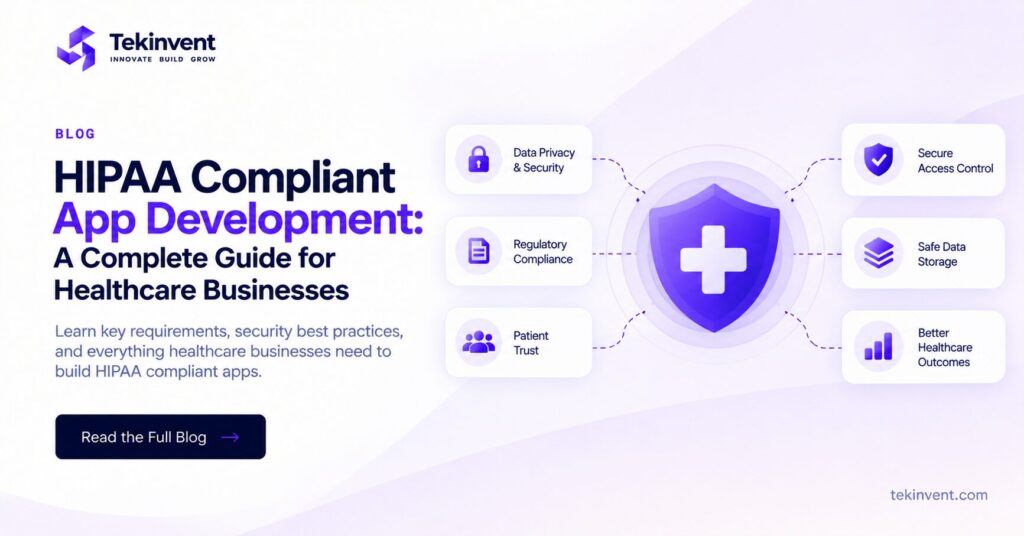
Healthcare applications handle some of the most sensitive information a business can manage. Patient records, prescriptions, medical histories, appointments, insurance details, test results, and communication between patients and healthcare providers may all involve protected health information.
That makes HIPAA compliant app development different from ordinary mobile app development. Healthcare businesses need to consider privacy and security throughout planning, design, development, testing, deployment, and ongoing maintenance.
HIPAA compliance is also not achieved by simply adding encryption or choosing a secure hosting provider. Whether HIPAA applies and what safeguards are appropriate depends on the organization, its relationships, the data being handled, and how that information moves through the application.
This guide explains what healthcare businesses should understand before developing a HIPAA compliant application, including ePHI, access controls, authentication, encryption, audit controls, cloud infrastructure, Business Associate Agreements, APIs, testing, and ongoing security.
What Is HIPAA Compliant App Development?
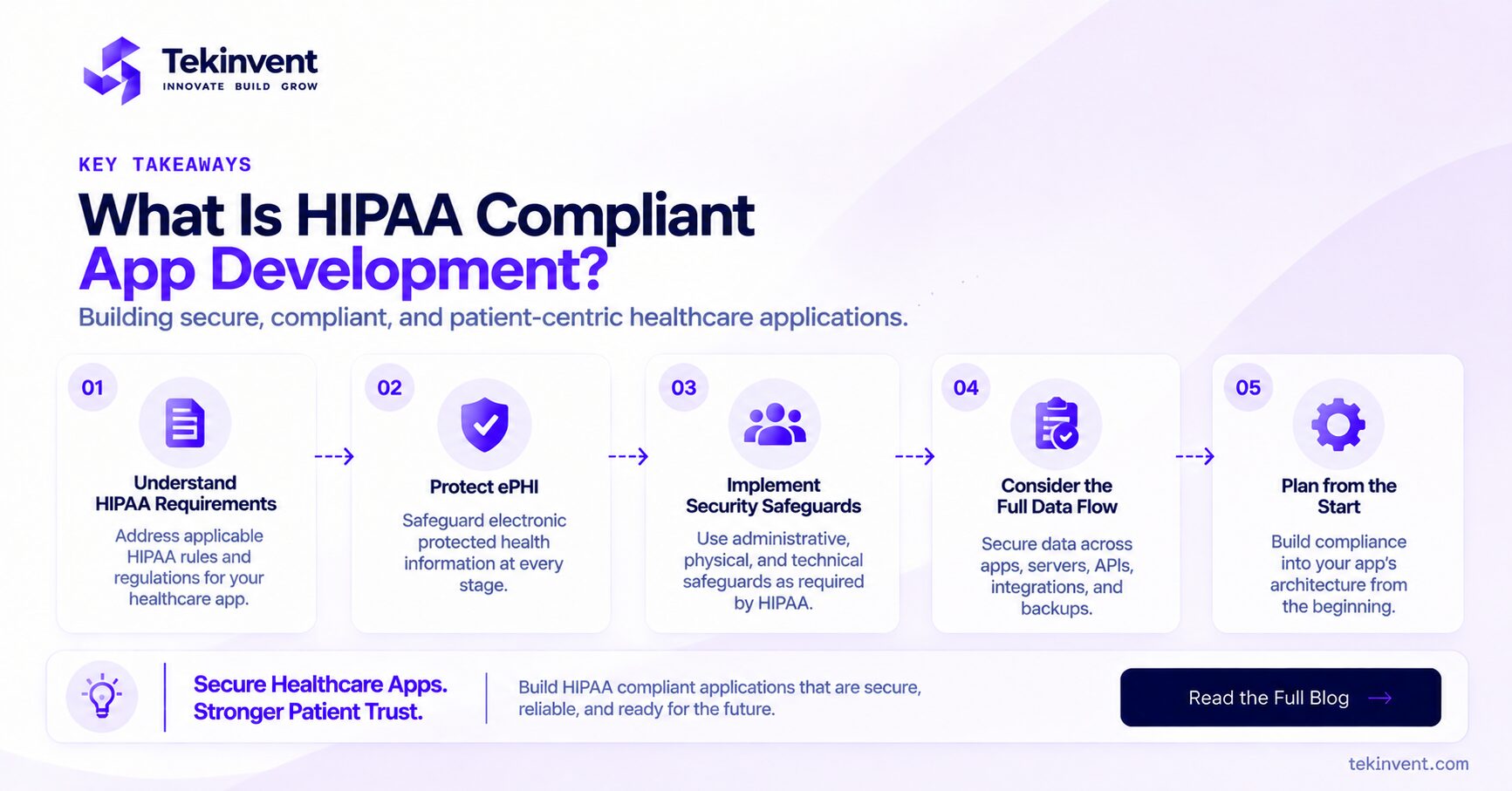
HIPAA compliant app development refers to designing and developing a healthcare application in a way that addresses applicable requirements of the Health Insurance Portability and Accountability Act.
For organizations subject to HIPAA, the application must be designed to protect electronic protected health information, commonly known as ePHI.
The HIPAA Security Rule requires covered entities and their business associates to use appropriate administrative, physical, and technical safeguards to protect ePHI.
This means security considerations extend beyond the mobile interface.
Healthcare businesses need to understand where information is collected, where it is stored, which systems receive it, who can access it, how it travels between systems, and what happens when information is updated or deleted.
Building these considerations into the architecture from the beginning is generally much more practical than attempting to add them after an application has already been developed.
Does Every Healthcare Mobile App Need HIPAA Compliance?
Not every healthcare, fitness, or wellness application automatically falls under HIPAA.
HIPAA applicability depends on factors such as who operates the application, the organization’s role, the information being handled, and the relationship between the app provider and HIPAA regulated entities.
For example, an app developer can become a business associate when it creates, receives, maintains, or transmits PHI on behalf of a covered entity. An application independently selected by a consumer can fall into a different situation depending on how information reaches the application and who controls it.
This distinction should be determined early.
Businesses should not simply assume that calling an application a healthcare app automatically makes it HIPAA compliant or subject to HIPAA.
Other federal and state privacy or healthcare regulations may also apply depending on the product and its users.
What Are PHI and ePHI?
PHI stands for Protected Health Information.
In the HIPAA context, it generally involves individually identifiable health information protected by HIPAA when handled by regulated entities.
When protected health information is created, received, maintained, or transmitted electronically, it is generally referred to as ePHI.
In a mobile application, sensitive information can exist in many places.
Patient information might move through the mobile application, APIs, backend servers, databases, cloud storage, administrative dashboards, backups, notifications, and external integrations.
A strong HIPAA compliant mobile app development strategy therefore needs to consider the complete data flow rather than protecting only what users see on their screens.
Core Security Safeguards for HIPAA Compliant App Development
HIPAA does not prescribe one specific programming language or mobile development framework that every organization must use.
Instead, organizations need to evaluate their circumstances and risks and implement appropriate safeguards.
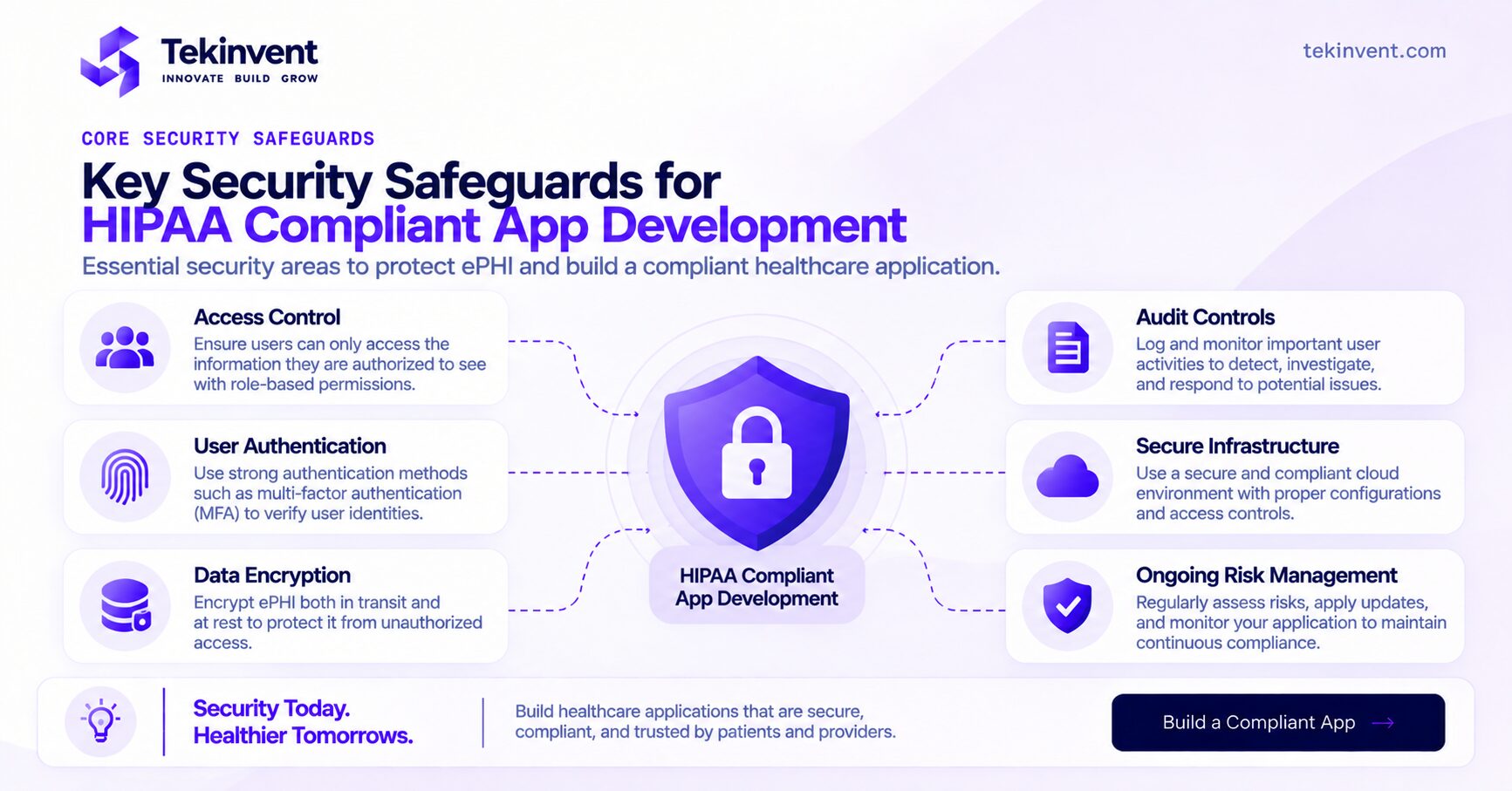
Several technical areas are particularly important when developing healthcare applications.
Access Control
Healthcare applications should prevent users from accessing information they are not authorized to see.
Consider an application used by patients, physicians, nurses, and administrative employees.
A patient may need access to personal records and appointments. A doctor may need clinical information for assigned patients. Administrative employees may require scheduling information without requiring access to complete medical histories.
Role based access controls can help enforce these boundaries.
Permissions should follow real healthcare workflows instead of giving every authenticated user broad access.
User Authentication
Applications also need appropriate methods for confirming user identities.
Depending on the risks and use case, authentication strategies can involve secure passwords, multifactor authentication, appropriate session management, account recovery controls, and other security measures.
Authentication should be considered together with authorization.
Successfully proving someone’s identity does not mean that person should have unrestricted access to the application.
Audit Controls
Healthcare organizations may need to understand what happens inside systems that contain or use ePHI.
Audit capabilities can record relevant system activity and help organizations investigate unusual or unauthorized behavior.
Depending on the application, audit information may help determine who accessed information, when it was accessed, and what actions occurred.
The HIPAA Security Rule specifically addresses mechanisms for recording and examining activity in systems containing or using ePHI.
Data Integrity
Healthcare applications should also protect information against improper alteration or destruction.
Developers need to consider how records are created, changed, transferred, and protected.
This becomes especially important when multiple systems exchange patient information through APIs or other integrations.
Transmission Security
Healthcare information frequently travels between smartphones, APIs, backend systems, cloud infrastructure, and third party services.
Technical safeguards should protect ePHI against unauthorized access during electronic transmission.
Secure communication protocols and appropriate encryption should therefore be considered during system architecture rather than added shortly before launch.
Risk Management
Security risks change throughout an application’s lifecycle.
New features, dependencies, integrations, infrastructure changes, and emerging vulnerabilities can introduce risks that did not exist when the application originally launched.
Risk management therefore needs to continue after development.
Encryption and HIPAA Compliant Mobile App Development
Encryption is an important security consideration when healthcare applications process sensitive information.
Businesses should consider protection for information both while it is being transmitted and when it is stored.
However, encryption alone does not make an application HIPAA compliant.
An application could use strong encryption while still having weak passwords, excessive permissions, insecure APIs, poorly configured infrastructure, or inadequate monitoring.
The security architecture should therefore consider encryption together with authentication, access control, audit controls, integrity, backups, infrastructure, and risk management.
Businesses should also understand where information might appear outside the primary database, such as logs, backups, temporary files, analytics platforms, or connected systems.
HIPAA Compliant Cloud Infrastructure
Most modern healthcare applications depend on cloud infrastructure.
Cloud services can provide scalability, databases, storage, computing resources, monitoring, and backup capabilities, but simply using a major cloud provider does not automatically make the complete application HIPAA compliant.
HHS explains that when a cloud service provider creates, receives, maintains, or transmits ePHI on behalf of a covered entity or business associate, the cloud provider is generally considered a business associate and an appropriate Business Associate Agreement is required.
The organization still remains responsible for properly configuring and operating its environment.
Permissions, networking, databases, backups, authentication, logging, disaster recovery, and other infrastructure components should all be evaluated.
What Is a Business Associate Agreement?
A Business Associate Agreement, commonly called a BAA, establishes required protections and responsibilities when a business associate handles PHI on behalf of a covered entity.
This can become relevant during healthcare app development because cloud providers, software vendors, development partners, and other third parties may potentially interact with ePHI depending on their role.
However, a BAA is not automatically required with every vendor used by a healthcare application.
The relationship and what the vendor does with PHI matter. HHS provides specific guidance about when covered entities are required to enter into business associate contracts.
Businesses should map their vendors and data flows early so these relationships can be evaluated before production data enters the system.
Secure API Development for Healthcare Applications
Modern healthcare applications rarely work independently.
An application may communicate with EHR systems, appointment platforms, pharmacies, laboratories, payment services, telehealth platforms, wearable devices, or other healthcare technologies.
Each connection expands the application’s technical environment.
Secure API development should consider authentication, authorization, secure transmission, input validation, error handling, rate limiting, credential management, and logging.
Businesses should also understand exactly what information an integration receives.
Sending unnecessary patient information to third party services can increase both security exposure and compliance complexity.
Data minimization should therefore be considered when designing integrations.
HIPAA Compliant Telehealth App Development
Telehealth applications require particular attention because they may process video consultations, messages, appointment information, prescriptions, medical records, audio, or other sensitive information.
A custom HIPAA compliant telehealth app development project should begin by identifying exactly which information needs to be transmitted, processed, and stored.
The architecture can then be designed around those requirements.
Vendor selection becomes especially important for telehealth applications because video, messaging, cloud, notification, and storage providers can potentially become part of the data flow.
Healthcare businesses should understand each provider’s role before integrating it into the application.
HIPAA Compliant App Development Process
A strong development process begins before coding.
The first stage is discovery.
Businesses and developers should identify who will use the application, what information it needs, what healthcare workflows it supports, and which third party systems will be involved.
The next step is mapping data.
Teams should understand where ePHI enters the application, where it travels, where it is stored, and which systems or users can access it.
Risk analysis should then help identify potential threats and vulnerabilities.
HHS describes risk analysis as an accurate and thorough assessment of potential risks and vulnerabilities to the confidentiality, integrity, and availability of ePHI.
Architecture decisions can then address those risks through appropriate safeguards.
Development follows with secure coding practices and appropriate access controls.
Testing should validate both application functionality and security behavior.
After launch, monitoring and maintenance continue because security and compliance responsibilities do not stop when the app reaches users.
A Practical HIPAA Compliant App Development Workflow
Healthcare businesses can organize development around six major stages.
1. Define Data and Users
Identify who will use the application and what information each user group genuinely needs.
Avoid collecting sensitive information simply because it might become useful later.
2. Map ePHI
Document where protected information enters the system, where it travels, where it is stored, and which internal or external systems receive it.
3. Analyze Risks
Identify potential vulnerabilities affecting the confidentiality, integrity, or availability of ePHI.
Risk analysis should influence the technical architecture.
4. Build Appropriate Safeguards
Implement authentication, authorization, audit controls, secure transmission, data integrity measures, infrastructure controls, backups, and other appropriate safeguards.
5. Test and Validate
Test user roles, permissions, APIs, authentication, integrations, error handling, infrastructure, and other relevant security controls.
6. Monitor and Maintain
Continue monitoring the application after launch.
Security patches, dependency updates, infrastructure changes, new features, and emerging vulnerabilities can change the application’s risk profile.
Testing a HIPAA Compliant Healthcare App
Healthcare application testing should extend beyond checking whether features function correctly.
Teams should test authentication and authorization rules.
For example, a patient should not be able to access administrative functionality simply by manipulating a request or URL.
API security should also be tested.
Session behavior, data transmission, input validation, logging, permissions, infrastructure configuration, and third party integrations deserve attention.
Different user roles should be tested independently because healthcare applications frequently expose different information and functionality to different users.
Security evaluation should continue as the product evolves.
Common HIPAA App Development Mistakes
One of the biggest mistakes is treating HIPAA compliance as a feature that can be added near the end of development.
Security decisions affect architecture, databases, APIs, permissions, infrastructure, integrations, and workflows.
Another common mistake is collecting unnecessary sensitive information.
Every additional piece of information that enters the application may create another data protection consideration.
Third party tools can also be overlooked.
Analytics, monitoring platforms, communication services, cloud products, APIs, and support tools should be evaluated before sensitive healthcare information is sent to them.
Businesses should also avoid assuming that a secure cloud provider automatically makes the entire application compliant.
Security depends on how the complete system is designed, configured, operated, and maintained.
Building HIPAA Compliant Healthcare Apps Around Real Users
Security is essential, but healthcare applications must still be usable.
Patients may need simple access to appointments, records, communication, prescriptions, or telehealth services.
Clinicians may need rapid access to relevant patient information.
Administrative employees may need operational tools without needing full clinical access.
Good healthcare application architecture considers these differences.
Permissions and interfaces can then be designed around actual user responsibilities.
Businesses planning complex healthcare products can work with a healthcare app development company to align application architecture, healthcare workflows, security considerations, and product requirements from the beginning.
Mobile Technology Choices for Healthcare Apps
Technology selection should depend on the application’s requirements rather than simply choosing the most popular framework.
Some healthcare applications may require deep device integration or platform specific functionality. Others may benefit from supporting Android and iOS through a shared development approach.
Businesses evaluating this decision can review the differences between native and cross platform development in TekInvent’s native vs cross platform app development guide.
Regardless of the mobile technology selected, sensitive healthcare information still needs appropriate protection throughout the broader application architecture.
Planning Post Launch Healthcare App Maintenance
Launching the application is not the end of the security lifecycle.
Operating systems change. Frameworks receive updates. Dependencies develop vulnerabilities. APIs change. Infrastructure evolves. New features introduce new data flows.
Healthcare businesses therefore need a defined maintenance process.
Post launch work can include vulnerability remediation, dependency updates, access reviews, infrastructure monitoring, security testing, backups, API maintenance, and compatibility updates.
Businesses that want to understand the broader financial impact can use TekInvent’s mobile app maintenance cost guide when planning ongoing application expenses.
Regular maintenance is generally more manageable than allowing security and technical issues to accumulate over several years.
HIPAA Compliance Checklist Before Launch
Before launching the application, confirm that the team understands what information the product handles and where it travels.
Review access permissions for every major user type.
Test authentication and account recovery.
Review audit capabilities.
Evaluate API security and data transmission.
Check cloud infrastructure configurations.
Review third party vendors and determine where appropriate BAAs may be required.
Test backups and recovery procedures.
Review production access.
Conduct appropriate security testing.
Document important technical and operational decisions.
Finally, establish who will be responsible for monitoring and maintaining the application after launch.
A checklist can support the process, but it should not be treated as a substitute for organization specific compliance or legal review.
How Much Does HIPAA Compliant App Development Cost?
The cost of HIPAA compliant app development depends heavily on the product.
A relatively focused patient application will have different requirements from a large telehealth platform connected to EHR systems, payments, messaging, pharmacies, and multiple healthcare organizations.
Features are only one cost factor.
Security architecture, user roles, infrastructure, APIs, integrations, testing, documentation, monitoring, and maintenance can all influence development effort.
Businesses should therefore create cost estimates after defining the application requirements and data flows rather than using a generic healthcare app price.
Maintaining HIPAA Compliance After Launch
HIPAA related security work should continue throughout the product lifecycle.
Businesses should monitor security events and application behavior, maintain dependencies, review user access, patch vulnerabilities, and reassess risks as the system changes.
Major feature releases should also trigger a review of data flows and permissions.
A feature that introduces a new vendor or type of sensitive information can change the security requirements of the application.
The goal is to maintain a security program that evolves alongside the product.
Final Thoughts
HIPAA compliant app development requires more than adding encryption or selecting secure hosting.
Healthcare businesses need to understand their users, data, workflows, vendors, infrastructure, integrations, and regulatory relationships before deciding how the application should be built.
For applications within HIPAA’s scope, important considerations include access control, authentication, audit controls, data integrity, transmission security, risk management, cloud infrastructure, vendor relationships, testing, and ongoing maintenance.
Security should therefore be incorporated throughout discovery, architecture, development, testing, launch, and maintenance.
Taking this approach can help healthcare businesses build applications that protect sensitive information while still providing practical digital experiences for patients, clinicians, and healthcare teams.
This article provides general educational information and should not be treated as legal or compliance advice. HIPAA requirements depend on the organization, relationships, data flows, and specific use case.

Build Smart with The Right Team.
We bring expertise, technology, and trust you look for in your digital journey.