
If you are planning custom software, one of the first questions after budget is usually simple: how long will it take to build?
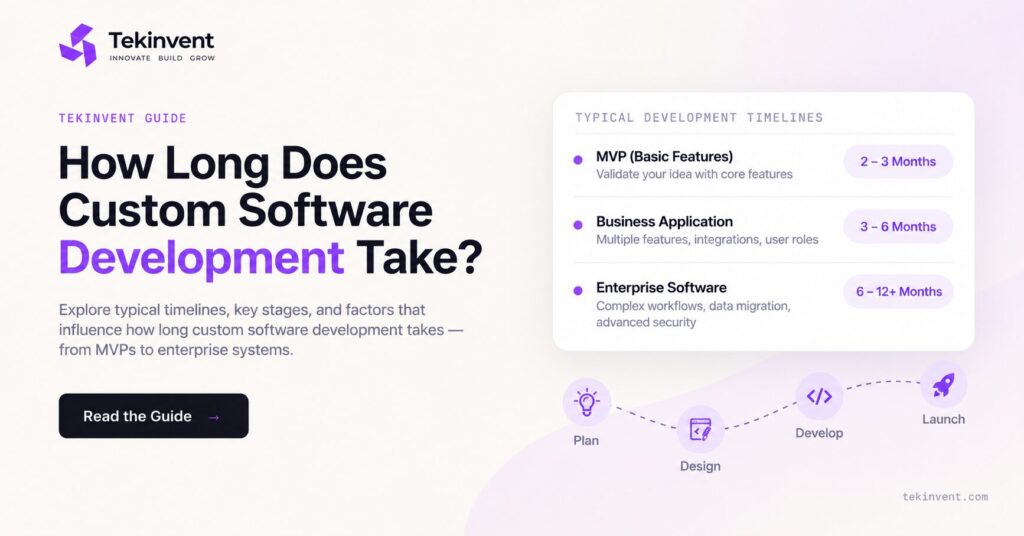
For most projects, the answer ranges from a few months to more than a year. A focused MVP may take around 8 to 12 weeks, a more complete business application may require 3 to 6 months, and complex enterprise software can take 6 to 12 months or longer. These are planning ranges rather than guaranteed delivery dates.
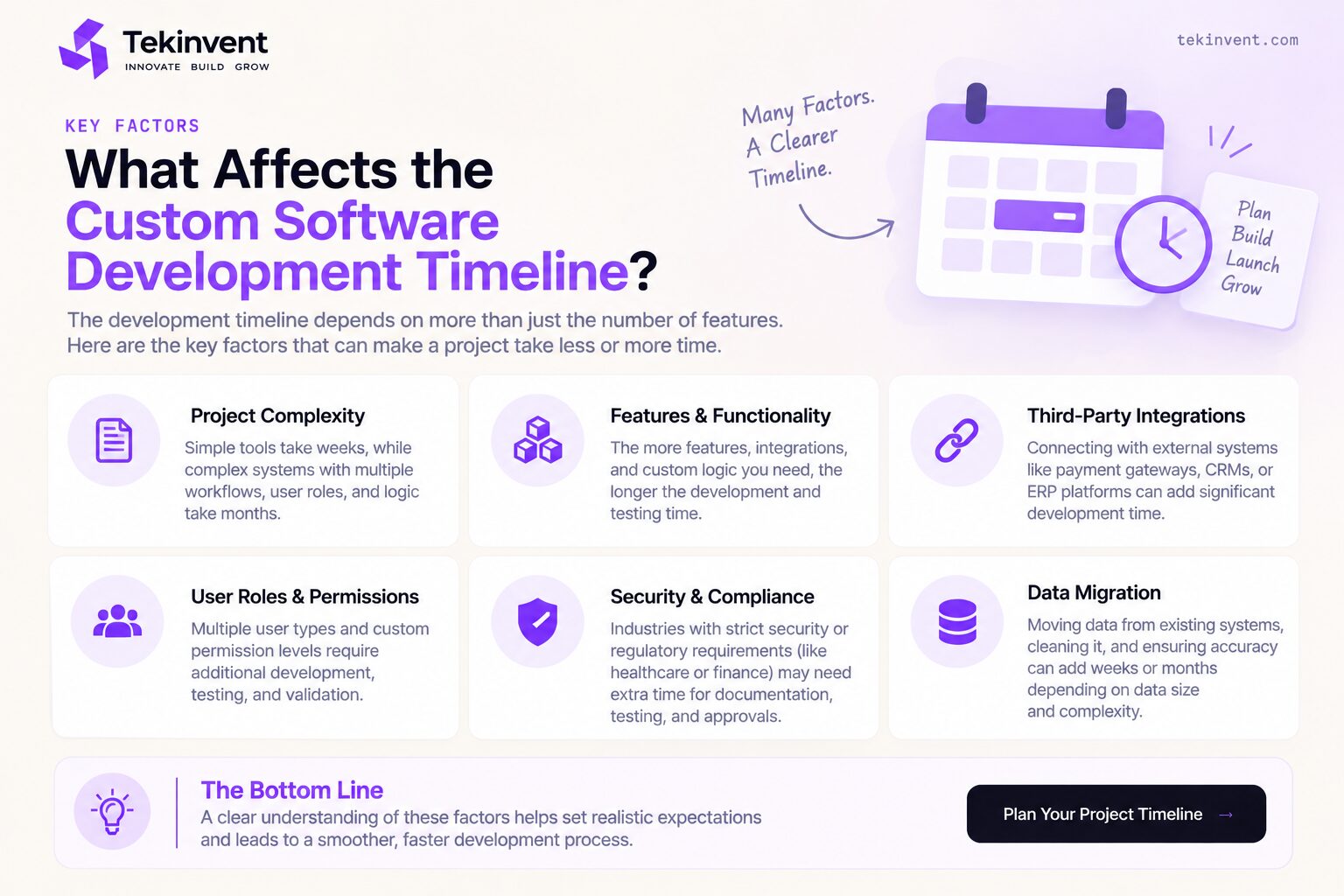
The custom software development timeline depends on much more than the number of screens in an application. Features, integrations, user roles, data migration, security, testing, feedback speed, and technical complexity can all change the final delivery date.
A company developing an internal dashboard for 20 employees should not expect the same timeline as an organization replacing an enterprise system used across several departments.
The most useful way to estimate your timeline is therefore to understand what happens during each development stage and what can make those stages longer.
What Is a Typical Custom Software Development Timeline?
A focused MVP with a limited number of core features can often be developed in approximately 2 to 3 months.
A medium-complexity business application involving multiple user roles, dashboards, APIs, reporting, and integrations may require around 3 to 6 months.
Larger applications can require 6 to 12 months, while enterprise platforms involving complex workflows, legacy integrations, extensive data migration, security requirements, and organizational rollout may take 9 to 18 months or longer. Recent industry guides show broadly similar ranges, although exact estimates vary by scope and methodology.
This is why a development company should understand your requirements before promising a specific launch date.
A realistic timeline is based on scope.
Why Is It Difficult to Give One Software Development Timeline?
Custom software is built around individual business requirements.
Imagine two businesses asking for a customer management platform.
The first company needs customer profiles, basic reporting, user login, and an administrative dashboard.
The second company needs customer profiles, multiple employee roles, automated workflows, payment processing, accounting integration, document management, analytics, mobile access, and migration of ten years of customer information.
Both companies may describe their project as a customer management system, but the engineering requirements are completely different.
This is why asking how long software development takes without defining scope is similar to asking how long it takes to build a building without specifying whether it is a small house or a commercial tower.
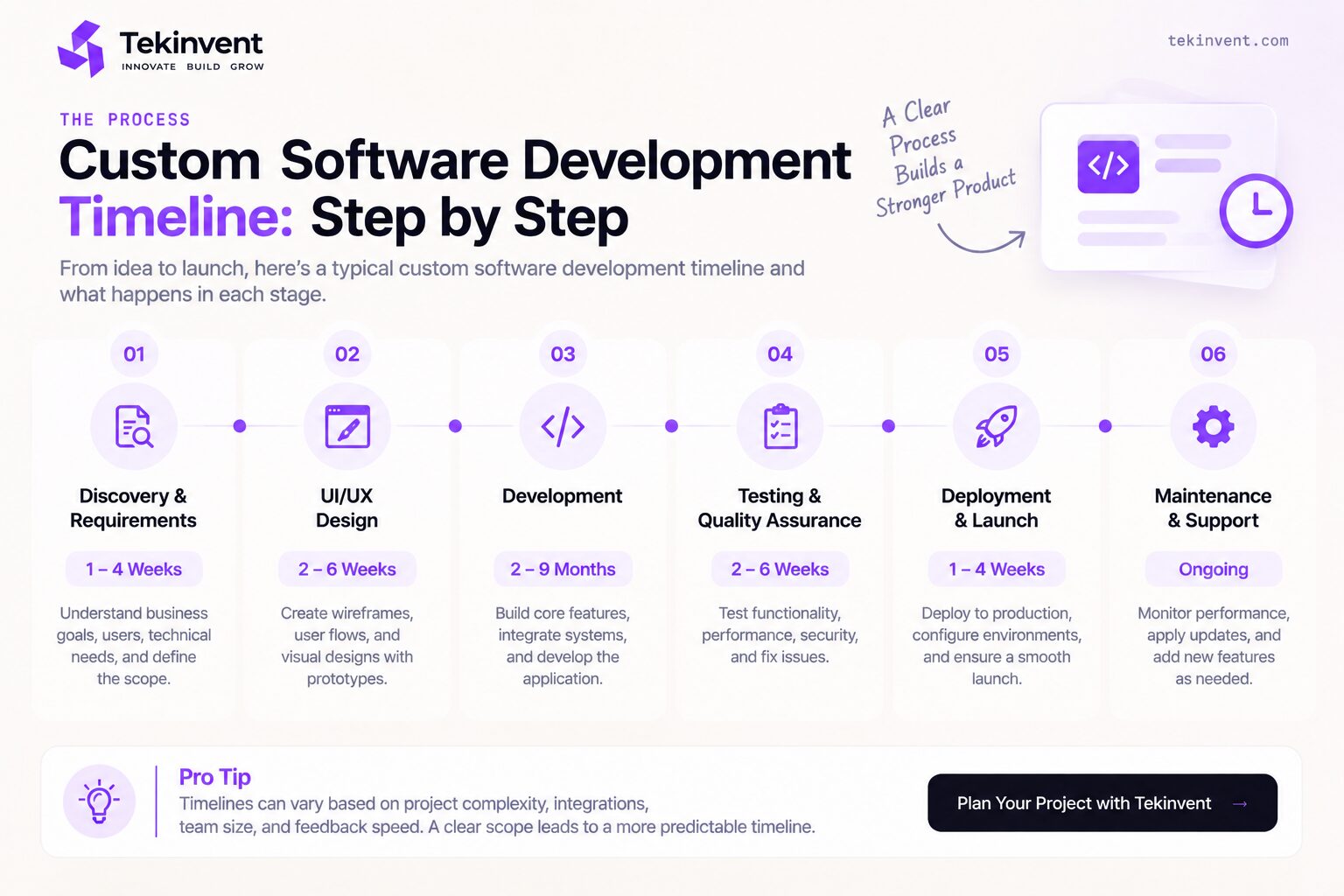
Phase 1: Discovery and Requirements
Most successful projects begin with discovery.
During this stage, the development team needs to understand the business problem, intended users, existing workflow, required features, integrations, technical limitations, and expected outcomes.
Discovery can take approximately one to four weeks depending on complexity. Recent timeline benchmarks place a typical discovery and specification stage in roughly this range.
This stage may feel like it slows development because developers are not yet building the final product.
In reality, good discovery can save significant time later.
If requirements remain unclear, developers may build functionality that stakeholders later decide should work differently. Rebuilding completed features can extend both the schedule and budget.
Discovery should therefore answer an important question: what exactly needs to exist in version one?
Phase 2: UI and UX Design
Once requirements are clear, designers can begin translating workflows into screens and user journeys.
The design phase can include information architecture, wireframes, user flows, visual interfaces, responsive layouts, and interactive prototypes.
A relatively simple internal application may require only a few weeks of design.
A customer-facing product containing several workflows and many screens can take longer.
The important advantage of prototyping is that stakeholders can identify problems before development becomes expensive.
Changing a button, workflow, or screen inside a prototype is considerably easier than rebuilding functionality after backend development has been completed.
Design and technical planning can also overlap in well-managed projects, helping reduce the total elapsed timeline.
Phase 3: Architecture and Technical Planning
Before significant coding begins, developers need to determine how the software will work behind the interface.
This can include selecting the technology stack, designing databases, defining APIs, planning integrations, setting permissions, and determining how the application will be deployed.
Architecture becomes especially important for software expected to grow.
A system serving 100 internal users may have different infrastructure requirements from a SaaS platform expected to support thousands of customers.
Taking time to make these decisions early can prevent major technical changes later.
The objective is not to overengineer the first version.
It is to create an architecture appropriate for the expected use case and growth.
Phase 4: Software Development
Development is usually the longest stage.
Frontend developers build what users interact with. Backend developers create business logic, databases, APIs, authentication, and integrations.
The duration depends primarily on scope and complexity.
A focused internal tool may require several weeks of development, while a large platform may require several months.
Development is also rarely one continuous period where the client sees nothing until the end.
Modern teams commonly work in iterations.
Features are developed, reviewed, tested, and adjusted throughout the project.
This allows stakeholders to see progress and identify misunderstandings before the entire product is completed.
How Long Does an MVP Take to Develop?
An MVP development timeline is generally shorter because the goal is not to build every possible feature.
The goal is to build enough functionality to solve the primary problem and test whether users find the product valuable.
A focused MVP may take roughly 8 to 12 weeks, although more complicated MVPs can require several months. TekInvent’s existing guidance uses the same 8 to 12 week range for simple MVPs.
The word “minimum” is important.
Businesses often call a project an MVP while requesting every feature they eventually want in the final product.
That defeats the purpose.
A genuine MVP prioritizes the smallest feature set capable of validating the product.
Additional functionality can be introduced after the initial release.
How Long Does a Mid Sized Business Application Take?
A more complete business application may require approximately 3 to 6 months, with some integrated applications moving toward 6 to 9 months depending on scope.
These applications commonly contain more than one workflow.
The software may include administrative dashboards, different user permissions, reports, third-party integrations, notifications, data management, and more sophisticated interfaces.
The timeline can increase when several departments are involved because stakeholders need to agree on how the software should work.
The technical development itself is therefore only part of the schedule.
Business decision making also affects delivery.
How Long Does Enterprise Software Development Take?
The enterprise software development timeline is usually much longer.
Complex systems can require 9 to 18 months or more, particularly when they replace legacy software or connect several departments and systems.
Enterprise development often includes requirements that smaller applications do not have.
The project may involve thousands of users, advanced permissions, security reviews, compliance requirements, large databases, data migration, multiple integrations, high availability, extensive testing, and employee training.
Large enterprise systems may also be launched in stages.
Instead of waiting for the entire platform to be completed, the company may release individual modules or departments gradually.
This reduces rollout risk and allows teams to collect feedback before expanding deployment.
Third Party Integrations Can Extend the Timeline
Integrations are one of the biggest variables in custom software projects.
An application may need to communicate with payment gateways, CRM platforms, accounting software, ERP systems, mapping services, email providers, analytics tools, or proprietary company systems.
Modern APIs with clear documentation may be relatively straightforward.
Legacy systems can be more difficult.
The development team may discover inconsistent data, outdated APIs, authentication limitations, or undocumented behavior.
This is why integrations should be identified during discovery rather than introduced near the end of development.
Data Migration Can Add Weeks or Months
Businesses replacing existing systems often underestimate data migration.
Moving information from an old database to a new application is rarely as simple as copying files.
Historical data may contain duplicates, missing fields, inconsistent formatting, outdated records, or structures that do not match the new system.
Developers may need to map, clean, transform, validate, and test the data before migration.
Large migrations may also require trial runs before the final transfer.
If historical information is important to the new software, migration should be included in the initial software development timeline.
Testing Is Part of Development, Not an Extra Step
A feature being coded does not mean it is ready for users.
Software needs testing.
Quality assurance can include functional testing, integration testing, compatibility testing, performance testing, security testing, regression testing, and user acceptance testing.
The more complicated the application, the more important this stage becomes.
A minor issue in an internal dashboard may cause inconvenience.
A defect in software processing payments, medical information, financial records, or critical business operations can have much greater consequences.
Trying to shorten the project by removing necessary testing can therefore create more delays after launch.
Security Requirements Can Affect Delivery Time
Security requirements vary by application.
A basic internal productivity tool and a platform handling sensitive customer information should not follow identical security processes.
More sensitive applications may require advanced authentication, encryption, audit logs, permission systems, penetration testing, security reviews, and additional infrastructure controls.
Regulated industries can also require compliance work.
These requirements should be identified early.
Adding major security requirements after the application is nearly finished can force developers to redesign important parts of the system.
Scope Creep Is One of the Biggest Causes of Delays
A project begins with an agreed set of features.
Then someone requests another dashboard.
Another stakeholder wants an additional integration.
A department asks for a different workflow.
A useful feature is discovered halfway through development.
Individually, each request may appear small.
Together, they can substantially change the schedule.
This is scope creep.
The solution is not to reject every new idea.
Instead, new requirements should be evaluated against the release plan.
Features that are not essential for the initial launch can move into a later development phase.
This protects the original timeline without losing valuable ideas.
Slow Feedback Can Delay Development
Not every delay comes from developers.
A development team may complete a design or feature and wait several days for stakeholder approval.
If this happens repeatedly throughout a six-month project, the lost time becomes significant.
Businesses can reduce this problem by identifying decision makers before development begins.
The project should have people who can review work, answer questions, and approve decisions quickly.
Fast feedback keeps development moving.
Can Adding More Developers Make the Project Faster?
Sometimes, but not always.
A larger team can allow multiple areas of the product to be developed simultaneously.
However, adding developers also increases communication and coordination requirements.
Some technical tasks depend on other tasks being completed first.
Ten developers cannot necessarily complete in one month what one developer would complete in ten months.
The correct team structure matters more than simply increasing headcount.
Experienced project management and clear architecture help developers work in parallel without creating unnecessary conflicts.
Does Custom Software Take Longer Than SaaS Implementation?
Usually, yes.
SaaS software already exists.
A business mainly needs to configure it, import information, connect necessary systems, and train users.
Custom software needs to be designed and built.
However, implementation speed is only one part of the decision.
Businesses comparing these options should evaluate whether existing software can actually support their workflows. The broader SaaS vs custom software decision should consider control, integrations, scalability, ownership, long-term costs, and business requirements alongside implementation time.
This keeps the timeline question separate from the broader build-versus-buy decision.
Does a Longer Development Timeline Mean Higher Cost?
Timeline and cost are related, but they are not identical.
A larger project generally requires more development resources and therefore costs more.
However, team size, developer location, technology, integrations, and engagement model also influence pricing.
Businesses primarily researching budget should review custom software development cost separately rather than using project duration alone to estimate their investment.
This distinction is important for SEO as well as user experience.
The timeline question answers how long.
The cost guide answers how much.
How Can You Speed Up Custom Software Development?
The best way to reduce development time is not to make developers code faster.
It is to remove uncertainty.
Start with clear requirements.
Identify the primary business problem and define what must be included in the first release.
Choose one person or a small group capable of making decisions quickly.
Provide developers with access to required APIs, documentation, existing software, and relevant data as early as possible.
Prioritize an MVP rather than trying to launch every future feature at once.
Review prototypes and development releases quickly.
Finally, avoid major scope changes during development unless they are essential.
These steps can reduce waiting, rework, and unnecessary development.
Should You Launch the Entire Product at Once?
Not necessarily.
Phased development can help businesses reach users sooner.
Instead of spending a year building a large platform behind closed doors, the team may release one valuable workflow first.
Users can begin receiving value while developers continue working on additional functionality.
Real usage also generates better feedback than assumptions.
This can influence later development priorities.
For complex software, phased delivery can therefore reduce both timeline risk and product risk.
How Accurate Can a Software Development Estimate Be?
An early estimate should be treated as a range.
The more the development team understands about requirements, integrations, data, users, security, and technical constraints, the more accurate the estimate becomes.
This is why discovery matters.
A vendor promising an exact delivery date after hearing a two-sentence description of the idea is working with significant uncertainty.
A credible estimate should explain assumptions.
If those assumptions change, the timeline may change too.
Businesses should therefore ask not only, “When will it be finished?” but also, “What assumptions is this timeline based on?”
When Should You Contact a Development Company?
You do not need a perfect specification before talking to developers.
You should, however, understand the business problem.
Explain who will use the software, what they need to accomplish, what existing systems are involved, and which outcomes matter.
An experienced custom software development company can then help translate those requirements into project scope, architecture, development phases, and a more realistic delivery estimate. TekInvent’s service model covers the full lifecycle from discovery and architecture through design, development, testing, and deployment.
The more information you can provide during discovery, the easier it becomes to create a timeline that reflects the actual project.
Final Thoughts
So, how long does custom software development take?
For planning purposes, think in ranges rather than one universal number. A focused MVP can often reach users within a few months. A more complete business application may take several months, while complicated enterprise systems can require a year or longer.
The most important factors are scope, integrations, data migration, security, design complexity, testing requirements, and the speed at which stakeholders make decisions.
A realistic custom software development timeline should also include more than coding. Discovery, design, architecture, testing, deployment, and rollout all contribute to when the software can actually begin delivering value.
Businesses that want to launch sooner should focus first on reducing uncertainty and unnecessary scope rather than skipping important development stages.
Define the problem clearly. Build the essential functionality first. Give the development team fast access to decisions and information. Test the software properly. Then expand it based on real business needs.
That approach produces a timeline that is not only faster, but far more likely to end with software users can actually rely on.

Build Smart with The Right Team.
We bring expertise, technology, and trust you look for in your digital journey.