
Artificial intelligence has moved beyond experimentation. US companies are applying it to customer support, document processing, fraud detection, forecasting, personalization, software development and internal operations. However, turning an AI idea into a dependable production system requires more than access to an API or a general software development team.
Companies need people who understand data pipelines, model behavior, software architecture, security, testing and responsible deployment. Finding all that expertise through permanent recruitment can take longer than the business opportunity allows.
AI staff augmentation gives a company access to specialized professionals who join its existing team for a defined period or initiative. The company retains control of the product roadmap, technical decisions and day-to-day work, while the augmentation provider helps source and evaluate the required talent.
This approach can help a business move from an AI concept to a controlled implementation without committing immediately to multiple permanent positions. It is most valuable when the company understands the business problem but lacks one or more technical capabilities needed to deliver the solution.
Why AI talent has become difficult to hire
Demand for AI expertise is growing across industries, but the relevant talent pool is highly specialized. A capable backend developer does not automatically have experience designing retrieval-augmented generation systems, evaluating model outputs or deploying machine learning workloads in production.
The US Bureau of Labor Statistics projects that data scientist employment will grow approximately 34% from 2024 to 2034, compared with 3% across all occupations. It also estimates approximately 23,400 data scientist openings per year during that period. The increase reflects growing demand for data-driven decisions, new products and improved business processes. US Bureau of Labor Statistics
Software development demand is also expected to remain strong. BLS projections indicate a 15.8% increase in software developer employment between 2024 and 2034, representing more than 267,000 additional positions. US Bureau of Labor Statistics
The World Economic Forum similarly identifies AI and big data as the fastest-growing skills through 2030. Its research also emphasizes that analytical thinking, collaboration, resilience and technological literacy remain important alongside technical AI skills. World Economic Forum
The hiring problem, therefore, is not simply finding someone who can write Python. Businesses need professionals who can connect AI development with reliable data, product objectives, security requirements and measurable outcomes.
What is AI staff augmentation?
AI staff augmentation is a flexible hiring model through which external AI specialists work as an extension of an organization’s internal team. These specialists can join for a specific development phase, cover a temporary skills shortage or remain with the company throughout a longer product initiative.
Unlike complete project outsourcing, the client normally continues to manage priorities, processes and delivery. The augmented professionals work within the client’s development environment, attend relevant meetings and collaborate with existing product, engineering and business teams.
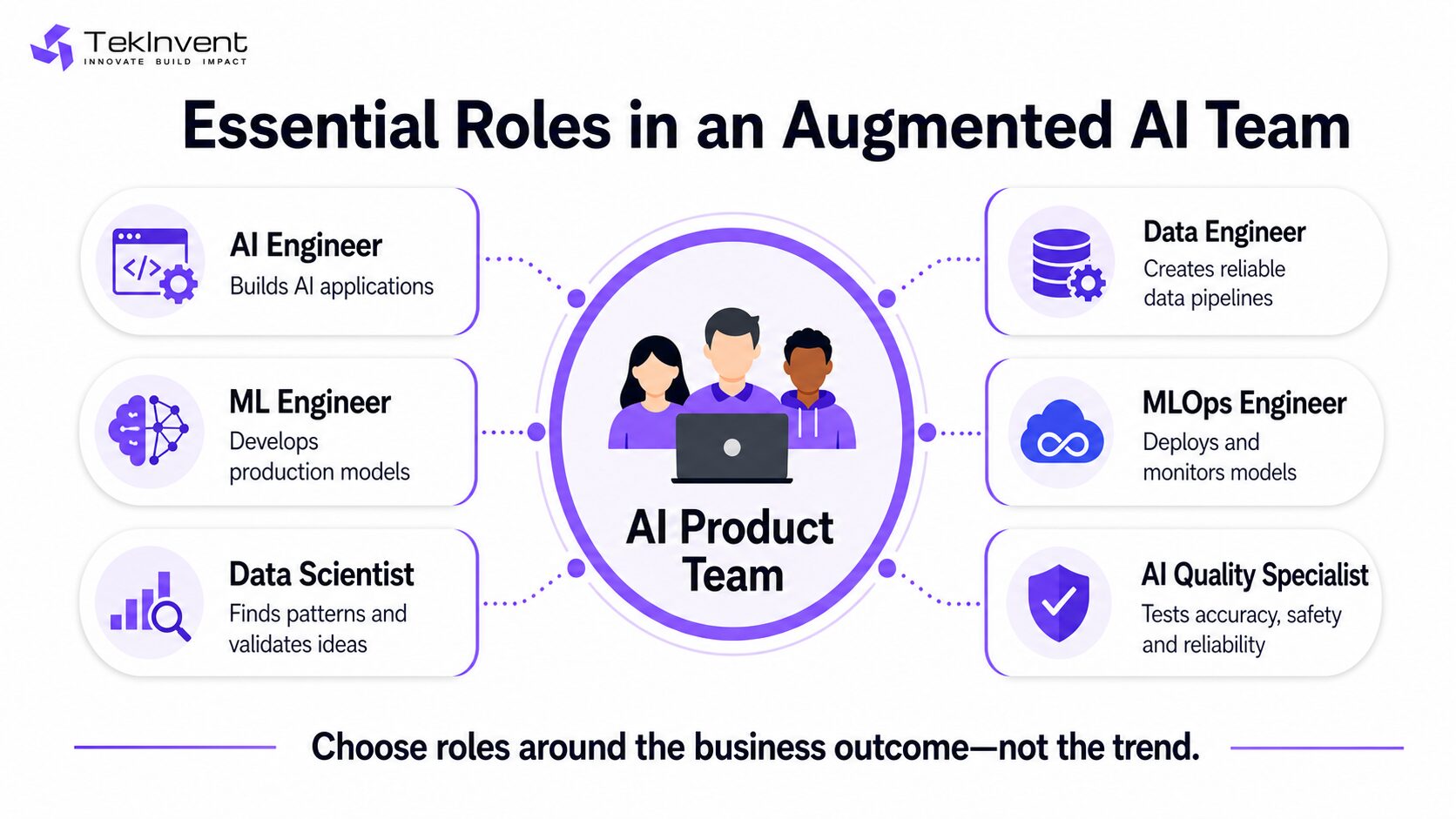
The arrangement can involve one specialist or a coordinated group. A company might add an MLOps engineer to help an internal data science team deploy models. Another organization might require an AI engineer, data engineer and quality specialist to build and validate a generative AI application.
The model is especially useful when a company has internal domain knowledge but lacks the specialized engineering capacity to implement its idea safely.
When should a company use AI staff augmentation?
The right time to augment an AI team is when a clearly defined capability gap is delaying a valuable business initiative.
For example, a company may already have software engineers but no one with production experience in large language models. A data team may have built a promising prototype but lack an MLOps specialist who can deploy, monitor and maintain it. A product team may need short-term expertise to evaluate whether an AI feature is technically and financially viable.
AI talent augmentation may be appropriate when:
- A product launch is being delayed by an unavailable specialist.
- The organization needs expertise for a defined AI use case.
- Internal employees need to work alongside experienced AI professionals.
- A proof of concept must be converted into a secure production system.
- Permanent recruitment would take too long.
- The company wants to validate demand before creating permanent roles.
The decision should begin with the business problem, not the technology. Adding engineers before defining the intended outcome often creates expensive experimentation without a clear path to value.
Companies still identifying their broader staffing requirements can review how technical staff augmentation addresses specialized capability shortages across development teams.
Which AI professionals can be added to your team?
The correct role depends on the problem being solved. “AI developer” is often used as a broad label, but different initiatives require different expertise.
| Role | Primary responsibility | When the role is needed |
| AI engineer | Integrates AI models into usable applications | Building AI-powered product features or internal tools |
| Machine learning engineer | Develops and productionizes predictive models | Forecasting, recommendations, classification and automation |
| Data scientist | Explores data and develops analytical or statistical models | Discovering patterns and validating potential use cases |
| Data engineer | Builds dependable data pipelines and platforms | Preparing, transforming and delivering data for AI systems |
| MLOps engineer | Automates deployment, monitoring and model operations | Moving models from experimentation into production |
| Generative AI engineer | Builds applications using LLMs and related models | RAG systems, assistants, search and document automation |
| AI quality specialist | Evaluates model accuracy, safety and reliability | Testing outputs, edge cases, bias and production behavior |
| AI solutions architect | Connects business requirements with system architecture | Complex integrations or organization-wide AI programs |
Some projects require more than one of these roles. A generative AI assistant, for example, may need an AI engineer for application logic, a data engineer for knowledge preparation, an MLOps engineer for deployment and a quality specialist for evaluation.
A reliable provider should help distinguish these roles instead of presenting every candidate as a generic AI expert.
AI staff augmentation use cases
AI augmentation can support both customer-facing products and internal operations. The strongest use cases have a defined user, a measurable business problem and enough suitable data to evaluate performance.
Generative AI applications
Companies can add generative AI engineers to build document assistants, internal knowledge tools, customer-support applications and content-processing systems. These initiatives may use retrieval-augmented generation to connect a language model with approved company information.
The work involves more than creating prompts. Engineers must design retrieval, permissions, evaluation, logging and fallback behavior. They also need to decide what information can safely be sent to external model providers.
Predictive analytics
Machine learning specialists can help create demand forecasts, risk models, customer-churn predictions and maintenance forecasts. A successful predictive system depends on data quality and whether employees can act on the result—not simply on model accuracy.
Intelligent workflow automation
AI can classify requests, extract information from documents, recommend next actions or route work to the correct team. Augmented professionals can integrate these capabilities into existing software instead of creating disconnected experiments.
Recommendation and personalization systems
Retail, media, SaaS and financial-technology companies can use machine learning to personalize content, offers and product experiences. These systems require ongoing measurement because a technically accurate recommendation may not always improve revenue or user satisfaction.
AI-assisted software development
Engineering teams may use AI for code assistance, test generation, documentation and incident analysis. Experienced professionals can introduce these tools with appropriate review processes so speed does not come at the expense of security or code quality.
How to build an augmented AI team
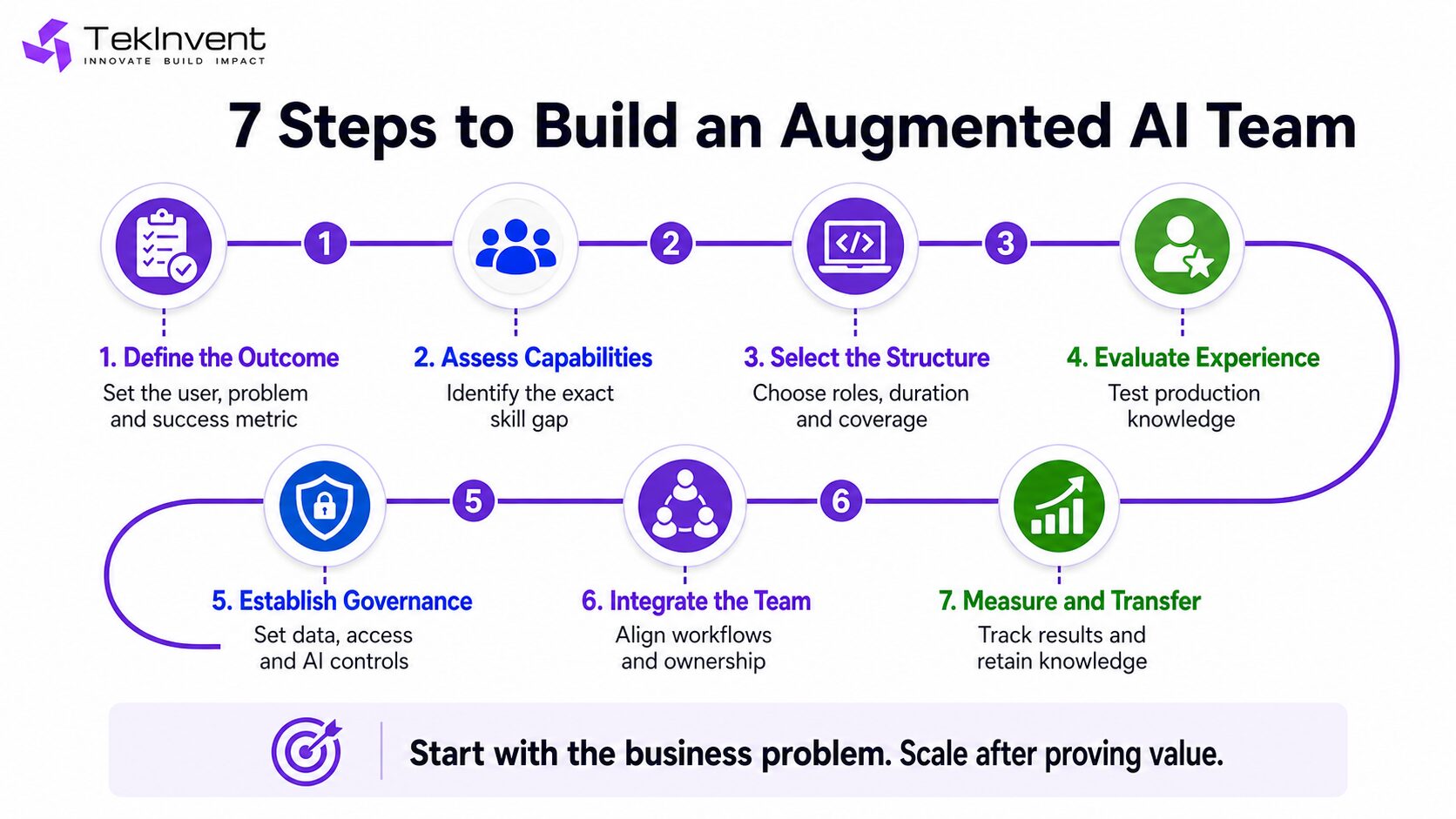
Successful augmentation starts with a narrow outcome. “We want to use AI” is not a sufficient project brief. “We want to reduce the time required to review a specific document type while maintaining human approval” is much more useful.
1. Define the business outcome
Specify the user, workflow and result the initiative should improve. Establish a baseline before development begins. If the goal is to reduce support-resolution time, document the current time and decide what improvement would justify the investment.
The outcome should also include constraints. These may involve accuracy, response time, data residency, operating cost or mandatory human review.
2. Assess internal capabilities
Identify what the current team can handle and where experience is missing. The gap might involve model selection, data engineering, cloud infrastructure, user-interface development, evaluation or security.
This assessment prevents overhiring. A company with strong internal software engineers may require only one experienced AI architect and an MLOps engineer rather than an entirely external team.
3. Select the right engagement structure
Decide whether the company needs one specialist, several complementary roles or a team that can expand over time. Establish expected working hours, communication routines, management responsibility and engagement duration.
If the initiative is exploratory, begin with a short discovery or validation phase. The company can then scale the team after confirming technical feasibility and business value.
4. Evaluate practical experience
AI candidates should be evaluated through relevant scenarios, not only general interview questions. Ask them to explain a system they deployed, how they measured its performance, what failed and how they handled production risks.
A generative AI candidate should be able to discuss retrieval quality, hallucination control, evaluation datasets, latency, model cost and sensitive information. An MLOps candidate should understand model versioning, monitoring, rollback procedures and infrastructure automation.
The provider-selection process matters as much as candidate screening. This guide explains how to choose an IT staff augmentation company without relying solely on hourly rates or impressive résumés.
5. Establish governance before development
AI risk management should begin before engineers receive data or production access. Define approved tools, data classifications, access levels, documentation requirements and human-approval points.
The National Institute of Standards and Technology developed the AI Risk Management Framework to help organizations incorporate trustworthiness considerations into the design, development, use and evaluation of AI systems. NIST also provides a dedicated Generative AI Profile covering risks that may be unique to or intensified by generative systems. NIST AI Risk Management Framework
The framework organizes AI risk activities around four functions: govern, map, measure and manage. These principles are useful when defining responsibilities for augmented professionals.
6. Onboard specialists into the real workflow
Give augmented professionals the context necessary to make sound decisions. They should understand the product, customer, architecture, coding standards, security policies and definition of done.
Access should follow the principle of least privilege. Start with the systems and data required for the assignment, then expand access only when justified. Assign an internal owner who can resolve questions and approve important technical decisions.
7. Measure outcomes and transfer knowledge
Measure the result of the AI initiative rather than the number of hours worked. Depending on the use case, relevant metrics might include precision, recall, task-completion rate, human-escalation rate, latency, cost per request, adoption or business savings.
Knowledge transfer should happen throughout the engagement. Architecture decisions, prompts, evaluation methods, data transformations and deployment instructions should remain accessible to the client.
How much does AI staff augmentation cost?
The cost varies according to role, experience, location, technical complexity and engagement length. A senior MLOps engineer or AI architect will generally cost more than a junior analyst because production decisions can affect security, reliability and long-term infrastructure costs.
The hourly rate should not be the only financial consideration. Businesses should also evaluate:
- Time required to present qualified candidates
- Interview and replacement effort
- Productivity during onboarding
- Model and cloud operating costs
- Technical rework caused by poor decisions
- Knowledge retained after the engagement
- The value of launching earlier
A lower hourly rate can become expensive if the specialist lacks relevant production experience. Conversely, a highly experienced professional may shorten the discovery process, prevent unsuitable architecture and help the internal team become productive sooner.
Use a defined baseline and expected business result to evaluate staff augmentation ROI rather than treating the hourly rate as the complete cost.
Planning an AI product or automation initiative? TekInvent can help you identify the required roles, assess technical gaps and assemble specialists aligned with your delivery schedule.
How to protect data and intellectual property
AI projects may involve customer records, proprietary documents, source code and commercially sensitive data. Contracts and technical controls must address how augmented professionals and third-party AI platforms can use that information.
The agreement should define ownership of code, prompts, model configurations, documentation and other deliverables. It should also cover confidentiality, approved tools, subcontractors, access termination and data deletion.
Technical controls should include role-based access, separate environments, credential management, activity logging and code review. Sensitive information should not be entered into public AI tools unless the organization has explicitly approved the tool and its data-handling terms.
Teams should also plan for model-related risks. Generative systems may produce unsupported answers, expose confidential context, reproduce problematic content or behave differently after a model update. Human review and ongoing evaluation remain necessary for consequential workflows.
Common mistakes to avoid
One of the most common mistakes is starting with a fashionable technology instead of a valuable problem. A sophisticated AI system will not produce a return if it does not improve a real workflow or customer outcome.
Another mistake is hiring one person and expecting that individual to cover data science, software engineering, data architecture, security and MLOps equally well. These disciplines overlap, but they are not interchangeable.
Companies also run into trouble when they evaluate only the initial demonstration. A prototype may work with carefully selected examples while failing with incomplete, ambiguous or adversarial production data. Testing should reflect the conditions users will actually create.
Finally, organizations should avoid becoming dependent on undocumented decisions. The client must retain access to source code, infrastructure, evaluation datasets, documentation and operational knowledge.
AI staff augmentation vs permanent hiring
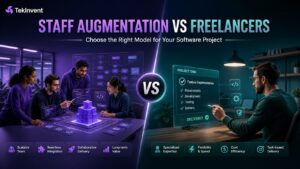
Neither model is universally better. Permanent hiring is often appropriate when AI capability will be central to the company’s long-term strategy and there is enough continuous work to support the position. Staff augmentation is useful when the company needs specialized expertise quickly, has a defined capacity gap or wants to validate an initiative before expanding permanent headcount.
| Decision factor | AI staff augmentation | Permanent hiring |
| Hiring speed | Usually faster | Often slower |
| Commitment | Flexible by project or period | Long-term employment commitment |
| Specialized expertise | Can target a precise skill | Depends on available candidates |
| Management control | Retained by the client | Retained by the employer |
| Scaling | Roles can be added or reduced | Requires additional recruitment |
| Knowledge retention | Requires a documented transfer plan | More likely to remain internally |
| Best fit | Urgent gaps and defined initiatives | Long-term core capability |
A hybrid approach is often effective. A company can retain internal product ownership and domain knowledge while using augmented specialists to accelerate architecture, implementation and knowledge development.
How to choose an AI staff augmentation partner
Look for evidence that the provider understands the difference between AI experimentation and production engineering. The company should be able to explain how it evaluates technical ability, communication, security awareness and relevant industry experience.
Ask how candidates are screened, who conducts technical interviews and what happens if a specialist is not a good fit. Review replacement terms, notice periods, intellectual-property provisions and data-security obligations before work begins.
A credible partner should also ask difficult questions about the use case. If a provider immediately recommends several engineers without discussing business objectives, data availability, security constraints or success metrics, the recommendation may be based on filling seats rather than delivering value.
For organizations ready to add specialized AI professionals, TekInvent’s IT staff augmentation services can help extend an existing engineering team while the client retains control of priorities and delivery.
Frequently asked questions
What is AI staff augmentation?
AI staff augmentation is a hiring approach in which external AI, machine learning, data or MLOps professionals join an organization’s existing team. The client manages priorities and delivery while the provider supports talent sourcing and vetting.
What is the difference between AI staff augmentation and AI outsourcing?
With augmentation, specialists work within the client’s team and the client normally retains day-to-day management. In outsourcing, a vendor generally takes responsibility for delivering a defined project or outcome using its own management structure.
How quickly can an augmented AI professional join a team?
The timeline depends on role complexity, screening requirements, time-zone preferences and market availability. A provider with an active specialist network may present candidates faster than a company beginning permanent recruitment from scratch, but highly specialized roles still require careful assessment.
Can augmented engineers work with confidential data?
They can, provided appropriate contractual and technical protections are in place. Organizations should use confidentiality terms, role-based access, approved development environments, monitoring and clear data-handling rules.
Can AI staff augmentation support a proof of concept?
Yes. A short, carefully scoped engagement can help evaluate feasibility, data readiness, likely operating cost and business value before the company commits to a larger implementation.
Does a company need an internal AI team first?
Not necessarily. However, the client should appoint an internal decision-maker who understands the business objective and can approve priorities. The augmentation partner can provide technical expertise, but ownership of the business outcome should remain with the company.
Build an AI team around a measurable outcome
The strongest AI initiatives do not begin with a model. They begin with a specific business problem, suitable data, clear ownership and a practical definition of success.
AI staff augmentation can give US companies faster access to specialized expertise without forcing them to create every permanent position before proving the opportunity. The model works best when roles are carefully defined, candidates are evaluated through relevant experience, governance is established early and knowledge remains with the client.
If your company has an AI initiative but lacks the engineering capacity to move it forward, TekInvent can help assess the talent gap and recommend an augmentation structure aligned with your product, security requirements and delivery timeline.
CTA: Talk to TekInvent about your AI talent requirements and receive a role-based team recommendation.

Build Smart with The Right Team.
We bring expertise, technology, and trust you look for in your digital journey.